Neptun - 10-1-2026 at 13:48
So, a little while back, I began to think about what kind of romantic things I could gift my girlfriend. Unfortunately, I'm neither a poet, musician,
nor a florist or anything else that could be perceived as romantic.
I do know that she likes the color blue, so I figured that my hobby of home chemistry would finally come in handy. I began my research on blue
crystals (no, not the one from the famous 2014 drama series...) and how to synthesize them.
They should be reasonably safe (i.e. nonexplosive, not extremely poisonous or radioactive), have a long shelf life and can be grown into crystals as
opposed to being an amorphous sludge.
The precursors should be easily accessible and don't need to be ordered from specialized shops.
Furthermore, I didn't want to make something as simple such copper sulfate or copper nitrate.
All of the things considered, I came up with a few obvious choices:
Tetraamminecopper(II) sulfate
Potassium bisoxalatocuprate(II)
Copper(II)-beta-alaninate or its urea complex
Copper(II)-glycinate urea complex
I chose copper(II)-beta-alaninate urea complex for one and ammonium bis(oxalato)cuprate(II) (better crystal growth than the potassium one) as my
synthesis targets.
Planned Synthesis
Because both of my desired compounds incorporate copper, I need a source for that. I don't want to waste precious nitric acid in order to synthesize
copper salts from the metal. Also, I used up all of my copper oxide for copper acetate, which I had a bunch of. So, I decided to use that as a
starting material.
The synthesis will be as following for the beta-alaninate: Copper acetate to Copper oxide to copper beta alaninate to the urea complex.
For ammonium bisoxalatocuprate, copper(II)-oxalate has to be dissolved in boiling ammonium oxalate solution. I plan to synthesize ammonium oxalate
from oxalic acid and ammonia, wheras the combination of oxalic acid and copper acetate will give rise to copper(II)-oxalate.
Experimental
Synthesis of copper(II)-beta-alaninate urea complex
Synthesis of copper(II)-oxide
A 500mL beaker is charged with a magnetic stirrer and placed on a hotplate. About 285mL of sat. copper(II)-acetate solution in dest. water (0.1025mol,
20,46g) is heated lightly just until all residual solids have dissolved. 10g (0.25mol) NaOH are slowly added as pearls to the vigorously stirring and
hot solution. Immediately, a Blue precipitate (copper(II)-hydroxide) forms and blocks the stirring. Dest. water is added portionwise to allow stirring
to resume, while unreacted spots of the solution and chunks of solids are broken up with a glass rod.
Under intense stirring, the suspension is heated to a boil until the colour of the precipitate darkens to pure black and the liquor above it is
colourless. This step takes about 15-20 minutes, but I forgot to write down the time.
Anyway, while hot, a part of the mixture is transferred to a 250mL-Büchner (the biggest i had) and is filtered under vacuum. The whole suspension is
added portionwise and the beaker washed out with dest. water. The cake is dried on the filter paper and then transferred to a beaker and heated, until
the paste turned into a somewhat free-flowing powder with residual water trapped inside. The crude product was weighed and 100% purity assumed, yield
7.9g, 96.93%
Discussion
The procedure has a few flaws that I would do better now and also recommend others to do that way. First of all, the sodium hydroxide should be
dissolved in a little bit of water to avoid the issues encountered with poor mixing. Furthermore, it may be advisable to add the NaOH-solution to a
boiling copper acetate solution opposed to only warm one I used. This would avoid copper hydroxide entirely and would instantly dehydrate it to the
desired oxide.
Lastly, at that time, I didn't have an actual vacuum hose. It clogged the entire time, rendering the process of vacuum filtration tedious and
annoying. This is why I didn't just dry entirely on the filter paper and decided to transfer it to a beaker. My losses in yield can be explained by
the copper oxide paste I couldn't get out of the Büchner funnel, else yield would have been quantitative.
Synthesis of copper(II)-beta-alaninate urea complex
About 27g (0.3mol) of pure beta alanine are dissolved in 200mL of dest. water under stirring. 7.9g (0.1mol) of previously synthesized copper(II)-oxide
are added at once. The black suspension is heated to a boil under constant stirring for about an hour. At this point, most of the copper(II)-oxide
dissolved, and a deep blue liquid is acquired. A random excess of urea (I used 10g) is added at once to the opaque solution, with no apparent colour
change. Heating and stirring is resumed for another 10 minutes to ensure full complexation. The hot solution is subjected to vacuum filtration to
remove excess copper(II)-oxide. The hot filtrate is transferred to a beaker and left to cool overnight. A solid chunk of the product formed on the
bottom of the beaker, but once broken up, a few well developed crystals could be obtained. Yield was not measured.
Discussion
My inspiration for this synthesis stems from this website, but unfortunately, no synthesis was given. So I came up with my own method of preparation.
Since the composition of the acquired complex is unknown to me, yield can't be calculated. Maybe in the future I'm able to analyze the compund at a
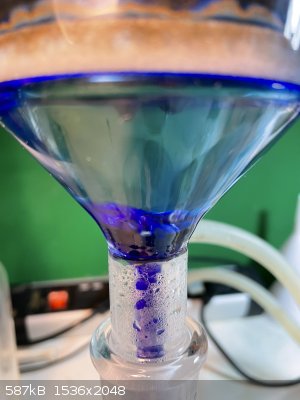
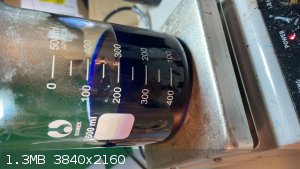
university with specialized tools and machinery. Beta alanine was purchased as a dietary supplement and used as is (100% beta alanine). Pictures of
the preparation are attached.
Synthesis of ammonium bis(oxalato)cuprate(II)
Synthesis of ammonium oxalate solution
A solution is conveniently preparated by acid-base neutralization of oxalic acid and ammonia.
20mL of commercial 12% ammonia solution (m/m%) is added as an excess into a beaker filled with 180mL of dest. water. Under stirring, 8.07g (0.064mol)
of oxalic acid dihydrate are added portionwise to the ammonia. After complete addition, the solution is stirred and lightly heated until the solution
is completely clear.
Synthesis of copper oxalate and ammonium bis(oxalato)cuprate(II)
12.78g (0.064mol) copper(II)-actetate hydrate are dissolved in 180mL of dest. water. 8.07g (0.064mol) of oxalic acid dihydrate are dissolved in 80mL
of warm dest. water and stirred until crystal clear. This oxalate solution is poured into the copper solution at once and immediately light blue
copper(II)-oxalate crashes out as fine particles.
I erroneously thought that I could filter it off via vacuum filtration, but the particles easily passed the filter and the Büchner funnel. I let the
suspension settle and pippeted off the upper aqueous layer as much as possible (about 200mL removed). The prepared ammonium oxalate solution is used
to wash the Büchner, which dissolved all of the leftover copper(II)-oxalate, and then added to the copper(II)-oxalate sludge. Immediately,
discoloration to a darker blue occurred. The beaker is heated and magnetic stirring was used to aid mixing. Another portion of ammonium oxalate
solution is prepared and added at once. After a few minutes, a crystal clear, sapphire-blue solution emerged, indicating the complexation of
copper(II)-oxalate.
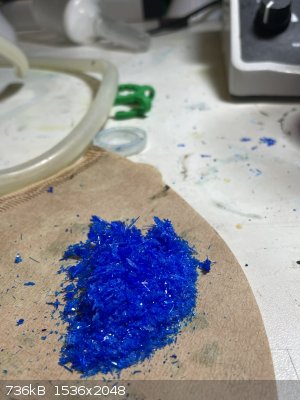
The hot liquid is left to crystallize overnight in an 1L beaker. After 2 Weeks of cristallization, filigrane crystalline needles of ammonium
bis(oxalato)cuprate(II) formed. Yield wasn't measured.
Discussion
In my opinion, the procedure concerning copper(II)-oxalate has to be reworked. Aside from my mishap with too little ammonium oxalate to completely
dissolve the copper oxalate, the colloidial suspension hindering filtration could be easily avoided by the technique of Ostwald ripening. I used this
approach in the disposal of wastes (see below). Pictures of the preparation and final product are attached. The reddit post from where I got the
synthesis idea was insufficient, unclear and not really scientific, so I did above procedure.
Cleanup
While these syntheses are a huge success, I needed to get rid off the mother liquors and also I accidentaly burned a few crystals I needed to dispose
off too. Also, I wanted the copper salts back for future projects. I forgot to write a protocol for the cleanup, which is why I can only write it up
from memory...
The waste-solution of the bisoxalatocuprate synthesis is added to a beaker and adjusted to an alkaline pH with a random amount of sodium hydroxide
solution. Under these conditions, ammonium bisoxalatocuprate degrades to sodium oxalate, ammonia and copper oxalate, which precipitates out. Under
strong and prolonged heating, a process called Ostwald ripening allows particles to dissolve and precipitate out as bigger particles again
(simplified). So, after heating to a boil for about half an hour, the copper oxalate could be easily filtered off using vacuum filtration. The paste
is then added to an alkaline solution and oxidized with dilute hydrogen peroxide solution, yielding a green-brown slurry. After CO2
evolution ceased upon H2O2 addition, heating is continued until the precipitate turns black. The resulting CuO can be collected
via vacuum filtration.
CuO from the beta-alaninate waste solution can, analagously to the above mentioned copper(II)-oxide preparation, be synthesized by heating in alkaline
solution.
After neutralization, both waste-solutions can be safely disposed off.
Conclusion
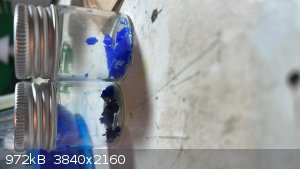
Two blue crystalline complexes were synthesized from household materials. I'm quite happy with how they turned out, but I'm not really into crystal
growing, which is why I didn't bother making huge crystals and left them as small crystalline shards. If I come to it, I'll do a professional analysis
of my compunds and will post results. had also an attempt on the glycine one, but it only formed an amorphous powder, instead of crystals, which is
why I decided to discard it. Maybe I'll post the synthesis anyway if there's any interest.
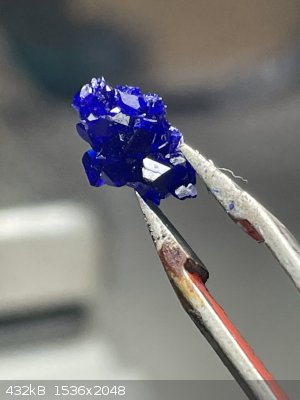
The darker one is the beta-alaninate complex, the lighter one the bis(oxalato)cuprate(II).
btw my gf liked the crystals 
![(NH4)2[Cu(C2O4)2].JPEG - 632kB](http://www.sciencemadness.org/talk/files.php?pid=705234&aid=108255)
![(NH4)2[Cu(C2O4)2] closeup.JPEG - 451kB](http://www.sciencemadness.org/talk/files.php?pid=705234&aid=108259)
bnull - 10-1-2026 at 14:57
Nice crystals, especially the oxalate needles. Have you considered embedding them in resin and making a pendant for her?
You may want to try ammonium copper sulfate, either by mixing ammonium sulfate and copper sulfate solutions or by dissolving cupric hydroxide in
boiling ammonium sulfate solution. The double salt is light blue and quite pretty when well crystallized.
[Edited on 11-1-2026 by bnull]
DraconicAcid - 10-1-2026 at 16:22
Copper(II) acetate monohydrate is more satisfyingly blue, I think, than the double sulphate.
Neptun - 11-1-2026 at 03:54
Thanks, bnull! That is a great idea, maybe I'll come to it in the future.
Concerning ammonium copper sulfate, I looked at pictures of the final product and thought that it was a little to light blue for my liking. It looks
like a crystalline version of copper oxalate.
As for the Cu(OAc)2 x H2O being blue, my prepared sample is more of a turquoise or green colour. I'm not really fond of that and
I personally don't think that it could be used to grow a satisfactory blue crystal.
Now that I think of it, another copper(II)-complex comes to mind; sodium tetrahydroxocuprate(II) (or its potassium pendant, I don't know which would
be better for crystallization), which could be easily acquired through either CuO or Cu(OH)2. I read that they possess a dark blue colour.
DraconicAcid - 11-1-2026 at 17:28
I don't think copper forms a very stable tetrahydroxy complex ion, although you can apparently get good crystal of azurite from strongly basic
solution.
Copper malonate (or was it maleate) give nice blue, blocky crystals. You can also get crystals of potassium bis(malonato)cuprate (but not maleato-
that falls apart).