Hexabromobenzene - 6-1-2025 at 06:08
From gel lead batteries after separation of plastic and separators 3 kg of electrode mass were extracted.
The process of electrochemical recovery was carried out in 2 stages, but you can do it in one stage.
First, the negative plates were put on a copper wire like beads and filled with a diluted solution of dirty potash from ash 20 g per liter (no photo).
The plates were placed on the bottom of a polypropylene container. The plate assembly was connected to the minus. One plate was connected to the plus.
For better contact, it was soldered to the copper wire
Electrolysis was carried out at a voltage of 5 volts. So it was at first 0.7A, quickly increased to 2 amperes in a couple of days and on the 5th day
was 5 amperes. At first, some amount of chlorine was released due to impurities in the potash. Then the release of chlorine stopped. During the
remaining time of electrolysis, some ozone was released.
After 2 days, the electrolyte became acidic. After 2 days, my contact to the anode collapsed
After that, the second stage began. Partially restored negative plates were placed in a layer in a 10-liter polypropylene container. Copper wire was
attached to 4 of them. A layer of whole positive plates was placed on top of the negative plate layer, and at the very top, a powder of resolved
positive plates. The result was a layered pie that was slightly compacted. The anode was made in the same way as in case 1 and a contact was soldered
to it, but it was insulated with varnish to protect against corrosion. The cathode pie was filled with electrolyte after electrolysis of the plates,
but diluted by 2 times to cover all the powder and space for the anode. (See photo)
A voltage of 5 volts was used for electrolysis. So it was 2 amperes at first, but after 3 days it grew to 4.3 and remained so until the end. On the
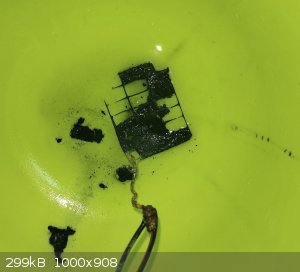
3rd day, hydrogen began to be released on the cathode, but the process continued for 6 days for complete conversion. The contact to the anode held up,
but the anode almost fell apart (see photo)
In theory, you need 50 ampere hours for 300 grams of lead sulfate
After electrolysis, the electrolyte was separated from the cathode, and the cathode mass was washed with water. You can see it before and after. A lot
of spongy lead was obtained, as well as some sulfuric acid. Spongy lead can be melted into an ingot with a flux and a reducing agent.
A destroyed anode can be restored in the same way. During electrolysis, a noticeable amount of ozone is released, especially at the end.


Sulaiman - 6-1-2025 at 07:50
very interesting
especially as I was just thinking about my own vrla processing waste
less than an hour ago, and saw this post.
I went in a totally different direction - and got lost 
I do not doubt that you have achieved what you described
but all I see is a bucket of toxic waste 
to others: please send your lead containing batteries for commercial recycling.
the waste generation is not worth it
unless it is like above for learning.
just my opinion
Hexabromobenzene - 10-1-2025 at 12:03
There were 4 kg of powder not 3. Destroyed anode was recovered by same way. Sediments from the wash waters were also recovered with the anode.
Amount of sulfuric acid obtained in process recalculation for 100% was about 0.5 kg.
Next, the powder is planned to be melted into ingots.
[Edited on 10-1-2025 by Hexabromobenzene]
Hexabromobenzene - 6-3-2026 at 14:33
Apparently, this method works. After melting a small amount of electrochemically reduced battery mass, approximately 70% or more was recovered in a
lead ingot. The first attempt was at low temperatures without adding a reducing agent, but much lead was not recovered.
During the second attempt, polyethylene and sugar were added to the lead container, and the heating time was increased. Despite 70% of the mass being
recovered, small lead balls were still visible in the crucible, and using flux, more lead can apparently be extracted. Some lead is also apparently
lost as heavy oxide powder. Perhaps these losses were due to the first incorrect attempt without a deoxidizer.
I recommend shaking the crucible before casting the lead to help the metal balls stick together.
Keep in mind that lead may have oxidized after a year of not being used.
[Edited on 6-3-2026 by Hexabromobenzene]
Sulaiman - 7-3-2026 at 07:54
70% sounds acceptable to me,
I am stuck with kilogrammes of lead bits encased in lots of its oxides
with carbothermal reduction my only economically viable route........ so far.
semiconductive - 7-3-2026 at 10:28
I've just experimented with tin oxide, and tried microwaving it in a gelatin and formic acid mixture to reduce it.
The process wasn't high nearly as high yield as it is copper oxide. But, it did work partially for me.
Original experiment shown by Murray Smith (before un-related suicide, obviously, so I can't ask him for more details of why it worked so well with
copper and why it might or not work for other metals. )
But, it seems to me that formic acid raised in temperature (especially by microwaves) is able to attack (some) metal oxides very rapidly.
I know that lead can be dissolved in acetic acid, which makes me suspect it might also be soluble in formic acid.
I wonder if FA might be able to leach lead oxide remains at a lower temperature if left for a long time in a sealed jar with no air in it. Or
perhaps, if exposed to sunlight in a jar with oxygen minimized. eg: Formic acid slowly darkens upon contact with air over a period of months, and the
darkening happens faster when FA is exposed to fluorescent light.
Acetic or formic acid might give you a way to separate the low-level lead oxide waste after which you could distill off the unused acid and
"carbo-thermically" reduce only the recrytallized lead formate.
I'm continuing experiments with tin ... which is in same column in the periodic table to lead.
Hexabromobenzene - 7-3-2026 at 11:14
Residues after smelting can be electrolyzed again and melted again, better with flux
[Edited on 7-3-2026 by Hexabromobenzene]
semiconductive - 11-3-2026 at 11:13
Flux --- in order to efficiently break up oxides, I'm assuming a fluoride is needed?
Which works best -- calcium fluoride, sodium fluoride, ???
Hexabromobenzene - 11-3-2026 at 13:20
For lead, sodium hydroxide is used as a flux.