
chempyre235 - 13-6-2025 at 10:22
I was contemplating the theory of a decarboxylation of citraconate by pyrolysis of its salts (pictured as anhydride), but I'm not certain as to what
products would be created.
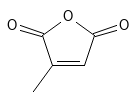
Citraconic Anhydride
Following only the rules for this decarboxylation, I would assume a product of 2-methyl cyclopropenone, but this would be highly strained. I'm not
sure this would be favored, but cyclopropenones are metastable due to tautomerization to an aromatic zwitterion.
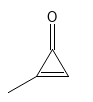
2-Methyl Cyclopropenone
I thought that a cyclic dimer would be favored depending on the reaction conditions, but an experiment like this may also result in a flask of useless
polymeric gunk.
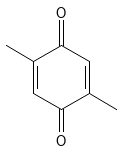
Cyclohexadiene 1,4 Dione (Dimer)
Does anyone know what kind of products or presumed yields could be proposed for this reaction?
Boffis - 14-6-2025 at 04:05
I can't answer your question definitively but it is possible. Your "cyclohexadiene-1,4-dione" is usually referred to as xyloquinone or
2,5-dimethylbenzoquinone and there is a fair bit of old published data on this type of reaction. For instance came across an old German paper that
describes the formation of this compound by the dimerisation of biacetyl. Your postulated intermediate is effectively a biacetyl "anhydride".
If you have some citraconic acid it might be worth a try, the quinone is volatile so should be readily distilled from the reaction mixture. Keep us
informed! 
chempyre235 - 16-6-2025 at 06:25
The volatility of the quinone certainly will make separation easy! Thanks for the info!
I don't have any citraconate yet, but I have it on my to-do list for when I get a lab set up, as part of my planned experiments with citrate
chemistry. I'll definitely keep you posted when I do get that far. I have to get my "ducks in a row," so to speak. Lab first, experiments after!