igxlabs - 22-7-2025 at 14:48
Hi - I was making a small batch of nitric acid using Glauber's process (H2SO4 + KNO3), in the correct stoichiometric amounts (1:1 molar).
But I was also pumping ozone and air into the reaction, slowly.
I distilled everything off - but needed to go over 230C, measured in the vapour space above the reactants.
Today I thought I'd just redistill the acid because I was after azeotropic HNO3.
Again - some small amount of weak acid came over, and I had to push the temperature up. I got to 180C before I called it quits. And I've used three
thermometers to be sure one wasn't badly calibrated.
Whatever acid this is, it's strong. Here's what I know at the moment - any advice or ideas gratefully accepted.
* diluted 1:1000 it tests between 2 & 3 on PH paper
* It releases NO2
* It dissolves copper as expected for concentrated HNO3
* It's colourless
* It has a boiling point higher than 180C - will determine that ASAP but need to figure out an accurate way with a small sample.
* It tests negative for sulfate, using Calcium nitrate
* Neutralized with KOH, it crystallizes in the same habit as KNO3.
* It *seems* stable, just sitting in the flask.
I thought it might be peroxynitric acid, but that decomposes too rapidly and below my temperatures.
Any ideas what this magic potion might be?
Thanks
might be a flaw in my thinking...
igxlabs - 22-7-2025 at 19:18
It's a new heating mantle so I wasn't thinking of it at all, but the boil from the bottom isn't as strong as I normally see. If that part of the
elements isn't working, then cranking up the heat increases the vapour temperature (from around the sides) but not the solution as much.
I'll check tomorrow - my gut says that's the problem.
jackchem2001 - 22-7-2025 at 23:59
Can you try distill water with the exact same setup and see the temperature?
Thermometers may be accurate but your location might mean you are not really measuring anything useful
And take a photo so we can see the location of the thermometer in the setup
Radiums Lab - 23-7-2025 at 03:42
U said that you passed O3+ air. For how long?
igxlabs - 23-7-2025 at 04:42
Radium Lab - probably a couple of hours, all told. I'll say that worked very well to clear up any NO2. And I should probably write a review of the
generator; I got it from Aliexpress and it's the best built piece of equipment I've seen in a long time.
jackchem2001 - I'll do that; plus I'm going to look at it with a thermal camera. I'll have definitive answers later today.
Radiums Lab - 23-7-2025 at 05:16
There is moisture in air and since you passed air for long time the acid may have been diluted.
[Edited on 23-7-2025 by Radiums Lab]
Don't quit my day job...
igxlabs - 23-7-2025 at 16:58
Well let's just be kind to myself and say I was running the mantle "out of spec".
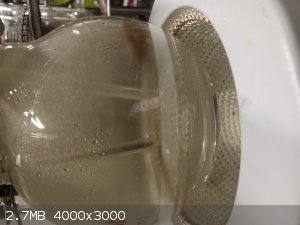
It's a two-litre mantle and 3 neck RBF. And as this was a test run it was a small batch. Too small, in fact.
You might be able to see the under-200 ml of solution at the bottom of the flask.
There is a tremendous amount of volume heated by the mantle above the solution, and that was heating the air. Only a small portion was available to
heat the liquid.
So lessons learned:
* if it looks like nitric, acts like nitric, smells like nitric - it *is* nitric
* Measuring vapour temperature is useful, but only if the liquid level is high enough to block the vapour space from being directly heated.
* Ozone makes fast work of converting NOx to useful HNO3
The ozone machine is sold by a store named Pinus Longaeva on Aliexpress.
Not sure if they still make mine but it has a CaCl2 drying tube, onboard air pump, inlet for another gas source, and a cycle timer. I'm really quite
fond of this store.
jackchem2001 - 24-7-2025 at 16:04
You have two places you could put the thermometer:
- Directly submersed in the liquid
- In the distillation head. There should be liquid condensate on the thermometer.
These will measure boiling point. The latter is better when dealing with a mixture of components and is the normal way.
[Edited on 25-7-2025 by jackchem2001]
teodor - 25-7-2025 at 05:49
Measuring of the boiling temp should be performed at the point where liquid phase is in the equilibrium with vapours. Putting it in another way,
wherea big part vapours are condensing. It is not possible to measure it on distillation of a solvent from solution or when vapours are going much
faster forward than are condensing back. To make an accurate measurement the best way is to use at least short fractionating arm which allows reaching
the equilibrium.