
ExcerptSix - 31-10-2025 at 12:33
I've been wanting to make some sort of a reliable and repeatable test set up for friction sensitivity of primaries and maybe some secondaries. I ended
up deciding that the BAM friction apparatus would be the easiest to copy. I finally finished up with that so I decided to write it up here and maybe
get some ideas on how to get more useful results.
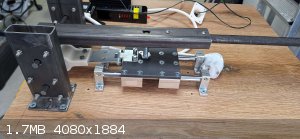
I went with a NEMA23 stepper for movement and a 3d printed crank for the rotation to linear translation much like the original. It's all made out of
rectangular steel tubing and some linear guides as it's clearly visible.
Initially I thought that the head of the bolt rubbing on the rough steel lower stage would be enough to set off some uNAP but that failed. The arm
itself without any weight on the lever puts about 1.3kg force on the bolt head. The lever arm is over twice the length of the axle to bolt distance so
that would give a mechanical advantage of 3:1 on the bolt head. I added a 1kg weight to the end of the lever arm. Still nothing just smearing of the
uNAP on the lower plate. I added extra weight with my arm on the end of the lever(no way to know how much but definitely more than the 1kg) still
nothing.
I'm guessing steel to steel friction just doesn't work for that low of a pressure for uNAP. When applying pressure with my hand on the lever i felt
that there was some flex in the system. After all the lever itself is something like 15mm OD and 11mm ID.
I'm planning on moving the "hammer" part of the system a bit further to the right so it's more centered to the free real estate of the lower stage.
Then perhaps I could rig up some ceramic tile as lower friction surface.
Do you think that lack of rigidity might be the problem?
Can anyone suggest what I can use for a repeatable abrasive?ceramic hammer rubbing on the ceramic tile if the bolt-on-tile doesn't work?
Would some sandpaper instead of the ceramic tile be more consistent? It would be easier.
[Edited on 31-10-2025 by ExcerptSix]
markx - 31-10-2025 at 14:34
Beautiful work! Congratulations on the glorious contrapulation!  I trust the
rigidity (or lack of it) is not really a serious problem here, as the force in action is of a continuous nature and the magnitude does not depend
whether a rigid or a flexible system transfers said force to the sample being tested. On an impact tester the rigidity plays a much more pronounced
role since we have a sudden shock load that has to be transferred to a sample without a part of it being dampened by the soft character of the
construction.
I trust the
rigidity (or lack of it) is not really a serious problem here, as the force in action is of a continuous nature and the magnitude does not depend
whether a rigid or a flexible system transfers said force to the sample being tested. On an impact tester the rigidity plays a much more pronounced
role since we have a sudden shock load that has to be transferred to a sample without a part of it being dampened by the soft character of the
construction.
But anyhow....the apparatus shall give you a scale of sensitivity over a spectrum of substances and samples. It is not really important that you
achieve the same absolute numeric values of sensitivity with your system compared to a test performed with a commercially manufactured friction unit.
You shall create your own scale bound to the particular machine. The values shall be somewhat shifted no doubt, but the trendlines remain the
same.....a more sensitive substance shall be perceived as such by both the improvised and professional testing unit. By all means you can use
sandpaper of appropriate grit instead of ceramic tiles as the substrate. Consistency I trust is less influenced by machine design nuances and more
dependent on your own dicipline and adherence to procedure when testing. Making sure the background conditions remain constant inbetween different
samples, so that the results are influenced mostly by the nature of samples and the effects of the background fluctuations become minimised.
Microtek - 1-11-2025 at 00:45
These kinds of difficulties were some of the reasons that I decided to use a hybrid approach for my oblique abrasive impact apparatus. I couldn't get
a reliable response from just friction, so I decided to rethink the whole thing with an eye towards the scenario I judged most likely to occur.