
Alchemica - 16-2-2026 at 13:41
Was wondering if a strongly acidic ion exchange resin eg. polystyrene sulfonic acid (Amberlyst/Dowex etc) was suitable and efficient for generating in
situ dry hydrogen halides for several reactions such as:
Halogenation of aliphatic alcohols?
Could refluxing an alcohol and halide salt in a mixture of sulfonic acid ion exchange resin bypass the need for conc. H2SO4 in the in situ formation
of HX and conversion of R-OH to R-X? Even if conc. H2SO4 is readily available and cheap, the large volumes of highly corrosive acid can be annoying to
work with. A polystyrene sulfonic acid H+ resin is super easy to remove from the post-reaction matrix and much more friendly to handle in it's solid
state.
Anhydrous HX in AcOH etc?
"...the H+ form solid material favours proton transfer reactions from the solids to reagents, since ionic sodium iodide is less soluble in alcohols
and polar aprotic solvents than the corresponding acid, e.g. HI."
One thing seems to be noted in Dowex/NaI reactions, is the need for extensive dehydration of the resin prior to use.
I can't find a pKa for polystyrenesulfonic acid resins easily but guessing it might be similar to p-tosic acid eg in the order of -1.
Macroporus strongly acidic resins can be had super-cheaply in bulk if you avoid buying a brand-name.
Got any interesting uses for ion exchange resins yourself?
Attachment: A Powerful tool for acid catalyzed organic addition.pdf (1.2MB)
This file has been downloaded 27 times
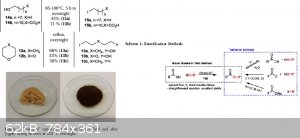
Attachment: turhanen-et-al-2019-green-and-efficient-esterification-method-using-dried-dowex-h-nai-approach.pdf (1.5MB)
This file has been downloaded 34 times
Dr.Bob - 16-2-2026 at 19:29
Many acidic resins can be used to form pseudoanhydrous acidic conditions, for example, forming a methyl ester from a carboxylic acid and methanol plus
some acidic resin, similar to using p-tosylic acid, H2SO4, or HCl. But water is formed in those reactions, so they are not really anhydrous, but the
equilibrium is shifted enough to work OK, but not always perfectly. But they are very handy for quick and easy workups, but HCl in methanol is also
pretty easy to make and workup.
But I don't think they will will work as well for halogen exchange. Also, for that reaction, the substrate often controls the reaction, in that
primary alcohols require really hard conditions, but benzylic and tertiary ones can be done easily, so perhaps for those, it might work somewhat, but
very dependant on substrate and ion.
For example, tBuOH + HBr ---> tBuBr + H2O is easy to do, so you might be able to add NaBr to acidic resin and tBuOH and get the reaction to go,
but for most harder substrates (primary alcohols, steric ones) I doubt it will work well, as those need very driving conditions to go towards
completion. But I know that some similar reactions can be done with resins, so I think it would require some testing.
Also, most PS ion exchange resins are hydrated, and drying too hard might collapse the resin; silica gel based ones are more stable to drying, but I
have not worked with them as much as silica gel based bases. Those I have more experience with, and they can be dried to near death without many
issues. But it takes a lot to dry them completely. Silica ones also have lower loading, sadly, which makes them more expensive than PS.
Alchemica - 16-2-2026 at 22:27
Thanks for sharing your valued expertise, Dr.Bob. I know when I was trying the NaI/Dowex catalyst for trying to form benzylic esters, the lachrymatory
effects of PhCH2I were very problematic