
Alchemica - 16-2-2026 at 16:11
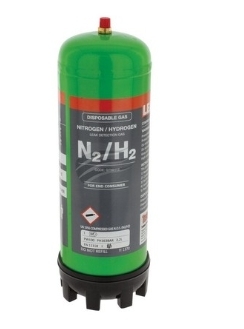
Any idea if utilising a stream of N2/H2 95:5 as the common 'Trace gas', which can be had in small disposable cylinders easily and at reasonable cost,
would allow an effective level of H2 for catalytic hydrogenations etc, whilst allowing a totally non-flammable gas to be super-safely utilised? Sure
gas qty would have to be adjusted for a 5% active H2 concentration but the rest is simply nitrogen which is unproblematic to allow to simply dissipate
into the environment
It's only 5% H2 but if I could just stream it through a reaction mix with a micron air stone or something, even if requiring significant gas volumes -
the lack of flammability vs H2 gas is super reassuring, personally
Contrary to a lecture bottle of H2, this is both readily available and reasonably priced in disposable cylinders
I wouldn't personally think the N2 would poison Pt/Pd catalysts (?) and the lower [H2] could still be unproblematic as the extremely high affinity of
H2 for absorbing on the surface of Pt/Pd on C should effectively 'trap' it while the N2 can flow through, and out, the reaction mixture?
Any thoughts or anyone tried it for such?
clearly_not_atara - 19-2-2026 at 20:20
If you don't mind waiting
Dr.Bob - 25-2-2026 at 11:05
The nitrogen is harmless to a hydrogenation, but the kinetics will be slow. But an interesting way to do this. My tendancy would be to use NH4CHO
as a hydrogen source with Pd/C or similar to generate hydrogen in situ, but for easy jobs, 5% might just work fine, and way less dangerous than pure
H2. I would just purge the container with N2, then it, and then seal it. I you use EtOH as the solvent, the fire risk is also lower than for
methanol. So that would likely work, and then purge with nitrogen and filter through Celite. Good luck.