beta4 - 7-12-2025 at 14:29
It's been a long while since I've done some home chemistry. Little time, other stuff distracting me, but the lab I built is still there. The reagents
and glassware waiting for me. The lab stands slowly rusting away...
Which got me an idea for what to do: zinc plating the lab stands.
Sometimes you want to do chemistry just because you feel like it. This is one of those times.
Alright, how to zinc plate? Rather than having ChatGPT hallucinate me some recipe, I went for a reputable source: the 2013/14 Universal Metal
Finishing Guidebook, Elsevier, page 324, Zinc Plating.
Three formulas are suggested. Avoiding the one with cyanide for obvious reasons, the "acid chloride" seems the most approachable:
- Zinc Chloride 22g/L
- Ammonium Chloride 135g/L
- pH between 5 and 6
Well, other than listing proprietary brighteners as further ingredient. Let's try without any and see what happens.
A quick look into the reagents cupboard and I only have zinc sulfate. Let's try to make the chloride with that, that's how you learn something. Before
even looking up how to do it, my plan was to first synthesize the cabonate, and then add HCl. The synthesis of zinc carbonare should in theory be
simple I thought, that's what I wrote down:
ZnSO4 + NaHCO3 -> ZnCO3 + NaHSO4 [wrong]
But then I had the idea to look it up just to be sure, and according to brauer page 1086, the reaction goes like this instead:
ZnSO4 + 4KHCO3 -> ZnCO3 + K2SO4 + K2CO3 + 2CO2 + 2H2O
Additionally, Brauer states it must be done at low temperature (3°C) and temperature should be increased over the course of days in a CO2-free
environment...
After a bit more searching to figure out the reason for such a complicated procedure I found out from wikipedia that zinc, just like copper, likes to
form a basic carbonate. But unlike copper, at least according to Brauer, it's possible to isolate the (non basic) carbonate.
Well, I decided to trade purity for speed and just run the reaction at ambient temperature. It's cold in the lab anyway. I dissolved 10.5g ZnSO4 in
50mL of water, then dissovled 21.8g of sodium bicarbonate in 250mL (took a long time with stirring). Mixed solutions, precipitate formed, some CO2
bubbled. Vacuum filtered, result is a white wet solid, likely a mix of the carbonate and the basic carbonate.
I added HCl till it all dissolved without waiting for it to dry to weigh it. I should have made a solution of about 8.8g of ZnCl2.
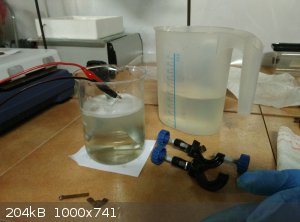
After adding the appropriate amount (54g) of ammonium chloride ad topping up with water to 400mL, I had a beaker of zinc plating solution.
With a current limited power supply (set the limit to about 1A), a zinc strip at the positive terminal (anode), I plated every screw of my lab stands
after attempting to strip the rust with some HCl.
The plating is't very uniform, likely due to incomplete rust removal before plating and the lack of brighteners in the plating bath, but the main goal
was to spend some time doing chemistry and learning something, which I did.
pesco - 20-12-2025 at 22:55
Consider Ni plating.
Much more durable than Zn.
Just as easy to plate.
YouTube is full of instructions.