| Pages:
1
2
3 |
bnull
National Hazard

Posts: 933
Registered: 15-1-2024
Location: East Woods
Member Is Offline
Mood: Happy New Year!
|
|
Electromigration: https://en.wikipedia.org/wiki/Electromigration; electrolysis: https://en.wikipedia.org/wiki/Electrolysis; electrophoresis: https://en.wikipedia.org/wiki/Electrophoresis. It can't get much better than that, there's no confusion or controversy among the terms.
Or, if you prefer a short and rather incomplete version: electromigration is when atoms in a conductor move along the material due to transfer of
momentum from electrons to these atoms; electrolysis is the decomposition of an electrolyte by means of an electric current; and electrophoresis is a
technique to separate (polar) molecules by the application of an electric field. Notice that electromigration requires the physical interaction
between electrons and atoms, while electrophoresis uses an electric field.
Edit: Fixed it.
[Edited on 17-12-2025 by bnull]
|
|
|
semiconductive
Hazard to Others
Posts: 388
Registered: 12-2-2017
Location: Scappoose Oregon, USA.
Member Is Offline
Mood: Explorative
|
|
Quote: Originally posted by bnull  |
Or, if you prefer a short and rather incomplete version: electromigration is when atoms in a conductor move along the material due to transfer of
momentum from electrons to these atoms; electrolysis is the decomposition of an electrolyte by means of an electric current; and electrophoresis is a
technique to separate (polar) molecules by the application of an electric field. Notice that electromigration requires the physical interaction
between electrons and atoms, while electrophoresis uses an electric field. |
Hmm.
| Quote: | | On a side note, ice can behave as a semiconductor. I've downloaded a paper (which I intend to read as soon as I can find it) about
electrical/electronic/electrochemical properties of ice, with and without dopants (mainly acids and bases). This, unfortunately, is completely useless
for you as you want to plate metals onto stuff, not make an ice transistor. |
Combining your quotes:
So when the wire representing 'move direction south, by southwest' really fast in the Russian RS28 SARMAT missile suddenly found itself on the 'math
coprocessor emergency interrupt' -- that's an example of electromigration.
But, it's probably not considered electroplating unless the wire moves through silicon in order to find itself on top of the math co-processor?
---
If you prefer a rather (shorter) and incomplete answer to your quest to understand 'What happens when there isn't a crystal lattice?'
One answer was hidden very cleverly in the "statistical mechanics" paper I already linked to, on page 17. ( First sentences of the left columb. )
https://srd.nist.gov/JPCRD/jpcrd696.pdf
What "you do" is invent a new word called "quasilattice".
This word, of course, means that you go right ahead and apply the equations meant for crystals to steam vapor.
It's a bit like when my physics professor said, "Now suppose we use a spherical model for a cat."...
|
|
|
bnull
National Hazard
Posts: 933
Registered: 15-1-2024
Location: East Woods
Member Is Offline
Mood: Happy New Year!
|
|
The first quote refers to @chornedsnorkack's question that unfortunately ended up at the end of the previous page, making my pointing out the
definitions a non sequitur.
It wasn't a quest. It was a passing question, like those comments in Fieser and Fieser's Organic Chemistry. "Oxalic acid can be used to dehydrate
cyclohexanol," that sort of thing. But it's good to know what to do in such cases.
As far as I know, the definition of electroplating involves a surface and a medium in contact with the surface from which comes the plating material
that is deposited in the surface. The plating material traveling through the body whose surface is to be plated doesn't seem to fit the definition.
Maybe one could call it electromigration plating. Theoretically interesting (yes, it is) but probably useless when one wants to plate stuff.
[Edited on 17-12-2025 by bnull]
|
|
|
semiconductive
Hazard to Others
Posts: 388
Registered: 12-2-2017
Location: Scappoose Oregon, USA.
Member Is Offline
Mood: Explorative
|
|
All I said is taken in good humor, I hope.
There's a lot of things that I don't mention, because I write too much for most people to read (as it is).
You might not know that when the graphite electrode of my last experiment touches the glass wall of the test tube that gas bubbles erupt much faster
than if it is not touching the glass.
This odd detail made me consider your article and dictionary definitions in ways I'm not going to fully explain. But: In the surprisingly novel
experiment you posted there are several things potentially going on, that I'm not even sure how I would talk about them (vocabulary wise).
One example: Do the charge 'carriers' really move through the ice in his experiment, or do they travel along the surface of the copper wire to the
surface of the ice and then migrate toward the 'junction' ?
( "Obviously", Ice melts along its surfaces ... and maybe under pressure at junctions. )
It's not just electrons which can move along ice surfaces.
But: The equation I posted for density of states (DOS) was derived presuming the only thing that actually moves are electrons (and spaces left where
electrons ought to have been -- holes);
Therefore the only units of energy needed is 'electron volts'. But, if I did the same (DOS) derivation assuming protons as charge carriers, then the
final equation would have to be adjusted to have different valued constants and even the exponent might change. ( There are no proton-volts units,
you just have to multiply electron volts by some scaling factor. And, electrons spin in pairs ... but is this really relevant to protons? )
Final passing comments:
I've not been talking about Einstein's E=mc², but measuring relative permittivity and not getting the value '1' is equivalent to saying the value of
'c' is different inside materials than in empty space.
This means the relationship between Energy and Mass ( which are the only two things used in the Density of States formula derivation) are very
slightly different inside a material than outside of it.
Now: I'm thinking --
The major difference between liquid and gas -- is that gasses tend toward a constant number of moles of material per volume; P·V=nRT (ideally).
In a constant pressure situation, P is not allowed to change. But that means the density of the substance must change drastically at the boiling
point -- and therefore, so does the dielectric constant of water and steam.
See my plot of energy gap back a few posts?
I think the rapid change of energy gap shape near 100 [°C] in my plot isn't a math error (in spite of the specific value I chose from NIST data at
25C being likely wrong).
It seems a reasonable hypothesis that normal water boils at a slightly hotter temperature than ultra pure water. eg: The strong (and unusual) curve
bend of the Energy gap is likely evidence that the experiment was either done slightly above sea level, or that ultra pure water boils at a lower
temperature than normal distilled water.
|
|
|
semiconductive
Hazard to Others
Posts: 388
Registered: 12-2-2017
Location: Scappoose Oregon, USA.
Member Is Offline
Mood: Explorative
|
|
I see my plotting mistake! I typed in 0.03033. and not 0.003033 into my plot.
This means S. Yefimov's equation as written does produce the same regression line.
But why do I get an estimate of >1 electron volt for his line, when he gets a value of 0.53 electron volts....
"A broken clock is correct twice a day"... 
Maybe:
0.53 [eV] · 2 = 1.06 [eV] which is rounded off 1.0597 [eV] of my number.
--- For future reference ---
IUPAC defines the boiling point of water under slightly different conditions.
Does Russia generally follow IUPAC?
I wonder if I will need to do the same for alcohol.... sigh...
96485.3321233 [eV] → 1 [kJ/mol]
Melting H₂O = 334 [ KJ/Kg ] ≈ 6.01701 [k J/mol ] ≈ 6.236 [ μ eV ]
Vaporizing H₂O (99.61 [°C] at 100 [k Pa] ) = 2257.5 [ k J/k g ] = 40.6688625 [k J/mol ] ≈ 42.15 [ μ eV ]
NOTE: Interesting discovery: ( I never knew this before. )
The amount of energy required to melt ice or to boil a single molecule of water is so small compared to the ionization bandgap of water itself, that
energy discontinuities during phase changes will not show up in a semiconductor band-gap plot.
AKA: It's not practical to be able to detect a 40 micro-volt change with a desktop volt-meter, reliably, or to show it in a plot.
This means that it it physical volume changes that are messing up my band-gap plot, and not electronic changes of individual molecules of water.
Kw ionization data is (apparently) very sensitive to dissolved gasses in a fluid (micro-bubbles) and even NON-ionizable substances in contact with the
fluid such as plastic container walls, dissolved droplets of kerosene or oil, etc.
To make an accurate band-gap estimate for semiconducting water, the KW data needs to be divided by the actual density changes of the water itself
(isolated) from other density changes.
eg: There can be no accurate water density value at 100 [°C] as that could be either water or steam, (depending on experimental setup , and time
given after temperature change to 'equilibriate'.)
It's not reasonable to believe these experiments were carried out in the international space station with a heater at the center -- and that means the
pressure of the fluid must not be perfectly constant, but rather pressure must form a gradient that is lowest near the water-gas interface.
Therefore:
For accuracy and precision reasons: I need to discard Kw data at 100 [°C]. The remaining Kw data needs to be adjusted for density of water changes
before it can be used to compute semiconducting coefficient values.
https://nvlpubs.nist.gov/nistpubs/jres/097/jresv97n3p335_a1b...
[Edited on 18-12-2025 by semiconductive]
|
|
|
semiconductive
Hazard to Others
Posts: 388
Registered: 12-2-2017
Location: Scappoose Oregon, USA.
Member Is Offline
Mood: Explorative
|
|
NIST already has water density equations that are accurate from 5 [°C] to 40 [°C], for degased or gassy water.
It's difficult to find water ice data where I know whether the water was boiled before freezing or not. But, I can find single crystal experiments
which will be immune to dissolved gas problems.
Example: "Thermal Expansion of Single-Crystal H2O and D2O Ice Ih", Physical review letters 121.
All articles I can find show that hexagonal H₂O Ice hits it's maximum density at around 60 to 64 [K]. The graphs also agree that on average
hexagonal ice expansion is isotropic.
I can fit the H₂O graphs in the cited article (by eye) with the equation:
DL/L₁₀ ≈ 138.2·10⁻⁹·(T-62)² -0.135·10⁻³
Scaling this equation linearly and then cubing to compute a constant mass ice volume fails with wrong values. This is not unusual -- https://www.physicsforums.com/threads/calculating-the-coeffi...
Alternate attack, I get two data points for ice density online.
T=-20 [°C] = 273.15 [K] → 0.9196 [ g/cm² ]
T=0 [°C] = 273.15 [K] → 0.9167 [ g/cm² ]
What I want is an equation that hits these two data points and has a maximum density at 62 Kelvin.
Density ≈ 1/( a·( T-62 )² + b )³
From 38.15 [K] to 273.15 [K], I can approximate:
Density=1/( 134.631·10⁻⁹·( T-62 )² + 1.02341 )³ [ g/cm³ ]
From 38.15 to 273.15 every 5 degrees:
['0.93272', '0.93280', '0.93286', '0.93291', '0.93293', '0.93293', '0.93292', '0.93289', '0.93284', '0.93277', '0.93268', '0.93258', '0.93245',
'0.93231', '0.93215', '0.93197', '0.93177', '0.93156', '0.93132', '0.93107', '0.93080', '0.93051', '0.93021', '0.92988', '0.92954', '0.92918',
'0.92880', '0.92840', '0.92798', '0.92755', '0.92710', '0.92663', '0.92614', '0.92564', '0.92511', '0.92457', '0.92401', '0.92344', '0.92284',
'0.92223', '0.92160', '0.92096', '0.92029', '0.91961', '0.91891', '0.91819', '0.91746', '0.91671']
For water near freezing, I can find data:
T=0⁺[°C] = 0.9998 [ g/cm² ]
T=3.98⁺[°C] = 1.0000 [ g/cm² ]
The zero degree value is actually the NIST ITS-90 polynomial rounded down, even though it's not technically valid between 0 and 5 [°C]. This is a
reasonable approximation, so I'll keep it.
Composite density of H₂O chart from 38.15 [K] to 40 [°C], is then:
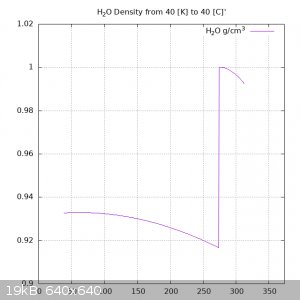
For any given experiment, the steep discontinuity will not be present because the time for freezing will become confounded with the temperature.
[Edited on 19-12-2025 by semiconductive]
|
|
|
bnull
National Hazard
Posts: 933
Registered: 15-1-2024
Location: East Woods
Member Is Offline
Mood: Happy New Year!
|
|
| Quote: | | All I said is taken in good humor, I hope. |
Yes.
What software you're using to plot data?
|
|
|
semiconductive
Hazard to Others
Posts: 388
Registered: 12-2-2017
Location: Scappoose Oregon, USA.
Member Is Offline
Mood: Explorative
|
|
I'm just using Gnuplot. Free, open software.
Note: I have a success!
If I adjust the densities of pH+pOH, to be Molal based rather than volume based, and don't force any 'p' values to match NIST, then the failure in
bandgap characteristic goes away. I get an excellent semiconductor fit using Varshini's correction.
It doesn't matter if I use the Russian or American data set, the answer is approximately the same.
Less than 0.2% error, everywhere.
This is a reasonable semiconductor model of 2·H₂O ionization into H₃O⁺, OH⁻.
I'm computing the pH+pOH values vs. inverse temperature. ( 'x' axis is 1/Kelvins )
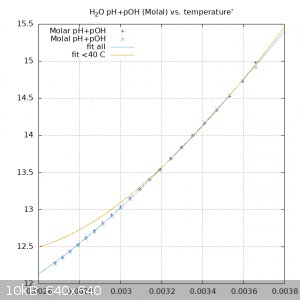
The maximum energy gap to overcome to ionize water and that fits all data points is 4674.12 / 2519.88... = 1.85 [eV]
This is not the usually published band-gap of water itself. Rather, this is difference in ion potentials between [OH⁻] and [H₃O⁺] which
correspond to the conduction and valence bands of silicon. eg: this gap is the ionization energy to make two ions with the 'Fermi' level being
halfway between.
The Varshini correction is small, which is a good sign that I've done the math right. The equation ought to be correct for both solid ice and water.
(Possibly even steam, but that's tricky.)
For all data points, assuming NIST density equation is correct all the way to boiling.
pH+pOH (Molal) ≈ 4674.12/T -10.5102 +0.651441·ln(T) + 7.4969·10⁻³·T²/( T+1.36780)/log₁₀(e)
If I re-run the fit, using only data points from 0 to 40 [°C], the band gap maximum becomes 2.47 [eV] ; but the Varishini's correction becomes
larger.
pH+pOH (Molal) ≈ 6232.50/T -21.0663 +0.651441·ln(T) + 15.2774·10⁻³·T²/( T+1.36996)/log₁₀(e)
This suggests that the NIST density equation likely is close to correct even above 40 [°C] because a smaller correction term usually indicates a
better over-all physics match.
And now I'm a bit stuck. There's disagreement in data sets at high temperature (near boiling) of up to 3%. The QM correction I'm using is just the
electron mass version (which exists even with real ions) -- but there is a more correct set of constants that reflect the relative permittivity of
water ( As changed by E=m·c² due to 'c' having a smaller value in solvents of any kind. )
Still, even wrong, either equation is close enough to correct to do basic predictions with. Getting a more accurate equation requires experiments
that I can't do yet.
I know that in semiconductors, when there are a lot of competing band transition values that depend on the direction you move through the crystal, the
"band gap" of the material is always taken as the lowest ionization energy possible.
With water, the lowest ionization energy corresponds to physical hydroxide and hydronium ions. But, in the literature I find, they aren't reporting
those ions energy differences as the band-gap of water.
But: There is a reasonable article I found, here, that tries to explain the different kinds of band gaps present in water.
https://www.researchgate.net/publication/276498338_Electroch...
But, I'm not sure where he's getting the K_H₂≈2·10⁻¹⁹ and K_O₂≈6·10⁻²² from.
Is that a Henry's law type of reasoning?
From: https://www.engineeringtoolbox.com/gases-solubility-water-d_...
where [c] is IUPAC symbol for Molarity, [ b ] is Molality:
I can see that at 25[°C], 1 atm.
[H₂]≈1.55·10⁻³[g]/2[g/mol] = 0.78·10⁻³ [c]
[O₂]≈0.04 [g]/31.996 [g/mol] = 1.2·10⁻³ [c]
I see a solubility of Oxygen that is 10x larger than he has in his paper.
Hmm...
reaction K₁: H₂ + 2·H₂O ⇌ 2·H₃O⁺ + 2·e⁻
K₁ = [ H₃O ]² / [ H₂ ] = [10⁻⁷]² / [ 0.78·10⁻³ ] = 1.3·10⁻⁹
reaction K₂: O₂ + 2·H₂O + 4·e⁻ ⇌ 4·OH⁻
K₂ = [ OH ]⁴ / [ O₂ ] = [10⁻⁷]⁴ / [ 1.2·10⁻³ ] = 8.3·10⁻²²
His oxygen constant value is close, but the Hydrogen value isn't.
I'm not sure what the reasoning is. 
[Edited on 21-12-2025 by semiconductive]
|
|
|
semiconductive
Hazard to Others
Posts: 388
Registered: 12-2-2017
Location: Scappoose Oregon, USA.
Member Is Offline
Mood: Explorative
|
|
Earlier, I tried to use the Nernst equation with fully balanced equation for an alkaline cell.
And I knew I was doing something wrong, but I couldn't figure out what.
2·[OH⁻] + H₂(g) ⟺ 2·H₂O(l) + 2e⁻
The voltage I looked up from NIST for the half cell reaction was: 0.828 [V] @ 25[°C]
https://www.sciencemadness.org/whisper/viewthread.php?tid=16...
Now, I've found an online tutoring company that happens to do the reaction:
https://allen.in/dn/qna/11044569
They list the full reaction as:
2·H₂O + 2e⁻ ⇌ 2·[OH] + H₂ -8.2777 [V] @ 25 [°C]
What I find fascinating about the video, is that it properly lists the full equation as the problem to do. But when you watch the tutor actually
describe how the problem is done, she immediately changes the fully balanced reaction into a fractional equation with a different number of electrons.
( But doesn't explain WHY! )
H₂O + e⁻ ⇌ 1/2 H₂ + OH⁻ -0.8277 [V] @ 25 [°C]
So, obviously I forgot something in the 30+ years since I took chemistry in college. But, I still don't know what.
And then the tutor plugs the single electron version of the equation into Nernst.
I plugged in a two electron version.
At the end of her calculation, it's obvious that K she is calculates with the Nernst equation is actually Kw.
Now, I already have a semiconductor fit equation for Kw at *all* temperatures that is very accurate.
Therefore, without knowing why her problem works -- I can plug my Kw value into her Nernst equation (as written) and I should compute accurate full
cell voltages for the reaction at any temperature. ( I'll do so in a lower post.)
I already suspect what is going to happen is that I will get cell voltages that increase with temperature, in spite of the fact that the band-gap for
the reaction really is decreasing with temperature. ( I'll check in a post below. )
Note: I looked up the equilibrium constant for water spontaneously decomposing into non-ionized hydrogen and oxygen gas. ( Google's AI did it for me
based on the full equation that I entered. Obviously, It could be wrong.... )
2·H₂O ⇌ 2·H₂ + O₂
K= 2·10⁻⁴² 25[°C] and 1 [bar]
But: I notice that the K value of this reaction is suspiciously close to the product of both K values in the paper I'm trying to figure out
(immdiately preceeding post from this one.) The solubility of Oxygen was off by a factor of 10, this answer is also off by a factor of 10.
( K_H₂ · K_O₂ ) ≈ 2·10⁻¹⁹ · 6·10⁻²² = 1.2·10⁻⁴¹
Might just be a coincidence...
|
|
|
semiconductive
Hazard to Others
Posts: 388
Registered: 12-2-2017
Location: Scappoose Oregon, USA.
Member Is Offline
Mood: Explorative
|
|
Next: I always carry out my calculations to more digits than really can be used. Then I throw away most of the work I've done.
Nernst Equation at 25 [°C] as used in the tutorial, but with extra useless digits:
E°_cell ≈ 0.0591593496847823 [eV] / 1 · log₁₀( Kw )
Oh, wait, the Nernst equation is only valid at 25[°C] ?!
Then what equation am I remembering from the newer library book I read at my alma-mater ?!
Kotz and Purcell, "Chemistry & chemical reactivity", (c)1987.
ISBN 0-03-058349-7
PP. 715 "The Nernst Equation"
I read ... blah blah ...
E°_cell = E° - R·T / ( n·F ) · ln( Q )
Oh, that's the Gibbs equation. It only gets re-named Nernst after someone plugs in T=298.15 [K] and computes the decimal value of the constants.
Q is any ratio of ions, whether in equilibrium or not. K is if they are in equilibrium.
Since we're doing auto-ionization, Q=K.
Hmm...
My equations are written in terms of log₁₀, and so is the final Nernst equation at 298.15 [°K] as stated in the book:
E°_cell = E° - R·T / ( n·F·ln(10) ) · log₁₀( K )
uh-oh. Maybe Q in my book can't be a function of temperature Q(T). They might mean a specific constant number Q° (at 25 [°C], 1 Bar. );
therefore K in the Gibbs equation, and the Nernst equation, could be K°. ( Bad words omitted. This is why I got the lowest grade in all my college
work in Chemistry. They wrote K and not K° ?! )
Note: My semiconductor equation is already in the form of logarithms that vary with temperature: log₁₀( Kw(T) )
The simplified equation from Kotz and Purcell ought to be written:
E°_cell = E° - .00019842143... [V/K] · T/n · log₁₀( Kw° )
I was wrong, I can't plug my Kw into this formula and get the precise cell voltage at all temperatures. S***s to be me.
Kotz and Purcell list standard *reduction* potential on p. 710 for:
O₂(g) + 2·H₂O(l) + 4·e⁻ → 4·OH⁻(aq) as +0.4.... [V]
2·H⁺(aq) + 2·e⁻ → H₂(g) as 0.0.... [V]
2·H₂O(l) + 2·e⁻ → H₂(g) + 2·OH⁻(aq) as -0.827.. [V]
(Note: no Hydronium ion was mentioned in the table, just H⁺.)
Worse note:
No matter what Kw value (<1) that my equation computes for 25 [°C], the Gibbs equation as written in my chem book will make the cell voltage
voltage become less negative with bigger temperatures. AKA: the log₁₀ value of ion concentration will *always* be negative and the gibbs equation
multiplies it by another negative sign.
For situations where Kw < 1, and the cell magnitude is negative; the cell voltage magnitude must decrease toward zero according to the Gibbs
equation in Kotz and Purcell.
But reality: I warm a battery in my hand, the voltage number/magnitude on my volt meter increases in value. This is true whether or not I reverse
the probes on my meter and the voltage is artificially made negative or positive.
My present line of thinking:
The energy level difference between OH⁻ and H₃O⁺ (in electron volt energy units [eV] ) must decrease with temperature because of Boltzmann
statistics and physics.
The gap must decrease with temperature in order to gently curve ionization concentrations non-linearly. eg: to make the gentle 'curve' in my plot.
If K is K° in the gibbs equation. Then the Gibbs equation and the Nernst equation are purely linear in temperature. This is *not* what people
report the ionization constant of real water does with temperature.
But:
The equations shown in my book, and recorded in NIST have sign conventions that aren't explained well. In order for my book's equation to be correct,
Kw must be >1. In that case, it doesn't make sense that my books equation is the same as the Nernst equation -- becuase the sign is NOT reversed
when simplifying to disagree with the tutorial that I linked.
I know:
Water ionization is at around 1.2... [V] for each electron ionized in dilute water. In concentrated 40% aq HCl + titanium dioxide, Ive measured
battery cell voltages as high as 2.6 [V] at room temperature...
But, I still don't know why.
[Edited on 23-12-2025 by semiconductive]
|
|
|
semiconductive
Hazard to Others
Posts: 388
Registered: 12-2-2017
Location: Scappoose Oregon, USA.
Member Is Offline
Mood: Explorative
|
|
If there is a company who could answer this for a tutorial fee, I wouldn't mind paying out for a definitely correct answer.
Here on the forums, the discussion is free. But it's not like I'm cheap.
My college education set me back a few pennies. My ex wife set me all the way back. What's a few more $$, but this time it better be worth it.
|
|
|
semiconductive
Hazard to Others
Posts: 388
Registered: 12-2-2017
Location: Scappoose Oregon, USA.
Member Is Offline
Mood: Explorative
|
|
Control experiment#2: Sulfite.
Since I can't replace the sodium with lithium, yet, I'm just going to replicate the same amount of alkalai in the last experiment but use sodium
meta-bisulfite.
Afterthought:
I should have used lithium citrate + citric acid, but I just citric acid + lithium carbonate. So, I generate a little more water in this experiment
which is bad.
Initial amounts:
3 [cc] ethanol 1 cc extra to allow more to evaporate
2 [cc] ethyl-citrate ( inert dilluting, and allows better visibility in coloidal suspensions. )
2 [cc] Kerosene To keep moisture and most air out of experiment.
Citric acid: 108 [mg]
Na-Met-bisulfite: 323 [mg]
LiCo3 125 [mg]
I was shooting for 0.0017 mole of sulfite, which gives 20-30 ethanol molecules for every sulfite. I might have messed up and gotten .0034 moles of
sulfite.
Ground powder all together in a test tube using a glass stir rod.
MIxed in liquids.
Initial state was colloidal with clear kerosene floating on top, but it completely settled out in about a minute.
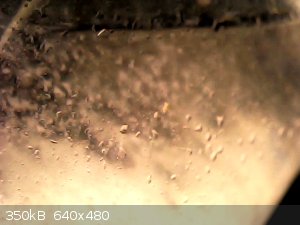
Began heating between 70 and 85 [°C]. I turned down heat to stop boiling and paid close attention to any smells. There were no sulfur smells. It
just smells slightly like ethyl alcohol.
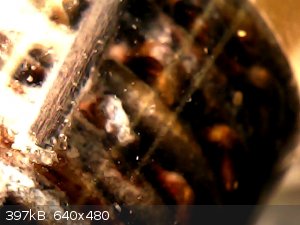
After running for about four hours, grey colored colloids began to circulate in the fluid. Black oxides stuck to test tube wall from the washer
(steel anode) stack. Then color began to lighten, with some yellowish looking color forming on steel.
All brief color changes went away, and the solution converted to a very dark olive green after 8 hours. Green colloidal material settles out easily
onto electrodes and tends to stick. WIth time it gets finer, and looser (less sticky).
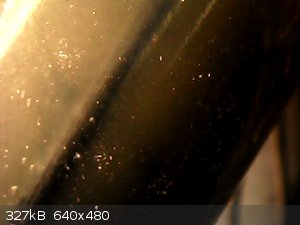
I will let this run a few days over Christmas and we'll see what happens.
|
|
|
semiconductive
Hazard to Others
Posts: 388
Registered: 12-2-2017
Location: Scappoose Oregon, USA.
Member Is Offline
Mood: Explorative
|
|
I added 1/2 cc of ethanol to bring the polar liquid volume back up to about 4cc. Because of variability of liquid volumes after miscing, I am not
sure how much ethanol is actually in solution any-more. I'm just attempting to maintain a constant volume and compare conductivity trends.
The color has remained a dark olive green. Over the last two days I have had small amounts of black material build up on the graphite electrode (-).
I've cleaned it off. The majority of white and olive-green salt falls to the bottom of the test tube.
Each time I add ethanol, the temperature at which the bottom of the test tube forms boiling bubbles has dropped. Less material stays settled at the
bottom of the test tube. I was able to run the test tube at 110 [°C] two days ago without boiling, but today I'm down to 80 [°C]. Pure ethanol
according to literature boils at 78.3 [°C].
On the other hand, the conductivity of the solution has slowly risen in spite of the boiling point lowering.
I am running AC current, around 10 [mA] with a D.C. bias of maybe 1 or 2 milli amps.
This should cause fast and reversible chemical reactions to remain in solution, while more permanent or slower reactions will become electrode
coatings (and I will clean them off).
Over time, I am hoping this will maximize conductivity of the solution by eliminating more stable oxides and traces of water. ( But I could be wrong.
)
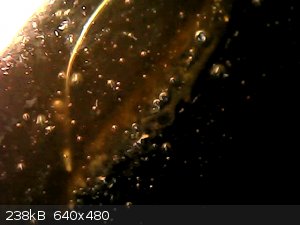
Note: Rechecked it an hour after adding 1/2 [cm³] denatured ethanol.
Result, the bottom of the test tube is still olive green colored with white+green precipitate. But the top 3 [cm] of the tube is now browner shade.
I assume this is because introducing new moisture comes with introduction of alcohol.
For scale: I lost an eyelash into the test tube while scraping off the graphite electrode (- biased electrode ). The electrode itself is 0.9 [mm]
wide. The view is highly magnified, with the glass test-tube oriented at 45 [degrees] to gravity. The top of the picture is level with the ground.
Bubbles tend to leave the graphite electrode at a 45 degree angle, this way, and I'm able to tell how much gas comes from each part of the electrode.
In general, this is where hydrogen gas likes to form.
I should be breaking down water and ethanol at both the anode and cathode.
[Edited on 29-12-2025 by semiconductive]
|
|
|
semiconductive
Hazard to Others
Posts: 388
Registered: 12-2-2017
Location: Scappoose Oregon, USA.
Member Is Offline
Mood: Explorative
|
|
For all intents and purposes, the solution has now become black uniformly black (6+ days of operation at 80+ [°C]. AKA: There's no point in posting
more pictures. )
I will continue A.C. current for another week, and see if the solution clarifies as I scrape off residues from electrode.
|
|
|
semiconductive
Hazard to Others
Posts: 388
Registered: 12-2-2017
Location: Scappoose Oregon, USA.
Member Is Offline
Mood: Explorative
|
|
Ficticious/non-isolatable chemicals problems:
In Alexander L. Shimkevich's paper on the electrochemical view of the "Band Gap" of liquid water, there are apparently differences in how Russian
chemists theorize about dissolution processes vs. American and English authors.
In U.S. literature,
Dissolved hydrogen and oxygen are treated as a diatomic molecule that stays intact in water. But, Alexander is talking about neutral hydrated and
dis-associated gasses in water.
Eg: Hypothetical O·H₂O = H₂O₂ molecule units with no charge. And, H·H₂O = H₃O molecules with no charge.
The former empirical equation is known to exist as hydrogen peroxide -- but the latter is not known.
Apparently, Russians have computed constants for these 'hypothetical' meta-stable H₃O states in a handbook of physical constants.
I am not completely able to understand Alexander's argument; but it's fairly clear that the energy gap he computes for H₃O⁺ vs. OH⁻ energy
levels is 1.75 [eV] on page 245.
That is actually consistent with the maximum value that I computed using a curve fit a few posts ago. I computed 1.85 [eV] as the maximum the energy
gap could be at absolute zero (Kelvin).
This energy gap is larger than a sum of two half reactions, pp. 246, (11) and (13) which are essentially standard hydrogen-oxygen fuel cell
reactions, yielding 1.228 [V] at 25 [°C] and 1 [bar].
But, the equilibrium constants Alexander turned into voltages are very curious to me:
[ H₃O⁺ ]/[ H₃O ] = e^(( εH₂O - εF(2) )/(kB·T))
+0.219 [eV]
[ OH ]/[ OH⁻ ] = e^(( εH₂O - εF(3) )/(kB·T))
-0.302 [eV]
For, these imply that free hydrated and dissolved oxygen and hydrogen must be available in the liquid, and that they have a rather large total effect
0.521 [eV] on the difference between cell voltage and water's intrinsic energy gap.
Generally in reputable auto-ionization experiments, distilled water will have been triple boiled and is (therefore) automatically de-gassed. There
really ought not be any dissolved gasses in the data I've been curve fitting, unless it's introduced by hydrogen electrode apparatus. (No oxygen
would be introduced, though).
When I used the half cell reaction for hydrogen gas and hydroxide ions and tried to force the energy gap to be 0.828 [eV], I was thinking that a SHE +
a graphite electrode in pure water explained the entire situation. But now I realize, my earlier attempts were over-simplified.
If I'm understanding what I'm reading in various chemistry texts:
The Nernst equation, and the Gibbs equation, are based on the ideal gas law relationships.
But, liquids deviate from these laws based on vander-Wall's forces.
Which means the temperature dependency of the Gibbs equation can be influenced by chemical properties of water.
[Edited on 2-1-2026 by semiconductive]
|
|
|
semiconductive
Hazard to Others
Posts: 388
Registered: 12-2-2017
Location: Scappoose Oregon, USA.
Member Is Offline
Mood: Explorative
|
|
--- Semiconductor fitting of water auto-ionization, what worked, what didn't ---
Reviewing the NIST™ data and comments, it's fairly clear that the density at both 0 [°C] and 100[°C] are very difficult to measure accurately.
The experimental data is only guaranteed valid over the range of 5 to 40 [°C].
Note: Online sources often use the NIST density polynomial at 0 [°C] as if it
were an accurate value, which I have discovered is a big mistake.
When comparing Molal pH+pOH values, vs. Molar pH+pOH values, the conversion does not significantly change my plot except at zero degrees celsius.
0.1/T=0.366... on the X-axis. I have a lot of reasons to believe this data point is wrong after running many fits. This point is a major outlier!
-----
When I plot water ionization curves with 1/T [Kelvin] as the x axis, and pH+pOH as the y axis, the slope of the curve represents the physical property
of 'energy required to make ions'.
By inspection of the Arrhenius plots that I've already done, it is evident that water auto-ionization slope is always less steep on the left side of
the plot (where the liquid is hotter) and more slanted on the right side of the plot ( Where liquid is colder. )
Therefore, the energy ionization gap of H₃O⁺ to OH⁻, decreases with an increase in temperature. This physical behavior is identical to crystal
based semiconductor behavior. The energy gap is largest in coldest materials.
Notice: in liquids the colors of complexes are often computed using crystal field theory, even though water isn't really a crystal with fixed length
bonds.
But: After some experimentation, I realized that Semiconductor physics are derived assuming a fixed sized crystal lattice and thermal expansion is
typically handled by Varshni's correction.
Therefore, to get the same model accuracy with water, it's necessary to convert the ion density of water into a Molal measurement basis rather than a
Molar basis.
I used least squares fitting of all data, including the erroneous/outlier data point at 0[°C], on a Molal basis, to get the following equation:
pH+pOH (Molal) ≈ 4674.12/T -10.5102 +0.651441·ln(T) + 7.4969·10⁻³·T²/( T+1.36780)/log₁₀(e)
This has a maximum energy gap of 4674.12 / 2519.88 ≈ 1.855 [eV]
( Which is reasonably close to another paper's calculation of it's value -- except that it's wrong by a factor of 2. ).
Notice the fit equation's intercept value is large at -10.5102; and this value is a correction of sorts, because if the model was exact the intercept
should be nearly zero.
On the other hand, The Varshini correction is much less than '1'. In my experience, the intercept correction is less important than the Varshni
correction because the intercept is affected by effective masses.
I got a much worse fit when fitting only 0 to 40 [°C] data, in an earlier post.
However, if I run data points from 5 degrees to 40, and purposely exclude 0 [°C]; I get an extreme improvement that is even better fit than the
full data set.
pH+pOH (Molal) ≈ 4615.39/T -10.0901 +0.651441·ln(T) + 7.16134·10⁻³·T²/( T+1.06895)/log₁₀(e)
Max energy gap: 4615.39/2519.88 = 1.831 [eV] # Fit of 5 to 40 [°C]
I can even re-check using data points that are in the 'too high' range, and they produce about the same result:
max energy gap: 4522.85/2519.88 = 1.794 [eV] # Fit of 40 to 75 [°C]
This indicates that the ionization data point at 0 [°C] is an outlier.
---- Correcting for effective mass without having a plot of the QM E-k rleationship ----
Intrinsic ion count in a semiconductor is usually written as:
n_i² = Const · T³ · ( m_e · m_h )^(3/2) · e^(( Ev-Ec)/(k·T))
Where (in silicon) m_e, m_h are the relative mass multipliers for electrons and holes. Ev-Ec is the energy required to ionize an electron from
valence orbital into conduction bands.
I have been fitting a square rooted version of this equation, where the effective masses are both considered to be unity.
n_i = Const ·T^(3/2) · (1·1)^(3/4) ·e^(E/(2·kB·T))
Which is a mistake on my part.
I forgot that n_i is the value of one kind of carrier, only, eg: pH or pOH by itself.
The carrier concentration product pH + pOH = -log₁₀( n_i² ).
When I do a best curve fit letting the temperature power be variable, I get a best fit of Kw data with an exponent of 3.02, not an exponent of 3/2.
This verifies that I made a mistake.
Kw is equivalent to n_i², not to n_i.
The correct fit for the equation 5 to 40 [°C] is:
pH+pOH ≈ 4327.11/T -1.02766 - 3·ln(T)/ln(10) + 5.9858·10⁻³·T²/( T+1.022)/log₁₀(e)
Going from 5 to 95 [°C], gives almost the same:
pH+pOH ≈ 4293.81/T -1.24649 - 3·ln(T)/ln(10) + 8.44233·10⁻³·T²/( T+1.017)/log₁₀(e)
But, this also means the energy gap scaling for the earlier part of the post is wrong by a factor of 2.
The remaining (tiny) errors in my plot are due to two issues, that semiconductor derivations of density of states (DOS) don't use the exact Planck
distribution because it has no analytical solution, Rather the derivations I've been linking substitute in a Boltzmann approximation.
The Boltzmann gas approximation is very accurate as long as the ionization energy gap is large compared to the the thermal voltage of the ions: eg:
6·kB·T > Energy of ionization. Thankfully I know that 6·0.024 [eV] = 0.144 [eV] at 0 [°C].
Since all ionization energies that I've computed are *easily* bigger than 0.144 [eV] , even at freezing temperatures, I know the standard
semiconductor approximation isn't introducing any significant error to the properties of water.
The second source of errors is that Density of States formulas were derived assuming that he speed of light, 'c', has a fixed value. But: liquids and
solids have lower values for 'c' than empty space does and (worse) they change with temperature.
In a true semiconductor setting, I would work out an E-k (energy momentum diagram), based on atomic orbitals and use that to compute an 'effective'
mass for the ions that accounts for the change in the speed of light.
But, that approach is impractical here and the error that is being corrected is very small (typically much less than 1%).
Since, I already know that both classical and relativistic energy-momentum diagrams can generally be described qualitatively as a hyperbola, I'm going
to attempt to fit a simulated E-k diagram to water auto-ionization data.
From the standard semiconductor equation, it ought to be obvious that the DOS mass equivalent is a geometric mean between two ion masses.
n_i² = Const · T³ · ( m_e · m_h )^(3/2) · e^(( Ev-Ec)/(k·T))
Therefore, I can replace the geometric mean with a single effective mass that is a function only of temperature:
( m_e(T) · m_h(T) )^(3/2) → ( m_DOS(T) )^3
The effect on pH + pOH is an error proportional to: 3· log₁₀( m_DOS(T) )
Therefore: m_DOS ≈ 10^( pKw_error/3 )
I am only fitting Kw data from 5 to 40 [°C], but even so the extrapolation of the curve is excellent even to boiling.
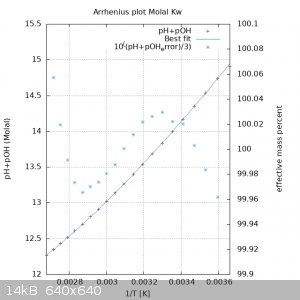
The quality of the data from 40 to 100 [°C] is unknown. The reason is that the international temperature standard ITS-90, document, indicates that
two different experiments might be involved in making these measurements. eg: The water samples and equipment making measurements are not
necessarily the same in these two temperature regions.
On the plot, the break point is x=0.0032. There's obvious trend-changes around this temperature, and that could easily be caused by interpolation
errors from different data sets or slightly different compositions of water.
The relative permittivity equation that I found earlier when researching "Kell", is clearly an optical permittivity. Trying to re-find the equation
using google searches doesn't work. I wonder if I've been given tampered with documents.... sigh.
When I compare it with other published data points, I don't get good agreement.
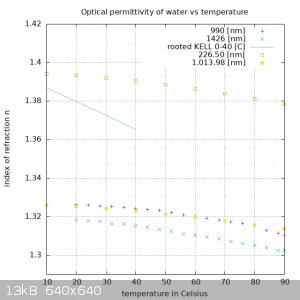
But, I need to estimate the speed of light for the energy being applied to the ion in order to do a theoretical effective mass correction.
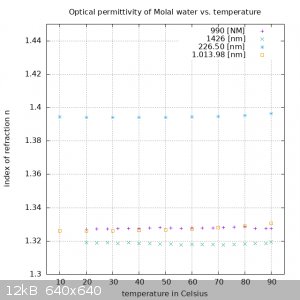
If I divide the index of refraction's reported experimental data by the cube root of density of water that NIST publishes for ITS90, I get straight
lines. But you can tell which lines are theoretical because they actually curve slightly.
For all practical purposes, light with energies of 0.5 [eV] to 6 [eV] have a constant delay per molecule of water encountered! This will simplify the
work I need to do to compute effective mass changes over temperature for my semiconductor model.
[Edited on 4-1-2026 by semiconductive]
|
|
|
semiconductive
Hazard to Others
Posts: 388
Registered: 12-2-2017
Location: Scappoose Oregon, USA.
Member Is Offline
Mood: Explorative
|
|
Hmm. I need to be able to re-do this derivation with alcohols, and I need it to be simple.
The NIST models are too complicated for hand computing without an online calculator. I'll work out a restricted standard conditions case, here.
I pretty much just need to know the refraction properties of liquid (water, alcohol) at 1 [bar] pressure for my own experiments.
I also need to verify what the density of water is over the full temperature range, and not just 5 degrees to 40 degrees Celsius.
I can get high quality data for index of refraction in water from multiple sites.
Therefore, I'll test out a theory out about how the index of refraction changes vs. temperature.
Using just the index of refraction data (mostly appendix info) from:
https://www.researchgate.net/publication/252888306_Water_ref...
And from NIST:
https://srd.nist.gov/jpcrdreprint/1.555859.pdf
I hypothesize:
Index of refraction is nearly constant after dividing out optical path length changes that are caused by water density. Eg: the delay in light travel
time is directly proportional to the number of molecules that are encountered independently of empty space traveled through. Therefore, I suspect
that the primary systematic error in measuring refraction experiments ( AFTER volume phenomena are removed/compensated for) will be inaccuracies in
temperature.
That means, if I normalize the index of refraction for a color passing through water , by dividing by the index of refraction of a specific color, eg:
589.32 [nm] light at the same temperature, the implicit volume changes get canceled out because both refractions values have the same volume/density
of water.
But: Slight errors in temperature or in-homogeneity of water mixing, will result in linear slope errors. IF this is the case, then dividing the index
of refraction of light by another refraction index of light of a different color will leave gently sloped lines that indicate temperature
mismatches/errors and other linear energy change errors.
*These errors should be easy to spot in replications of the same experiment by different authors.*
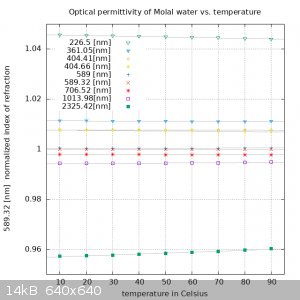
YES! The plot looks very linear, as expected!
The straight line least squares fits are:
1.04533 -18.8847·10⁻⁶ · (t-25) @ 226.5 [nm]
1.01131 -3.69776·10⁻⁶ · (t-25) @ 361.05 [nm]
1.00771-2.02039·10⁻⁶ · (t-25) @ 404.41 [nm]
1.00751-8.29188·10⁻⁶ · (t-25) @ 404.66 [nm]
1.00039+1.69418·10⁻⁶ · (t-25) @ 589 [nm]
1.0 @ 589.32 [nm]
0.997912-2.23743·10⁻⁶ · (t-25) @ 706.52 [nm]
0.994315+6.72551·10⁻⁶ · (t-25) @ 1013.98 [nm]
0.957622+37.0681·10⁻⁶ · (t-25) @ 2325.42 [nm]
The standard reference for 589.32 [nm] light at 25[°C] and 1[bar] is n=1.3325
Therefore, my linear fits predict at 25[°C], 1 [bar], vs. "simple approximation", vs. NIST's recommended fit.
n= 1.3929 @ 226.5 [nm] vs. 1.3230 vs. 1.3925
n= 1.3476 @ 361.05 [nm] vs. 1.3441 vs. 1.3474
n= 1.3428 @ 404.41 [nm] vs. 1.3415 vs. 1.3426
n= 1.3425 @ 404.66 [nm] vs. 1.3415 vs. 1.3426
n= 1.3330 @ 589 [nm] vs. 1.3322 vs. 1.3328
n= 1.3297 @ 706.52 [nm] vs. 1.3288 vs. 1.3299
n= 1.3249 @ 1013.98 [nm] vs. 1.3242 vs. 1.3248
n= 1.2760 @ 2325.42 [nm] vs. 1.3204 vs. 1.2758
The simple approximation is close everywhere except the two extreme wavelengths.
But: The NIST equation, #7, although accurate for my data set -- doesn't even reproduce the first wavelength between the values listed in the NIST
tables for 20 to 30 degrees of wavelength .36105 micron in it's own document. The author has tables that aren't computed by the formula he publishes
?
To represent standard laboratory conditions at 25[°C], (1 bar pressure) I set:
T=298.15; T₀=273.15
ρ=997; ρ₀=1000
λ=361.05; λ₀=589.0
Using Table 4 in the document for full range optimized variables, I compute with equation (7):
n = 1.3474
Using the different coefficients in the Appendix, I still compute,
n = 1.3474
This value is not between n=1.39336 at [20°C] and 1.39208 at [30°C] on page 704 in the 0.1 Mpa pressure column. (1 bar).
I really ought to use experimental data, first... But now comes another problem.... index of refraction values at standard temperature and pressure
are contradicted by different published sources:
Kudos, Philiplaven, for pointing this out!
http://www.philiplaven.com/p20.html
Note: My estimated values are at close to IAPWS & Lynch & Livingston's.
Alternately, I thought I could use Wikipedia's tables:
https://en.wikipedia.org/wiki/Optical_properties_of_water_an...
But my values substantially disagree. (Jan 2026)
What a nightmare! This is basic science.
Curve fits are fickle....
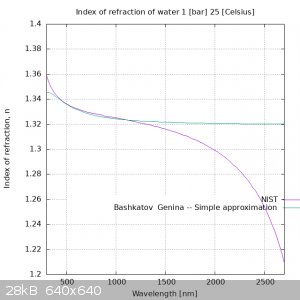
NIST = Journal of Physical and Chemical Reference Data 19, 677 (1990); https://doi.org/10.1063/1.555859 19, 677
--------- Side Note:
Optical absorption of light in water hits a maximum at around 2.7 microns. This light's energy ought to roughly correspond to the energy gap of
water OH⁻, H₃O⁺ or an integer fraction because this is the primary energy being used to cause ionization of water.
Energy of 2.7 micron light is 0.459 [eV].
This value corresponds closely to the article that BNull linked, regarding frozen water diodes made of dilute acid and bases.
[Edited on 6-1-2026 by semiconductive]
|
|
|
| Pages:
1
2
3 |
|


![[*]](images/xpblue/default_icon.gif)


