| Pages:
1
..
102
103
104 |
Dr.Bob
International Hazard

Posts: 2920
Registered: 26-1-2011
Location: USA - NC
Member Is Offline
Mood: Mildly disgruntled scientist
|
|
I use a base bath frequently for glassware, it does not hurt it or bother the joints. The amount of glass removed is atoms thick, not measurable.
Only a very long time (days to months) there will ever remove enough glass to matter. HF on the other hand will etch glass in a few hours, and it
does not ever look the same again. I have a few flasks that HF was a byproduct in, and they all look bad when wet, and worse when dry. They look
sand blasted or such.
Scotch bright pads are good for cleaning the joints if they get dirty. The rubber septa will sometimes leave a film of goo on them, especially after
exposure to acid.
|
|
|
Sir_Gawain
National Hazard
Posts: 530
Registered: 12-10-2022
Location: southeast
Member Is Offline
|
|
Can anyone with some geology experience verify if this is actually cinnabar? https://www.etsy.com/listing/1705692311/australian-rough-cin...
|
|
|
Rainwater
National Hazard
Posts: 993
Registered: 22-12-2021
Member Is Offline
Mood: Break'n glass & kick'n a's
|
|
Distill a sample at 600c. Not efficient but its worked for 10⁴ years
"You can't do that" - challenge accepted
|
|
|
yobbo II
National Hazard
Posts: 822
Registered: 28-3-2016
Member Is Offline
Mood: No Mood
|
|
How can the Alpha and the Beta CaSO4:0.5H20 have different solubilities (in the long term)?
Perhaps the study did not wait for days/weeks for all to dissolve, ie. the Beta is slower???
Yob

|
|
|
4-Stroke
Hazard to Self
Posts: 61
Registered: 20-4-2024
Location: Canada
Member Is Offline
Mood: Often Wrong, Never Unsure
|
|
Sulfur Chlorides Using HCl instead of Chlorine
I know this might be a dumb question, but I was wondering if HCl gas (which is easier and cheaper to prepare than chlorine) could be used instead of
chlorine in the synthesis of sulfur chlorides? Thanks.
Ukrainium
|
|
|
j_sum1
Administrator
Posts: 6487
Registered: 4-10-2014
Location: Limbo
Member Is Offline
Mood: Just got through yet another "take this job and shove it" moment.
|
|
Just a quick one.
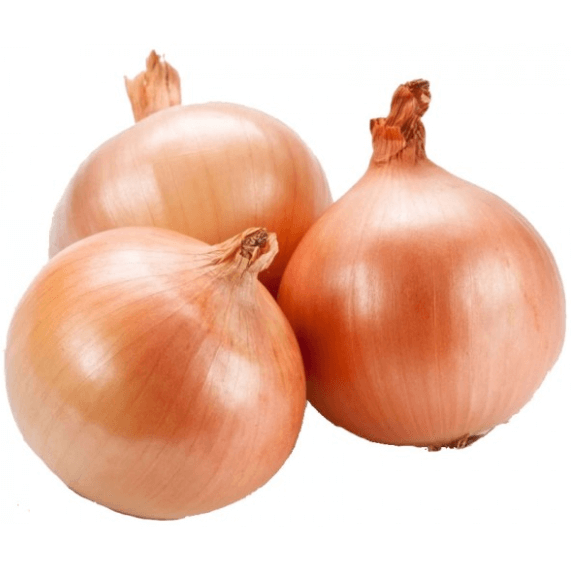
My daughter has extracted some pigment from brown onion skins to use for an art project.
I am curious. What class of compounds would be giving the colour?
|
|
|
bnull
National Hazard
Posts: 999
Registered: 15-1-2024
Location: East Woods
Member Is Offline
Mood: Fecking annoyed
|
|
Anthocyanins (https://pmc.ncbi.nlm.nih.gov/articles/PMC9363841/). By the way, the pigment can also be extracted from dried skins that are discarded by the
grocers.
|
|
|
j_sum1
Administrator
Posts: 6487
Registered: 4-10-2014
Location: Limbo
Member Is Offline
Mood: Just got through yet another "take this job and shove it" moment.
|
|
| Quote: | | Anthocyanins are the flavonoid compounds responsible for the purple/red color of onion and are highly concentrated in the skin |
She used brown onions, so I don't think it is anthocyanins. Also, the pigment does not respond to changes in pH.
I had thought it was probably a tannin of some kind. But then I wondered about the possibility of sulfur compounds.
|
|
|
bnull
National Hazard
Posts: 999
Registered: 15-1-2024
Location: East Woods
Member Is Offline
Mood: Fecking annoyed
|
|
Well, that's odd.
I took a few bits of brown onion skin and tried to extract the pigment with boiling ethanol and with boiling water. Alcoholic
solution: almost colorless, no reaction with oxalic acid, yellow precipitate on addition of saturated NaOH solution that dissolved on
addition of HCl (10%). It looked like iron oxalate but paler. Aqueous solution: this one is funny. Persistent yellowish color at pH
neutral to low, orange color at high pH. Addition of hydrogen peroxide (3%) to acidic and basic solutions made no change. The funny bit is that, while
I was neutralizing the base in one of the tubes, it went from orange to wine red (burgundy or darker) and then yellow.
I still think the pigment is related to the anthocyanins, most probably a degradation (oxidation) product. If I find my red onion extract, I'll see if
reacts in a similar way.
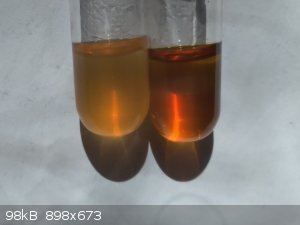
Acidic (left) and basic (right) aqueous solutions of brown onion pigment.
By the way, what solvent did you use?
|
|
|
j_sum1
Administrator
Posts: 6487
Registered: 4-10-2014
Location: Limbo
Member Is Offline
Mood: Just got through yet another "take this job and shove it" moment.
|
|
My daughter used water.
She separated inner skins from outer ones and so got two different shades. My suspicion is that the two are just different concentratikns but
essentially the same. One batch dhe boiled down until a solid started to appear.
This was a kitchen activity and I did not do any rigorous testing. Just used vinegar and sodium bicarb to test for pH colour changes.
|
|
|
bnull
National Hazard
Posts: 999
Registered: 15-1-2024
Location: East Woods
Member Is Offline
Mood: Fecking annoyed
|
|
| Quote: | | My suspicion is that the two are just different concentratikns but essentially the same. |
Nope. It is two different substances related to quercetin. I knew it had something to do with leuco dyes and stuff after the peroxide reaction.
Y. Ito etc al., Cepaic acid, a novel yellow xanthylium pigment from the dried outer scales of the yellow onion Allium cepa, (https://doi.org/10.1016/j.tetlet.2009.04.093).
|
|
|
yobbo II
National Hazard
Posts: 822
Registered: 28-3-2016
Member Is Offline
Mood: No Mood
|
|
What it the most reactive metal that you can cathodically protect by using it as a cathode is a water solution of (say) salt?
Cheers,
Yob
|
|
|
j_sum1
Administrator
Posts: 6487
Registered: 4-10-2014
Location: Limbo
Member Is Offline
Mood: Just got through yet another "take this job and shove it" moment.
|
|
Gadolinium chemistry - unexpected transient yellow compound
I was just starting a project preparing some Gd salts. Initial step was to dissolve some metallic Gd in 20% HCl.
The reaction should produce a clear solution corresponding to a near colourless salt. However, I notices a distinct yellow appearance when the
reaction started, and persisting in a kind of halo around the Gd pieces. Some kind of intermediate I presume.
Anyone know what the yellow is? Maybe some unstable Gd2+ ions?
Just curious.
J.
|
|
|
Sulaiman
International Hazard
Posts: 3952
Registered: 8-2-2015
Member Is Offline
|
|
recently released gadolinium video you may like
https://youtu.be/YIxjFKBl5eg?si=bqoQy0tJmsGEKPig
CAUTION : Hobby Chemist, not Professional or even Amateur
|
|
|
j_sum1
Administrator
Posts: 6487
Registered: 4-10-2014
Location: Limbo
Member Is Offline
Mood: Just got through yet another "take this job and shove it" moment.
|
|
Thanks Sulaiman. I did see that.
Coming back after a couple of hours out of the house, and the last fragments are still dissolving in the acid. When I left, the mixture was milky
looking with very fine bubbles. Now it is yellow. And cloudy rather than clear.
But online pictures show GdCl3 as off-white.
Anyway, I am kind of enjoying the subtle pastel shades of the lanthanides. I just bottled up some praseodymium carbonate.
I will see how it all goes.
|
|
|
Fery
International Hazard
Posts: 1149
Registered: 27-8-2019
Location: Czechoslovakia
Member Is Offline
|
|
How much pure is your Gd? Content of small amount of Fe in it?
|
|
|
j_sum1
Administrator
Posts: 6487
Registered: 4-10-2014
Location: Limbo
Member Is Offline
Mood: Just got through yet another "take this job and shove it" moment.
|
|
Gd was sourced from onyxmet, sold as an element. It sholld be pretty good.
I have a chloride solution and a nitrate solution: both are a pale yellow. This is exactly what I expected until I started looking at online pictures
that showed both salts as nearly pure white.
The observation I thought was interesting was the strong yellow around the metal pieces whlle reacting with HCl - even though the solution was
colourless at that stage.
|
|
|
| Pages:
1
..
102
103
104 |



![[*]](images/xpblue/default_icon.gif)


