PoWEr
Harmless

Posts: 26
Registered: 2-5-2025
Location: Poland
Member Is Offline
Mood: Feeling Explosive-Not
|
|
Sulfuric acid from pyrite
Some time ago I was reading about environmental hazards from mining operations, I found that there is something called "Acid Mine Drainage".
Apparently naturally pyrite can slowly turn into sulfuric acid:
2FeS2 + 7O2 + 2H2O -> 2FeSO4 + 2H2SO4
This process is done faster by some type of bacteria, but I belive that all you would need to do is crush the pyrite, put it in distilled water and on
a hot plate and blast air at it.
I will test it out in a few days, I need to order some pyrite and an aquarium pump.
The only problem I see is nitrogen reacting, but for now this is going to be an experiment if this is even viable.
I would attach some sources but my internet doesnt allow me to do so, I will try again later.
[Edited on 19-8-2025 by PoWEr]
|
|
|
chempyre235
Hazard to Others
Posts: 208
Registered: 21-10-2024
Location: Between Nb and Tc
Member Is Offline
Mood: Quite distracted
|
|
These bacteria are called Acidothiobacillus Thiooxidans, and form slimy colonies called snottites in caves. The snottites, reaching a pH of
1-2, erode rock and seem to be the basis for most cave formations, from what info I've been able to obtain.
[Edit]:
I recently toured a cave near me. Though no snottites were present, smaller bacterial colonies could be seen under blacklight. After the tour, I asked
a couple of the guides about the presence of this bacteria as well as Ferrooxidans (oxidizes iron compounds), and they confirmed that these
were present.
[Edited on 8/19/2025 by chempyre235]
"However beautiful the strategy, you should occasionally look at the results." -Winston Churchill
"I weep at the sight of flaming acetic anhydride." -@Madscientist
"...the elements shall melt with fervent heat..." -2 Peter 3:10
|
|
|
bnull
National Hazard
Posts: 994
Registered: 15-1-2024
Location: East Woods
Member Is Offline
Mood: Fecking annoyed
|
|
The problem I see is one of scale. Sulfur dioxide is an intermediate and is volatile. The time it takes to diffuse from the bottom of the lake (or
whatever it is called) where it is produced to the surface is several orders longer than in a beaker. That is exactly the time available for the
oxidation of dioxide to trioxide. If you boil pyrite in a beaker, sulfur dioxide simply goes away with the air. Not to mention that, if the solution
becomes more acidic, one has $$FeS+2H^+\rightarrow Fe^{2+}+H_2S.$$
Sulfhydric acid is volatile, poisonous and stinks. You'll lose it well before it is oxidized first to sulfur then sulfur dioxide and trioxide.
Nitrogen won't react. It takes more than boiling water and bubbling air for that to happen.
Edit: Typos.
[Edited on 19-8-2025 by bnull]
|
|
|
Radiums Lab
Hazard to Others
Posts: 299
Registered: 18-3-2025
Location: India
Member Is Offline
Mood: Experiencing the elegance of science.
|
|
As bnull mentioned, N2 wont react under such conditions. I learnt about this FeS process today.
Water is dangerous if you don't know how to handle it, elemental fluorine (F₂) on the other hand is pretty tame if you know what you are doing.
|
|
|
PoWEr
Harmless
Posts: 26
Registered: 2-5-2025
Location: Poland
Member Is Offline
Mood: Feeling Explosive-Not
|
|
Quote: Originally posted by bnull  | The problem I see is one of scale. Sulfur dioxide is an intermediate and is volatile. The time it takes to diffuse from the bottom of the lake (or
whatever it is called) where it is produced to the surface is several orders longer than in a beaker. That is exactly the time available for the
oxidation of dioxide to trioxide. If you boil pyrite in a beaker, sulfur dioxide simply goes away with the air. Not to mention that, if the solution
becomes more acidic, one has $$FeS+2H^+\rightarrow Fe^{2+}+H_2S.$$
Sulfhydric acid is volatile, poisonous and stinks. You'll lose it well before it is oxidized first to sulfur then sulfur dioxide and trioxide.
Nitrogen won't react. It takes more than boiling water and bubbling air for that to happen.
Edit: Typos.
[Edited on 19-8-2025 by bnull] |
Welp, I found a paper that shows elemental sulfur is favored over sulfate production and the more ph decreases, the less sulfate is produced. Well, this
idea seemed cool to me at least, I mean, pyrite is very cheap.
|
|
|
Admagistr
Hazard to Others
Posts: 395
Registered: 4-11-2021
Location: Central Europe
Member Is Offline
Mood: The dreaming alchemist
|
|
And what about adding (NH4)2S2O8 to the reaction mixture??
|
|
|
PoWEr
Harmless
Posts: 26
Registered: 2-5-2025
Location: Poland
Member Is Offline
Mood: Feeling Explosive-Not
|
|
I was looking for reactions with ammonium persulfate before, it is a very strong oxidizer but it could be probably better to just use normal iron
instead and using aps would also remove the need of oxygen in reaction.
Edit:
Also after reading bnull comment I was already looking again (I still remember my old attempt at making sulfuric acid from it, it was very complex to
say the least) at ammonium persulfate but Im still skeptical about it. I guess now that someone also said something about it, maybe Its actually worth
trying at least.
Edit 2:
Forgot to write something again - ammonium persulfate is used as an etchant and unless the wikipedia page for it changed 8 hours after I was reading
it, someone was testing it on iron, nickel, copper and something else but then according to that reaction on wikipedia, that requires 2+ ion, so maybe
FeS2 is indeed needed anyways, yeah, I cant think atm, when I was reading about aps I was about to go to sleep and now I just wake up.
[Edited on 20-8-2025 by PoWEr]
|
|
|
PoWEr
Harmless
Posts: 26
Registered: 2-5-2025
Location: Poland
Member Is Offline
Mood: Feeling Explosive-Not
|
|
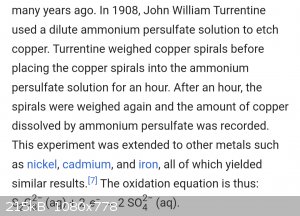
Image of what I meant is attached.
Indeed FeS2 would be needed here.
In this scenario I see 4 possible reactions:
(NH4)2S2O8 + 2FeS2 + 2H2O + 5O2 -> (NH4)2SO4 + 2FeSO4 + S + 2H2SO4
(NH4)2S2O8 + 4FeS2 + 2H2O + 8O2 -> (NH4)2SO4 + 2Fe2(SO4)3 + S + 2H2SO4
The other 2 are basically the 2 above but without sulfuric acid if there is no complete oxidation or environment is not acidic enough.
Seems like reaction with FeSO4 would be better as less pyrite is consumed BUT Fe2(SO4)3 is practically insoluble in sulfuric acid, water and alcohols.
So Its a choice between cheaper and less hassle.
Dealing with (NH4)2SO4 and excess (NH4)2S2O8 should be easy as you could just add ethanol to separate sulfuric acid from it and then evaporate it
later.
To prevent what bnull mentioned, just keep it dilute.
Source: Sciencemadness Wiki
So far I see only problem with oxidation but maybe if you just blast a lot of air at it, it should minimize loss. I saw on internet cheap pump that
can go 400L/h, 6.6L/min should be enough.
Edit: one missing number
[Edited on 20-8-2025 by PoWEr]
|
|
|
RU_KLO
Hazard to Others
Posts: 319
Registered: 12-10-2022
Location: Argentina
Member Is Offline
|
|
I dont think this would proceed:
(NH4)2S2O8 + 2FeS2 + 2H2O + 5O2 -> (NH4)2SO4 + 2FeSO4 + S + 2H2SO4
because:
1) FeS2 is insoluble in water (so you should find a proper solvent) or it wont react - or take to long. - molten salts maybe but will interfere with:
2)(NH4)2S2O8 (APS) decomposes at low temperatures (Melting point 120 °C (248 °F; 393 K) decomposes)
I have used for etching purposes and you should heat it to work, staring at 60C - best at 90C)
3) you needs to oxidize from sulfide (-2 (or in this case -1) to +6 which is a long way and you have sulfur (valence 0) in between. I did not find a
paper that APS could oxidize sulfur. (probably could oxidize sulfide to sulfur, but not beyond)
maybe direct converion of APS to H2SO4:
check this post:
https://www.sciencemadness.org/whisper/viewthread.php?tid=16...
Go SAFE, because stupidity and bad Luck exist.
|
|
|
PoWEr
Harmless
Posts: 26
Registered: 2-5-2025
Location: Poland
Member Is Offline
Mood: Feeling Explosive-Not
|
|
By the way that is my post so I know :)
I scrapped that idea because KHSO4 and MeOH are basically very cheap, less work and less dirty stuff, though before scrapping it I had another idea to
just react APS/ammonium sulfate with formic acid or HCl, not sure if that would work anyways, there are no studies on it.
I found a better source of sulfuric acid aka drain cleaner anyways but honestly Im so deep inside the topic of diy sulfuric acid that I want to find
an even easier and cheaper method than KHSO4 and MeOH.
[Edited on 20-8-2025 by PoWEr]
|
|
|
clearly_not_atara
International Hazard
Posts: 2926
Registered: 3-11-2013
Member Is Offline
Mood: Big
|
|
Pyrite is a semiconductor. Presumably anodic oxidation is a possibility.
|
|
|
PoWEr
Harmless
Posts: 26
Registered: 2-5-2025
Location: Poland
Member Is Offline
Mood: Feeling Explosive-Not
|
|
Just looked up if pyrite is soluble in anything and to my shock, it practically isn't. Also I found a study on anodic oxidation with pyrite but I cant access it at the moment as my internet is letting me down. It could really be the only
viable method.
|
|
|
teodor
International Hazard
Posts: 1169
Registered: 28-6-2019
Location: Netherlands
Member Is Offline
|
|
... and you promised to do some experiments in that thread ...
I generally have different idea what will happen, so the proof should be on your side.
|
|
|
Texium
|
Thread Moved
20-8-2025 at 12:05 |
PoWEr
Harmless
Posts: 26
Registered: 2-5-2025
Location: Poland
Member Is Offline
Mood: Feeling Explosive-Not
|
|
And I didnt expect anyone to actually care, there are already better and cheaper methods than what I theorized so I saw your and Radiums Lab second
comment as sarcastic. That experiment wouldn't even contribute to anything, you need dmg which I didn't even know it existed and cobalt hydrate and
I've rarely seen cobalt compounds appear in any reactions. In the end it just didn't feel worth the time and cleaning after.
|
|
|
Admagistr
Hazard to Others
Posts: 395
Registered: 4-11-2021
Location: Central Europe
Member Is Offline
Mood: The dreaming alchemist
|
|
There is another direct and uncomplicated method of obtaining H2SO4 from pyrite. This is the dry method. Powdered pyrite is placed in a heat-resistant
tube and heated with a supply of air or oxygen. The resulting SO2 is oxidized in another tube on a catalyst, which can be V2O5 or even Fe2O3. The
resulting SO3 is absorbed in H2SO4 to form oleum:H2SO4.(n)SO3 or H2S2O7, which is then diluted with water to H2SO4...
|
|
|
teodor
International Hazard
Posts: 1169
Registered: 28-6-2019
Location: Netherlands
Member Is Offline
|
|
I care otherwise I wouldn’t created thread for ammonium persulfate decomposition study before.
And which method you consider as a better method now? There are many posts about making H2SO4 last year but only very few experiments, so I have no
idea to which one you are referring to (no sarcasm)
[Edited on 21-8-2025 by teodor]
|
|
|


![[*]](images/xpblue/default_icon.gif)


