RU_KLO
Hazard to Others

Posts: 319
Registered: 12-10-2022
Location: Argentina
Member Is Offline
|
|
Foaming in destilling nitric acid (bisulfate method)
I tried destilling nitric acid from the bisulfate method (for the first time)
used (aprox):
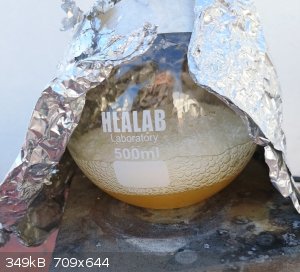
150 gr. sodium bisulfate (from ph- for pools) pic 1
50 gr. potassium nitrate.
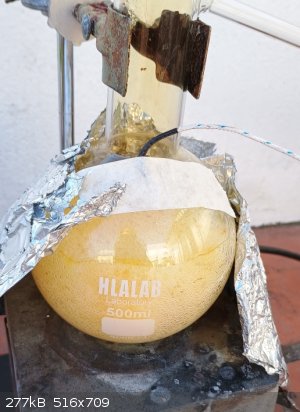
It foamed a lot. and it clogged the delibery tube (pic 2), triggering the "safety valve" (aka as flying cork, 3 meters high and 1,2 meters long - pic
03).
when cleaning I realized that the foam was like pumice stone (aereated stone) and needed a blowtorch to liquify and remove it. (boiling water was no
good or too slow)
Luckily I was 2 meters away when this happened, because one can find molten salt drops 50 cm away from the launching site).
After cleaning I redo the experiment, but instead, water was added and the salts reduced by half (75 gr bisulfate, 25 gr KNO3) and a stirrer was also
added.
the destilantion proceeded normaly, but the destilate was mostly water (less than 1M HNO3)
Once the brown fumes (mild) were produced, checked the flask (it was covered with aluminium foil) and there was again foam. pic 4.
When /I thing) that concentrated nitric acid was finally destilling, there was a lot of foaming. it did not reached the top, but 75% of the flask was
with foam (pic 5)
I have seen videos online that this is not normal (maybe some could share the experience with this method) and the procees is very straight foward.
So, how can I do this, without /or controling the foam.
First idea (that currently is underway) is to cristallize the bisulfate, maybe it contains some surfactant that is complicating things.
The information I found online (no MSDS or datahsheet) is that it contains sodium bisulfate/sodium sulfate.
Any ideas? bigger flask - which I dont have....?
Go SAFE, because stupidity and bad Luck exist.
|
|
|
Radiums Lab
Hazard to Others
Posts: 299
Registered: 18-3-2025
Location: India
Member Is Offline
Mood: Experiencing the elegance of science.
|
|
Is your nitrate and bisulphate free of carbonates and bicarbonates?
Water is dangerous if you don't know how to handle it, elemental fluorine (F₂) on the other hand is pretty tame if you know what you are doing.
|
|
|
bnull
National Hazard
Posts: 994
Registered: 15-1-2024
Location: East Woods
Member Is Offline
Mood: Fecking annoyed
|
|
Could it be that your potassium nitrate is actually a mix of nitrate and urea? Urea decomposes above 130 °C.
|
|
|
RU_KLO
Hazard to Others
Posts: 319
Registered: 12-10-2022
Location: Argentina
Member Is Offline
|
|
Will check by adding a small amount of diluted sulfuric acid (to the bisulfate) and nitric to the nitrate, and check for bubbling/gas production. if
gas, Ca(OH)2 test for carbonate.
Go SAFE, because stupidity and bad Luck exist.
|
|
|
RU_KLO
Hazard to Others
Posts: 319
Registered: 12-10-2022
Location: Argentina
Member Is Offline
|
|
Quote: Originally posted by bnull  | | Could it be that your potassium nitrate is actually a mix of nitrate and urea? Urea decomposes above 130 °C. |
It was bought in a company that sells bulk salts, maybe.
How do I check? by decomposition temperature?
Go SAFE, because stupidity and bad Luck exist.
|
|
|
bnull
National Hazard
Posts: 994
Registered: 15-1-2024
Location: East Woods
Member Is Offline
Mood: Fecking annoyed
|
|
| Quote: Originally posted by RU_KLO | | Quote: Originally posted by bnull | | Could it be that your potassium nitrate is actually a mix of nitrate and urea? Urea decomposes above 130 °C. |
It was bought in a company that sells bulk salts, maybe.
How do I check? by decomposition temperature? |
Add calcium hydroxide and heat it. Ammonia is evolved and can be detected by smell or by waving a filter paper wet with hydrochloric acid over the
mix. To see if biuret is formed when heating would be even better but I have no idea of the effect nitrates have on the reaction.
|
|
|
RU_KLO
Hazard to Others
Posts: 319
Registered: 12-10-2022
Location: Argentina
Member Is Offline
|
|
test performed:
a spatula tip of sodium bisulfate was added to a test tube. 2-3 ml of 4M H2SO4 added. No bubbling. It was heated and the salt dissolved in the
solution. No gas was produced.
Meaning: no carbonate/bicarbonate in the bisulfate
a spatula tip of potassium nitrate was added to a test tube. 2-3 ml of 3M HNO3 added. No bubbling. It was heated and the salt dissolved in the
solution. No gas was produced.
Meaning: no carbonate/bicarbonate in the nitrate.
a spatula tip of potassium nitrate was added to a test tube. 2-3 ml of 6M NaOH added. No bubbling. It was heated and the salt dissolved in the
solution. No gas was produced. No smell of ammonia.
Meaning: no urea was present in the KNO3.
So maybe there is a surfactant in the bisulfate?
How to test for surfactants? (without knowing which one - if any)
Go SAFE, because stupidity and bad Luck exist.
|
|
|
bnull
National Hazard
Posts: 994
Registered: 15-1-2024
Location: East Woods
Member Is Offline
Mood: Fecking annoyed
|
|
I see no reason why one would sell a mix of sodium bisulfate and carbonate or bicarbonate; it defeats the main purpose of a "pH minus".
Dissolve some bisulfate in water, put the solution in a capped flask and shake it. If the bubbles take too long to burst, it means there is a
surfactant.
|
|
|
woelen
Super Administrator
Posts: 8150
Registered: 20-8-2005
Location: Netherlands
Member Is Offline
Mood: interested
|
|
I once made HNO3 by distilling HNO3 from KNO3 and conc. H2SO4. I also had a lot of foaming. Distilling a mix of H2SO4 and KNO3 resulted in excessive
foaming, so much that it rose into the cooler and even into the receiving flask. It was horrible. In my case, the KNO3 was the issue. It was
fertilizer grade. It consisted of white prills, which felt a little bit waxy. When this stuff was added to water, I obtained a solution, with quite
some off-white scum on the surface. I found out that the prills were covered by some wax-like substance, probably to assure that the prills do not
stick together, when stored in a cold and somewhat humid barn.
I dissolved a few 100's of grams of the fertilizer KNO3 in water and poured the hot solution with scum in it through a big coffee filter. In this way
I obtained a nearly clear solution without scum. This I boiled down until I had a dry solid. When i used that, I hardly suffered from foaming in my
distillation.
Where I live, in the recent past we could buy 96% KNO3/4% MgO in 25 kg bags. The prills of MgO could be hand-picked, they were dark grey, while the
KNO3 was white. Nowadays, these bags of KNO3 are gone, but I still have several kilo's of it. I keep it, maybe in the future I use it for making HNO3
again.
|
|
|
j_sum1
Administrator
Posts: 6472
Registered: 4-10-2014
Location: Limbo
Member Is Offline
Mood: Just got through yet another "take this job and shove it" moment.
|
|
I have found NaNO3 less foamy than the potassium salt.
Last batch I made was from Fe(NO3)3 and it was a most pleasant experience.
|
|
|
macckone
Dispenser of practical lab wisdom
Posts: 2211
Registered: 1-3-2013
Location: Over a mile high
Member Is Offline
Mood: Electrical
|
|
The solution to this is to keep the level of reactants below 25% of reaction flask volume. Bubbling is a result of water and nitric acid being
generated in the dry mix. Bisulfate hydrate has a pretty low melting point. And it separates into water and bisulfate with it dehydrating and
distilling off nitric acid. You can dehydrated the sodium bisulfate in advance to reduce melting below 300+ C.
|
|
|
RU_KLO
Hazard to Others
Posts: 319
Registered: 12-10-2022
Location: Argentina
Member Is Offline
|
|
| Quote: Originally posted by bnull |
Dissolve some bisulfate in water, put the solution in a capped flask and shake it. If the bubbles take too long to burst, it means there is a
surfactant. |
I did this procedure with the bisulfate, no indication (bubbles dont hold), buy when I done with the KNO3, some small bubbles were hold for longer
time.
1) cristallized some KNO3 (dissolving a random amount , filtering trough cotton, and once some cristals were made, removed (the orange... solution)
and dried the cristals
On testing both (putting in a test tube and shaking), original KNO3 vs filtered KNO3, no much difference was seen,
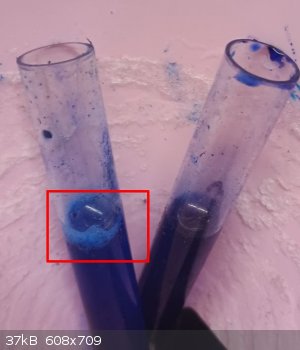
but then read: that adding methylene blue and using PP test tube, there is a qualitative test (paper attached) for surfactants.
So I took tip of the spatuta of powder methylen blue, added to each PP test tube, shook them and compare. A distintive difference, even after 10
seconds was seen. (Pic)
So the problem was not the bisulfate but the KNO3 (which wasn't like Woelen's prils, but like sugar consistency)
So will try again with the "cleaned" KNO3 if better results.
Attachment: overview (1).pdf (242kB)
This file has been downloaded 113 times
Go SAFE, because stupidity and bad Luck exist.
|
|
|



![[*]](images/xpblue/default_icon.gif)


