deadrush
Hazard to Self

Posts: 51
Registered: 3-3-2014
Location: Worcester MA
Member Is Offline
Mood: Ecstatic
|
|
PTFE diaphragm or even membrane - Unsintered v. Sintered
I read read recently that plumbers tape is unsintered and "porous" (sorry, don't remember source). Now it's not porous enough to allow even the
smallest gas but what about electrons?
|
|
|
markx
National Hazard
Posts: 657
Registered: 7-8-2003
Location: Northern kingdom
Member Is Offline
Mood: Very Jolly
|
|
I might be wrong, but to my knowledge all solid parts of PTFE are sintered at some stage as PTFE is produced in powder form and then pressed+sintered
to yield a usable stock which can be machined or rolled/drawn. We used PTFE powder as a binder in emulsion form to produce flexible porous carbon
electrodes. As the carbon mass was mixed, rolled and pressed the PTFE powder was drawn into thin fibers which acted as a tangled cage and bound
everything together. I trust plumbers tape is rolled/drawn from sintered solid stock and has a rather nonporous nature being intended to act as a
seal.
Exact science is a figment of imagination.......
|
|
|
deadrush
Hazard to Self
Posts: 51
Registered: 3-3-2014
Location: Worcester MA
Member Is Offline
Mood: Ecstatic
|
|
"The fact that Thread Sealant Tape is calendared, unsintered tape,"
https://polyfluoroltd.com/blog/expanded-ptfe-tapes-thread-se...
The second link has the most specific information on its properties.
Here's a few more sites that say the same:
(
https://www.professionalplastics.com/TeflonPTFE_Unsintered?s...
https://www.3pcorporate.com/en/materials/ptfe/ptfe-tape/
Attachment: UnsinteredPTFEDatasheet.pdf (95kB)
This file has been downloaded 64 times
[Edited on 31-10-2025 by deadrush]
|
|
|
bearbot22
Harmless
Posts: 30
Registered: 10-4-2018
Member Is Offline
Mood: No Mood
|
|
Hi,
some time ago, i did tests with thread sealant tape to find out if it is suitable as diaphragm for an electrochemical cell.
Although it is porous and permeable to gas, it is not permeable to water. This is due to the hydrophobic nature of PTFE.
This means that it is impermeable to electricity and therefore not suitable as a diaphragm in this form.
But as soon as the thread seal tape is moistened with ethanol or IPA, this changes:
it becomes transparent, impermeable to gases but permeable to water. It also becomes permeable to electrical current and its resistance is very low.
It remains in this state until it is completely dry again.
This is how I explain it:
The alcohol can penetrate the pores of the PTFE. This makes it impermeable to gas. Water can dissolve in alcohol and thus migrate through the PTFE.
The alcohol practically 'tunnels' the water molecules through the PTFE. Because PTFE is hydrophobic, the alcohol cannot be displaced by the water.
This works so well that the migration of ions is hardly slowed down.
Unfortunately, this also means that it is not suitable as a diaphragm for a synthesis cell where you want to keep ions apart.
If the only requirement is to keep electrodes separated from each other, e.g., in a battery, it could work very well.
It might also work to prevent alcohol-insoluble ions from migrating, but i did not test this.
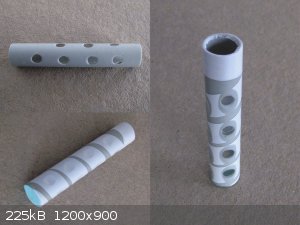
If you want to do tests with PTFE tape, here is an easy way to build an electrode compartment with it:
Drill holes with a diameter of 8-10 mm in a PVC or PE pipe and carefully smooth all edges.
Then wrap the tape over the holes with a little tension. The sealing properties of the tape are sufficient so that no further sealing is required.
If all the holes are arranged in a spiral around the pipe, they can be coverd with a single piece of thread. Just loop the tape around the pipe above
the holes, then wrap it over all the holes to the bottom of the pipe, insert the end of the tape into the bottom of the pipe, and seal it with a plug.
This pic shows the PVC pipe drilled, wrapped with PTFE-Tape and filled with isopropanole.
|
|
|
Hexabromobenzene
Hazard to Others
Posts: 262
Registered: 27-4-2021
Member Is Offline
|
|
Interesting. Have you made electrical tests on this diaphragm? I could easily get 2 amps from a polypropylene diaphragm of this size without any
problems, possibly even at 5 volts.
How fast does this diaphragm leak?
Polypropylene wets very well after treatment with persulfate or nitric acid, but I'm not sure if something similar can be done with Teflon.
In organic electrochemistry you always use a solvent and this diaphragm would be great for organic compounds
[Edited on 13-11-2025 by Hexabromobenzene]
|
|
|
bearbot22
Harmless
Posts: 30
Registered: 10-4-2018
Member Is Offline
Mood: No Mood
|
|
Hi Hexabromobenzene
I did a lot of tests with IPA-treated Teflon tape because I was hoping to get a great diaphragm or membrane with it.
In summary, I can say that Teflon tape treated with IPA has high permeability to electricity.
Its permeability to water is also high, but can be reduced by forming a gel.
It didn't work for me as a diaphragm because it doesn't slow down ion migration enough.
The purpose of a diaphragm is to keep the reduced or oxidized ions in their half-cell.
In a current flow test, 5.8V were required for 1000mA compared to 5.1V without any separating layer.
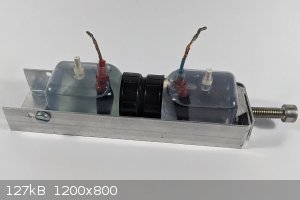
Most of the tests were done using the test cell, which you can see in the picture.
It's using a separating layer with a diameter of 20mm and two 50 ml containers.
In the drip test with IPA-treated Teflon tape, 23.5g of 35g water leaked out in 24 hours.
In the same test with gel (2g xanthan per liter of water), only 6.7g leaked out.
The most important test is the acid-base exchange test.
For this, I filled one container with 50g of diluted sulfuric acid (0.3 mol) and the
other side with distilled water, to which I added 1ml of sodium hydroxide solution (10%) to make it alkaline.
As a separating layer, the IPA-treated Teflon tape was used.
It took 60 minutes until the water side has become acidic.
I repeated this test, but placed the cell at an angle so that the water-base side was higher.
It also took 60 minutes.
Then I did another test with the cell tilted and additionally thickened the diluted acid with xanthan gum.
That took 100 minutes.
This test shows that ion migration has different speeds and rules than water penetration.
|
|
|
Organikum
resurrected
Posts: 2344
Registered: 12-10-2002
Location: Europe
Member Is Offline
Mood: frustrated
|
|
I am sure cheap plumbers tape is actually a PTFE powder sprinkled PET film, the PTFE being for greasing purposes.
PTFE sheets 0,1 mm is completely different from sealing tape too (transfer foil for screen printing)
I am talking of home-depot or Amazon cheapo stuff not the one for real industrial applications.
For membranes you look for Gore-Tex what can be bought or salvaged from old high quality outdoor clothing.
And PTFE can be rendered more accepting towards other things for glueing with epoxides for example or changing the hydrophobic properties with finely
divided sodium metal in Xylene, prepared by melting Sodium metal in Xylene und dispersing it with a Hershberg stirrer made from SS wire.
Good Luck
|
|
|
Hexabromobenzene
Hazard to Others
Posts: 262
Registered: 27-4-2021
Member Is Offline
|
|
Quote: Originally posted by Organikum  | I am sure cheap plumbers tape is actually a PTFE powder sprinkled PET film, the PTFE being for greasing purposes.
|
Are you sure?
| Quote: |
I did a lot of tests with IPA-treated Teflon tape because I was hoping to get a great diaphragm or membrane with it. |
bearbot22,great job! Сan you test the PP/PP composite material on your device as described in my thread? I think this is the best
option for making an best and avalible diaphragm for electrolysis. PTFE tape is available in widths no greater than 20mm and is difficult to make
large diaphragms.
[Edited on 19-11-2025 by Hexabromobenzene]
|
|
|
bnull
National Hazard
Posts: 994
Registered: 15-1-2024
Location: East Woods
Member Is Offline
Mood: Fecking annoyed
|
|
I had the misfortune of having to buy plumber's tape during Pandemics. Our usual cheapest brand is surprisingly good: you can make it cheap but not
cheaper, otherwise the customers won't buy it. It wasn't made from PTFE-coated PET, though. They made it from good old PTFE but
thinner than usual due to scarcity of material. I could see through it, I could even see that the machine needed a new blade because
of the striae it left during manufacture.
Even so it still behaved as all the other tapes I have used through the years. When they want it cheap, they make it thinner.
[Edited on 20-11-2025 by bnull]
|
|
|
bearbot22
Harmless
Posts: 30
Registered: 10-4-2018
Member Is Offline
Mood: No Mood
|
|
All thread seal tapes to which MSDS are available are made from 99% paste-extruded PTFE plus some extrusion aid.
I guess the tremendous price differences have less to do with the composition but with certifications for specific purposes such as high-pressure
oxygen lines, high temperatures or military purposes.
The original Gore-Tex membrane consists of expanded PTFE. It is -in simple terms- manufactured by paste-extruding PTFE, heating it to remove the
extrusion aid and finally stretching it to a membrane. As a diaphragm, IMHO, it behaves similar to teflon tape.
However, in order to reduce PFAS, only few textiles are still manufactured with ePTFE membranes. Even Gore-Tex has been switching its membranes from
ePTFE to ePE (expanded polyethylene) since 2023.
|
|
|



![[*]](images/xpblue/default_icon.gif)


