math
Hazard to Others

Posts: 114
Registered: 21-7-2006
Member Is Offline
Mood: No Mood
|
|
Most economical and recyclable (long term) drying agent?
Hi,
I'd like to know if Magnesium Sulfate is likely one of the cheapest, safest and easily recyclable drying agents.
I found Magnesium Sulfate (hydrate) as crystals in 1 kg bags for bath use, so should be fairly pure.
I'd mostly dry sealed storage jars or bottles, but I'd like it to potentially double as indoor drying agent.
Could I regenerate it in an energy-efficient way by say putting it in an open conteiner in an oven which I'm using anyway to cook bread in?
Or would electric dehumidifiers be more cost-effective long term anyway and shall I invest in one instead and maybe pipe the dry air output in jars or
bottles as needed, and just use it an indoor air dryer?
Thank you
|
|
|
Radiums Lab
Hazard to Others
Posts: 299
Registered: 18-3-2025
Location: India
Member Is Offline
Mood: Experiencing the elegance of science.
|
|
CaCl2 is better. 3A seives are best but they are not that cheap.
Water is dangerous if you don't know how to handle it, elemental fluorine (F₂) on the other hand is pretty tame if you know what you are doing.
|
|
|
MrDoctor
Hazard to Others
Posts: 249
Registered: 5-7-2022
Member Is Offline
|
|
isnt magnesium sulfate somewhat acidic? i know it can mess with acetone at least.
the standard seems to be sodium sulfate. plus it forms an anhydrous salt at like 34C so really its just a matter of boiling the water away, its
incredibly regenerable assuming one even cared to do so. but the main thing is its extremely inert. as for the affinity for water, i couldnt say, i
know its slower than magnesium but i would think the monohydrate of sodium would beat magnesiums. Anyway for long term storage, anything not worth
using sieve/silica on, and cant handle calcium chloride, would do well with sodium sulfate.
As for a good way to prep anhydrous magnesium sulfate, oven + lots of stirring and never letting it drown itself as the water is released, because it
ends up setting like concrete making it hard to expose enough to air to dry it out at the final stage.
you need around 200C to dry magnesium sulfate all the way, i suppose its a rather expensive process energy wise unless you have a well ventilated
microwave that is ok to run 30 minutes straight with a low load. that gets down to monohydrate pretty fast, but then you have to oven it the rest of
the way.
And no, if you bake food while drying the magnesium it will soak up a bunch of oils and aromatics and they char on the magnesium. actually you have to
make sure the oven is clean beforehand too, residual oils and such will contaminate the magnesium sulfate.
i think you can microwave calcium chloride in a silicone tray, idk how hot it gets as it reaches anhydrous. keep in mind too, dehumidifier salt
calcium chloride, like damprid, isnt anhydrous its the dihydrate. still strong but anhydrous is a different kettle of fish in terms of capacity to
leech water from organic solvents.
Lastly, while silica gel is tricky to regenerate over and over without degrading, activated alumina is pretty chill with aggressive regeneration. but
its moreso suited to drying air, its applications in organic solvent drying are more limited than 3A sieve. alumina is pretty cheap though in some
places.
|
|
|
Dr.Bob
International Hazard
Posts: 2918
Registered: 26-1-2011
Location: USA - NC
Member Is Offline
Mood: Mildly disgruntled scientist
|
|
Calcium chloride is hard to work with and not used much for drying solvents. The two most common, and cheap drying agents are MgSO4 and NaSO4, both
of which can be bought anhydrous or hydrated and then dried. Both are pretty safe for organics, and can be reused, although cleaning them of any
contamination would be tough, so best to reuse for same process over and over. Alumina can be reused as mentioned, and has some areas it excels at,
like drying some solvents for chromatography, as it removes acids. K2CO3 can also be used sometimes, and is ideal for DCM, CHCl3, as it absorbes the
HCl that can form in them.
|
|
|
math
Hazard to Others
Posts: 114
Registered: 21-7-2006
Member Is Offline
Mood: No Mood
|
|
How do 3A compare with 4A or (possibly other, cheaper) molecular sieves?
Thank you
|
|
|
Radiums Lab
Hazard to Others
Posts: 299
Registered: 18-3-2025
Location: India
Member Is Offline
Mood: Experiencing the elegance of science.
|
|
3A is size of pores. 3A means 3 amstrong (3*10^-10m). Larger pores like 4A are for large molecules.
Water is dangerous if you don't know how to handle it, elemental fluorine (F₂) on the other hand is pretty tame if you know what you are doing.
|
|
|
Precipitates
Hazard to Others
Posts: 186
Registered: 4-12-2023
Location: SE Asia
Member Is Offline
Mood: Acid hungry
|
|
Depends what you're drying* - alkaline indoor drying agents e.g., NaOH, have the benefit that they will absorb acidic vapours, but will liquify
quickly (depending on the dampness of the space).
*Drying agents are typically cheap, or/and reusable, so this becomes the more pertinent question.
For me...NaOH as a blunt dehydrating agent - say I want to crystallise a solution, so will put in a box (or desiccator) with a container full of dry
NaOH
Anhydrous CaCl2 for more specialist procedures, say as a moisture trap during an organic synth susceptible to water
Anhydrous CuSO4 (or others) - as needed, for the direct addition to a solution, where other dehydrating agents may interfere with the
solution to be dried
|
|
|
MrDoctor
Hazard to Others
Posts: 249
Registered: 5-7-2022
Member Is Offline
|
|
iirc magnesium sulfates acidity is only an issue due to the pore/particle size one is left with after baking it dry in an oven, its not acidic enough
to cause problems for most things though it will make acetone condense.
drying calcium chloride is not super difficult, and sometimes pointless unless you are doing buckets of the stuff and have free heat sources given how
cheap it can be. calcium chloride will continue to deliquesce as a liquid, allowing for its usage in a form of air conditioner where saturated
chloride solution is used to dry air before its water is sprayed in to cool it, much like how sulfuric acid is used to dry gas, and this is done in 2
or more stages to go well beyond the capabilities of a swamp cooler using solar-heat to regenerate the chloride solution just into a more concentrated
one since one of the liquid-hydrates seems to decompose at only mild temps.
In a dessicator, esp a pumped one, there might be some value in recirculated bubbling through sulfuric acid.
Also a weird drying agent out there is HCl gas. theres a threat, or at least a discussion about this, but dry HCl gas seems to be able to remove the
water from hot sulfuric acid right up to something like 80-90% at mild temps like 100-150C, as opposed to sulfurics normal regeneration temp which
approaches 300C. I have a future project where ill try and circulate HCl through a mild dessicant, and see how much further past 90% it can go without
incurring losses, i have a few ideas in mind. A big obvious issue though is the fact you cant really pump HCl gas or duct/tube it anywhere without
causing damage to most materials, so im kind of just waiting for something to fall in my lap there.
a nice common one is sodium sulfate. its compatible with almost everything. its great for drying solvents to the 99.5% mark, clumps nicely keeping
large amounts of water in a filterable crystal form like copper and magnesium do, though i think that unlike mg hexahydrate it wont let that water go
quite so easily provided you keep the solution at or below room temp, so, i think that while its weak towards heat, as long as its not hot, its going
to pull the moisture levels much lower. Really you should never distill something hygroscopic with the dessicant used to dry it still in solution, so
the fact glaubers salt decomposes just being warm isnt too problematic.
you can crystalize it alternating between 40 to 20C so its easy to reclaim, and its pretty damn hard to decompose the sulfate, plus considering how
often we use sodium hydroxide/carbonate/bicarbonate and sulfuric acid and increasingly, sodium bisulfate, youll never be in short supply.
given that absolute ethanol can dry copper sulfate to the monohydrate, if not further based on the color-change, i would say though it might be
essential to have something a bit stronger. or 1-2 general purpose solvents, and a diverse but not neccesarily volumous range of potent application
specific ones.
3A sieve is good sure, but activated alumina works too and can take quite a bit more punishment than sieves. every moisture trap ive ever seen with my
own eyes, in a vacuum reaction system has always been alumina. Activated alumina is cheaper than 3A, more tolerant of just cooking the crap out of it
rather than messing around with multi-stage vacuum and/or microwave heating to avoid damaging the pores when restoring its capacity. I think it favors
gas over directly drying liquids though, which is good if you use it in a dessicator, in liquids though unlike molecular sieve it is not as particular
about what it adsorbs, and it might pull certain things out of solution.
Its also handy to have around since its one of the standard go-to catalysts or catalyst substrates.
Silica gel is regenerable and can be used to dry solvents, though 3A is still probably favored commercially since silica wont have super specific pore
size and might hold onto alcohols or things very similar to water like how methanol is held by 4A. Same deal as alumina, its also a handy to have
catalyst substrate too once crushed up. its also crazy inert to most things besides bases and probs phosphoric acid or acidic phosphates.
i forget which, either potassium carbonate, or phosphate, one of those is able to brine out all the water from ethanol making it functionally
anhydrous. in this application it is regenerable.
If you have the heat supply to do so cheaply, calcium oxide has many of the benefits of sodium hydroxide, on top of being able to dry some liquids as
well without destroying the glassware. the extreme heat needed to regenerate it is really its only drawback. Calcium oxide is often pretty high up in
the dessicating potential hierarchy.
A key merit to calcium oxide though is its a regenerable water scavenger, meaning like magnesium or activated aluminum, it reacts with water and
destroys it irreversibly, theres no potential for any sort of equillibrium unless maybe the hydroxide is soluble or something, it should just react
with all the water and no chemical force should be able to get calcium oxide and free water back again, or at least not in a liquid form, but it is a
strong base which is worth considering. Like NaOH though it will also denature ketones and absorb dissolved CO2 and acids, i think it was once used to
concentrate distilled alcohol(s). As far as water scavengers go its not the best, but you can easily make usable amounts with some metal tubing and a
blowtorch to finish drying what a milder drying agent couldnt, or prepping for storage/final distillation.
Brine made from sodium chloride is also good, though you probably want to discard it, but its really damn cheap just make sure its not contaminated
with calcium or magnesium chlorides, otherwise youll get surprise emulsion promoting precipitates. Sodium chloride brine is used a lot as a neutral
liquid drying agent in solvent extraction processes since all you have to do is shake the wet solution in it, and it will absorb most to all of the
water if its not an appreciably hygroscopic organic phase. i think calcium chloride solution works too though calcium chloride is weirdly soluble in a
lot of organic solvents just a little, and is probably going to react with any trace acid or base if it would result in an insoluble calcium salt.
Usually brine is applied right before a distillation or the addition of a very small amount of potent dessicant especially if that happens to be a
consumable and expensive water scavenger. Brine also seperates better than pure water and, being saturated wont leech out a slightly water soluble
organic product, it scrubs up the flask and coalesques all water and particulates that preffer floating or dissolving in the aqueous layer, wheras
pure water might stick to the glass, as well as remove your desired product each time its used.
Last one;
organic solvents. toluene, benzene, ethyl acetate, ethanol and hexane (or hexane+heptane mix if you watch out for other azeotropes)
these all at very low temps remove water from many liquids as well as solids via azeotropic distillation. in the case of ethanol, you can use
molecular sieve, possibly even as your fractionation column media, to regenerate the ethanol in realtime. subsidizing the burden or tolerance of your
drying agent upon your mixture. Ethyl acetate is good to use wherever possible, its not toxic, in mild conditions not reactive, and boils at a very
low temperature like benzenes azeotrope, and in fact often replaces toxic benzene where a low boiling azeotrope is required. In principle hexane does
this too but, in practice i dont like it, its nasty neurotoxic stuff that throws off lots of fumes incurring losses no matter what like trying to
handle DCM or ether, and even in ternary mixtures the azeotrope with water is quite poor. toluene and benzene are ofaten used in the final stage of
purification, being distillation and/or drying, they can azeotropically remove water to a degree that no further drying is generally needed other than
as a formality or for storage, or preparation for a subsequent reaction.
|
|
|
bnull
National Hazard
Posts: 994
Registered: 15-1-2024
Location: East Woods
Member Is Offline
Mood: Fecking annoyed
|
|
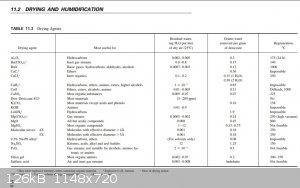
Below is a table of drying agents from Lange's Handbook of Chemistry (15th ed.).
|
|
|
pesco
Hazard to Self
Posts: 95
Registered: 19-11-2015
Member Is Offline
Mood: No Mood
|
|
Nice starting point table, but some entries are questionable:
1) KOH recovery is stated as "impossible" when it is very much possible and pretty easy. It's not just s theory, I have done it few times when I run
out KOH and needed it quickly. KOH decompose to K2O at less than 500°C and K2CO3 requires just above 900°C. Since
KOH quickly converts to carbonate you can assume that some/most of it is carbonate hence the furnace. Just a cheap metal melting furnace available on
ebay or amazon is very adequate. then K2O + H2O = 2 KOH. Even stranger is that for CaO recovery is stated as "difficult, 1000°C", so
recovery with higher temperature is "difficult" and with lower temperature "impossible" ?
2) Why recovery of MgSO4 is marked as "not feasible"? Just around 200°C (ordinary oven!) and you get monohydrate from heptahydrate. I
consider is not only feasible, but dead easy even for novice.
3) Sulfuric recovery as dehydrating agent is stated as "not feasible" and it is also pretty straightforward - just boil it till you get white fumes.
Yes, it is more dangerous procedure than heating MgSO4, but for an individual with chemistry experience its rather nothing extraordinary.
Am I missing something ?
|
|
|
bnull
National Hazard
Posts: 994
Registered: 15-1-2024
Location: East Woods
Member Is Offline
Mood: Fecking annoyed
|
|
These entries stop being questionable when you consider that the authors had students and workers in academic and professional labs as their intended
readership.
|
|
|
|



![[*]](images/xpblue/default_icon.gif)

