| Pages:
1
2
3 |
Hexabromobenzene
Hazard to Others

Posts: 262
Registered: 27-4-2021
Member Is Offline
|
|
I tried to improve the sulfonated polystyrene diaphragm. It was again treated with sulfuric acid at 100-120 degrees for 8 hours. Polystyrene is
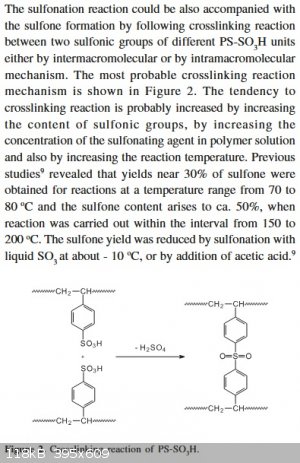
partially dissolved in sulfuric acid in the form of polystyrene sulfonic acid. Then the solution turns black. Crosslinking also occurs to form
polystyrene sulfone. But this diaphragm still conducts current poorly. Much lower conductivity than just porous polypropylene
This method probably does not produce a well-conducting membrane. It might be worth trying cross-linked aminated PVC with diamines or sulfonated
polystyrene-divinylbenzene. But I don’t have reagents for this and I’m not sure that it will have conductivity better than a classic porous
diaphragm. Most likely no
[Edited on 3-12-2025 by Hexabromobenzene]
|
|
|
Hexabromobenzene
Hazard to Others
Posts: 262
Registered: 27-4-2021
Member Is Offline
|
|
Quick update. It was discovered that the first diaphragms made of PP/PS-SO4 show lower electrical resistance. It was manufactured using a different
technology. Polystyrene solution was applied to a preform with pressed fabric and then treated with sulfuric acid. Apparently they had a thinner layer
of polystyrene on them, which reduced the resistance.
It was also confirmed by combustion that after treatment with sulfuric acid, it was a different plastic. When heated, it smelled different from
polystyrene and was charred, confirming its cross-linked structure.
A new test was also conducted on 30mm diameter samples. 35 grams of sodium chloride per liter at 12 volts.
Without diaphragm: 1.26 A
Vacuum cleaner bag: 1.2 A
Simple PP bag treated with a 20% polypropylene solution in kerosene: 1.17 A
Separator from a lithium-ion smartphone battery: 1.1 A
Industrial battery separators have higher resistance than fabric diaphragms. All samples were soaked in 50% ethanol before testing. A lithium-ion
battery separator cannot be used without ethanol treatment. A similar problem was observed with a PP/PP composite diaphragm. A sample that had a
current of 4.5 A in previous tests did not conduct current without prolonged soaking in water. Microporous diaphragms have poor wettability.
[Edited on 3-12-2025 by Hexabromobenzene]
|
|
|
Hexabromobenzene
Hazard to Others
Posts: 262
Registered: 27-4-2021
Member Is Offline
|
|
PP/PS-SO4 diaphragm described in the post(25mm sample) https://www.sciencemadness.org/whisper/viewthread.php?tid=16... was tested for ion selectivity. A dilute sodium sulfate solution was poured into a
beaker. Tap water was added to the diaphragm, and a lead electrode was immersed in it, serving as the anode. At 12 V, the current was initially 20 mA,
but then dropped to 5 mA and only after an hour of electrolysis did it slowly increase to 6 mA.
Next, a simple porous PP same diameter diaphragm was poured in, and the experiment was repeated. The current was initially only 1.2 mA, but quickly
increased, reaching 120 mA after 40 minutes. The higher the current, the faster it grew, which means it has nothing to do with diffusion.
PP/PS-SO4 is ion-selective material!
Comparative test was also conducted between a separator from a car battery and a lithium-ion battery. Their conductivity is approximately the same,
but the lithium-ion battery's is slightly lower(1.05A vs 1.1A)
[Edited on 6-12-2025 by Hexabromobenzene]
|
|
|
Hexabromobenzene
Hazard to Others
Posts: 262
Registered: 27-4-2021
Member Is Offline
|
|
A few more tests. 30mm circle, diluted sodium chloride solution, 12V.
Hot-pressed vacuum cleaner filter, 1A
Separator from a 1A car battery
Hot-pressed vacuum cleaner filter treated with a polypropylene paraffin solution, 0.8A (requires ethanol wetting)
Experimental results vary due to different conditions, but the resistance pattern is as follows.
Polypropylene fabric = battery separators > polypropylene/polypropylene/polystyrene composites
PP/PS-SO4 materials and similar composites, such as PVC, are apparently more complex. This is a porous matherial with ion-exchange properties. Further
experiments will reveal more.
I think adding regular ion-exchange resin from a water filter between the anode and cathode compartments will improve efficiency. Apparently the ion
exchange layer slows down the migration of the neutral zone
|
|
|
Hexabromobenzene
Hazard to Others
Posts: 262
Registered: 27-4-2021
Member Is Offline
|
|
Apparently, the PP/PS-SO4 diaphragm didn't produce high alkali yields from salt.
During one of my sulfuric acid electrosynthesis experiments, I achieved a noticeable yield due to the crystallization of sodium sulfate on the
diaphragm. The yield from a dilute solution was very low. This is a hint. Sodium sulfate reduces ion diffusion, probably due to the formation of an
acidic salt.
I think I should make a different type of diaphragm: a porous ion-exchange diaphragm, with ion-exchange resin sandwiched between two fabric-lined
vessels. The ion exchange layer must have some equivalent to slow down diffusion.
[Edited on 12-12-2025 by Hexabromobenzene]
|
|
|
Varungh
Hazard to Self
Posts: 70
Registered: 23-6-2025
Location: India
Member Is Offline
Mood: Bad mood
|
|
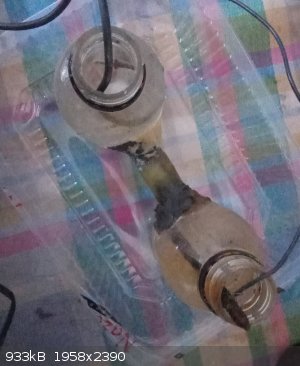
I have made a another type of electrolyzer. 2 PET bottles were taken, holes were drilled. Then a pipe was taken and stuffed with polyster. The pipe
was inserted in both the holes and the holes were sealed with epoxy putty to prevent leakage.
The system is resilient enough that enen blowing hard on one side of the container creates pressure. So it seems it will not leak.
I am currently making FeCl2 from this. I don't have a need for NaOH as I already have lots but I obviously don't waste reagents.
I will make a bigger scaled up version. I will post it as a new topic however.
|
|
|
Hexabromobenzene
Hazard to Others
Posts: 262
Registered: 27-4-2021
Member Is Offline
|
|
I recently made a new diaphragm. It was made taking into account all my developments. Photo will be later in the topic
A 2.5 liter black bucket was used as a blank for the diaphragm. Using a soldering iron, a lid was welded to it, a plumbing thread of an inch and a
quarter was welded to it, and holes were also made using a soldering iron. Welding polypropylene with a soldering iron is similar to argon arc
welding.
Next, sanding and baking the fabric from the vacuum cleaner bag at 165-170.
To prevent peeling, the fabric was also WELDED to the workpiece from the bottom and top using a soldering iron.
Next, 10 grams of polypropylene were dissolved in 50 grams of mineral oil (cosmetic liquid paraffin) at 200-250 degrees. Next, the workpiece with the
fabric was heated to 100 degrees and the plastic solution was cooled
At 125 degrees, a solution of polyprolene in mineral oil was applied to the fabric using a brush. This must be done as quickly as possible since at
100 degrees the mixture crystallizes.
Next, wash with 150 ml of kerosene and then the same amount of volatile white spirit
After this, you need to dry the finished diaphragm for up to a week.
This diaphragm has very little leakage but you will need to wet it with ethanol before use. Perhaps your surface layer of plastic will oxidize in the
dichromate solution and in the future it will not require this treatment
[Edited on 23-12-2025 by Hexabromobenzene]
|
|
|
Hexabromobenzene
Hazard to Others
Posts: 262
Registered: 27-4-2021
Member Is Offline
|
|
Quote: Originally posted by Varungh  | I have made a another type of electrolyzer. 2 PET bottles were taken, holes were drilled. Then a pipe was taken and stuffed with polyster. The pipe
was inserted in both the holes and the holes were sealed with epoxy putty to prevent leakage.
The system is resilient enough that enen blowing hard on one side of the container creates pressure. So it seems it will not leak.
I am currently making FeCl2 from this. I don't have a need for NaOH as I already have lots but I obviously don't waste reagents.
I will make a bigger scaled up version. I will post it as a new topic however. |
Your installation will likely have high resistance. What is your current and voltage?
I use blanks with a large surface area and a flexible cathode surrounds the anode chamber
Although in my case the main voltage drop occurs at the anode since its area is TENS of times smaller than that of the cathode in order to reduce the
formation of hydroxides
Material PP/PS-SO4 showed even lower alkali yield as in the case of simple polypropylene since chloride was only in the anode chamber
60 grams sodium hydroxide from about 300 grams salt
Perhaps the ion exchange layer should have a larger capacity
[Edited on 23-12-2025 by Hexabromobenzene]
|
|
|
Hexabromobenzene
Hazard to Others
Posts: 262
Registered: 27-4-2021
Member Is Offline
|
|
| Quote: Originally posted by Hexabromobenzene | I recently made a new diaphragm. It was made taking into account all my developments. Photo will be later in the topic
A 2.5 liter black bucket was used as a blank for the diaphragm. Using a soldering iron, a lid was welded to it, a plumbing thread of an inch and a
quarter was welded to it, and holes were also made using a soldering iron. Welding polypropylene with a soldering iron is similar to argon arc
welding.
Next, sanding and baking the fabric from the vacuum cleaner bag at 165-170.
To prevent peeling, the fabric was also WELDED to the workpiece from the bottom and top using a soldering iron.
Next, 10 grams of polypropylene were dissolved in 50 grams of mineral oil (cosmetic liquid paraffin) at 200-250 degrees. Next, the workpiece with the
fabric was heated to 100 degrees and the plastic solution was cooled
At 125 degrees, a solution of polyprolene in mineral oil was applied to the fabric using a brush. This must be done as quickly as possible since at
100 degrees the mixture crystallizes.
Next, wash with 150 ml of kerosene and then the same amount of volatile white spirit
After this, you need to dry the finished diaphragm for up to a week.
This diaphragm has very little leakage but you will need to wet it with ethanol before use. Perhaps your surface layer of plastic will oxidize in the
dichromate solution and in the future it will not require this treatment
[Edited on 23-12-2025 by Hexabromobenzene] |
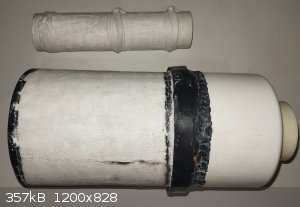
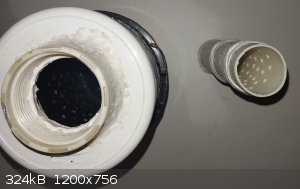
Samples made using the same technology but earlier
|
|
|
Varungh
Hazard to Self
Posts: 70
Registered: 23-6-2025
Location: India
Member Is Offline
Mood: Bad mood
|
|
| Quote: Originally posted by Hexabromobenzene | | Quote: Originally posted by Varungh | I have made a another type of electrolyzer. 2 PET bottles were taken, holes were drilled. Then a pipe was taken and stuffed with polyster. The pipe
was inserted in both the holes and the holes were sealed with epoxy putty to prevent leakage.
The system is resilient enough that enen blowing hard on one side of the container creates pressure. So it seems it will not leak.
I am currently making FeCl2 from this. I don't have a need for NaOH as I already have lots but I obviously don't waste reagents.
I will make a bigger scaled up version. I will post it as a new topic however. |
Your installation will likely have high resistance. What is your current and voltage?
I use blanks with a large surface area and a flexible cathode surrounds the anode chamber
Although in my case the main voltage drop occurs at the anode since its area is TENS of times smaller than that of the cathode in order to reduce the
formation of hydroxides
Material PP/PS-SO4 showed even lower alkali yield as in the case of simple polypropylene since chloride was only in the anode chamber
60 grams sodium hydroxide from about 300 grams salt
Perhaps the ion exchange layer should have a larger capacity
[Edited on 23-12-2025 by Hexabromobenzene] |
The resistance is rather high. At 12V I can see slight bubbling.
At 30V heavy bubbling occurs and the cell gets warm.
Unfortunately my multimeter seems to be cooked(apparently you should not measure 20kv with a cheap 5$ multimeter)
|
|
|
Hexabromobenzene
Hazard to Others
Posts: 262
Registered: 27-4-2021
Member Is Offline
|
|
| Quote: Originally posted by Varungh |
The resistance is rather high. At 12V I can see slight bubbling.
At 30V heavy bubbling occurs and the cell gets warm.
Unfortunately my multimeter seems to be cooked(apparently you should not measure 20kv with a cheap 5$ multimeter) |
This is too much. Usually, 5 volts is enough with a well-made diaphragm.
Meanwhile, I completed an experiment modifying the diaphragm with ion-exchange resin. Results were inconsistent. See the topic on chlorides.
|
|
|
Hexabromobenzene
Hazard to Others
Posts: 262
Registered: 27-4-2021
Member Is Offline
|
|
In my topic on the preparation of metal chlorides, I made a new type of diaphragm. Composite separator PP/PP-cationite-PP. This is the best example at
the moment. Significantly slows down the diffusion of ions and is suitable for the preparation of acids
Simply apply a layer of ground ion exchange resin from the filter and wrap a polypropylene cloth over the diaphragm described above
|
|
|
| Pages:
1
2
3 |



![[*]](images/xpblue/default_icon.gif)


