| Pages:
1
2
3 |
teodor
International Hazard

Posts: 1169
Registered: 28-6-2019
Location: Netherlands
Member Is Offline
|
|
The most useful compound after 20% HF on my opinion is NH4HF2. Use the ammonia and you will still get something useful. But I would stay with HF.
|
|
|
Radiums Lab
Hazard to Others
Posts: 299
Registered: 18-3-2025
Location: India
Member Is Offline
Mood: Experiencing the elegance of science.
|
|
Labcoatz recently posted his synthesis of fluorine gas using an easy method compared the the other electrolysis method(I think someone else pointed
about this in other threads too),
I don't want to make some fluorine now but I'll try that later(not in near future though). I can get 500 grams of KHF2 for 6 dollars (it's 99% pure).
290 degrees is a pretty attainable temparature too.
Water is dangerous if you don't know how to handle it, elemental fluorine (F₂) on the other hand is pretty tame if you know what you are doing.
|
|
|
Sulaiman
International Hazard
Posts: 3944
Registered: 8-2-2015
Member Is Offline
|
|
neutralising and disposing, plan A
After thinking it through, I'm not too keen on the CaCl2 option due to the HCl produced.
(55%HF = 32.4M, x500ml = 16.2 moles of HF converted to 16.2 moles of rust-generating HCl)
I'm considering agricultural grade Ca(OH)2 to produce the less soluble CaF2
which I could dispose of as solid waste to a landfill.
I have a few questions (Qn, where n>>3 but for now....)
(Q1= is this a sensible route?)
As calcium hydroxide is not very soluble I would:
. To a clean 45 litre black plastic bin (with lid) add a quantity of tap water
(Q2= how much water : more dilute = a calmer reaction but a greater volume to deal with)
. add the 500ml 55%HF to the water
. slowly add solid Ca(OH)2 until an excess has been added.
. evaporate by sunlight over days, with possibly a little added rainwater.
. collect, dry, contain the solid fluorite then send it to a landfill.
(Q3= any suggestions?)
[Edited on 18-3-2025 by Sulaiman]
CAUTION : Hobby Chemist, not Professional or even Amateur
|
|
|
teodor
International Hazard
Posts: 1169
Registered: 28-6-2019
Location: Netherlands
Member Is Offline
|
|
I think there is a chance that reaction with Ca(OH)2 will not go to completion. This is just a safety remark. A constructive remark was given before.
[Edited on 18-3-2025 by teodor]
|
|
|
bnull
National Hazard
Posts: 994
Registered: 15-1-2024
Location: East Woods
Member Is Offline
Mood: Fecking annoyed
|
|
Neutralise it like @woelen suggested in page 2 and add an excess of calcium chloride. Then you can do whatever you please with it: collect the solid
and send to a landfill, give it a free toilet ride, store it for later, make a nice concrete block with it.
|
|
|
Radiums Lab
Hazard to Others
Posts: 299
Registered: 18-3-2025
Location: India
Member Is Offline
Mood: Experiencing the elegance of science.
|
|
@Suliman I know a pretty old YouTube video where some university professors try to dissolve a bulb in HF , in the end of that video thy neutralise it
using sodium carbonate. But if you want insoluble salts then it's not useful in following the sodium carbonate method.
Here's a quick link to it:
https://m.youtube.com/watch?v=6ZBwluyR2Tc&pp=ygUKQnVsYiB...
[Edited on 18-3-2025 by Radiums Lab]
[Edited on 18-3-2025 by Radiums Lab]
Water is dangerous if you don't know how to handle it, elemental fluorine (F₂) on the other hand is pretty tame if you know what you are doing.
|
|
|
6dthjd1
Hazard to Self
Posts: 94
Registered: 30-6-2018
Member Is Offline
|
|
it's a fairly decent cumulative poison compared to the stuff mentioned already. That said the less volatile nature of many arsenic compounds does make
it easier to handle
Quote: Originally posted by chornedsnorkack  | | Quote: Originally posted by woelen | I personally have done a few experiments with 48% HF, but I did not feel comfortable at all while working with this.
I know about the extreme risk and the toxic effects. It is much more dangerous than e.g. cyanides or even arsenic.
|
What is so bad about arsenic?
HF and HCN seem to have some of the similar hazards - both are low boiling (HF at 19,5 Celsius, HCN at 25,5 Celsius), weak acids, can pass through
intact skin. Both are weak acids so you can suppress volatilization (and skin absorption?) by keeping solutions neutral/basic. HF is stronger acid
than HCN, so easier to keep in neutral or mildly basic solutions.
In contrast, much of the As compounds is not so volatile. OK, arsine and halides are, but it seems that HAsO2 does not tend to volatilize as much?
Does this HF also etch your glassware? You don´t seem to mention it.
Also, are there any nice colour reactions for low concentrations of HF?
[Edited on 15-2-2024 by chornedsnorkack]
[Edited on 15-2-2024 by chornedsnorkack] |
|
|
|
Sulaiman
International Hazard
Posts: 3944
Registered: 8-2-2015
Member Is Offline
|
|
A glass bottle near my 50%HF developed a rainbow of colours - pretty
there was also ugly etching of the glass.
(HF now contained more completely)
CAUTION : Hobby Chemist, not Professional or even Amateur
|
|
|
6dthjd1
Hazard to Self
Posts: 94
Registered: 30-6-2018
Member Is Offline
|
|
| Quote: Originally posted by Sulaiman | A glass bottle near my 50%HF developed a rainbow of colours - pretty
there was also ugly etching of the glass.
(HF now contained more completely) |
how did you contain your HF before?
|
|
|
Sulaiman
International Hazard
Posts: 3944
Registered: 8-2-2015
Member Is Offline
|
|
in the hdpe bottle that I received it in.
I've added a ziplock bag and then put the bagged bottle in a plastic tub with 1kg of calcium carbonate.
EDIT : OOPS ! ... I lied, I did not put back the ziplock bag,
I think because condensation droplets formed inside the ziplock bag,which can fly in the air when the bag is opened.
My memory is not as reliable as I'd like ...
I just checked :
_____________________Inside my 'Acids' tub_________________________inside the HF tub
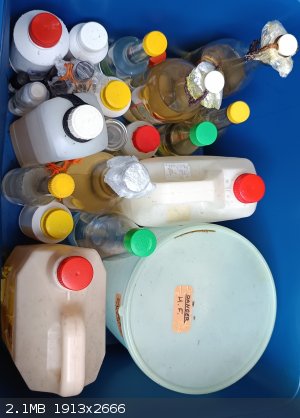 
PS.....I have respect for all of my acids except HF, which I still fear, greatly.
[Edited on 21-12-2025 by Sulaiman]
CAUTION : Hobby Chemist, not Professional or even Amateur
|
|
|
6dthjd1
Hazard to Self
Posts: 94
Registered: 30-6-2018
Member Is Offline
|
|
do your hands tremble when working with HF?
| Quote: Originally posted by Sulaiman | in the hdpe bottle that I received it in.
I've added a ziplock bag and then put the bagged bottle in a plastic tub with 1kg of calcium carbonate.
EDIT : OOPS ! ... I lied, I did not put back the ziplock bag,
I think because condensation droplets formed inside the ziplock bag,which can fly in the air when the bag is opened.
My memory is not as reliable as I'd like ...
I just checked :
_____________________Inside my 'Acids' tub_________________________inside the HF tub
PS.....I have respect for all of my acids except HF, which I still fear, greatly.
[Edited on 21-12-2025 by Sulaiman] |
|
|
|
Sulaiman
International Hazard
Posts: 3944
Registered: 8-2-2015
Member Is Offline
|
|
When I first received the HF I felt a slight tremble in my left hand just before opening the parcel,
I stopped for a few seconds then continued.
I do not frighten easily so that was a surprise for me.
Now I do not tremble, but it is still fear rather than respect 
I've not done anything serious with the HF yet,
mainly due to presently inadequate ppe for ankles and feet...soon.
I still think that it was unwise of me to buy it, but now that I have it ......
CAUTION : Hobby Chemist, not Professional or even Amateur
|
|
|
| Pages:
1
2
3 |



![[*]](images/xpblue/default_icon.gif)


