| Pages:
1
2
3
4 |
clearly_not_atara
International Hazard

Posts: 2928
Registered: 3-11-2013
Member Is Offline
Mood: Big
|
|
A new challenger approaches:
https://pubs.rsc.org/en/content/articlehtml/2024/cc/d4cc0250...
| Quote: | | While the tremendous potential of peroxodicarbonate as a sustainable oxidant was recognized early on, reports on applications up until 2022 have been
sparse, since the challenging synthesis and the low overall concentrations of peroxodicarbonate posed large obstacles.33 This changed with the
publication of the landmark paper by Waldvogel and Gooßen.45 One important aspect which was solved is the enhancement of the carbonate concentration
in aqueous media. When using a mixture of sodium and potassium carbonate, a peroxodicarbonate concentration of up to 0.337 M was obtained in a similar
setup to that of Comninellis and co-workers.33 By adding bicarbonate to the solution the concentration of peroxodicarbonate could be further enhanced
to 0.406 M. The authors assumed that bicarbonate balances the hydroxide ions released over the course of the electrolysis. Consequently, a composition
of 1.125 M K2CO3, 0.9 M Na2CO3 and 0.225 M KHCO3 provided optimal results.To achieve even higher concentrations, not only was the composition of the
electrolyte crucial, but also the heat dissipation during and after the electrolysis event. It was found that efficient cooling by addition of an
in-line heat exchanger resulted in a concentration of 0.588 M.45 Based on this finding, a new electrolysis cell design with an elaborate heat-transfer
system was developed, enabling the production of peroxodicarbonate with a concentration of up to 0.919 M. |
...
| Quote: | | The total content of oxidizing agents can be determined by adding H2SO4 and converting all peroxodicarbonate species into hydrogen peroxide.
|
[Edited on 8-9-2025 by clearly_not_atara]
|
|
|
Mister Double U
Hazard to Self
Posts: 66
Registered: 21-2-2025
Member Is Offline
|
|
An interesting read!
With a well-designed cooling system, it could be a route.
I have also thought about a switch of the chemical compound for H2O2 generation. My choice would be Sodium Perborate. I have tried the electrolysis a
couple of times, but without any success. The white powder which crystalized from the solution was simply Sodium Tetraborate (Borax). This is probably
due to the acid environment around the anode. I remember mixing NaHCO3 stoichiometrically with Borax to make Sodium Metaborate by boiling down the
solution. This seems to be not the right ratio. 'The Manufacture of Chemicals by Electrolysis' states "45 grams of borax and 120 grams of sodium
carbonate per liter".
This method would also come with the benefit, that one Perborate molecule contains 2 peroxo groups.
|
|
|
Alkoholvergiftung
Hazard to Others
Posts: 241
Registered: 12-7-2018
Member Is Offline
|
|
Perborate should be similar to Potassiumpercarbonate. They are made with an diaphragma cell with an Pt Anode and an Pt Kathode. The Chamber is cooled
down to -16C. The temperatur is allowed to fluctuat betwenn -10 C and -15 C.
high current densitys are favored. Source " fabrikation of Bleaching Agents"
Maybe you need to work with lower temerpatures.
|
|
|
clearly_not_atara
International Hazard
Posts: 2928
Registered: 3-11-2013
Member Is Offline
Mood: Big
|
|
According to the paper, BDD works better than Pt for percarbonate.
Primarily I think percarbonate is of interest because it is more easily hydrolyzed, so the peroxide can be obtained from a solution containing less
H2SO4. Also, probably bisulfate can be substituted as the acid for hydrolysis (it is reported to be hydrolytically unstable below pH 8!), avoiding
H2SO4 altogether. But even a concentration of 0.9M is relatively low. So in order to obtain a good concentration of H2O2 from e.g. K2C2O6 you would
most likely want to precipitate the salt and then hydrolyze it with acid. Alternatively, you may concentrate the solution under vacuum. But I think
you will find that crystals form.
| Quote: | Potassium peroxodicarbonate, obtained
as a microcrystalline, light blue powder, was filtered and washed with
ethanol and diethyl ether. The peroxide content was determined iodo-
metrically. [16] K 2 C 2 O6 decomposes rather slowly when stored below 20 8C
for several weeks (8 % per week)
According to the results of thermal analysis (DTA/TG/MS; Metzsch STA
429; 20 8C ± 800 8C; 2 8C min1 ) and in agreement with previous exper-
iments, [3e] K 2 C2 O 6 decomposes at 141 8C by generation of oxygen and
carbon dioxide.
|
https://onlinelibrary.wiley.com/doi/abs/10.1002/1521-3773(20020603)41:11%3C1922::AID-ANIE1922%3E3.0.CO;2-T
Thankfully, it does not appear to be a violent decomposition 
|
|
|
Mister Double U
Hazard to Self
Posts: 66
Registered: 21-2-2025
Member Is Offline
|
|
Potassium Peroxodisulfate with 50% Sulfuric Acid Distillation - First Success
Hello,
As stated in my last post, I tried to electrolytically generate some Sodium Perborate. I tried multiple runs with the different ratios of Borax and
Sodium Carbonate / Sodium Hydroxide. All of those did not yield any crystalline product in the electrolysis cell and were considered failures.
When I thought about next steps, I decided to revisit the distillation of Potassium Persulfate with Sulfuric Acid. When I last attempted this, I did
not use redistilled acid - just straight drain opener acid diluted to 30%.
Additionally, I remembered a patent mentioning the use of 50% acid for the hydrolysis step.
So, today I distilled some H2SO4 and then made 100g of a 50% solution. To that I added 50g of K2S2O8 and heated this to ~70C for hydrolysis. Not all
of the Persulfate dissolved. I kept the solution + slurry at this temperature for about 3 hours and noticed little decomposition.
After that I let the flask cool down and started vacuum distillation. The first liquid started to come over at ~35C. Temperature rose to 51C during
the course of the distillation. At the end of the run some decomposition seemed to happen. About 55ml were collected in the receiving flask and I was
prepared for another failure.
Before I started my usual Copper + heat peroxide test I decided to give the receiving flask a swirl and noticed some disturbances in the liquid - like
when you mix two solutions of different concentrations.
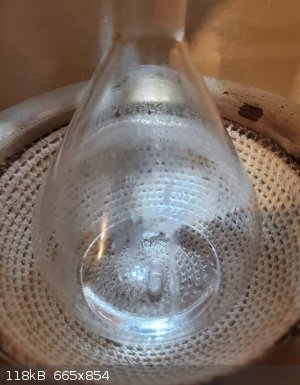
Here the pictures of the usual test:
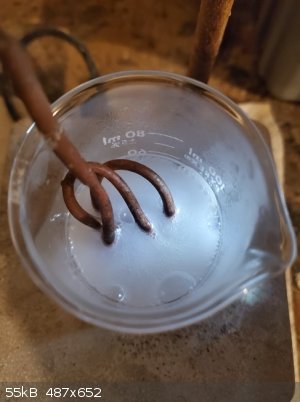
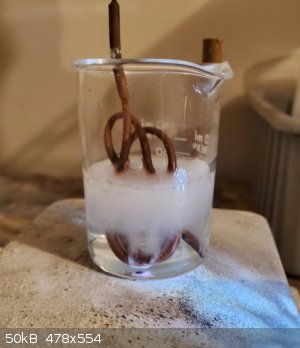
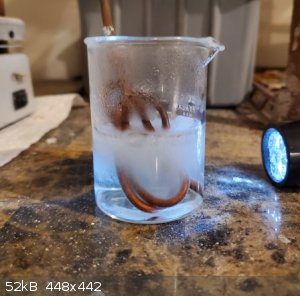
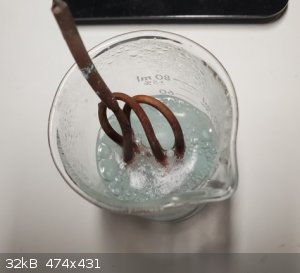
Last picture is several minutes after taking of the hotplate. The bubbling looked stronger than the 3% commercial solution.
So, it seems doable after all. A very acidic environment helps with the hydrolysis.
Next step will be to repeat and do some quantitative testing.
Y'all have a great evening :-D
|
|
|
Mister Double U
Hazard to Self
Posts: 66
Registered: 21-2-2025
Member Is Offline
|
|
Potassium Persulfate with 70% Sulfuric Acid Distillation - Success
Hello Team,
As promised, I conducted another run.
But before I report, I want to give a word of warning:
After I finished the last run, I disassembled the condensers and found a big white stain on my thumb. The typical peroxide 'burn'. I was not expecting
any high concentrations, so I did not wear gloves. It does look though, that H2O2 of considerable concentration can distill over at the end.
I ended up putting some Vaseline on it and the white spot disappeared over the course of the next hours. Anyway, everyone please wear your PPE
(especially safety glasses)!
This finding let me to believe, that even higher concentrations of Sulfuric Acid can be used, and I decided to go with 70% this time.
130g of 70% H2SO4 were mixed with 67g of K2S2O8 in the distillation flask (I wanted to keep the ratio of double the amount of liquid compared to the
solid the same as in the last run).
Distillation temperature was between 50 and 70C.
Pictures:
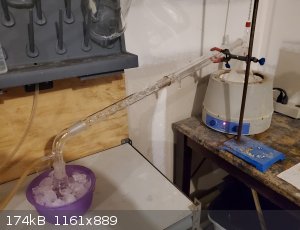
Setup:
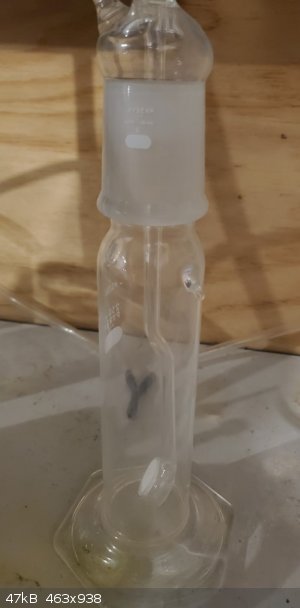
Empty wash bottle between vacuum pump and receiver to capture water:
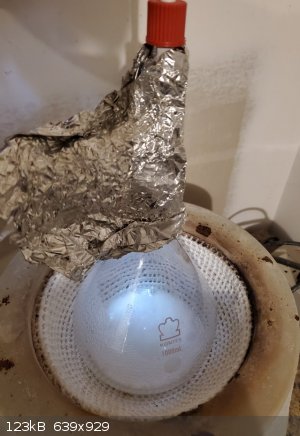
Begin of distillation - boiling slurry:
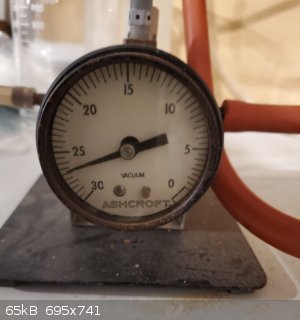
Vacuum reading:
Flask after cooling - a viscous liquid which did not solidify:
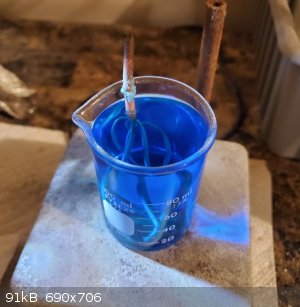
Dissolved Copper - this time from H2O2 (+H2SO4):
Results:
45ml of liquid were collected in the receiver. 15ml of this were used to perform the usual Copper and heat test which showed vigorous bubbling (@
~80C). The liquid had no color after the reaction fizzled out - in other words, no Copper was dissolved.
The other 30ml were mixed with 21g of H2SO4 and topped up with water to 110ml (max of my small beaker). Into that the Copper spiral was introduced and
left for a couple of hours. At the end of this period the solution was heated (~80C) to drive the reaction to completion.
6.5g of Copper were dissolved. That means the sample contained 3.48g of H2O2. The total amount was 5.22g with the liquid from the first test. Based on
the Persulfate this was a yield of 61.8%.
Unfortunately, I did not measure the weight of the distillate, so I can't calculate the exact weight% of the H2O2 solution. However, with knowing that
5.22g were contained in 45ml of liquid, it is fair to say that the concentration was somewhere around 10%.
So, the reaction works. However, a lot of chemicals are needed.
(I assume the Sulfuric Acid could be recovered by distillation and the KHSO4 reused)
[Edited on 11-12-2025 by Mister Double U]
|
|
|
Mister Double U
Hazard to Self
Posts: 66
Registered: 21-2-2025
Member Is Offline
|
|
Persulfuric Acid - Revisited
After being successful with the last Potassium Persulfate run which was done with greater care with respect to contamination, I decided to revisit the
straight Persulfuric Acid route. After all, if that works, it would be the easiest route, because there is no need to separate salt from acid after
the run. The acid could just be reused as is - straight and simple.
The first 12 hours of the electrolysis were performed at ~25C in the anolyte.
Then I decided to follow Alkoholvergiftung's recommendation to lower the temperature - the setup was switched to an ice bath.
Hopefully, i can increase the Persulfuric Acid concentration a little more with that.
Experiment:
Current: 2[A]
Electrolyte: 300g of 60% Sulfuric acid (Anolyte volume ~250ml)
Diaphragm: Small flower pot sealed with hot glue.
Anode: BDD
Cathode: Tungsten rod (TIG welding electrode)
Pictures of setup:
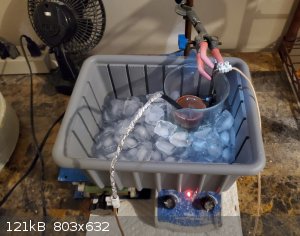
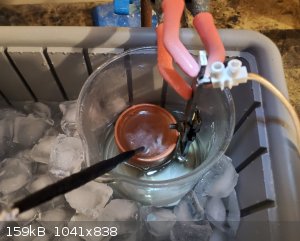
Anode side is on the outside and cathode on the inside of the flower pot.
A small stir bar was inserted the keep concentrations and temperature uniform on the anode side.
I will report back, once I have some results.
[Edited on 14-12-2025 by Mister Double U]
|
|
|
Mister Double U
Hazard to Self
Posts: 66
Registered: 21-2-2025
Member Is Offline
|
|
Persulfuric Acid - Revisited - Failure
Just a quick update.
After the distillation step no H2O2 was detected.
When distillation started a lot of decomposition happened, even before the heating was turned on (just when the vacuum was turned on). When heat was
switched on, the decomposition became vigorous.
My hypothesis:
1. Since the liquid started decomposing very easily, I think a decent amount of Peroxymonosulfuric Acid was generated.
2. I did see bubbles forming on the outside of the clay pot during the first part of the electrolysis (~25C). So, the metals in the clay seemed to
catalyze the decomposition of the product.
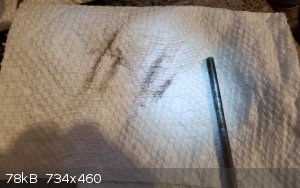
Initially, I hoped that all metals in the clay which dissolved, would migrate to the cathode. This seemed to be true, as there was a black deposit on
the cathode by the end of the run. However, the surface of the clay pot itself seems to be the catalyst here. This is not very astonishing. It was
probably wishful thinking on my behalf, that something as cheap as a clay pot would work in this instance.
Pictures:
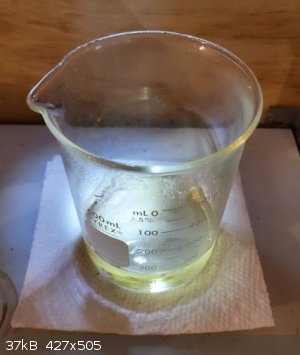
Cell liquor with slightly yellow hue:
Wiped off residue from cathode:
I attribute the slight yellow color to Titanium contamination from the anode clamp. The color vanished, once the solution was heated.
I wish everyone a good start into the week!
|
|
|
Varungh
Hazard to Self
Posts: 70
Registered: 23-6-2025
Location: India
Member Is Offline
Mood: Bad mood
|
|
Quote: Originally posted by Mister Double U  | Hello Team,
As promised, I conducted another run.
But before I report, I want to give a word of warning:
After I finished the last run, I disassembled the condensers and found a big white stain on my thumb. The typical peroxide 'burn'. I was not expecting
any high concentrations, so I did not wear gloves. It does look though, that H2O2 of considerable concentration can distill over at the end.
I ended up putting some Vaseline on it and the white spot disappeared over the course of the next hours. Anyway, everyone please wear your PPE
(especially safety glasses)!
This finding let me to believe, that even higher concentrations of Sulfuric Acid can be used, and I decided to go with 70% this time.
130g of 70% H2SO4 were mixed with 67g of K2S2O8 in the distillation flask (I wanted to keep the ratio of double the amount of liquid compared to the
solid the same as in the last run).
Distillation temperature was between 50 and 70C.
Pictures:
Setup:
Empty wash bottle between vacuum pump and receiver to capture water:
Begin of distillation - boiling slurry:
Vacuum reading:
Flask after cooling - a viscous liquid which did not solidify:
Dissolved Copper - this time from H2O2 (+H2SO4):
Results:
45ml of liquid were collected in the receiver. 15ml of this were used to perform the usual Copper and heat test which showed vigorous bubbling (@
~80C). The liquid had no color after the reaction fizzled out - in other words, no Copper was dissolved.
The other 30ml were mixed with 21g of H2SO4 and topped up with water to 110ml (max of my small beaker). Into that the Copper spiral was introduced and
left for a couple of hours. At the end of this period the solution was heated (~80C) to drive the reaction to completion.
6.5g of Copper were dissolved. That means the sample contained 3.48g of H2O2. The total amount was 5.22g with the liquid from the first test. Based on
the Persulfate this was a yield of 61.8%.
Unfortunately, I did not measure the weight of the distillate, so I can't calculate the exact weight% of the H2O2 solution. However, with knowing that
5.22g were contained in 45ml of liquid, it is fair to say that the concentration was somewhere around 10%.
So, the reaction works. However, a lot of chemicals are needed.
(I assume the Sulfuric Acid could be recovered by distillation and the KHSO4 reused)
[Edited on 11-12-2025 by Mister Double U] |
A 10% solution is relatively decent, since it is hard to get H2O2 at that concentration in some places. I would like to add a question - why not
measure concentration of the solution by reaction of H2O2 and KMnO4?
|
|
|
Mister Double U
Hazard to Self
Posts: 66
Registered: 21-2-2025
Member Is Offline
|
|
@Varungh
To answer your question: I have never done the KMnO4 titration of H2O2.
In addition, I currently do not have any Potassium Permanganate.
Some years ago, I made some myself which looked like a decent product.
It still contained some MnO2 though (which decomposes H2O2). So, I do not think such quality of KMnO4 could be used. Lab grade would be needed.
From what I read, KMnO4 titration is the standard method. If I had some, I would give it a try - thank you for the suggestion :-)
|
|
|
Mister Double U
Hazard to Self
Posts: 66
Registered: 21-2-2025
Member Is Offline
|
|
Sodium Persulfate with Sulfuric Acid Distillation - Success
Hello,
I conducted another run with NaHSO4.
First, Sodium Persulfate was generated by electrolysis. Then the cell liquor was distilled with Sulfuric acid.
Cell Parameters:
Current: ~2A
Voltage: ~6V (did not exactly measure, but judging from the transformer dial)
Duration: 58hrs
Cell Volumen: 500ml
Electrolyte: 250g NaHSO4 dissolved in 400ml H2O
Anode: BDD (8 cm^2, Titanium holder taped-off with electrical tape to prevent Ti contamination)
Cathode: Tungsten rod (4 cm^2)
Temperature: ~20C
No diaphragm or other means to prevent reduction were deployed.
The run time for the cell was roughly double the time required to convert all NaHSO4 to Persulfate. This was done to assure, that the maximum possible
concentration of Persulfate could be established in the electrolyte (to overcome reduction losses). Electrolysis started at 2.4A and dropped to 1.9A
after a day. Current flow did not change after that.
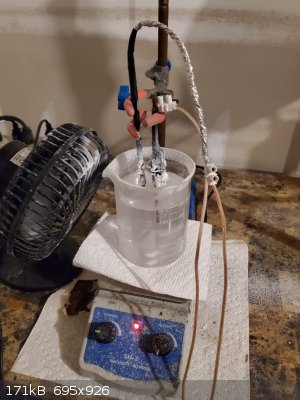
A fan was positioned next to the cell for cooling.
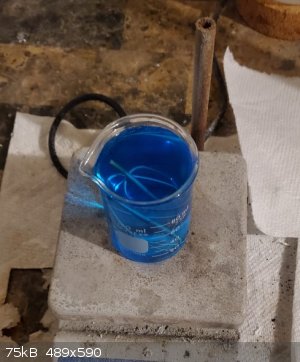
After the electrolysis finished, 50ml of the cell liquor were separated, mixed with 50ml of water and used to determine the Persulfate content
(through Copper dissolution).
To the remaining 450ml of the cell liquor 250g of H2SO4 were added. This heated the solution to the point, that it could not be touched anymore
(estimate 90-100C). This heating step was beneficial, because it ensured hydrolysis of Na2S2O8 to Hydrogen Peroxide.
When the solution cooled back down, vacuum distillation (100mbar) was started.
Pictures:
Cell setup:
Test for peroxide:
Results:
The initially separated 50ml of cell liquor dissolved 2.85g of Copper. That means there were 10.7g of NaS2O8 present in this sample. Since there were
25g of NaHSO4 in this volume before the electrolysis, 42.7% were converted to Persulfate.
After distillation of the remaining 450ml of cell liquor (with H2SO4), 301g of distillate were collected. Of this, 80g were taken and mixed with 20g
H2SO4. Into this another Copper spiral was introduced - 5.2g were dissolved. As a result, this sample contained 2.8g of H2O2. For the whole distillate
this would be ~10.5g (if the initial Persulfate sample is added this would be 11.6g). The yield from Na2S2O8 to H2O2 was 76%.
If the conversion from NaHSO4 to Na2S2O8 could be improved, this seems like a viable route to generate small amounts of Hydrogen Peroxide for the
amateur chemist.
As a last remark, all the H2SO4 used for the vacuum distillation, was recovered through regular distillation and can be reused (so was the NaHSO4).
|
|
|
Alkoholvergiftung
Hazard to Others
Posts: 241
Registered: 12-7-2018
Member Is Offline
|
|
Found an very old Patent for Elektroylsis of ammoniumsulfate. They use an Tin or Aluminium Cathode and an small Platin Anode discribed as an wire of
2mm² and 30cm lenght. The elektrolyt is an mix of 350g Ammoniumsulfate and 200 sulfuric acid. They stird the solution and put and glass spiral where
they pumped water throught for cooling inside.
Attachment: AT000000069734B_all_pages.pdf (83kB)
This file has been downloaded 44 times
|
|
|
Mister Double U
Hazard to Self
Posts: 66
Registered: 21-2-2025
Member Is Offline
|
|
Hallo Alkoholvergiftung,
Another interesting read.
I will say that I am a bit skeptical about aluminum's and tin's ability to hold up in sulfuric acid. From brief research it seemed, that both metals
would not be stable. On the other hand, some alloys might be stable in certain conditions.
The patent claims 60-80% current efficiency. It would be nice if they said which concentrations of per-salt/acid was reached. Maybe that is something
mentioned in the original patent...
|
|
|
teodor
International Hazard
Posts: 1169
Registered: 28-6-2019
Location: Netherlands
Member Is Offline
|
|
I have a book which compares different methods of producing H2O2 from persulfuric acid, ammonium and potassion persulfates. Probably you can find it
also, Willy Machu "Das Wasserstoffperoxyd und die Perverbindungen". I have also translation of the chapters regarding electrolisys and H2O2
distillation from persulfates as well as some other translated sources regarding this topic (the original study was performed in Germany in the first
part of XX century).
I can summarize that info I have read:
Ammonium sulfate is the most easy for electrolysis but it cannot be used directly because hydrolisys causes a big loss of active oxygen which oxidize
ammonia. So, usually they did metathesis to get K2S2O8 first and then liberate H2S2O8 with sulfuric acid. In any case, not depending on the starting
matherial, the reaction is always between H2S2O8 and water:
1) H2S2O8 + H2O = H2SO5 + H2SO4
2) H2SO5 + H2O = H2O2 + H2SO4
The rate of reactions 1) and 2) are different. The condition should be chosen to delay the reaction 2 because H2O2 acts as a reducer on both H2SO5 and
H2S2O8, so at some concentration it inhibits the further reaction and gives only decomposition to O2/O3 mixture. Especially at high temperature. So,
premix is usually with 50% H2SO4. You don't need more concentrated sulfuric acid.
There are 3 methods how H2O2 could be isolated:
1. Pouring the mixture (with proper proportion persulfate / H2SO4 / water) through a heated tube to avoid heating without evaporation, this way H2O2
will evaporate just after formation. It is good for industrial production but I think not optimal for the laboratory preparation
(flow/temperature/vacuum control).
2. Extracting H2O2 with ether. Up to 40-45 concentration probably doable but forms peroxides, at concentration 90-95% the mixture with ether (after
most of ether evaporation) the residue explodes by touch of a glass rod. Not recommended. I think this was a method which caused most accidents. At
least with ether. Potentially can work with other solvent (which don't form peroxides) but there is no info about that.
3. Steam extraction. The most reliable method for laboratory. But of course complex. The proper mixture K2S2O8 / H2O/ H2SO4 is placed in a flask, the
flask is heated 70-75C, steam is supplied and the result could be up to 90-95% H2O2 with proper reaction rate regulation (the steam does hydrolisys as
well as distillation). Problem is maintaining vacuum. (Methods 1,2 (all distillation methods) requires vacuum because at 90C H2O2 is already almost
totlly lost by decomposition). The reaction liberates quite a big amount of ozone which destroys vacuum tubing/pump if not adsorbed. Also H2O2 vapours
which usually 70%+ with this method. In the classical scheme they used 2 liquid oxygen traps and one trap with Cu shavings heated with a bunsen burner
to catch O3 (it is decomposing with heating).
So, generally, the process is well studied, and the ozone/H2O2 trap is most critical part of it.
P.S. Also all methods contains at least 2 condensers - the first for H2O2 and the second one for water with different temperature of cooling liquid.
This necessity is explained in the book - without that the concentration of peroxide in the distillate is always relatively low. It is named
"fractional condensation".
[Edited on 17-2-2026 by teodor]
|
|
|
Mister Double U
Hazard to Self
Posts: 66
Registered: 21-2-2025
Member Is Offline
|
|
Hello teodor,
Do you by any chance have a copy of that book to download?
When I searched, I could only find previews which were omitting the Persulfates chapters (and some sketchy websites which triggered a virus warning).
Regarding the steam extraction, I think it might be a doable route. Have a second H2O boiling flask and connect this to the main distillation flask
through glassware and silicone tubing (boiling temperatures is not too high at 100 mbar).
|
|
|
teodor
International Hazard
Posts: 1169
Registered: 28-6-2019
Location: Netherlands
Member Is Offline
|
|
I've sent U2U with a link to download the german book. I have english translation of the chapters about electrolisys and distillation, probably will
upload them later also.
Yes, I also think the steam method is doable if somebody will set a goal to implement it. For this case I think the following article whould be
extremely helpful. It is about D2O2 preparation, but the method is described in great details and could be easily changed (also simplified) to produce
H2O2. (See the attachment).
Attachment: Feher-ber.eng.A.pdf (218kB)
This file has been downloaded 56 times
[Edited on 19-2-2026 by teodor]
|
|
|
teodor
International Hazard
Posts: 1169
Registered: 28-6-2019
Location: Netherlands
Member Is Offline
|
|
This is a chapter from Gmelin Handbook about H2O2 distillation from Peroxydisulfuric Acid or its salt solutions (translated to English):
Attachment: Gmelin-O-278.A.eng.pdf (89kB)
This file has been downloaded 39 times
|
|
|
Alkoholvergiftung
Hazard to Others
Posts: 241
Registered: 12-7-2018
Member Is Offline
|
|
Mister Double U. Aluminium is very resistant against oxydizing acids. I was suprised when i read the tools for guncutton nitration to squez the acid
out where all from aluminium because mixed acid does only very little corrosion. I think the same goes for the ammoniumsulfate electrolysis.
|
|
|
Mister Double U
Hazard to Self
Posts: 66
Registered: 21-2-2025
Member Is Offline
|
|
Hallo Alkoholvergiftung,
I remember having an aluminum rod in some dilute Nitric Acid (~10%) and it indeed did not corrode.
In the meantime, I tried dissolving some tin wire in 25% Sulfuric Acid. At room temperature, nothing happens at all. When brought to a boil there is a
slow reaction, but it still takes many hours to dissolve even a little bit.
In other words, you are right that these metals could potentially be used as a cathode for making Persulfates. At least it might be worth a try.
Friendly Greetings :-)
|
|
|
Mateo_swe
National Hazard
Posts: 591
Registered: 24-8-2019
Location: Within EU
Member Is Offline
|
|
I saw something on TV about a new US company started by 2 students that uses a biological way to make highly concentrated H2O2.
If i remember correctly they use some enzyme and i think it was corn syrup to form the H2O2.
It´s a new method and the company have built a brand new large scale factory to make and sell highly concentrated H2O2.
Unfortunately i don't remember the company name but i would like to hear/read more on this process and if it is something that can be done without
special equipment or unobtainable chemicals.
Any of you have heard anything about this biological way of making H2O2?
Or maybe what's the company name so i can try search for more info on this?
Edit, AI found the company, probably. I like that they started with a small PVC pipe reactor. I will read up on this. It probably belongs in another
subforum though.
The new company you are likely referring to is Solugen, a Houston-based startup founded in 2016 by Gaurab Chakrabarti and Sean Hunt. Solugen is
notable for being the first to produce hydrogen peroxide (H2O2) using a "chemoenzymatic" process that converts plant-derived sugars (like corn syrup)
into chemicals, rather than relying on the traditional, high-emission petrochemical route.
Key Aspects of Solugen:
Process: The company uses engineered enzymes to convert corn syrup into an intermediate, which is then processed with metal catalysts to create
hydrogen peroxide.
Sustainability: This method is carbon-negative, produces no toxic emissions or wastewater, and is powered by wind energy.
Products: Beyond hydrogen peroxide, which is used for water treatment and sanitation, the company produces other bio-based acids and chemicals.
Scale: Solugen has transitioned from a small PVC pipe reactor to producing over 10,000 metric tons of chemical product annually, with significant
expansion plans.
[Edited on 2026-4-1 by Mateo_swe]
|
|
|
| Pages:
1
2
3
4 |


![[*]](images/xpblue/default_icon.gif)


