Valery
Harmless

Posts: 6
Registered: 11-1-2026
Member Is Offline
Mood: No Mood
|
|
Syringa aldehyde, 4-propoxy-3,5-dimethoxy-benzaldehyde preparation.
Syringa aldehyde, 4-propoxy-3,5-dimethoxy-benzaldehyde preparation.
Hi all
Here is the preparation of Syringa aldehyde, 4-propooxy-subst aldehyde.
There is information online on the synthesis of syringa aldehyde via bromovanillin catalyzed by CuCl(I) or CuBr(I) in DMF. Here is the link, but there
are no detailed reaction conditions.
https://www.sciencemadness.org/whisper/viewthread.php?tid=70...
I will describe the preparation of syringa aldehyde in DMF catalyzed by CuCl2.
10 g of Na is added to 130 ml of methanol. After an hour of stirring, a sodium methoxide solution is obtained. A solution of 4.0 g CuCl2 in 40 ml DMF
and 20.0 g 5-Bromovanilline in 40 ml DMF is prepared. A solution of sodium methoxide in a 500 ml flask is heated to a temperature of 60...70 and first
the CuCl2 solution in DMF is added, then the 5-Bromovanilline solution in DMF. A magnetic stirrer was not used, the contents of the flask were simply
shaken several times (note 1). The solution acquired a dark green-blue color. Using an oil bath at 110-115 degrees, methanol is slowly distilled off
(note 2). The color gradually changes to dark green-brown, approximately 40 ml of methanol is distilled off in 30-40 minutes, then it becomes dark
brown, another 30-40 minutes and 40 ml of methanol. The bath temperature is raised to 120 and a little methanol is distilled off in another 10
minutes. The reaction is complete and cooled to room temperature.
Wokup
The mixture is slowly poured into 150 ml of H2O, and 100 ml of HCL (17%) is added. The mixture is extracted with 2 x 150 ml of ethyl acetate, and the
ethyl acetate solutions are washed with 2 x 50 ml of H2O and then with 50 ml of 20% NaCl. The ethyl acetate is distilled off, and the orange oil is
dissolved in 10 ml of methanol. 20 ml of water is added, and the syringaldehyde solution crystallizes in the refrigerator within an hour. After
filtration, 10-11 g (62-68%) of pale yellow syringaldehyde crystals are obtained.
Note 1. In the original article, CuCl2 and 5bromo-vnl is dissolved in 100 ml of DMF and added to the sodium methoxide solution. The mixture turns blue
and thickens considerably, and only after 30 minutes of reaction can it be stirred again. In this case, my product turned out brown instead of pale
yellow.
Note 2. The original article used 5.4 g of CuCl2. I initially used 5.4 g, and the reaction proceeded for an hour, then 4.0 g for 80 minutes, and then
3.5 g for 90 minutes. The oil bath temperature must be adjusted to ensure very slow distillation of the methanol, approximately 110-115 degrees. If
the temperature is above 120, the methanol will distill too quickly and the reaction will not be complete. Most of the reaction occurs in the last
half hour, when the methylate concentration approaches 5.4 M, at which point the color changes completely to dark brown.
literature:
1. Attachment: SYNTHESIS 308 (1983).docx (31kB)
This file has been downloaded 96 times
2. Attachment: SYNTH. COMMUN. 20(17), 2659 (1990).docx (32kB)
This file has been downloaded 91 times
Preparation of 4-propoxy-3,5-dimethoxy-benzaldehyde
Usual methods for the alkylation of vanillin or syringa aldehde in DMF by alkyl halide . This method, using DMSO, alkyl bromide has a short reaction
time and good yields.
5 g of syringaldehyde, 6.5 g of K2CO3, and 100 mg of NaI in 35 ml of DMSO are stirred and heated to 75°C.The reaction mixture thickens and becomes
more difficult to stir. 3.3 ml (4.4 g) of bromopropane is added to the reaction mixture, making stirring easier (Note 1). The temperature rises to
85°C and stirring is continued for another hour.
Workup
The mixture is poured into 50 ml of ice water and extracted with 4 x 50 ml of ethyl acetate. The ethyl acetate extracts are washed with 2 x 25 ml of
2N NaOH (8 g of hydroxide per 100 ml of water), then with 50 ml of 10% NaCl. The mixture is dried over magnesium sulfate, and the ethyl acetate is
distilled off. The resulting orange oil is dissolved in 20 ml of methanol. 20 ml of water is added until the mixture is homogeneous. If not, more
methanol can be added. After an hour of cooling in the refrigerator, white crystals of the substituted aldehyde precipitate. After adding another 20
ml of water, let it crystallize for another 4-5 hours. After filtration and drying, the result is 4.7-4.8 g.
I didn't measure the melting point, but it is quite low, around 40°C.
Note 1. As practice has shown, increasing the amount of bromopropane (I used 10% excess) does not affect the increase in yield, as does the reaction
time, an hour is quite enough at 85°C.
literature:
1. Attachment: 10.1002@1522-2675(200209)85$3A$9$3C$3019$3A$$3A$AID-HLCA3019$3E$3.0.CO$3B$2-4.pdf (95kB)
This file has been downloaded 62 times
[file]108381[/file]
|
|
|
Fery
International Hazard
Posts: 1127
Registered: 27-8-2019
Location: Czechoslovakia
Member Is Offline
|
|
Welcome to the forum. Well done! Nice experiment! Do you intend to synthesize something further from the 4-propoxy-3,5-dimethoxy-benzaldehyde?
|
|
|
Valery
Harmless
Posts: 6
Registered: 11-1-2026
Member Is Offline
Mood: No Mood
|
|
Quote: Originally posted by Fery  | | Welcome to the forum. Well done! Nice experiment! Do you intend to synthesize something further from the 4-propoxy-3,5-dimethoxy-benzaldehyde?
|
Thank you for appreciating my work. I think it's not hard to imagine what else could be made from these components. And yes, I have the desire to
continue working on it.
|
|
|
Valery
Harmless
Posts: 6
Registered: 11-1-2026
Member Is Offline
Mood: No Mood
|
|
4-propoxy-3,5-dimethoxy-beta-nitrostyren
4-propoxy-3,5-dimethoxy-beta-nitrostyren
To obtain nitrostyrene, cyclohexylamine was chosen as a catalyst and a mixture of IPA and acetic acid as a solvent. These reaction conditions allow
obtaining pure nitrostyrene in good yields.
Mix 4.3 gr 4-propoxy-35dimethoxy-benzaldehyde in 20 ml IPA , mix 1.5 gr cyclohehylamine in 10 ml acetic acid and add to IPA solution of aldehyde . Add
nitromethane 3.5 ml stirred and heated at 70…75 3 hours . The mixture is poured into 30 ml of H2O, and the nitrostyrene solution crystallizes in
the refrigerator within an hour. After filtering and washing with cold water twice 50 ml -3.6 g of bright yellow crystals are obtained.
Recrystallization from 20 ml of IPA and 6 hours in the refrigerator yielded 3.4 g of nitrotyrene (65%).

syringaaldehyde

4-propoxy-35dimethoxy-BA

4-propoxy-35dimethoxy-betanitrostyren
|
|
|
Valery
Harmless
Posts: 6
Registered: 11-1-2026
Member Is Offline
Mood: No Mood
|
|
Proscaline Preparation
Proscaline Preparation
Two methods for synthesizing proscaline have been described in the literature. The first was by the Czech chemist Leminger in 1972, followed by
Shulgin and Nichols in 1977 using a nitrile. It was interesting to follow Leminger's route, obtaining syringaldehyde, then
4-propoxy-3,5-dimethoxy-aldehyde, and 4-propoxy-3,5-dimethoxy-beta-nitrostyrene. The aldehyde was obtained in DMSO in good yield and isolated as a
white crystalline compound using the method of Trachsel (2002). Nitrostyrene was obtained by cyclohexylamine-catalyzed condensation in IPA-acetylic
acid, yielding a pure, bright yellow crystalline product with a 65% yield. To obtain the amine, the method chosen was reduction with sodium
borohydride and CuCl2, which I will describe below.
Reduction
3.2 g NaBH4 (0.087 M) was added to the IPA-H2O mixture (26 ml and 14 ml) with stirring, then, after dissolution, 3.14 g (0.0117 M) nitrostyrene was
added in small portions. The flask was placed in a water bath at 20 degrees, and the temperature of the reaction mixture did not exceed 30 degrees.
Each portion discolored fairly quickly, and the entire addition took 10 minutes (Note 1). Next, a solution of CuCl2 in water (0.7 ml of a 2 M
solution) 0.18gr CuCl2 was added in a thin stream, causing the mixture to darken. The reaction mixture was heated to 80 degrees, and refluxing was
continued for 30 minutes. Afterwards, the mixture was cooled to room temperature.
Note1
Initially, the reaction was run longer, for about 30 minutes before adding CuCl2 and 40-50 minutes of reflux at 80°C, but the yields were much lower.
The original article (lit1) describes a reaction time of 10-30 minutes, after which a dimer and other byproducts form. Therefore, the first part of
the reaction was completed in 10 minutes; copper chloride solution was added and refluxed for 30 minutes, after which the reaction stoped.
Lit1:
Attachment: Beilstein Jorg. 2025, 21, 39.pdf (524kB)
This file has been downloaded 45 times

first part - lose color

second part - refluxing

hydrofumarate presipitation
Workup
The reaction mixture is poured into a 150 ml beaker and the flask is rinsed with 10 ml of IPA. The layers are immediately separated, with the
IPA-amine layer on top and the aqueous layer below. 25 ml (7 g NaOH + 20 ml H2O) are added. The upper layer is carefully separated to avoid dark
copper flakes. The aqueous layer is then extracted with two 15 ml portions of IPA. A saturated solution of K2CCO3 (18 g + 20 ml H2O) is prepared. The
IPA solution is shaken twice with 10 ml of K2CO3, then dried with MgSO4. The result is approximately 55 ml of a clear, slightly yellowish solution of
amine in IPA. The alcohol is evaporated, and the resulting solution is dissolved in 10 ml of acetone. A solution of 0.8-0.9 gr fumarik acid is
prepared in hot acetone and added to the amine solution until pH = 6. White crystals of hydrogen fumarate immediately precipitate; after washing with
acetone and drying, 2.75 g (0.0077 M) was obtained.
Proscaline-HCL
2.75 g of fumarate are dissolved in 27 ml of H2O with heating. 7 g of NaOH in 7 ml of water is added. The released amine base is extracted with three
portions 10ml of DCM, the DCM is dried with magnesium sulfate, and evaporated. The amine is dissolved in 10 ml of IPA and carefully neutralized with
approximately 0.6 ml of 35% HCl acid to a pH of 6. The IPA is slowly evaporated in a water bath, yielding a brownish crystalline solid. After washing
with acetone and drying, white crystals of Proscaline hydrochloride (1.6 g) (0.0058 M or 50% based on nitrostyrene) were obtained.
Thank you all for reading  , and I am personally grateful to everyone who
posted their work online, for example, Benignium, the preparation of nitrostyrene 345trimethoxyBA, and its reduction. All these experiments help avoid
mistakes and achieve good results. , and I am personally grateful to everyone who
posted their work online, for example, Benignium, the preparation of nitrostyrene 345trimethoxyBA, and its reduction. All these experiments help avoid
mistakes and achieve good results.
|
|
|
dicyanin
Hazard to Self
Posts: 69
Registered: 29-3-2020
Location: Europe
Member Is Offline
Mood: inquisitive
|
|
Nice work. Any special reason for choosing NaBH4/CuCl2 tandem instead of NaBH4/NiCl2 (nickel boride)?
Interesting note about the reaction time and dimer formation, that must be the reason from the wide variation in success rate with this method.
sic transit gloria mundi
|
|
|
Valery
Harmless
Posts: 6
Registered: 11-1-2026
Member Is Offline
Mood: No Mood
|
|
Thanks The appendix to the article posted above contains various
conditions for this reaction, primarily increasing the reaction time for
25-dimethoxystyrene. As the reaction time increases to an hour or more,
the yields drop significantly and the amount of dimer increases.
For different styrenes, several reactions can be performed with small quantities, varying the reaction time—for example, 20 minutes,
then 40 minutes—and the yields can be compared.
Attachment: Beilstein-5397-21-4-S1 _suplmnt.pdf (2.5MB)
This file has been downloaded 42 times
|
|
|
pihkameleon
Harmless
Posts: 2
Registered: 20-7-2023
Member Is Offline
Mood: No Mood
|
|
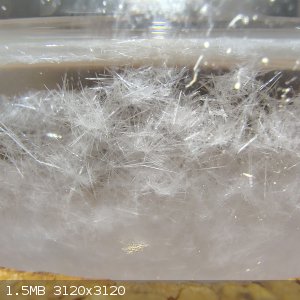
Good job, it is an interesting class of compounds. The 4-cyclopropylmethoxy derivative made some stunning crystals as the hydrochloride, see attached
picture. If you want to go for the secondary analogues, say the 4-isopropoxy isomer, time for the alkylation is significantly longer and monitoring
via TLC to replenish the 2-bromopropane may be helpful.
Two questions: I assume you used anhydrous CuCl2 for the reaction, was this reagent purchased or prepared? If prepared, how? I preferred making CuBr
or CuI as it is easier to get anhydrous starting from hydrated Cu(II) salts. Additionally, did you ever TLC the syringaldehyde? I attempted
methoxylation of 5-bromobourbonal some time ago in a botched attempt (conditions not kept entirely anhydrous) and ended up with a complex mixture of
starting material, bourbonal (which was not present in the precursor, so must have dehalogenated) and what I assume to be the product
5-methoxybourbonal. Did you TLC your syringaldehyde to ensure homogenous product?
PS: Depending on the substrate, higher catalyst loading and NaBH4 can be beneficial in the NaBH4/Cu. It seems like molecular oxygen coming into
contact with the Cu particles can be particularly detrimental, even up to the filtering step. Excess NaBH4 and inert atmosphere can be helpful. Some
substrates seem to benefit from significantly longer reflux periods than outlined in the publication, but it is probably best to keep the reaction
under inert gas then. Against the findings of the publication, depending on substrate and exact conditions, partial to full dehalogenation of
brominated substrates has been observed by various connoisseurs of nitrostyrene reduction.
[Edited on 7-2-2026 by pihkameleon]
|
|
|
Valery
Harmless
Posts: 6
Registered: 11-1-2026
Member Is Offline
Mood: No Mood
|
|
Good afternoon!
Thank you for your feedback and congratulations on your result
About your questions -
1. Regarding the preparation of syringaldehyde.
I'll cite three articles on various methods of halogenated vanillin methoxylation, with preparation examples.
The article in Tetrahedron vol. 45 is particularly interesting, as it covers a large number of reaction conditions
with different copper salts, reaction times, and reagent concentrations.
Attachment: Terrahedron Vol. 45. No. 17_5565.pdf (958kB)
This file has been downloaded 22 times
Attachment: pepper-macdonald-2011-the-synthesis-of-syringaldehyde-from-vanillin.pdf (390kB)
This file has been downloaded 24 times
Attachment: US4218567.pdf (637kB)
This file has been downloaded 22 times
I used anhydrous CuCl2, purchased and of good quality.
CuCl2 dissolves much better in a DMF-methanol system.
I also used freshly prepared NaOMe in methanol, since the reaction conditions require anhydrous reagents.
The following additional conditions can also be used for a successful reaction: methylate concentration of 5.4 M
and a molar excess of 5x or higher.
Under these conditions and a reaction temperature of approximately
110°C, the reaction is complete in two hours maximum for bromovanillin.
I didn't perform TLC, but I was guided by the considerations above.
The resulting syringaldehyde dissolves in a very small amount of methanol upon recrystallization, unlike bromovanillin.
For each new substrate, such as bourbonal, separate studies are needed. For example,
if methoxylation proceeds well under these conditions, ethoxylation is much worse or does not occur at all
. Also, different substituents in the ortho position to the halogen
affect the reaction course.
2. Regarding the 4-isopropoxy-substituted aldehyde, it would be interesting to try it.
I would like to know the reaction time and evaluate the results.
Your 4-Cycloproploxy variant could be quite interesting, as would 4-Methallyloxy.
3. Regarding reduction, I think an inert atmosphere is definitely welcome, and the reaction time and catalyst concentration should be tested for each
styrene.
In the case of propoxy, increasing the time resulted in a decrease in yield. If there are successful experiments with other substrates,
I'd be happy to read about them
[Edited on 9-2-2026 by Valery]
|
|
|
|


![[*]](images/xpblue/default_icon.gif)


