SnailsAttack
Hazard to Others

Posts: 179
Registered: 7-2-2022
Location: The bottom of Lake Ontario
Member Is Offline
|
|
Gravimetric method of evaluating container seal quality
Someone's probably thought of this before, but I found that it's possible to quantitatively evaluate the air seal quality of almost any container
using a simple gravimetric method.
By adding a small amount of volatile solvent to a container and tabulating the change in mass over time due to vapor loss, you can easily measure the
rate of gas leakage.
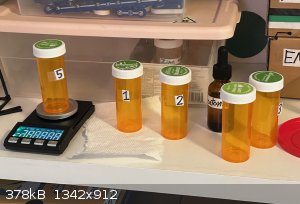
In the following example, I evaluated the seal of 5 pill bottles which were more or less identical. A quarter of a milliliter of acetone was added to
each bottle, and their change in mass over time was tabulated in the attached spreadsheet.
 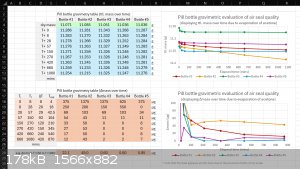
(i believe the initial sloping that occurs before the change in mass over time becomes linear at around T+30 minutes is
primarily due to a minor buoyancy effect caused by the expansion of the plastic bottles as the internal pressure reaches equilibrium somewhere around
1.3 atmospheres)
From the data you can see that the seal quality of each bottle varies significantly. The mass loss over time between the bottles with the best seal
(bottles 3 and 4) and the worst seal (bottle 2) varies by a factor of almost 40!
-
In theory, the rate of vapor loss should be largely independent of the surface area of the solvent and the volume of the container so long as the seal
is good enough to maintain an internal pressure roughly equal to the ambient pressure plus the vapor pressure of the liquid.
If you want you can actually estimate the shelf life for a given mass of solvent. As an example, the average loss rate for bottle #5 (from T+150 mins
to T+1080 mins) was measured at 0.000006 grams per minute, which means 10 grams of acetone would take roughly 3.2 years to fully evaporate. Neat.
A moment of silence for all the homebrew chloroform and ether lost from leaky jam jars and wine bottles.
[Edited on 2/5/2026 by SnailsAttack]
|
|
|
BromicAcid
International Hazard
Posts: 3323
Registered: 13-7-2003
Location: Wisconsin
Member Is Offline
Mood: Rock n' Roll
|
|
It's a the little experiments like this that make big differences. Very cool work and thanks for sharing. Make me think I need to do this at work
for some of the compounds that I work with. We have several different bottle types and have a 'feeling' that some are better than others based on
past experiences but it would be cool to have some quantitative data.
|
|
|
Sulaiman
International Hazard
Posts: 3942
Registered: 8-2-2015
Member Is Offline
|
|
A very nice experiment, I may try it myself
For anyone planning to similarly test their storage containers
repeatedly perform re-calibration of the scales, or simpler,
weigh any fixed stable mass at each weighing session to arithmetically correct for any drift.
(you don't need precision weights, just a stable mass of similar weight to the stuff being weighed.)
I make a mark on transparent or translucent storage containers after dispensing liquid.
This allows a quick check for any serious leaks.
________________________________________________
If others perform similar experiments in different storage conditions
we could have a pictorial database of some common storage containers and their performance vs common liquids.
super precision is not required because changes in atmospheric density could swamp any short term leakage.
GREAT - a very useful gravimetric experiment that needs neither accuracy nor precision.
just an occasional weighing session
CAUTION : Hobby Chemist, not Professional or even Amateur
|
|
|
SnailsAttack
Hazard to Others
Posts: 179
Registered: 7-2-2022
Location: The bottom of Lake Ontario
Member Is Offline
|
|
yeah i hope people can get some good use out of this, it's way better than my original method where i was packing bottles full of naphthalene to see
how much of the smell leaked out.
Quote: Originally posted by Sulaiman  | | repeatedly perform re-calibration of the scales, or simpler, weigh any fixed stable mass at each weighing session to arithmetically correct for any
drift. |
you shouldn't have to frequently recalibrate your scale. Of the two cheap 0.001 g precision digital
scales I've owned, only one of them has fluctuations and it's only by around ±0.002 grams.
you should be able to fix it by fiddling with the balancing arm, i've had to do that with both of mine.
| Quote: Originally posted by Sulaiman | | we could have a pictorial database of some common storage containers and their performance vs common liquids. |
maybe, but there's a huge variety of containers in commercial use and even containers of the same type are inconsistent regarding the quality of the seal
|
|
|
jackchem2001
Hazard to Others
Posts: 110
Registered: 2-6-2024
Member Is Offline
|
|
To prevent pressurisation during storage, add the volatile solvent to the container and shake/vent like you would with a separatory funnel. This
causes much faster equilibriation of the atmosphere inside the container (i.e. mass transfer of solvent to vapour phase). Doing this largely prevents
the container from popping when opened in the future.
Could also add the solvent while warm and perform the same procedure to pull a mild vacuum (obviously container must withstand load). I do this when I
can't be bothered to clean some unpleasant smelling boiling flasks with hot water. Air leaks in rather than out.
|
|
|
Texium
Administrator
Posts: 4743
Registered: 11-1-2014
Location: Salt Lake City
Member Is Offline
Mood: Seeking gainful employment
|
|
Nice. A follow up I’d be interested to see would be how much it helps to add different external seals to your medicine bottle. Comparing Parafilm to
good old fashioned electrical tape would be interesting.
|
|
|



![[*]](images/xpblue/default_icon.gif)