semiconductive
Hazard to Others

Posts: 442
Registered: 12-2-2017
Location: Scappoose Oregon, USA.
Member Is Offline
Mood: Explorative
|
|
Ball Mill restoration and enhancement.
Hi All!
I have a need to powder various substances in a ball mill.
I also have a need of producing silica dust with no moisture in it.
I have trouble getting an inert ball mill that won't add organics or metal oxides to the final product, and is reasonably priced.
Tumbling in a glass jar works, but the glass inevitably cracks and leaks solvent.
Plastic containers are out, because they inevitably add small amounts of organics that will react with my solvents, and/or products. (Note: Silicone
doesn't cause a problem, but it also doesn't last when exposed directly to solvent because it swells too easily.)
So, I think I'm going to try a hybrid solution: I am going to attempt to make a silicone+glass liner for an existing metal tumbler.
I found that I can buy old steel Thumler's Tumblers model "B" cans off ebay™ for less than $100 each. The hexagon can is something that I can
silicone disposable glass grinding plates to. Small hairline cracks in the glass won't matter because it will be backed by a steel wall that will
hold the cracked glass in place and prevent leaking of solvent.
I also found I can buy a chemical stirrer motor that can be precisely speed controlled in the same price range. This will allow me to have variable
tumbling speeds which is critical to milling various materials efficiently for the range of $300 or less in parts.
I bought the steel tumbler can off ebay, and found it was horribly rusty once I removed the rubber liner! It's pretty much worthless in the state it
comes in.
Sandpaper + oxalic acid and lots of work were required to get my first can clean. The metal of the can is just mild steel; which is unacceptable
since it can introduce rust into the final product.
I need to coat the can with a metal that won't stick strongly to glass. Preferably a shiny metal, so that when viewed through glass it will reflect
light and make inspection of integrity of the can possible. The obvious choice, is tin, which is used during melted glass manufacturing.
Over-all, the can is (now) in decent shape except for the inside bottom which is pitted from rusting for so many years. If I can get a tin coating on
it, I can use a torch and fill the pits with plumbers solder.
But, after attempting to tin plate the can with an acetic acid solution, I was not able to get a really good coat of tin on it everywhere. The tin
deposited, but the solution broke down.
(Supposedly tin is the easiest metal in the world to electroplate.  ) )
Unfortunately: The inside bottom portion of the can still rusts when exposed to humid air for more than two weeks. This can had no rust on it a
month ago...
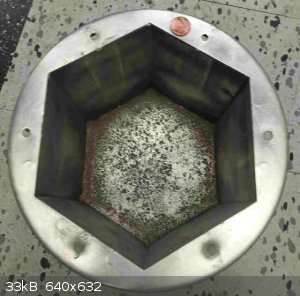

So, I'm stuck. Just barely short of being able to use the can!
I've contacted metal re-finishers in Portland Oregon, and they basically refuse to work with the public because of fears and government regulation. (
Eco terrorists... trying to get them in trouble.) I contacted an individual that redoes tin pans for people in southern oregon, and he's afraid of
trying it because it's not copper coated like the pans that he normally re-tinns.
I understand his concerns.
I failed to tin plate it straight with acetic acid and tin. I'm not interested in spending a long time figuring out how to do this, either.
Therefore: I researched commercial/hobbiest solutions. Eg: Caswell™ "Plug and plate" tin kit for U.S. $55 (2026). This will allow me to brush on
the tin by hand, and the chemicals aren't very hazardous and can be easily disposed of cleanly afterward.
But, these kits aren't designed for plating steel directly, either!
Apparently, it does work but there are several extra steps necessary that aren't well documented (and suggests that they don't really work.)
So, the next best thing would be to look for guaranteed ways to plate copper on steel, and then use a Caswell™ tin plating kit on the copper.
But: I know from trying that copper tends to flake off steel if applied directly from sulphate or chloride solutions.
Google is my friend...:
I found a simple method of puting a durable copper coating on the steel is proposed by "Robert Murray Smith". Robert found that thermal decomposition
of copper formate in gelatin is capable of plating copper solidly onto steel in a durable way.
He demonstrates that micro-colloidal solutions of copper can be made from oxide here:
https://www.youtube.com/watch?v=K4j6naFO1qg
And plating action, here:
https://www.youtube.com/watch?v=AiML2lvwWY8
But, then I realized the same process might work for tin oxide, because I think tin is easier to reduce than copper!
( Am I mistaken? )
Tin oxide powder can be purchased from ceramic shops, is very low toxicity, and is easily reduced to tin metal.
If I can get a tin base coat on all the steel by scrubbing with a tin formate, including the parts which rust, I can then use the Caswell™ tin
plating kit to thicken the tin without fear of being incompetent 
Tin plates on tin as easily as it plates on copper.
Thoughts?
[Edited on 7-2-2026 by semiconductive]
|
|
|
Sulaiman
International Hazard
Posts: 3944
Registered: 8-2-2015
Member Is Offline
|
|
not my area of knowledge but
iron cookware uses enamel (fused glass powder) as a surface finish,
it may be doable and easily repairable ?
https://en.wikipedia.org/wiki/Vitreous_enamel
CAUTION : Hobby Chemist, not Professional or even Amateur
|
|
|
MrDoctor
Hazard to Others
Posts: 249
Registered: 5-7-2022
Member Is Offline
|
|
ive seen in the amateurpyro forums or whatever its called, some people have used heavy duty freezer bags or thicker heat-sealed bags, made of PP as
single use liners. I forget why this was done, but it was successfully being used to mill alu powder from foil. I can only assume that the rubber
tumblers used had some sort of limit to how often they could be cleaned/decontaminated, i could totally see rubber cracking after being washed with
strong detergent enough time.
I have no idea how well this works in this situation but i have also been recommended once or twice to sinter ptfe dry lube to the inside of my
glassware for reactions with either a strong base or concentrated phosphoric acid that you simply cannot do in normal glass. PTFE dry lube supposedly
forms a thorough enough suspension that when sintered 2-4 layers thick you get a teflon coating inside that protects glass for quite a while. non
stick coatings are kind of made the same way. now, this is probably not going to work in a ball mill but i thought id throw that idea out there, as
well as the fact that, you can do this with numerous powders provided you can get a uniform suspension.
nickel plates on steel fine, and copper plates/alloys with nickle, would that not be a viable option instead? im not sure but i think a lot of the
complexities in nickel plating are to get a smooth finish rather than good adhesion , so if you are prepared to polish it down, you can probably focus
on just maximizing the adhesion. alternatively just nickel plate the whole thing since nickel is fairly resistant to oxidation, especially if it never
has to deal with high temps.
|
|
|
semiconductive
Hazard to Others
Posts: 442
Registered: 12-2-2017
Location: Scappoose Oregon, USA.
Member Is Offline
Mood: Explorative
|
|
| Quote: | not my area of knowledge but
iron cookware uses enamel (fused glass powder) as a surface finish,
it may be doable and easily repairable ? |
Thanks anyway.
That would easy to do...
Unfortunately, glass absorbs iron and chemically reacts.
The point of my not wanting rust to get into my ground glass is because it contaminates the glass dust. eg: If you look at window pane glass from the
side it's always 'green' and this is 'low contamination' with iron.
The glass dust, sintered to the side of the barrel, will wear green glass into the main mix.
That is sort of self-defeating.
|
|
|
semiconductive
Hazard to Others
Posts: 442
Registered: 12-2-2017
Location: Scappoose Oregon, USA.
Member Is Offline
Mood: Explorative
|
|
| Quote: | | I have no idea how well this works in this situation but i have also been recommended once or twice to sinter ptfe dry lube to the inside of my
glassware for reactions with either a strong base or concentrated phosphoric acid that you simply cannot do in normal glass. PTFE dry lube supposedly
forms a thorough enough suspension that when sintered 2-4 layers thick you get a teflon coating inside that protects glass for quite a while.
|
That's a very interesting idea. PFTE might not be a problem in the final product.
PFTE sinters around 400[°C], and glass doesn't soften until about 600 [°C]. That's pretty reasonable.
I have strips of glass 1 inch wide, that I was planing on silicone-ing to a bigger glass plate that is siliconed against the walls of the cylinder.
i expect the plates will crack, but hairline cracks wont match between glass layers and won't let let enough solvent in contact with silicone to
dislodge the lining. Since all glass plates will be in compression against each other, cracked glass ought to stay put just fine.
My thought was just to scrape these 1 inch plates off with a spatula when they wear thin or chip excessively, and put another one in it's place --
always keeping the glass stack at least two layers thick.
eg: The lining glass doesn't wear like the first layer of loose glass inside the tumbler does because it pushes a layer of loose glass above it which
takes the main impact of tumbling. It's the same reason that plastic tumblers work at all with rocks !
But, if PFTE could be used to sinter the main glass plate to the wall of the hexagon (but with tin melting at 200 something...?), that would be
pretty much be impervious to the mild solvents that I use.
Nickel plating is definitely another possibility. Dull nickel can be made with vinegar and salt.
I would have to scrape off the tin, though....
|
|
|
Twospoons
International Hazard
Posts: 1393
Registered: 26-7-2004
Location: Middle Earth
Member Is Offline
Mood: A trace of hope...
|
|
I too think Nickel would be the way to go. But take it to an electroplater rather than trying to DIY, and ask for hard nickel.
Helicopter: "helico" -> spiral, "pter" -> with wings
|
|
|
semiconductive
Hazard to Others
Posts: 442
Registered: 12-2-2017
Location: Scappoose Oregon, USA.
Member Is Offline
Mood: Explorative
|
|
OK.
I've written and/or called every listed electroplater in Portland, OR.
They won't work with the public, but only companies on larger orders ; or else, they refuse to respond back to me after several inquiries. This
includes sites that claim that they work with the public...
Do you have suggestions of someone who will give me a quote over email, and then I can snail mail the rusted thing to that company and they will
actually do the job?
The pictures of the can are right there at the top of the thread. It's not a difficult job.
[Edited on 9-2-2026 by semiconductive]
|
|
|
|



![[*]](images/xpblue/default_icon.gif)


