foxofax474
Harmless

Posts: 15
Registered: 17-4-2023
Location: USA
Member Is Offline
Mood: Still processing
|
|
SNAr Azidation of Fluorinated Benzaldehydes with NaN3
Recently had to do this reaction en route to make custom amino acids for peptide synthesis. Thought this might prove useful to anyone who might want
to do something similar (make an aryl azide to do stuff with).
In general, the reaction installs a para-azido group on halogenated benzaldehydes via nucleophilic aromatic substitution with sodium azide in DMSO.
The aldehyde strongly activates the para-fluorine toward SNAr.
Three substrates are possible/generalizable from what I did:
4-fluorobenzaldehyde --> 4-azidobenzaldehyde
3,4-difluorobenzaldehyde --> 4-azido-3-fluorobenzaldehyde
3,4,5-trifluorobenzaldehyde --> 4-azido-3,5-difluorobenzaldehyde
(and their halogen equivalents)
Note that the remaining possible substrates (2,3,4,5; 2,3,4,5,6 fluoro) have ortho fluorines, and because the aldehyde also activates the ortho
positions (though much less than para), diazide formation is a real concern if stoichiometry or temperature are not controlled, so you probably need
to find better reaction conditions and measure azide stoichiometrically, and also possible run a column(?) to get pure product.
General Procedure
Substrate (1 eq) and NaN3 (1.1-1.2 eq) are put in DMSO (0.5 M, ~2 mL per mmol substrate, NaN3 doesn't dissolve much) in a two-necked flask equipped
with a septum and a two-way gas adapter + argon balloon. The solution is purged with argon (3 vacuum/argon cycles). The flask is heated to 70C with
fast stirring. The reaction is monitored by TLC via syringe sampling through the septum (check at 1 hour, then every 10-20 minutes until starting
material is consumed). The azide is slightly more polar so you should visually see a different spot below SM on a 5% v/v EtOAc/Hex TLC. Once complete,
the flask is removed from heat and cooled to room temperature under argon.
The argon atmosphere is to prevent oxidation of the aldehyde to the carboxylic acid at elevated temperature. The reaction itself is not air/moisture
sensitive, so if you're sloppy with the air exposure it's whatever.
Workup
Dilute the cooled rxn mixture with water. Extract with ethyl acetate (3-5x). Wash combined organic layers with water to remove remaining DMSO (3-4
water washes), and bicarbonate (x2) to remove carboxylic acid from oxidation of the aldehyde. Wash with brine and dry over NaSO4, and concentrate in
vacuo.
If for some reason your reaction is messy (idk maybe impure starting material???), bisulfite adduct purification is also possible. Add saturated
NaHSO3 directly to the cooled DMSO reaction mixture (DMSO acts as the water-miscible solvent to improve reaction efficiency). Shake/stir for 60-90
seconds (preferrably under argon). Dilute with water. Extract with EA to remove non-aldehyde contaminants (discard organic). Basify aqueous layer with
Na2CO3, extract with EA (3x), wash organics with water (4x) to remove DMSO, dry, concentrate.
The product in general should be a yellow solid forming chunky crystals with needle-like texture after being cooled and all solvent stripped. Azide
addition can be confirmed via FTIR since it has a strong, sharp absorption at ~2100/cm. Further confirmation can be done with 1H, 13C NMRs (matching
the ChemDraw prediction), and 19F NMR (for the 3,4 and 3,4,5 fluoro starting materials).
Practical Tips
- Keep reaction concentration at 0.5 M in DMSO. Diluting significantly will slow the reaction dramatically since SNAr is second-order in kinetics.
- Monitor by TLC, since if you heat/wait too long the azide may start attacking meta fluorines, and this is literally unseperable via column.
- Minimize air exposure of hot aldehyde, or your yield kinda will suffer.
- Wash your ending organic layer with water thoughly because DMSO is ass to get rid of lol
Hopefully this will be useful to someone 
[Edited on 7-3-2026 by foxofax474]
[Edited on 7-3-2026 by foxofax474]
:doomcat: cooked
|
|
|
foxofax474
Harmless
Posts: 15
Registered: 17-4-2023
Location: USA
Member Is Offline
Mood: Still processing
|
|
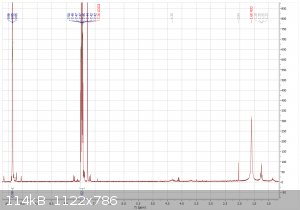
Also i just got NMRs of my 4-azido-3,5-difluorobenzaldehyde product and i had to share them since they looked so nice
Here is the decoupled 19F, showing a singlet from the symmetric fluorine environments

Here is the decoupled 13C, with aldehyde triplet at ~188 split by J4(C-F). C3/5 carbons at ~156, with a large splitting by J1(C-F) to the directly
bonded fluorine, and the small splitting is longer range coupling to the other F. C4 at ~124 is the azide carbon, C2/6 at ~113 is split by J4(C-F),
and C1 is ~132.

For 1H, we see the aldehyde proton and two aromatic protons from integration. The aldehyde as expected is split 1:2:1/triplet from J4(H-F). The
aromatic region has a dd with two flanking peaks on each side, consistent with J3(H-F)/J4(H-H) splitting + AA'XX' spin system magnetic inequivalence
for the smaller satellite peaks. There is minor EtOAc contam but it is very minor.

[Edited on 10-3-2026 by foxofax474]
:doomcat: cooked
|
|
|
|


![[*]](images/xpblue/default_icon.gif)


