| Pages:
1
2 |
draculic acid69
International Hazard

Posts: 1371
Registered: 2-8-2018
Member Is Offline
|
|
Last question:. Is this recrystallisation problem route specific or common to all anthranillic acid synthesis?
|
|
|
SuperOxide
National Hazard
Posts: 542
Registered: 24-7-2019
Location: Devils Anus
Member Is Offline
|
|
Well if the theory is right that it's the recrystallization that turns it brown, then it wouldn't really matter how you get there.
mr_bovinejony posted a thread on making anthranilic acid starting from methyl anthranilate, and while in his original post he comments that it was almost pure white, he
eventually posted some photos that showed it turned brown - He too used water, if I'm not mistaken.
Last night I was making some anthranilic acid to test this theory, as usually when I make it it comes out a very nice off-white in its crude state.
But I got a little impatient as it was getting late, and it went from light beige to brown right before my eyes >_< Dangit. I'll try again, but
on a smaller scale, and I will report my findings - Promise!
[Edited on 21-4-2021 by SuperOxide]
|
|
|
SuperOxide
National Hazard
Posts: 542
Registered: 24-7-2019
Location: Devils Anus
Member Is Offline
|
|
I just finished processing 20g of phthalimide into crude anthranilic acid to test if it maintains its off-white color if I keep it away from H2O
during a recryst. The crude product isn't as white as the previous run I showed a picture of above, which is disappointing... but it'll do for just
testing this theory.
Here's some photos: https://imgur.com/a/nMVvEta
Usually I would just dump it right into some distilled water for the recryst, but since I'm trying to keep water away, I'm going to let it dry out in
my ghetto desiccation chamber under a light vacuum.
Will give updates after recryst or if something bombs before then.
|
|
|
Keras
International Hazard
Posts: 1129
Registered: 20-8-2018
Location: (48, 2)
Member Is Offline
|
|
So apparently there are several threads dedicated to purifying anthranilic acid, and everyone reports crap forming with the product. I surmise, but
don’t take my word for it, that the crap is caused by oxidation (of impurities in phthalamide?) caused by either the hypochlorite/hypobromite itself
or, for those who use bleach, by the sodium chlorate produced when bleach decays.
From what I observed, the crap-like colouring develops as temperature rises. Temperature control of the initial reaction doesn’t amount to much,
since it needs to be pushed to 80 °C anyway later to complete the process. I've tried to add various reducing agents after heating the solution, but
it doesn’t really do much either. Adding reducing agents before heating is counterproductive since it will destroy bleach/hypobromite.
I (almost) successfully purified very dirty crystals this way: recrystallise from boiling water. You should obtain a very dark solution, and probably
no crystal will form when cooled. This is due to a wrong pH value. Add hydrochloric acid until the pH is way more acid than anthranilic's pKa (say,
2): the crap will polymerise and fall out, while the anthranilic acid will remain dissolved (anilinium form). Leave overnight in the fridge. In the
morning, you should come up with a light yellow solution over a thick layer of sticky tar deposited at the bottom of your beaker (clean with acetone).
Decant the clear light orange liquid above, and cautiously add sodium hydroxide: nearly pure anthranilic acid will precipitate. Collect and dry.
[EDIT] I've tried this rearrangement using in-situ hypobromite, commercial bleach and home-made bleach from calcium hypochlorite.
[NOTE: don’t use calcium hypochlorite directly as a substitute for bleach: it will react with sodium hydroxide to form calcium hydroxide that will
precipitate out, reduce the alkalinity of the mix and all sorts of problems. So if you want to use calcium hypochlorite as a source of ClO⁻ ions,
prepare sodium hypochlorite from calcium hypochlorite in advance by pouring it into a COLD sodium hydroxide solution. Don’t dissolve sodium
hydroxide directly into it, as this will cause the solution to heat up and bleach to degrade. Then filter.]
Nothing really works, they all produce the same crap. I also recrystallised the phthalimide I made in ethanol rather than using it straight away from
the urea + phthalic anhydride reaction. It didn't change much. Maybe I’ll have to use recrystallised phthalimide plus in-situ made hypobromite,
which I didn't do (I ran out of bromine). Another way to explore is to use N-bromosuccinimide instead of hypobromite. I read somewhere that it could
be used for Hofman rearrangements, and probably wouldn't be as oxidising as bleach/hypobromite (but way more expensive).
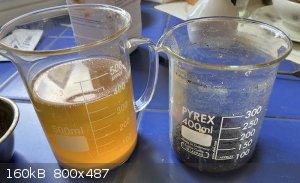
Lastly, a picture from the recrystallisation.
[Edited on 3-8-2025 by Keras]
|
|
|
Keras
International Hazard
Posts: 1129
Registered: 20-8-2018
Location: (48, 2)
Member Is Offline
|
|
So, here is what I finally found on preparing pure (white) anthranilic acid:
• Use recrystallised phthalimide. 25 g of phthalimide made from phthalic anhydride and urea can be recrystallised in ~ 600 mL of standard 90°+
denatured alcohol. It crystallises in fluffy, white needles.
• Use bromine and make hydrobromite on the fly following the method in Vogel p. 898. Don’t let the temperature of the initial sodium hydroxide
solution rise above 0°C. Don’t remove the ice bath until you have added the second sodium hydroxide solution. The temperature will rise to ~ 30 °C
and then maxx out. When the temperature starts to fall down again, remove the ice bath and heat up to 80 °C. The solution should slightly change
colour, from a straw like yellow to a golden one, but never turn darker than that.
• Precipitate the anthranilic acid as described in Vogel. The yield is somewhat impressive, but the powder is grey/yellow, somewhat dirty due to
oxidation. Recrystallise in ~ 200 mL of boiling water, add a gram or so activated carbon, and after 10 min let it cool and add a 100 mg circa of
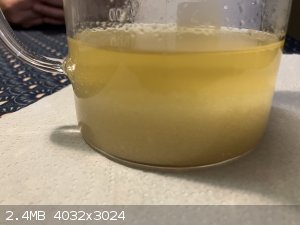
sodium hydrosulfite (dithionite). The solution should be pale yellow at this point, and the anthranilic acid will separate in white crystals.
• Don’t – I repeat don’t – put the recrystallisation beaker in the fridge. Put it in an ice bath, and filter as soon as it is cold enough (5
°C). Letting the crystals bathe in the yellow solution will recolour them after a while.
• Dry if possible in a vacuum dessicator and store.
Picture taken during the recrystallisation.
Edit: Yield of slightly dry product > 20 g whereas Vogel states 14.
[Edited on 17-8-2025 by Keras]
|
|
|
Lionel Spanner
Hazard to Others
Posts: 203
Registered: 14-12-2021
Location: near Barnsley, UK
Member Is Offline
|
|
Having had plenty of experience making anthranilic acid from methyl anthranilate, as the first part of IBX synthesis, I'd like to make an additional
point regarding crystallisation from water.
The solubility of anthranilic acid in water increases sharply between 80 and 100 °C, as does the rate at which it oxidises. The least discoloured
crystals I've ever got from the hydrolysis resulted from not letting the temperature exceed 80 °C while adding acetic acid - crystallisation was very
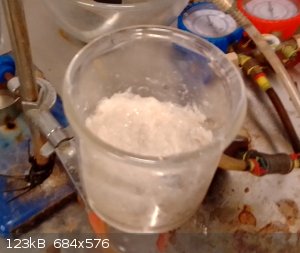
rapid, no water had to be boiled off, and said crystals were pale beige. The photo shows what was recovered from the mixture on the pump after cooling
overnight.
By contrast, heating the same solution to boiling required nearly two-thirds of it to be evaporated before any precipitate formed, and the solution
itself was nearly black.
|
|
|
Keras
International Hazard
Posts: 1129
Registered: 20-8-2018
Location: (48, 2)
Member Is Offline
|
|
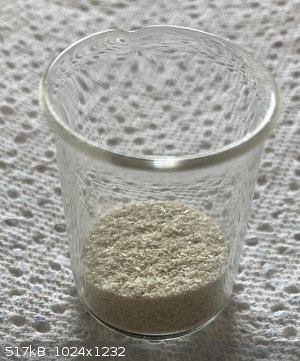
I completely agree with that. The picture below shows a sample (660 mg) of my last batch. It is light beige. I generally use a mix of two methods to
purify it, the first being standard recrystallisation in boiling water followed by addition of sodium hydrosulfite to reduce any oxydation product,
the second being re-dissolution in a basic solution (basically adding sodium hydroxide), adding sodium hydrosulfite, filtering and re-precipitation
using acid until the pH is around 4.
I've already observed what you describe, i.e. that following a 100 °C recrystallisation the solution gets dark and would not crystallise back. This
is, in my experience, caused by a wrong pH. Adding a few drops of HCl immediately precipitates the acid, though not in the purest form.
[Edited on 23-8-2025 by Keras]
|
|
|
| Pages:
1
2 |
|



![[*]](images/xpblue/default_icon.gif)


