| Pages:
1
2
3 |
langevin
Harmless

Posts: 4
Registered: 30-6-2011
Member Is Offline
Mood: No Mood
|
|
Hi all
After reading the thread and following your attempts, I looked for a material already used in common devices. The membrane of Li-ion batteries (white
film) seemed like a good candidate.
I tried with a piece of this diaphragm with iron sulfate solution and the results were encouraging.
Electrolysis is still in progress and litmus paper indicate 1.5
Not so strong acid but juste two hours passed
Regards
|
|
|
Hexabromobenzene
Hazard to Others
Posts: 262
Registered: 27-4-2021
Member Is Offline
|
|
Experiments with the diaphragm continue. It has been concluded that non-woven polypropylene passes too much liquid probably due to porosity. Backing
in the oven does not fix it enough
For experiments, a 30mm polypropylene pipe with a nut was taken to fix the diaphragm was taken. The diaphragm was cut out by scissors a circle of
30mm. The following up -ups were tested
Solution 70 grams per liter of sodium chloride, iron electrodes, voltage 12V
1. A pipe without a diaphragm. Current 2a
2. A diaphragm made of non-woven polypropylene. Current 1.3 A. Leak is very fast
3. The diaphragm polypropylene backed in the oven. Current is the same 1.3A. The leak is less but still significant
4. A separator from a car battery. Current 1.5a. Leak is very small. Good material for small diaphragms
5. Non -woven polypropylene(NON BACKED) impregnated with polystyrene glue and placed in water according to the mysteriousbchoice method(Glue
Impregnation and then washed in soapy water)
Current 0.8a. Leak is few drop per second. More than a car separator but much less than non-woven polypropylene
Experiment 2
Next, experiments were carried out with ready diaphragms from the blanks with holes with backed non-woven polypropylene (backed is poorly
impregnated). A polystyrene covered diaphragm and it was treated with soap water.
After drying, a large diaphragm showed a current of 0.2 amperes (40mm) small 0.1 (25mm). A significant reduction in conductivity. Initially, both
diaphragms showed the current more 1 A. But the leak was highly reduced
And now your attention. Both diaphragms are soaked by 50% sulfuric acid and placed in the oven for 5 hours at 100 degrees
After baking, a large diaphragm showed current 1.2a with the same leak and a small diaphragm showed current 1.6a(16!! times increase). I do not
understand what caused incrase of conductivity. This is probably due to the fact that polystyrene became water -absorbing and water penetrates better
into pores. But it can be also due to conductivity of ion exchange resin
I prepared a diaphragm from partially sulfonated polystyrene. It showed good results. But the main problem of the ion exchange membrane that it passes
only one type of ion, which means that the current will be 2 times less with a solution of salt in 2 containers. On the other hand, conductivity is
much higher
Sulfonated polystyrene will also be destroyed by organic solvents and cannot be used for electroorganic synthesis. The optimal material for organic
syntesys is a separator from a car battery. Although it is possible to find a filler for non-wowen polypropylene to reduce its porosity. A separator
from lithium of the ion battery has poor mechanical properties and has not been tested
[Edited on 25-6-2025 by Hexabromobenzene]
|
|
|
Hexabromobenzene
Hazard to Others
Posts: 262
Registered: 27-4-2021
Member Is Offline
|
|
What do you think about it? I really liked the results with the diaphragm with partially sulfonated polystyrene.
Since I have no solvents of polystyrene glue prepared from the old aerosol paint. The gas was released, the liquid was poured, the precipitate(filler)
was separated and the PS foam was added to form a viscous solution. The upper layer of the solvent with a large amount of acrylic varnish was
separated
I do not think that impurities of acrylic varnish influenced the result. Polyacrylic acid poor electrolyte, unlike sulfonated polystyrene
[Edited on 25-6-2025 by Hexabromobenzene]
|
|
|
MrDoctor
Hazard to Others
Posts: 249
Registered: 5-7-2022
Member Is Offline
|
|
mysteriusbhoice never made a video on it, but they, either themselves or, through a 3rd party that actually made one, had success with the ion
exchange resin design that they had speculated about for some time, the 3rd party, presumably one of his friends, reported it worked in a chlor-alkali
cell setup without any real issue.
Finely ground resin could be bound with PVC cement, in principle without any substrate but, a substrate like PP should still be used. When i asked
them about if it worked and if it leaked, since the particle size seemed rather large and crude, they likened its microscopic structural properties to
something like perovskite membranes, which operate based on the structure of pores that still go all the way through. But when subject to
electrolysis, it functions like an ion-pump so the fact that rather large pore channels run all the way through doesnt really matter, and actually
that it was required for it to work properly, fully blocking the channels would stop it from working correctly too. So, this is why initial tests
using a LOT of PVC cement to fill all the gaps failed, and why using thin layers of the ultrafine ground resin also basically did nothing. chemical
adsorbtion is occuring through the network of pores alongside electrochemical forces driving ions through.
Another thing was, apparently they found only either the ion or cation resin worked well in the manner in which they tested it, i forget which though.
Lastly, mysteriusbhoice said this to me directly when i made a polystyrene membrane which wasnt working too great, but the PS membranes made in the
way he had described, need to be regenerated every so often, likened to acetone vapor bathing ABS prints to smooth the surface.
Im going by memory here so take with a grain of salt.
Personally though im curious as to what results could be achieved by using styrene monomer and inducing polymerization inside a substrate. I have
noticed, not all PS liquifies the same and i speculate, that the composition of what actually penetrates deeply might not be consistent.
|
|
|
Hexabromobenzene
Hazard to Others
Posts: 262
Registered: 27-4-2021
Member Is Offline
|
|
It works as an ion exchange resin and not a diaphragm. Correct? Without sulfonation only 0.1A with sulfonation 1.6A means only 1/16 of the current can
transfer anions.
So there is no point in using sodium sulfate in 2 containers to increase the yield of sulfuric acid as example
I also tried to press the ground ion exchange resin from the filter with polypropylene at 200 degrees. But the result was a product with very poor
conductivity. Only 50 mA under the same conditions as in the post above. Unacceptable
This technology does not allow the production of thin membranes (which is important for conductivity), unlike impregnation of non-woven polypropylene
[Edited on 26-6-2025 by Hexabromobenzene]
|
|
|
Hexabromobenzene
Hazard to Others
Posts: 262
Registered: 27-4-2021
Member Is Offline
|
|
A piece of polypropylene fabric impregnated with polystyrene was treated with sulfuric acid as described above. The current increased from 0.8A to
1.1A. Not a significant increase this time. Leak did not increase
Conclusion. The increase in electrical conductivity is due to better soaking of sulfonated polystyrene, not to ion exchange
|
|
|
Hexabromobenzene
Hazard to Others
Posts: 262
Registered: 27-4-2021
Member Is Offline
|
|
I found the best material for the diaphragm. It is a vacuum cleaner bag with microfiber fabric. Even without baking in oven, it has less leakage than
polypropylene polystyrene composite. After baking, it decreases very significantly
Current without baking is 1.8-1.9! amperes under similar conditions. After baking 1.3A, but perhaps baked fabric is not completely saturated in a
short time. This is ideal material
Fabric from the vacuum cleaner consists of 3 layers. 2 external protective and one internal with microfiber fabric from polypropylene. This is the
BEST material of all studied and the absolute leader. Its electrical conductivity is even better than the industrial separator from a car battery
Baking this fabric with a blank of perforated polypropylene pipe and you will get an excellent diaphragm for organic and inorganic syntheses. Use
polyethylene fishing line to firmly fix the polypropylene fabric after baking.
Diaphragm made of polypropylene polystyrene composite treated with sulfuric acid is apparently not an ion exchange membrane. Treatment with sulfuric
acid only increases the wettability of microporous plastic. There is no point in making
[Edited on 15-7-2025 by Hexabromobenzene]
|
|
|
Hexabromobenzene
Hazard to Others
Posts: 262
Registered: 27-4-2021
Member Is Offline
|
|
I finally found a way to make microporous polypropylene. Polypropylene is fused with kerosene then kerosene evaporates for several days
To avoid a strong smell, you can use paraffin and extract it with a volatile solvent.
Polypropylene is poorly soak with water as polystyrene. But this can be fixed by processing by oxidizing agents. Permanganate, nitric acid,
dichromate, chlorate
Porosity can be changed by the amount of polypropylen in composition 30-70%
Very good material. Wait for experiments
Already made samples of porous propylene/fiberglass with different porosity treated with nitric acid
Plans to fusion with ion exchange resin composite
Sample
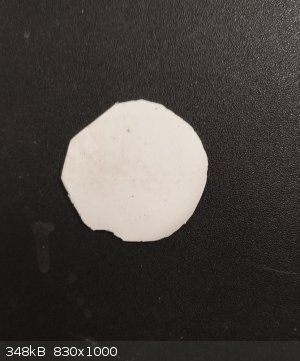
[Edited on 27-7-2025 by Hexabromobenzene]
[Edited on 27-7-2025 by Hexabromobenzene]
|
|
|
camura
Harmless
Posts: 5
Registered: 11-7-2025
Member Is Offline
Mood: No Mood
|
|
Hell yeah, love that. Would this aid with holding the chemically active component of a selective ion exchange membrane? Also, how did you test for
microporosity?
|
|
|
Hexabromobenzene
Hazard to Others
Posts: 262
Registered: 27-4-2021
Member Is Offline
|
|
Experiments are still being conducted. Here is the result so far
Test composites of polypropylene/ion exchange resin were made, but with poor mechanical properties. The best mechanical properties are in the
polypropylene/fiberglass composite. The composite with fiberglass can be made very thin, which reduces its electrical resistance.
Some more interesting things. The amount of polypropylene in the kerosene solution should be about 30 percent. Apparently, with a larger amount, the
micropores inside the plastic overlap and strong shrinkage is observed during drying
The alloy of polypropylene and kerosene is very soft and TRANSPARENT immediately after preparation. This is probably due to the fact that
polypropylene is reversibly wetted by kerosene, and polypropylene and kerosene have a similar refractive index. After drying, the plastic becomes much
stronger and bright WHITE COLOR as in the photo. THIS IS NOT PAINT
Plastic is poorly wetted by water. After treatment with nitric acid (sulfuric + nitrate), water begins to wet it
Electrical tests will come later
Note: Kerosene dissolves polypropylene only near melting point(150 and more). Cooling the alloy causes crystallization of the plastic and the
formation of micropores. For faster drying, soak the alloy in a volatile solvent such as hexane.
[Edited on 29-7-2025 by Hexabromobenzene]
|
|
|
Hexabromobenzene
Hazard to Others
Posts: 262
Registered: 27-4-2021
Member Is Offline
|
|
A sample of the diaphragm made from a vacuum cleaner filter, 3-layer fabric baked at 170, was treated with nitric acid for better wetting as described
above.
After soaking for a couple of minutes, the current in the test setup was 1.8-1.9A as described in the posts above. The leak is certainly
noticeable(one drop few second) but not critical compared to polypropylene from bag. I remind you that the separator from a car battery shows a trace
leak.
Reminder: without a diaphragm, the current is 2A
A composite of microporous polypropylene and fiberglass (made using the kerosene method) with nitric acid treatment showed a current of 0.5A. However,
this sample was made from too strong a polypropylene solution, which reduced the porosity. However, this type of diaphragm shows only a trace leak,
which is useful for organic syntheses. I will continue to experiment with this material
|
|
|
Hexabromobenzene
Hazard to Others
Posts: 262
Registered: 27-4-2021
Member Is Offline
|
|
The best samples from left to right.
1. Microporous composite polypropylene fiberglass (method with kerosene) treated with nitric acid
2. Pressed at 170 and treated with nitric acid vacuum cleaner filter (still wet)
3. Composite polypropylene (bag) polystyrene treated with sulfuric acid
4. Separator from car battery
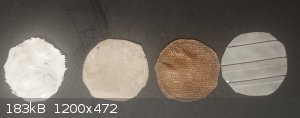
[Edited on 30-7-2025 by Hexabromobenzene]
|
|
|
Hexabromobenzene
Hazard to Others
Posts: 262
Registered: 27-4-2021
Member Is Offline
|
|
The composite porous polypropylene fiberglass showed poor conductivity. Current 0.2a.
It was also discovered that polypropylene with kerosene forms alloy with a melting point of slightly higher than 100. This alloy can be applied to the
polypropylene farbic that was done. However, the results are even worse. Spunbond polypropylene porous polypropylene composite treated with nitric
acid showed current 0.1a under the same conditions.
It is also concluded that any fabric type Spunbond has a strong leak due to many holes in the thickness of the fabric. This can be fixed only by its
modification. For example, in the case of a composite polypropylene polystyrene or a 3 -layer bag for a vacuum cleaner with a microporous cloth in the
center. There are also 6 layer packages for a vacuum cleaner that will have a likely smaller leakage
|
|
|
Hexabromobenzene
Hazard to Others
Posts: 262
Registered: 27-4-2021
Member Is Offline
|
|
So the best results showed a 3 layer bag from a vacuum cleaner. Great conductivity and a small leak. The separator from car battery is also not bad.
Good conductivity and insignificant leak. However, only fabric from the bag from the vacuum cleaner can you betray any shape with backing
The rest of the materials such as polypropylene polystyrene composite showed the results much worse, considering that polystyrene is less resistant to
aggressive media plastic (perhaps this can be fixed with polystyrene crosslinking)
In the case of large containers, the resistance of the diaphragm is of lower value
Also, if in the process of electrolysis you form a large amount of sediment, you can use spunbond as is. For example, the synthesis of iron chloride 2
and alkali from salt with an iron anode
Also interesting fact is also that a composite from ordinary celulose farbic and porous polypropylene is cracked after acid treatment. This suggests
that a layer of porous plastic does not protect the substrate
I think my research is completed here. The diaphragm of a different type is many times more labor -intensive. You can try to find a multilayer package
from a vacuum cleaner (more than 3 layers). Perhaps this will be the best option of available
Alloy of polypropylene and kerosene can probably be used as glue for polypropylene fabric
[Edited on 17-8-2025 by Hexabromobenzene]
|
|
|
MrDoctor
Hazard to Others
Posts: 249
Registered: 5-7-2022
Member Is Offline
|
|
just thought id drop in, i noticed a source of nonwoven PP fabric the other day at the hardware store, you can find it as "Bastion; non-woven
polypropylene bandage reinforcing fabric" comes in rolls for concrete/brick work, its very thin presumably so that concrete can still crystalize
through it.
because its so thin, i would imagine it might have some application possibly layered with membrane materials like glues or paints, that dont often
adequately form a nice clean mono-layer. but many too porous layers together, ironed down into one, would do well i think.
Another thing, polystyrene with a high % of alpha methyl styrene forms a weird polymer, similar to hot melt glue, as the AMS depolymerizes at either
70C or 90C or something, its used for high temperature applications of all things, presumbly so it can self-heal from impacts at temps where it can
weld or de-strain itself without going completely fluid. Anyway i saw papers a while back talking about the use of polyalphamethylstyrene-polystyrene
and/or poylcarbonate perhaps? or another styrene like ABS, to form membranes comparable to nafion for limited applications, where it can be
regenerated with a heating cycle without removing from the cell, just adding hot water. the tradeoff is besides obviously solvents, its also not too
keen on mixtures of free halogens in strongly acidic environments, or peroxides
|
|
|
Hexabromobenzene
Hazard to Others
Posts: 262
Registered: 27-4-2021
Member Is Offline
|
|
In addition to leakage due to the large number of holes, spunbond has another problem. These holes consist of a plastic film that is not porous, which
reduces conductivity(Look for fabric with minimal hole size). That is why a diaphragm from a vacuum cleaner bag with 2 very thin layers of spunbond
and one solid microporous layer between them conducts current so well
Again, when making diaphragms with a volume of a liter or more, you are not afraid of poor conductivity of the fabric due to the large surface area
However, if you want to do electrolysis with a voltage of 3.3 volts for saving electricity but not 5 volts, you need a minimum resistance
After pressing the fabric at 175 to the workpiece, it can detach from it. To prevent this, use clamps. I have tried many options, the best is to cut a
ring from a polypropylene pipe of a larger diameter, wrap it around your diaphragm and weld it with a soldering iron
About ion-exchange membranes. I'm not sure they are needed. They are difficult to manufacture, there are no available materials for them that are
resistant to aggressive environments
Also, ion-exchange resin conducts only one ion. This means that your current yield during electrodialysis of, for example, sodium sulfate will drop by
2 times
In organic electrochemistry, the advantages of ion-exchange membranes are also not obvious
There is no point in making
[Edited on 18-8-2025 by Hexabromobenzene]
|
|
|
clearly_not_atara
International Hazard
Posts: 2926
Registered: 3-11-2013
Member Is Offline
Mood: Big
|
|
I was reminded of this:
https://www.sciencemadness.org/whisper/viewthread.php?tid=16...
|
|
|
Hexabromobenzene
Hazard to Others
Posts: 262
Registered: 27-4-2021
Member Is Offline
|
|
Interesting discovery was made during the process of producing ferric chloride using a diaphragm. A diaphragm made of highly porous polypropylene
fabric in 3-4 layers showed the best results with lower leakage. Due to its low density, it has low resistance and modification with iron hydroxide
gives very low leakage. Not so good result was demonstrated by a diaphragm made of a 3-layer vacuum cleaner bag in 1 layer, and the worst leakage was
demonstrated by a diaphragm made of a single layer of simple polypropylene bag. During electrolysis with an iron anode, a composite diaphragm of
polypropylene fiber and iron hydroxides is formed. This is a like ceramic. Therefore, the best option is to use the lowest density fabric and wrap the
workpiece in several layers.
|
|
|
Hexabromobenzene
Hazard to Others
Posts: 262
Registered: 27-4-2021
Member Is Offline
|
|
Based on the post above, a 6-layer vacuum bag should be the best material for diaphragm when working without hydroxides.
I also plan to make a diaphragm out of Teflon tape. If it works, it will be great for organic synthesis.
https://www.sciencemadness.org/whisper/viewthread.php?tid=16...
|
|
|
Hexabromobenzene
Hazard to Others
Posts: 262
Registered: 27-4-2021
Member Is Offline
|
|
Test results were reviewed. The polypropylene/polypropylene composite is poorly wetted by water, but impregnation with 50% ethanol helps the aqueous
solution quickly penetrate the polymer.
The following samples were taken: a 3-layer vacuum cleaner bag, a regular polypropylene bag, and the same bag impregnated with a 20% polypropylene
solution in kerosene at 100°C and dried.
Leakage test: The PP/PP composite from the regular bag showed the best result, despite the bags leaking significantly due to perforation. The 3-layer
vacuum cleaner bag showed the worst result, while the regular polypropylene bag showed a terrible result.
Conductivity test: Potassium sulfate solution and 12V voltage:
Vacuum cleaner bag and regular bag 2.5A current, polypropylene/polypropylene composite 2.2-2.3A.
Creating a porous layer by crystallizing plastic from a solvent works.
|
|
|
bearbot22
Harmless
Posts: 30
Registered: 10-4-2018
Member Is Offline
Mood: No Mood
|
|
Hi Hexabromobenzene!
I tested the use of a 3-layer vacuum cleaner bag as diaphragm using my test cell and conditions as described in my post from dec 14th 2024:
Dripping: 12g in 24h
Current: 40mA@2Volts ... 300mA@8Volts vs. 80mA ... 520mA without diaphragm
Acid-Base: 80min
Summary: Dripping is quite low, current is good, ion-exchange could be slower.
|
|
|
Hexabromobenzene
Hazard to Others
Posts: 262
Registered: 27-4-2021
Member Is Offline
|
|
Technology for composite polypropylene diaphragm (Currently the best option)
A vacuum cleaner filter cloth was wrapped around a perforated polypropylene pipe and baked at 170°C. Then, 30 grams of transparent polypropylene was
dissolved in 150 grams of paraffin. The diaphragm blank was heated to 120°C. The molten polypropylene and paraffin mixture was cooled to 120°C. Keep
in mind that there is a window between 120°C and 100°C. Above this temperature, the polypropylene fabric disintegrates; below, the mixture
crystallizes. The polypropylene-paraffin solution is applied to the blank with a brush.
After cooling, the paraffin is dissolved in white spirit when heated to 60°C.
I do not recommend using paraffin as a solvent for polypropylene. It dissolves poorly in solvents without heating. Use mineral oil. For mineral oil
extraction, use hexane.
Note. During impregnation, polypropylene fabric is significantly deformed. Weld it to the perforated workpiece and also weld the fabric to itself
vertically at the joint
[Edited on 30-11-2025 by Hexabromobenzene]
|
|
|
Hexabromobenzene
Hazard to Others
Posts: 262
Registered: 27-4-2021
Member Is Offline
|
|
Quote: Originally posted by bearbot22  | Hi Hexabromobenzene!
I tested the use of a 3-layer vacuum cleaner bag as diaphragm using my test cell and conditions as described in my post from dec 14th 2024:
Dripping: 12g in 24h
Current: 40mA@2Volts ... 300mA@8Volts vs. 80mA ... 520mA without diaphragm
Acid-Base: 80min
Summary: Dripping is quite low, current is good, ion-exchange could be slower.
|
Thank you for the test. This is a good result. Keep in mind that vacuum cleaner filter diaphragms take a time to wet. For better wetting, you can
treat them with nitric acid or soak them in ethanol like Teflon tape.
|
|
|
Hexabromobenzene
Hazard to Others
Posts: 262
Registered: 27-4-2021
Member Is Offline
|
|
Testing a composite polypropylene/polypropylene diaphragm manufactured using the method described above. Voltage: 12 volts, sodium chloride: 40°C,
200 g/liter. Current 4.5 A
Liquid leakage is observed, but this is due to gaps between the blank and the fabric.
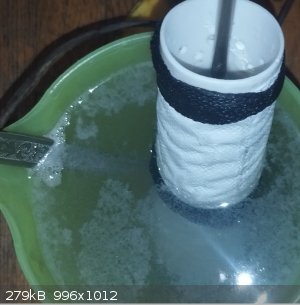 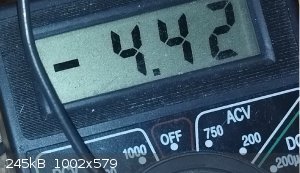 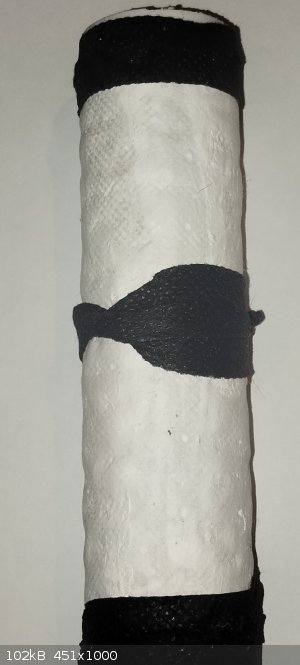 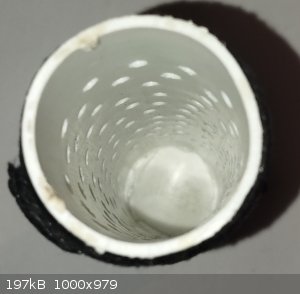
[Edited on 30-11-2025 by Hexabromobenzene]
|
|
|
Hexabromobenzene
Hazard to Others
Posts: 262
Registered: 27-4-2021
Member Is Offline
|
|
Polypropylene polystyrene composite diaphragm treated with sulfuric acid. Current 1.5 amps(12V) with a solution of 200 grams of salt per liter. This
is very low considering the large surface area. Other samples had current of 0.5 A.
Maybe complete sulfonation of polystyrene would help. Then it will become an ion exchange membrane. But then it become like gel. A cross-linked
polymer is needed to manufacture such diaphragms. The project is on hold.
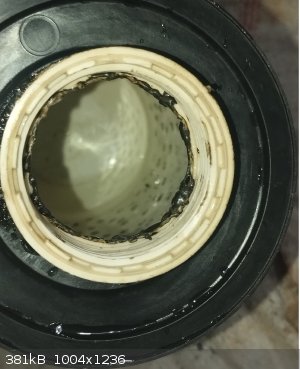 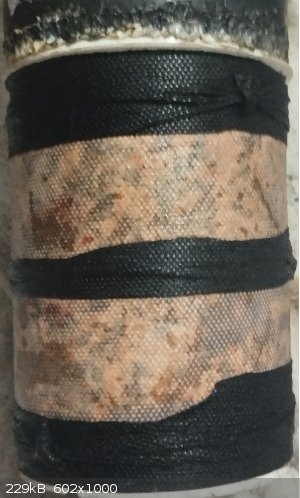
[Edited on 30-11-2025 by Hexabromobenzene]
|
|
|
| Pages:
1
2
3 |



![[*]](images/xpblue/default_icon.gif)


