| Pages:
1
2
3 |
semiconductive
Hazard to Others

Posts: 388
Registered: 12-2-2017
Location: Scappoose Oregon, USA.
Member Is Offline
Mood: Explorative
|
|
| Quote: | | As this whole thing has to do with nickel plating in non-aqueous solutions, the question that should be asked is, is nickel sulfite soluble in any
non-aqueous solvent? The SDS below has a few references that may lead somewhere. |
Actually, I put this in a different thread because it has more general application than just nickel plating. Regarding plating: I am actually more
interested in plating iron, and iron pyrite (Fools Gold), than nickel. But: I've been attempting nickel because it's easier to reduce from solution
than iron.
Note: I successfully plated grey iron this last week in a solution where iron oxalate ought to have been insoluble. But the test tube is super bright
yellow and very conductive. I also succeeded from an acetone bath, and also using di-cyanamide as a complexing agent. So -- I've actually had
amazing progress this last month after failures for two solid years.
If you do research on sulfites, I think you will find it is generally going to be the case that sulfites except of sodium, potassium, and ammonium,
tend to be hard to dissolve.
However, what I'm finding is that the common solubility rules of (rarely, but with notable exceptions), do not apply when double salts are made.
Aluminum, for example, has oxidation state +3, and therefore can not be totally bonded with just a single sulfite molecule. If I half-neutralized
sulfite (or metabisulfite, which we've sort of ignored) using aluminum; then there will be one bond left over which could be occupied by nickel, an
alkyl, iron, or other cation.
You're probably very familiar with potassium alum, which is a common chemical to find in nature. It's extremely fond of absorbing water. But, I've
done a few experiments in methanol and it will happily absorb methanol in place of water yielding a new gelationous substance that is quite conductive
of electricity.
There ought to be similar chemicals that can be made with sulfite or meta-bisulfite, which both have the same -2 maximum charge as ions as sulfate
has. ( But, I expect the properties are going to be slightly different -- I have no idea if they will be better or worse candiates, and am just
experimenting! )
Since potassium aluminum sulfate in methanol has some plating activity, I wonder about analogs like lithium aluminum sulfite or potassium aluminum
meta-bisulfite.
However, the form I have these acids in always have sodium attached to them. Sodium sulfite + hydrochloric acid, is not a good choice!!! So I'm
looking for ways to remove the sodium without producing SO₂ gas ...
For the most part, I'm looking for metastasis reactions that allow me to get rid of sodium and replace it arbitrarily.
But, my chemistry knowledge is very limited.
[Edited on 28-11-2025 by semiconductive]
|
|
|
DraconicAcid
International Hazard
Posts: 4487
Registered: 1-2-2013
Location: The tiniest college campus ever....
Member Is Offline
Mood: Semi-victorious.
|
|
I wouldn't expect aluminum sulphites to be stable in the presence of water or hydrogen ions.
Al(3+) + 3 HSO3(-) ---> Al(OH)3 + 3 SO2(g)
Please remember: "Filtrate" is not a verb.
Write up your lab reports the way your instructor wants them, not the way your ex-instructor wants them.
|
|
|
semiconductive
Hazard to Others
Posts: 388
Registered: 12-2-2017
Location: Scappoose Oregon, USA.
Member Is Offline
Mood: Explorative
|
|
Quote: Originally posted by DraconicAcid  | I wouldn't expect aluminum sulphites to be stable in the presence of water or hydrogen ions.
Al(3+) + 3 HSO3(-) ---> Al(OH)3 + 3 SO2(g) |
Indeed.
And there is some odor using sodium aluminum sulfite in water.
It's not a lot of gas, but it's obviously possible for some to escape.
I find it rather curious that sulfite salts are stable at all.
I'm thinking sodium sulfite Na₂SO₃ could be thought of as Na₂O + SO₂, and in the presence of hydronium or 'alk'onium ions, the Na₂O could
become hydroxide radicals. As far as 'leaving' groups go, Na₂O is neutral just as H₂O is neutral.
So, I don't really understand why even stable sodium sulfite doesn't absorb water and release SO₂ gas *all the time*.
The meta-bisulfite is less puzzling to me because the oxygens are not easily grouped into Na₂O. I think it's probably a much bigger molecule that
would have to 'leave', and that might help keep the SO₂ groups mechanically 'stuck'.
But, I still don't totally get why it doesn't just decompose down in to sulfite and then into SO₂. I have weird dreams that don't actually happen
when tried in test tubes.
|
|
|
bnull
National Hazard
Posts: 933
Registered: 15-1-2024
Location: East Woods
Member Is Offline
Mood: Happy New Year!
|
|
| Quote: | | or metabisulfite, which we've sort of ignored |
By design rather than by accident. It hydrates to bisulfite in contact with water and I suppose you're going to make your other sulfites using aqueous
solutions. You may try using another solvent, although I'm not sure if the metabisulfite ion will remain as it is or will decompose to sulfite plus
sulfur dioxide. I'd bet on the latter as I never had heard of, say, aluminum metabisulfite or iron metabisulfite.
I know of only two ways of removing sodium ions. One uses uranyl acetate (plus some zinc or magnesium ions to make the triple (?) salt) and the other
uses ion-exchange resins. The advantages of the resins are that they are cheaper than the uranyl salt and reusable.
Edit: One more thing. Did you use a solution of aluminum sulfate?
[Edited on 29-11-2025 by bnull]
|
|
|
semiconductive
Hazard to Others
Posts: 388
Registered: 12-2-2017
Location: Scappoose Oregon, USA.
Member Is Offline
Mood: Explorative
|
|
The aluminum sulfate comes as an anhydrous powder. It can be mixed with ethanol, methanol, or other alcohols to avoid water. Lithium, potassium, or
other salts of very weak acids can be added.
Most of my successes have come from using alkalai citrates.
For example, lithium citrate made in water, can be dried in an oven at around 215 farenheight without decomposing. (101 to 102 Celsius spread in a
thin layer). Powdered after drying, citrates can be added to aluminum sulfate in an alcohol solution. I've tried many variations of other organic
salts. A fair number of them will loose amounts alkalai to the aluminum sulfate under heated conditions. At that point, the solution will start to
form a gel and begins absorbing alcohol molecules because (I assume) there is insufficient water for the alum to become hydrated. The alcohol
molecule is the next closest thing to water that is available...
I've tried lithium carbonate in methanol with aluminum sulfate powder, but it's nowhere near as effective.
|
|
|
semiconductive
Hazard to Others
Posts: 388
Registered: 12-2-2017
Location: Scappoose Oregon, USA.
Member Is Offline
Mood: Explorative
|
|
--- Continuing on to the auto-ionization of water ---
I don't hear anyone explaining why NIST's sign is different from what I expected; so I'm going to make a guess and move forward.
Looking around, I see in a Wikipedia, a relationship that is empirical and slightly easier to work with than the linear to Arrhenius relationship that
can be derived from lump modeling of atoms.
The empirical formula is called "Varshni's" correction to band gap narrowing.
https://en.wikipedia.org/wiki/Band_gap
I think It has sufficient degrees of freedom to handle the phase change effects of ice into water, or even water into pressurized steam.
What I am going to do next is 'wrong'.
I am going to ignore the sign of the formula from NIST, and use my experience from semiconductor design to make chemical predictions.
Disclaimer: Do not use this technique in any professional settings or where safety is paramount. The professional documentation from NIST disagrees
with me. I don't know why.
But:
The differences between water and solids is mostly confined to the ability of ion donors to migrate during ionization.
In liquids both hydrogen atoms and electrons can hop from one group of atoms to neighboring ones, and simultaneously the atoms themselves can
re-orient or mix.
This extra motion means that fluids have one more degree of motion freedom than solid semiconductors do. The quantum band shape can change with
*time* as fluids re-arrange themselves.
Re-arrangement of the 'band' structure also implies that localized regions of pH must change with time even when the chemicals, themselves, are at
'equilibrium' sealed and isolated in a container.
This is something I was never taught in undergraduate classes, but is a necessary consequence of band theory as I understand it from electrical
engineering.
The closest analogy I can think of is chemical oscillation, where colored solutions go back and forth between two states several times before settling
down to an equilibrium condition. Although the bulk oscillation *appears* to stop, I want to suggest that it still continues at a microscopic level
with random changes in color that cancel out on average. The pH shifts with time in a liquid.
Even with pure distilled water, rippling ionization effects must be occurring that semiconductor equations don't model.
With that in mind, I'm going to use the NIST data (ignore the time dependency) and change the sign of the ionization rate to agree with what it would
be in solid semiconductors.
I'm merely going to figure out what constants alpha and beta applied to Varshni's correction will yield the same derivative (change in ion
concentration vs. temperature) at standard conditions as is reported in the NIST document. But I am going to ignore the SIGN of the slope, which is a
definite error on my part.
Then I'll make a chart of auto-ionization strength for distilled water based on the semiconductor analogy.
|
|
|
semiconductive
Hazard to Others
Posts: 388
Registered: 12-2-2017
Location: Scappoose Oregon, USA.
Member Is Offline
Mood: Explorative
|
|
Working out an energy gap correction for distilled water, or very dilute ionic strength solutions.
Any two distilled water solutions from different labs will likely have slight variations in properties. ( Who knows how much deuterium is in any
given source of water... )
But, here goes: Data magnitude is taken from NIST, author "Steven G. Bratcsch" -- and I preserve the original sign of ΔE/ΔTc to check the 'correct'
calculations before doing my own 'wrong' calculations.
For H₂(g).OH⁻ ⟷ H₂O(liq)
Tc=25 [°C], E°=-0.828 [eV], ΔE/ΔTc=-0.0008360 [eV/°C]
I'm implicitly converting to energy (electron Volts) which is pressure in volts multiplied by electrons involved. Electronic multi-meters generally
measure only a pressure in volts.
The intrinsic ion/carrier concentration (Ni) equation from semiconductor physics has the following logarithmic form ( assuming a constant energy gap
). There are two arbitrary constants, A and B, which depend on material properties.
log₁₀( Ni ) = A + 0.6514·ln(T) - |E₀|·B/T
For Isobaric conditions, STP, H₂O:
log₁₀( Ni ) = -13.996 At 25 [°C]
Therefore:
-0.828 [eV] ·B/298.15 [K] + 0.6514·ln(T) = -13.996... - A
At freezing, I find the following data:
chem.libretexts.org/Bookshelves/General_Chemistry/Map%3A_Chemistry_-_The_Central_Science_(Brown_et_al.)/16%3A_AcidBase_Equilibria/16.03%3A_The_Autoion
ization_of_Water
But, the author does not say if this is a theoretical value or an experimentally measured value of ice-water. ( This is my life... ugh! )
log₁₀( Ni ) ≈ log₁₀( 1.15/10¹⁵ ) = -14.9393...
Considering the trouble I run into when asking for the pH measurement of distilled water even at 4 [°C] from Google, I am going to do a little more
research.
I can't find any pH probe measurements at 4C. People don't report them.
If I search for carbon dioxide error in pH measurements at 4[°C], I find notes that the pH is often between 5.5 and 6.5 due to CO₂ gas absorbtion.
Taking the more basic measurement as the least CO₂ affected; then log₁₀( Kw ) is between -13.0 and -14.939.
Sigh: The possible range of data represent completely different qualitative changes from standard temperature and -log₁₀( Kw ) = 13.996. It's
not just AI that aren't trustworthy, the original documents don't publish useful data that conclusions can be made from. !
I'll try to use conductivity experimental data to isolate another corroborating auto-ionization value at a nearest to maximum density temperature of
3.98 [°C].
https://www.researchgate.net/publication/237310270_The_Funda...
But, the footnote shows he got the Kw data from someone else...
Reference 4: 4. E. Schmidt, Properties of Water and Steam in SI-Units, Springer-Verlag, New York -- 1969
at 0 [°C] -log₁₀( Kw )≈14.9412
at 5 [°C] -log₁₀( Kw )≈14.7287
Considering the fact that I have two values from different authors that are very slightly different; I'm now going to (temporarily) assume both these
values are experimentally valid; ( but in reality, I'm in the same dilemma. I do not know how the values were arrived at. ) A voltage probe
measurement is physical, and is in volts. An ionization constant Kw is inferred, indirectly or calculated theoretically.
Half cell voltages change close to 'linearly' according to NIST publications with respect to temperature. ( But this comment is rather suspect!!! )
Therefore, I'm first going to solve three equations in three unknowns presuming the energy gap does not significantly change over the small
temperature range of 0 to 5 [°C], but does over 0 to 25 [°C]. I want to know what the E gap needs to be (approximately) near freezing to test for
linearity.
I do know by voltage measurement what the energy gap is at 25 [°C].
-0.828 [eV] ·B/(273.15 + 25 )[K] + 0.6514·ln(298.15 [K]) = -13.996... - A
-E [eV] ·B/(273.15 + 5) [K] + 0.6514·ln(278.15 [K]) = -14.7287... - A
-E [eV] ·B/(273.15 + 0) [K] + 0.6514·ln(273.15 [K]) = -14.9412... - A
Therefore:
A ≈ -4.99237...
B ≈ 3822.47...
E (near 2.5 [°C] ) ≈ 0.824345...
What this shows is that for all three data points to be experimentally valid, the energy gap near freezing will be smaller than standard conditions by
around 4 millivolts.
But: That means the experimental data is nowhere near linear.
The NIST data claims:
ΔE/ΔTc=-0.0008360 [V/°C],
Over a 25 [°C] change, this gives:
E = -0.828 + ( 273.15 - 298.15)·(ΔE/ΔTc ) = -0.8071 [ V ] .
An approximately linear change is around +20 [mV] according to NIST.
That's ~500% larger than the available data supports. ( Bad words omitted. )
---- Thoughts ----
Since the voltage (gap) is with respect to a hydrogen gas electrode, the half cell reaction is also identical to a full cell reaction. I can't mess
that up.
The Nernst equation cancels out since auto-ionization is an 'equilibrium' condition by definition.
E°cell = R·T/n · ln( K )
E°cell = 0.0592/298.15 · T · ln( K )/n
E°cell = 0.0001986 · T · ln( K )/n
The NIST publication didn't list a balanced equation for the hydroxide/hydrogen reaction.
But, I think it is: 2·[OH⁻] + H₂(g) ⟺ 2·H₂O(l) + 2e⁻
E°cell = 0.0001986 · T · ln( K )/2
Still, this doesn't advance me. K is obviously temperature dependent. That's an Enthalpy Entropy relationship, which I haven't done in over 30 years
...
The reduction of 2·H₃O⁺ (aq) + 2e⁻ ⟺ H₂ + 2·H₂O is by definition, zero volts.
But -- Aha! -- there is energy stored when ions appear in water with a dielectric constant separated from other ions of opposite charge. There's
something subtle going on...
I give up for today.
[Edited on 30-11-2025 by semiconductive]
|
|
|
semiconductive
Hazard to Others
Posts: 388
Registered: 12-2-2017
Location: Scappoose Oregon, USA.
Member Is Offline
Mood: Explorative
|
|
Thank you. I'm beginning to understand that.
| Quote: |
You´re considering very cold alcohol?
The liquid range of neat ethanol at 1 bar is from +78 to -114.
The liquid range of neat sulphur dioxide also at 1 bar is from -10 to -75.
|
I tried looking up 'neat' alcohol and sulfur dioxide, and got strange definitions saying it ought to be drunk at room temperature.
| Quote: |
You need a suitably polar solvent.
At about 20 Celsius, the dielectric permittivity of ethanol is 25.
At -10, the dielectric permittivity of sulphur dioxide is 16.
Not awfully good for ions but not quite intolerable either.
Certainly sodium ethoxide C2H5ONa has high solubility in ethanol (20%). Do sodium ethoxide solutions in dry ethanol conduct electricity and
electrolyze?
Would sodium ethoxide react with dry acidic oxides? Like
C2H5O-+SO2=C2H5SO3-
C2H5O-+CO2=C2H5CO3-? |
I can measure the permittivity of my solutions with a capacitance meter.
I will have to buy a little reagent grade sodium ethoxide and do a test. ( It'll be a week or two... )
The auto-ionization constant of water (Kw) that I'm trying to understand and model in dry ethanol is sometimes estimated using permittivity
calculations. I'm not familiar with this technique.
I see key words like: Born equation, and some debate over whether it is Enthalphy or Gibbs free energy related. So, the accuracy of the calculations
isn't something i understand yet.
I can also find articles like the following (Which I am slowly reading and absorbing):
https://srd.nist.gov/JPCRD/jpcrd696.pdf
But, perhaps you already know
The relative permittivity of water is approximately:
ε_r ≈ 1.94315 - 0.0019720·( T [K] -273.15 )
I can measure this for neat alcohol and create an equation, easily.
I just need to 3D print a capacitive cell to hold alchohol while freezing it.
I'm thinking:
Hydrogen atoms in vacuum take 13.6 [eV] of energy to completely ionize.
The energy stored in a capacitor is E = 1/2·c·V²
How is the energy required to completely ionize hydrogen in water related to the energy required to ionize electrons in vacuum?
Is there a simple physical relationship that I might exploit?
[Edited on 30-11-2025 by semiconductive]
|
|
|
semiconductive
Hazard to Others
Posts: 388
Registered: 12-2-2017
Location: Scappoose Oregon, USA.
Member Is Offline
Mood: Explorative
|
|
| Quote: Originally posted by davidfetter |
STOP RIGHT THERE
If you're consulting AI for literally anything, you do not have the judgment needed to mess with chemistry. Doing so is a sign that you need to do
some pretty large reassessments of what you're doing with your life, what sources of information you trust, and what you use to establish that trust.
Chemistry can be extremely unforgiving, and AI will happily tell you to do things in that field that will kill you and could kill people near you.
|
Yes, I plan on scheduling a third mid-life crisis for next Wednesday at 2. I take anti-anxiety meds and wonder each day when I wake up God wants me
to live. I keep telling my counsellor that I'm not exactly suicidal, but if I were to die -- that'd be OK. There's not much to live for when
everything I want to do is out of reach.
I appreciate your thoughts:
I'm not worried about myself, but killing my Mom would be a problem.
I am trying to be careful.
|
|
|
semiconductive
Hazard to Others
Posts: 388
Registered: 12-2-2017
Location: Scappoose Oregon, USA.
Member Is Offline
Mood: Explorative
|
|
I'm running a control experiment, today.
I'm using sulfate in place of sulfite, because sulfate is very stable.
I want to see if a a lithium ferric double salt can be made to dissolve in alcohol.
2CC's denatured ethyl alcohol.
4CC's ethyl citrate (esterified) -- reasonably pure 99.9%.
2CC's kerosene as a cap to keep air and moisture out.
Oven dried lithium citrate at 215 [°F] for 4 hours.
Oven dried Ferrous Sulfate Monohydrate. 280F for 4 hours, 475 for 20 minutes.
I used analytical grade heptahydrate. I pre ground it before baking with a glass rod to make a fine dust. It sticks to glass severely after baking,
so the grinding has to happen before in order to make a fine powder.
Even though this is baked in air, there is only a very slight darkening of the dust at the lower temperature. It became a very light tan, almost
white.
Note:
Stirring and higher temperatures are a mistake, for it noticeably darkens the salt. Probably Oxygen from air reacting with iron to make it Fe(III)
rather than Fe(II).
289 [mg] FeSO₄·H₂O
118 [mg] Li₃[ citrate ]
If I've done the math right, I ought to have around 20 molecules of ethanol for every molecule of Ferrous Sulfate. There ought to be one lithium atom
for every sulfate atom.
Sulfate ions have a very weak bond for the first ionization, making it nearly completely ionize in water. The second bond is much stronger making the
second ionization a weaker acid. It's harder to break the stronger bond, so I'm hoping to half neutralize a fair portion of sulfate anions with
lithium. I'm hoping the lithium will occupy the stronger bond, which will leave the weaker bond to hold onto iron. This might make it electroplate
better.
Salt and liquid, stirred, makes a colloidal suspension that falls out in a matter of an hour to the bottom of the test tube.
I heated the solution to 80 [°C] for 4 hours and conductivity very slowly rises. (used 12 steel washers as an anode on a nylon insulator).
Less than 1/5th the salt dissolves into solution.
If I raise the temperature to 102 [°C], there is notice-able bumping, but only small bubbles of gas escape. Most of the salt enters solution. Less
than 1/2 CC of solution evaporates in 20 hours of heating. The top of the test-tube never rises above 40[°C].
The colloidal suspension returns and remains for as long as heat is applied. Bumping becomes stronger when all salt is mixed with liquid.
There is almost no plating activity. A very small amount of silvery metal can be seen to form on the tip of the graphite cathode, but it doesn't
thicken.
Conductivity is very low ( less than 2 [mA] current at >12 [V]. )
After a day and a half, I replaced 1CC of lost ethanol with 1CC of 1,3 propanol to see if solubility might be better in propanol.
Solution immediately darkens to a brown color, and conductivity doubles. But solution still appears to be colloidal.
I used an inkbird to temperature regulate the test tube over night. There are some risks as it disconnects occasionally (Randomly once in 12 hours,
but sometimes it runs for 36 hours straight and reliably). eg: I had to program the heating unit to shut off the iron whenever temperature
monitoring stalled for more than 60 seconds.
Electrolysis does release small amounts of hydrogen gas, but there was no sulfur dioxide smell. But, conductivity did not rise (significantly) as
water was removed.
First picture, 102 [°C] at bottom of tube, roughly 75[°C] where graphite electrode is.
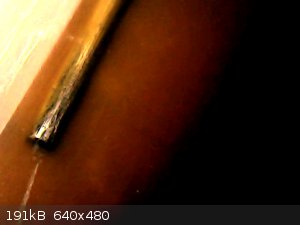
Second picture, slightly different lighting, same tube with a few milli amps of current flowing through 6 washers. Hydrogen/oxygen bubbles are
visible.
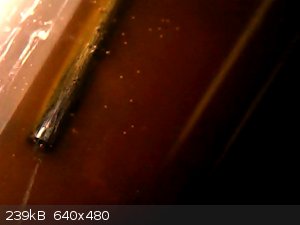
After scratching off the graphite electrode, it immediately plated again with a thin grey coating.
I'm running AC current for a while to see if I can get more ions into solution while removing hydrogen and oxygen...
The solution is slowly becoming less colloidal and more of a clear brown liquid.
The colloid precipitated onto the washers in the background, and you can see some of it piled up on the side of the graphite electrode.
Parts of the graphite electrode, which were not scratched clean, did not plate after re-inserting into the solution. Mostly on the left side near the
tip you can see darker color material.
[Edited on 13-12-2025 by semiconductive]
|
|
|
semiconductive
Hazard to Others
Posts: 388
Registered: 12-2-2017
Location: Scappoose Oregon, USA.
Member Is Offline
Mood: Explorative
|
|
Hmm .... I see sodium dithionite also exists. Wow.
That's even more unstable than meta-bisulfite.
In all cases, the presence of at least one sodium cation is responsible for keeping the sulfer dioxide in solution for short periods of time before
decomposition happens.
I don't see why lithium or potassium woudn't do the same thing.
If I've understood what I've read, correctly:
Sodium meta-bisulfite, dis-associates into two sodium-hydrogen-sulfites; (half salts), in water. That is equivalent to removing half the sodium from
sodium sulfite while in solution. So the half sulfite salt must be reasonably stable in water solution. ( slow decomposition ).
If I want to replace the sodium and bisulfite ions with lithium or potassium bisulfite ions in alcohol, I must work out solubilities and ionization
constants for a metastasis reactions to figure out which ions will exchange, and which ones won't. ( I still need to figure out the formulas for
auto-ionization of alcohol. )
But it brings up two thoughts:
Perhaps I can electrolytically dis-associate iron pyrite (FeS₂ )into a solution of sodium metabisulfite. Iron can be in the +2 or +3 oxidation
state. Sulfur can act like oxygen, S⁻², Therefore: I think iron pyrite might dissolve (on average) into solution as FeS₂⁻ ions.
But, if that's the case, then the ions might come from the cathode and not from the anode ?!
Ahh.... this might explain an earlier experiment that I couldn't reproduce. When I put aluminum anodes into an iron pyrite powder bath, and pulsed
large amounts of current, sometimes I would get iron pyrite films rapidly forming on the aluminum anode surface. But, it wasn't consistent.
Note: Found a useful article
https://ajsonline.org/article/59780.pdf
FeS₂⁻ is unlikely in water, and I suspect alcohol:
Apparently, the most likely situation is ferrous ions and polysulfide anions in a hot water solution 40 [°C]:
Fe⁺² + S₅S⁻² + H₂O + HS⁻ → FeS₂ + S₄S⁻ + H₃O⁺
Sodium sulfide + solid sulfur + alcohol, might make a decent electrolyte to try.
Second thought:
I have cellulose acetate which I cam make a semi-permeable membrane that will allow positive ions to pass in alcohol -- but it will block negative
ions. ( I can't use acetone with cellulose acetate, though, only alcohol or water -- because it dissolves in acetone. )
But:
If I put medium amounts of sodium metabisulfite in one compartment along with iron (solid) next to another compartment containing only sulfamic acid;
(all materials submerged in ethanol and/or 1,3-propanol and separated by cellulose acetate) ,
I imagine the sodium atom will work it's way through the semi-permeable membrane fairly easily and can be precipitated out as sodium sulfamate.
Perhaps this would allow me to build up iron sulfide ions in solution on the other side of the membrane ?
(Any thoughts?)
[Edited on 14-12-2025 by semiconductive]
|
|
|
DraconicAcid
International Hazard
Posts: 4487
Registered: 1-2-2013
Location: The tiniest college campus ever....
Member Is Offline
Mood: Semi-victorious.
|
|
I think you'll have a hard time finding something that iron pyrite will be soluble in.
Please remember: "Filtrate" is not a verb.
Write up your lab reports the way your instructor wants them, not the way your ex-instructor wants them.
|
|
|
semiconductive
Hazard to Others
Posts: 388
Registered: 12-2-2017
Location: Scappoose Oregon, USA.
Member Is Offline
Mood: Explorative
|
|
| Quote: | | I think you'll have a hard time finding something that iron pyrite will be soluble in. |
Yes. So far, I have only gotten small amounts to transfer when using citric acid and DMSO.
But, it's only thin films formed repeatably. Thick plating only happens randomly.
But, the article in the previous post might explain what's going on.
Solid sulfur might need to be present to make poly-sulfides in solution.
Unfortunately, either I don't understand the author's notation or the reactions are not entirely balanced. I wrote into the post what I think they
meant. ( Correct me if I'm wrong. )
I either need to add sulfur to the mix, or remove some iron from the pyrite in order that excess sulfur exists.
Hmm...
I think sulfur goes liquid at around 120[°C].
If it doesn't burn ethyl citrate at that temperature ... I can get my test tube that hot under kerosene, just fine....
[Edited on 14-12-2025 by semiconductive]
|
|
|
semiconductive
Hazard to Others
Posts: 388
Registered: 12-2-2017
Location: Scappoose Oregon, USA.
Member Is Offline
Mood: Explorative
|
|
Now to figure out ionization constants...
I'll take the Kw data for ultra-pure water that I linked to earlier, and I'll assume basic semi-conductor physics (for ice like substances).
I looked up codata for kBoltzman = 8.61733326·10⁻⁵ [eV/K]
So. this will be more accurate than my earlier post's approximations.
The equation for the energy gap is:
C₀ = unknown and is affected by material compression/etc.
C₁ = 3/(2·ln(10)) ≈ .65144
C₂ = 1/( 2·kB·ln(10) ) ≈ 2519.889
E in terms of ( Kw [negative exponent] ,T [Kelvin] ):
E = ( Kw - C₀ - C₁·ln(T) )·T/C₂
At 25 [°C] = 298.15 [K], and 'ultra pure water' I know:
Eg = -0.8280 = ( -13.9933 - C₀ - C₁·ln( 298.15 ) ) · 298.15 / C₂
At standard lab conditions, 298.15 [K] or 25 [°C]:
C₀ ≈ -10.7069
Therefore, I get the following values using a linear energy gap correction that is *opposite* of what NIST shows.
E ≈ -0.8280 + .0008360 · ( T-298.15 )
This is from 0[°C] to 100[°C] in 5 degree increments:
Note: Exponents are negative, and I'm keeping the sign I calculated. For reporting pH calculations in Chemistry, the sign needs to be reversed.
Calculated:
['-14.88', '-14.69', '-14.51', '-14.33', '-14.16', '-13.99', '-13.83', '-13.68', '-13.53', '-13.38', '-13.24', '-13.10', '-12.96', '-12.83', '-12.71',
'-12.58', '-12.47', '-12.35', '-12.24', '-12.12', '-12.02']
From the earlier linked reference, but rounded off to two digits after the decimal:
['-14.94', '-14.73', '-14.53', '-14.34', '-14.16', '-13.99', '-13.83', '-13.68', '-13.54', '-13.40', '-13.27', '-13.15', '-13.03', '-12.92', '-12.81',
'-12.70', '-12.61', '-12.52', '-12.43', '-12.34', '-12.26']
Therefore:
With no phase change correction and assuming a linear model whose voltage *decreases* in total magnitude with increasing temperature; my basic
semiconductor equation yields water errors of:
| 14.88 - 14.94 |/14.94 to | 12.02-12.26 |/12.26 = 0.4% to 2.0%.
(No surprise) The error is smaller near freezing (solid-state) than boiling.
The basic semiconductor equation, even without a correction for liquid motion or pressure vessel distortions is surprisingly accurate when I use the
wrong sign of voltage change from the NIST paper because it agrees with my intuition (I'm not a chemist!). I expect semi-conductor band gaps to
decrease in magnitude with increasing temperature...
Next: I'll compute a correction for typical material expansion and packaging in semiconductors, and see if I can get a better fit.
[Edited on 14-12-2025 by semiconductive]
|
|
|
semiconductive
Hazard to Others
Posts: 388
Registered: 12-2-2017
Location: Scappoose Oregon, USA.
Member Is Offline
Mood: Explorative
|
|
End of control experiment, and it's not really good news:
AC current run for 24+ hours has not increased ion-conductivity of the solution.
I put a fresh graphite catholde (-) into the solution.
No electroplating activity is seen except a tiny bit near the tip. But the amount of metal is small enough that it might be an impurity and not
necessarily iron.
The solution has become clearer and less brown with time.
I raised the temperature at the test tube bottom for the last 8 hours to 120[°C], and that just accelerated the clarification of the solution. The
ethyl citrate is stable, no burning, and surprisingly I haven't lost another CC of solution by boiling out more ethanol.
Post mortem:
H₂SO₄ Ka1 = 100%, Ka2 = 1.2·10⁻²
Citrate Ka1 = 7.4·10⁻⁴ Ka2 = 1.7·10⁻⁵ Ka3 = 4.0·10⁻⁷ # zero ionic strength
Hmmm.... I don't recall how ioninc strength of organic acids change with concentration. But if I look at the zero ioninc strength, it suggests my
mistake was thinking that the Ka2 of sulfate would trap a signifiant portion of the Ka1 from citrate.
The organic acids are much better at holding on to the lithium at low concentrations than the sulfate is. That's rather counter-intuitive. ( Who
knows what temperatures did to the values... )
If I've only got around 10⁻² difference in Ka values at room temperature, then I suspect less than 1% of the lithium ions would transfer from
citrate to sulfate at room termperature?
If I were to repeat the experiment with sulfite ions, though, the sulfite is a much weaker acid than sulfuric. It will hold onto sodium, lithium, and
iron better. Unfortunately, I've already got sodium attached to it....
I'll finish my calculations for auto-ioninzation of water, then alcohol, and then try to work out some estimates for the same experiment using sodium
meta-bisulfite rather than sulfate.
|
|
|
semiconductive
Hazard to Others
Posts: 388
Registered: 12-2-2017
Location: Scappoose Oregon, USA.
Member Is Offline
Mood: Explorative
|
|
Rereading the pyrite article, both sides need to have negative 1 charge total:
I think I missed a '2' for the poly-suflide ion.
Fe⁺² + S₅S⁻² + H₂O + HS⁻ → FeS₂ + S₄S⁻² + H₃O⁺
If both sides are charge neutral, than possibly there is a missing/implied hydronium ion to neutralize the ionised HS⁻:
Fe⁺² + S₅S⁻² + H₂O + HS⁻ + H₃O⁺ → FeS₂ + S₄S⁻² + 2·H₃O⁺
I'm thinking: a very similar reaction might be possible if I use sodium sulfide salt: Na₂S and cook it with elemental sulfur, to produce
polysulfide ions, in an alcohol solution.
I am able to find analogous reactions using either selenide or arsenide, so perhaps practical information and clues are available from more popular
research
https://www.mdpi.com/2079-6412/13/11/1905
[Edited on 16-12-2025 by semiconductive]
|
|
|
semiconductive
Hazard to Others
Posts: 388
Registered: 12-2-2017
Location: Scappoose Oregon, USA.
Member Is Offline
Mood: Explorative
|
|
Sigh. There is definitely a difference between semiconductor physics and chemical reactions / fuel cells. I find it amazing that I got such close
agreement (2%) after curve fitting semiconductor equations when they are likely incompatible.
When I calculate the energy gap voltage for 'super pure water' using semiconductor equations, the energy gap can be shown to decrease as temperature
increases.
Assuming the energy gap was 0.828 [eV] at 25 [°C], this graph shows the energy gap required for super pure water vs. temperature in order to produce
the correct number of hydronium and hydroxide ions.
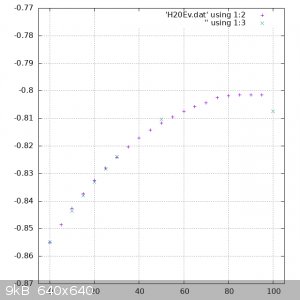
Y axis is the energy gap, x-axis is temperature in Celsius.
This is a graph of the expected (empirical) band gap voltage shape vs. temperature is water acted the same as a solid semiconductor.
Note:
Although the ionizing voltage drops as temperature increases, the ionizing voltage changes less and curves more with increasing temperature.
That's a clue that the physics is very different.
Y.P. Varshni's correction isn't going to work for water.
The trend in semiconductors is opposite of what water does. A typical semiconductor ionization voltage curves most near absolute zero Kelvin, and
decreases in magnitude with increasing temperature -- but the slope of energy gap change per decree celsius becomes more linear with temperature (not
less).
example: Silicon, and several other semiconductors:
https://www.researchgate.net/publication/319068163_A_novel_t...
When I read up on fuel cell reactions, I see that the voltages measured do increase with temperature. ( Just tried it with a AA battery as well. )
But when I measure the voltage across a silicon diode for a fixed amount of current, the opposite happens. As the diode gets hotter, the voltage
decreases.
So my intuition is exactly backward, and I need to figure out why before I can do anything more.
|
|
|
bnull
National Hazard
Posts: 933
Registered: 15-1-2024
Location: East Woods
Member Is Offline
Mood: Happy New Year!
|
|
| Quote: | | There is definitely a difference between semiconductor physics and chemical reactions / fuel cells. I find it amazing that I got such close agreement
(2%) after curve fitting semiconductor equations when they are likely incompatible. |
I've had my share of these things in my time in Physics. After a while, the amazement gave way to a chuckle and a "That again."
Some comments. (1) pH decreases with temperature, and pH plus pOH is not a constant. The sum is 14 at 20 °C (or 25 °C, I forgot which one) and goes
up or down according to how much hotter or colder than that water happens to be. (2) The lattice in solid water is very different from the one in
semiconductors. Water molecules are polarized, whether protons or hydroxyls are present as impurities or not. The same doesn't happen to silicon, not
to mention that the impurities in silicon serve to increase conductivity. The ways that charges can travel within both lattices are very different.
It's years since I dealt with semiconductor physics and I forgot most of it. I can still visualize it but I can't explain it in words.
Edit: Fixed an idiotic mix up.
[Edited on 16-12-2025 by bnull]
|
|
|
semiconductive
Hazard to Others
Posts: 388
Registered: 12-2-2017
Location: Scappoose Oregon, USA.
Member Is Offline
Mood: Explorative
|
|
| Quote: | | Some comments. (1) pH decreases with temperature, and pH plus pOH is not a constant. The sum is 14 at 20 °C (or 25 °C, I forgot which one) and goes
up or down according to how much colder or hotter than that water happens to be. |
Charge neutrality must exist both in intrinsic semiconductors and (equally true) neutral liquids. Electrons and protons are neither created nor
destroyed during ionization events -- the charges only physically move around.
For: Pure water (with no contaminating ions that are not made of hydrogen and hydroxide); I already know the Kw data. SInce pOH=pH at every
temperature that is electrically charge neutral -- I expect pOH+pH = 2·pH = 2·pOH for distilled water.
From two posts back the exponents of Kw for 'ultra pure' water are listed. I think these values equal -(pH+pOH) for every 5 [°C] increment:
['-14.94', '-14.73', '-14.53', '-14.34', '-14.16', '-13.99', '-13.83', '-13.68', '-13.54', '-13.40', '-13.27', '-13.15', '-13.03', '-12.92', '-12.81',
'-12.70', '-12.61', '-12.52', '-12.43', '-12.34', '-12.26']
Therefore, the pH value of 'neutral' water is (by definition) - 1/2 the total exponent:
pH=pOH=[' 7.47', ' 7.36', ' 7.26', ' 7.17', ' 7.08', ' 7.00', ' 6.92', ' 6.84', ' 6.77', ' 6.70', ' 6.64', ' 6.57', ' 6.52', ' 6.46', '
6.41', ' 6.35', ' 6.31', ' 6.26', ' 6.21', ' 6.17', ' 6.13']
T[°C] = [ 0,5,10,15,20,25,30,35,40,45,50,55,60,65,70,75,80,85,90,95,100]
The number 7.00 shows up at 25 [°C] in this chart.
Therefore: I'm seeing distilled water pH values decrease with temperature.
eg: That means the number of hydronium ions is *increasing* as the liquid gets hotter because the number's exponent is by convention the negative of
the pH number.
Both authors I found online show the same trends (though slightly different values) vs. temperature. They agree very well from 0 to 30 [°C], but
there are disputes up to 3% for hotter temperatures.
Note: There are a couple of problems with this kind of data: people regularly fail to report what the source of water was and how the measurement was
made.
Therefore, I can't do any math to correct for things such as an experiment done in a closed jar (approximately iso-choric) vs. an open jar
(approximately iso-baric). In a lot of ways, this makes the data somewhat useless...!
But: Two different authors have the given approximately the same values (rounded to three digits) in their data for low temperatures, so I think
whatever experimental conditions were used by one author are very similar to the other author.
I could put some pH indicator in distilled water, but that technically will change the pH since pH is very sensitive to the mass-action law.
Note: The same mass-action law is used in semiconductors as with liquids.
[Edited on 16-12-2025 by semiconductive]
|
|
|
bnull
National Hazard
Posts: 933
Registered: 15-1-2024
Location: East Woods
Member Is Offline
Mood: Happy New Year!
|
|
| Quote: | | I'm curious: Do you have a reference experiment showing the pH increase with temperature? |
No. I just happen to be a jackass and didn't notice what autocorrect did and wrote accordingly. Sorry for that.
Edit: What I was going to write, and somehow fumble and forgot it, was that the number of charge carriers increase with temperature, and so does the
movement of the water molecules. In semiconductors, such movement is restricted by the lattice. The same doesn't happen in water because there is no
restriction as to where a molecule goes except for the walls of the container and (to some extent) the surface of the liquid.
Also, the band gap is directly related to the characteristics of the lattice; what happens to the band gap when there is no lattice?
On a side note, ice can behave as a semiconductor. I've downloaded a paper (which I intend to read as soon as I can find it) about
electrical/electronic/electrochemical properties of ice, with and without dopants (mainly acids and bases). This, unfortunately, is completely useless
for you as you want to plate metals onto stuff, not make an ice transistor.
[Edited on 16-12-2025 by bnull]
|
|
|
semiconductive
Hazard to Others
Posts: 388
Registered: 12-2-2017
Location: Scappoose Oregon, USA.
Member Is Offline
Mood: Explorative
|
|
| Quote: | Edit: What I was going to write, and somehow fumble and forgot it, was that the number of charge carriers increase with temperature, and so does the
movement of the water molecules. In semiconductors, such movement is restricted by the lattice. The same doesn't happen in water because there is no
restriction as to where a molecule goes except for the walls of the container and (to some extent) the surface of the liquid.
Also, the band gap is directly related to the characteristics of the lattice; what happens to the band gap when there is no lattice?
|
OK! Got it!
Hey, every post of mine is edited ... I'm lucky to write exactly what I mean by the third edit. ( Disability and medication side-effects. )
I'm very qualified to do solid state semiconductor modeling. So good that a patent of mine has been stolen by 13+ U.S. companies who never paid the
owner of the patent a penny. Starting cost for litigation is $6 Million. ( And I'm not bothering to pursue. )
So, I'm kind of reading your question and thinking "He believes the grass is greener on the other side of the fence AKA: life is simpler in solids."
I agree, there are differences between liquids and solids; and I'm going to have to understand them to get any better at chemistry.
But, there is a reason I tried the semiconductor equations on liquids; and I'd like to elucidate a bit.
AKA: solids aren't simple! (Trust me!!!)
If you click on the link I gave for energy gaps in semiconductors, you'll see both simple crystalline semiconductors and compound semiconductors with
huge mixes of oddly shaped atoms (both). The crystal shape (no matter how perverted) doesn't change the basic equations which model them.
The fact is, many solids even have dipole moments in the crystal. A good example is the lithium citriate I made for the test experiment in this
thread. As a solid, Cit-Lit is piezoelectric; therefore merely placing an electric field across a crystal will cause the lattice spacing to change.
( eg: for the crystal to snap meta-stably into different shapes. ) This is how "Ferroelectric" memory works.
The 'lattice spacing' of silicon isn't really constant, either.
Depending on which direction you go measure the atom spacing through the crystal, the atoms will be closer or farther apart.
I can even take electronic transistors in plastic packages, and make a device to change the gain of a purchased transistor changing the pressure
applied to the outside of the package.
Very few people even realize that merely talking next to a transistor can cause it's gain to change a *tiny* bit from sound waves hitting it.
The ability of lattice spacing (in silicon/solids) to change just means that the tendency of ions to be released in certain directions, and the
conductivity of the material in different directions, is hetrogenous.
eg:
I can demonstrate metal contacts hooked to silicon wafers at exactly the same spacing, but along different directions of the crystal, and the
resistance values measured by my ohm meter will be different in one of three orientations (but not the other two).
Anytime you put an impurity atom into a lattice, the lattice gets deformed. Other times, ions can migrate through the lattice just as if it were very
viscous liquid. Electromigration is a real phenomena even in AMD and Intel made microprocessors.
Their engineers do everything they can to 'stop' it!!!!
I seem to recall; You linked me in another thread to an article about making sodium by having it flow through the glass envelope of a vacuum tube.
The electrons from a heated filament reduce the ions to sodium metal.
So, I'll return your own novel example to you.
That, right there, is solid state electroplating!
( Cool idea, by the way. )
Electroplating (albeit very SLOW) is also likely possible in ice.
It's also the case that semiconductors can melt when they get hot enough. Yet, (strangely) the same equations are used to model them.
So -- with that backgorund: let me answer your rhetorical question:
There always an average distance between atoms, and you do a density of states calculation in all directions and compute a statistical average
'effective' lattice distance that weights the distances by how often (percentage) they exist.
When you get into liquids, the same ought to work.
I think the article that Draconic Acid linked me to demonstrates this for alcohol:
| Quote: |
For methanol, pK(autoionization) = 22.67
|
https://pubs.acs.org/doi/10.1021/acs.jpca.5c03979
The quantum mechanics relationships are identical regardless of the phase of the material for density of states calculations.
I'm thinking:
The very fact that the law of mass action is used in chemistry of liquids and that the same law can be derived physically from density of states
calculations in solids (semiconductors), shows that the fundamental physics can not be essentially different; but only that the density of states
needs to be modified in some way in *value* or trends.
I'm sure if you get a chart of the density of water (molecules/cm³) from NIST, it will show that water molecule spacing (average) expands over most
of it's liquid temperature range from 5[°C] to boiling.
When I thought about doing the calculation, I only suspected a real difference in water properties as compared to silicon in the -10 degrees to +10
degrees celsius region.
Because this temperature range is a place where the spacing of atoms doesn't follow a single trend. It doesn't always shrink with temperature or
always grow with temperature.
Y.P. Varshni's correction assumes a single direction of change.
I'm sure theres a couple of differences in that:
1) The spacing of molecules can change rapidly with time in a non-oscillatory (phonon) manner in a liquid. 2) The molecules are able to rotate which
allows for more 'states' to exist.
Thus the 'density' of states will be affected by how much a molecule is free to rotate vs. temperature.
But the fact that the calculation reveals the band gap becoming almost constant near the boiling temperature of water means that there are at least
two spacing/fighting effects going on in water that work in opposite directions.
From the chart, it looks like 40 degrees C is about where these two different trends in statistical spacing of water happens.
I don't see anything suspicious near 4 degrees Celsius, and that's where I would have suspected the biggest differences to appear. The density of
water changes it's slope around 4 [°C].
This makes me suspicious that I've mis-identified the band-gap (or band separation) energy of water ionization with the voltage of the fuel cell.
In semiconductors, I used to laugh at people who think the optical band gap is identical with the semiconductor band gap. For, I've done experiments
showing they don't always agree -- but that there is a predictable relationship in the error.
But, I've got that feeling that I'm probably making the same mistake in this thread and I'm not sure where I did it. Anxiety kicks in....
Boltzmann statistics and math operate exactly the same regardless of material phase. So, what assumption have I made about batteries that is wrong --
and how do I check it?
|
|
|
bnull
National Hazard
Posts: 933
Registered: 15-1-2024
Location: East Woods
Member Is Offline
Mood: Happy New Year!
|
|
My statistical mechanics has been dead and buried since before Pandemics. Good to see forgotten stuff brought back to life (of sorts). And no, I've no
answer to that.
I found the article I mentioned and there's good news and bad news. The good news is that the article on semiconducting ice mentions another article
on the measurement of the band gap of water, which by its turn references an article on the dependence of the ionic product of water (Kw) on
temperature (in Russian, again), so you can compare the latter with what you have so far. The bad news is, the publisher of both the first and the
second article is considered a predatory publisher and they were written by the same person. But even a broken clock is right twice a day, so I'm
attaching both articles here.
Attachment: S. Yefimov - Ice diode.pdf (378kB)
This file has been downloaded 35 times
Attachment: S. Yefimov - Band gap of water.pdf (292kB)
This file has been downloaded 37 times
|
|
|
semiconductive
Hazard to Others
Posts: 388
Registered: 12-2-2017
Location: Scappoose Oregon, USA.
Member Is Offline
Mood: Explorative
|
|
Very interesting. Thank you for the articles.
Note: 4.3[°C] is roughly 0.0036 on the chart in the second paper.
S. Yefimov is assuming a constant energy gap for all data points and using a simplified equation.
If I plot his paper's regression line vs. the combined (rounded off) American Kw data that I found, you'll see that my plot and his are very similar
except at 4.3 degrees C.
( Which is where I would expect a defective point to be found based on water density being a maximum. )
Note: When I plot his equation (2), I don't get his regression line.
Do you see a mistake in the equation I plotted?
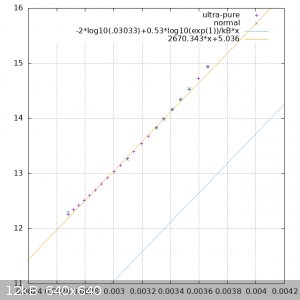
I will recompute the band-gap value from the regression line of the plot (in brown), to see what I get (next post) if there's no obvious error in what
I plotted.
|
|
|
semiconductive
Hazard to Others
Posts: 388
Registered: 12-2-2017
Location: Scappoose Oregon, USA.
Member Is Offline
Mood: Explorative
|
|
There's only one really noticeable difference between the equations S. Yefimov is using, and the ones I used from quantum mechanics.
He isn't correcting for quantization of states.
eg: He's neglecting a T^(3/2) factor which is missing.
Why:
Whenever an object moves it has an energy and a momentum; but quantum mechanics makes a single extra requirement that all possible energies and
momentum(s) are not continuous but are broken up by Plank's constant and the relationship E=hf.
What this ultimately means is that there is a discrete number of speeds which an object of mass 'm' can take on for finite changes in energy. The
number of speeds an object can take on for a finite change in energy is known as the 'density of states' (DOS).
The following videos are not necessary, but they are a refresher course on how to figure out how many charged particles of a given mass could be
moving (in any way, whatsoever) in a trapped (ionized) environment.
https://www.youtube.com/watch?v=z7YGS67GETo
https://www.youtube.com/watch?v=3vFNQOx6kBo
To summarize the video: for charged objects having some average mass, the statistical number of possible ions per mole of ionizable material (where
the ionized object has mass m) is determined by a simple classical approximation formula:
g(E)·dE = 4·π·(2·m)^(3/2)·√(E) / h³
This formula is written in the square root of energy, but it really is linear in velocity (speed of ion travel.) And chemists know that velocity is
fixed by temperature and mass.
Therefore, the full equation for semiconducor ion concentration is usually a little bit more complicated than in the articles you linked.
Ni = C₁ · T^(3/2) · e^(- Eg/( 2·k·T ))
Consider:
The number of atoms in a given mass of water, or silicon, or whatever, is usually constant. But the volume that number of atoms occupies changes
with temperature depending on the thermal expansion characteristic of the material.
Hence, the above formula should (personal opinion) work even for gasses, but it doesn't take into account volumetric changes.
In the other article:
The straight line fit, 2670.343/T + 5.036 assumes that the volume of water does not change with energy and the water does not change in volume with
temperature. eg: He's assuming these two effects cancel each-other out -- and they generally don't.
It's the gentle curve among the data points which he is not predicting, correctly.
In my formula, you can remove the term which makes a generic quantum mechanical correction for ion velocity. This will reduce it to the same as S.
Yefimov's equation.
Doing that means:
Eg = (kW - const )·T / 2519.8890927
(kW-const) = Eg*2519.8890927/T
Assuming the constant is zero (as I don't know why the constant shows up there, anyhow), the energy gap in electron volts for the article ought to be:
2670.343/2519.8890927 = 1.0597 [eV]
[Edited on 17-12-2025 by semiconductive]
|
|
|
chornedsnorkack
National Hazard
Posts: 579
Registered: 16-2-2012
Member Is Offline
Mood: No Mood
|
|
What is the distinction between "electromigration", "electrolysis" and "electrophoresis"?
|
|
|
| Pages:
1
2
3 |
|



![[*]](images/xpblue/default_icon.gif)


