Lion850
National Hazard
  
Posts: 517
Registered: 7-10-2019
Location: Australia
Member Is Offline
Mood: Great
|
|
Manganese gluconate (& other gluconates)
I was wondering how strongly pink manganese gluconate would be, so made it to find out! A hot calcium gluconate solution (solubility increases greatly
near boiling) was mixed with a manganese sulphate solution in stoichiometric amounts; solution immediately became cloudy but it was stirred for some
15 minutes. After stirring a white ppt of presumably calcium sulphate quickly settled:
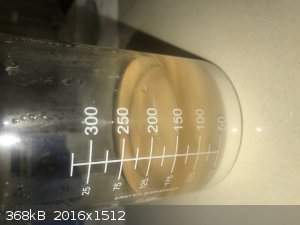
The solution was filtered and the filtrate boiled down to around 40ml. It was then transferred to a steam bath. A white with pale pink crust
crystalized out and dried easily on the steam bath. The was this crystallized out of solution was a surprise, as both cobalt gluconate and copper
gluconate when made similarly dried to a sticky mess that then had to boiled with xylene to get a dry free flowing salt (as reported elsewhere
referenced below).
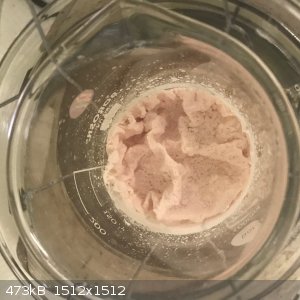
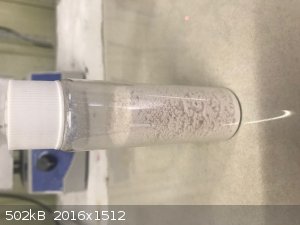
After crushing the product was looked a lot less pink! Yield was over 90%.
My earlier brief post on copper gluconate can be find here:
http://www.sciencemadness.org/talk/viewthread.php?tid=16586&...
And cobalt here:
http://www.sciencemadness.org/talk/viewthread.php?tid=78561&...
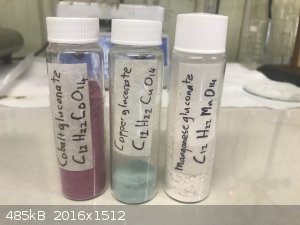
I don't think these are particularly interesting compounds but I thought good to get the pictures out as example of what the salts looks like. I will
add to this post as I make gluconates.
|
|
|
Bedlasky
International Hazard
   
Posts: 1252
Registered: 15-4-2019
Location: Period 5, group 6
Member Is Offline
Mood: Volatile
|
|
Lot of manganese(II) salts are not very interesting in colour, because they are just white. A made manganese phosphate and ammonium manganese
phosphate and they both look the same. Triammonium hexamolybdatomanganate(II) was big surprise to me, because it is orange (unlike manganese(II)
molybdate which is white). Anyway, nice collection of gluconates!
|
|
|

KoiosPhoebus
Hazard to Self

Posts: 55
Registered: 23-1-2023
Member Is Offline
|
|
An interesting follow-up on copper(II) gluconate:
Gluconic acid has two pairs of hydroxyl groups in threo-configuration, which means that it can form complexes with Si4+ according to this paper. That paper and another paper by the same group seem to suggest that the most common complex is a 1:3 Si:Gluc, hexa-coordinate complex, for example:

I wondered whether such a complex could also further complex other metals, in a similar fashion to Fe(CN)64-. Another example is
boron complexes with similar boron-diolate coordination, such as calcium borogluconate.
To try and prepare a silicogluconate, I first prepared copper(II) gluconate by reacting calcium gluconate and copper(II) sulphate. 9.15 g of calcium
D-gluconate monohydrate (~0.02 mol) was dissolved into ~80 mL of hot water with some difficulty. 5.04 g of copper(II) sulphate pentahydrate was
dissolved into ~15 mL of water separately and the two solutions were combined. The calcium sulphate precipitate was filtered off and the solution
topped up to 150 mL and mixed thoroughly. 75 mL of the copper(II) gluconate solution (~0.01 mol) was decanted into a separate beaker.
In another beaker, 1.79 g of glucono-delta-lactone (~0.01 mol) was dissolved into ~10 mL of water. Glucono-delta-lactone (GDL) hydrolyses in water to
give gluconic acid, particularly in alkaline conditions where the gluconic acid deprotonates to give gluconate (and hence cannot cyclise back to GDL).
To this solution, I added 0.62 g of 90% potassium hydroxide (~0.01 mol), then stirred with mild heating to form potassium gluconate. After about 5
minutes of the mixture becoming clear, I added 1.25 mL of 8M K2SiO3 to prepare a potassium gluconate/silicate solution.
After a few minutes of mixing, the potassium gluconate/silicate solution was then added to the 75 mL of copper(II) gluconate solution with stirring.
Immediately upon addition, a deep blue complex formed which resembled that of a copper-ammonia complex. Compare the Cu/Si/Gluc mix on the left with
the copper(II) gluconate solution on the right:

(the copper(II) gluconate solution looks slightly more greenish-blue in-person)
After a minute or less of stirring, a dark-blue gel started to form towards the top of the solution:
 
Additionally, at the bottom, a greenish precipitate began to form:

I'm not entirely sure what either precipitate was, so I gravity-filtered the solution through some qualitative filter paper. While leaving the beaker
out, I noticed that the gel seemed to shrivel and lose water:

Interestingly, a yellow precipitate seemed to have formed on the stir bar, but not anywhere else. When cleaning up, the precipitate dissolved readily
into a sulphamic acid solution that I use for cleaning metal stains.

I wonder whether under specific conditions, the gluconate can act as a reducing agent for copper(II), forming hydrated copper(I) oxide in the process?
Alternatively, it's plausible that there was some trace of glucose (a reducing sugar) either in the calcium gluconate or glucono-delta-lactone used as
the sources of gluconate ion; my understanding is that GDL is synthesised by oxidising glucose.
The filtrate was still a deep blue with the precipitates filtered off (picture on right taken with camera flash, solution slightly more green-blue in
person):

And the precipitate was also a fairly deep blue:

As far as I can tell, washing the precipitate with distilled water does not appear to reduce its blueness. Given the gel-like consistency of the
precipitate, it's probably made of some kind of amorphous silica. My guess would be that it's silica gel which has adsorbed some of the copper(II)
gluconate complex, perhaps even enclosing some of the complex in itself. It could also possible that the copper(II)-gluconate has formed part of the
structure of the silica. Once it's dried, I'll add some of it to a sulphuric acid solution to see if the copper(II) is dissolved out.
As for the deep-blue complex: my suspicion is that the alpha-hydroxy group on at least some of the gluconate ions deprotonated and coordinated to the
copper(II). Gluconate is considered a useful metal chelator in alkaline solution (https://www.acs.org/molecule-of-the-week/archive/g/d-gluconi...) though some authors seem to consider the complexes formed as M(OH)L complexes
instead of MH-1L complexes; i.e. they think the gluconate complexes formed in alkaline solution involve gluconate and hydroxide coordinated
to the metal, as opposed to the gluconate itself deprotonating and complexing the metal.
However, one publication does describe something very similar where they noted deprotonation of the alpha-hydroxy group in the copper(II)-lactate
complex: https://doi.org/10.1149/2.0831810jes
Of interest from that paper is this image (Figure 5c):

The colour of the copper(II)-lactate complex in that image very closely resembles the comparison between the first photo comparing
copper(II)-gluconate vs the alkaline copper(II)-gluconate + silicate. As the alpha-hydroxyl group of lactic acid is more basic than that of gluconic
acid (pKa=15.1 for lactic acid, pKa=13.9 for gluconic acid), it's quite likely that the deep-blue complex obtained involves gluconate anions with deprotonated hydroxyl groups. A purer version
of the same complex could probably be obtained by reacting copper(II) gluconate with sodium/potassium hydroxide, or a mixture of sodium/potassium
gluconate and sodium/potassium gluconate to provide the gluconate dianion in excess to minimise Cu(OH)2 precipitation.
[Edited on 20-5-2025 by KoiosPhoebus]
|
|
|
moviez
Hazard to Self

Posts: 63
Registered: 25-8-2024
Location: USA
Member Is Offline
Mood: No Mood
|
|
Lots of interesting gluconate chemistry here!
I actually purchased a small amount of manganese gluconate from a supplement company. It’s a solid with very faint pink color. After taking the
picture, I had to turn up the color saturation to see the pink hue.
One interesting experiment of metal gluconates: they can add some sparks in your homemade firework! The hypothesis is some metal gluconates, when
heated, can form fine metal particles, which react with the oxidizer/oxygen in the air.
The composition is just oxidizer + metal gluconates, with gluconates in slight excess. So far, manganese and ferrous gluconate worked the best. The
flame temperature should remain relatively low so Ammonium Perchlorate should be used. I’ve tried potassium perchlorate but the reaction was too
fast. once you found the right composition, you would see really impressive display of sparks when you light the mixture. It’s probably much safer
to mix oxidizer + metal gluconates instead of oxidizer + powdered metal.
|
|
|
KoiosPhoebus
Hazard to Self

Posts: 55
Registered: 23-1-2023
Member Is Offline
|
|
Quote: Originally posted by moviez  | | One interesting experiment of metal gluconates: they can add some sparks in your homemade firework! The hypothesis is some metal gluconates, when
heated, can form fine metal particles, which react with the oxidizer/oxygen in the air. |
Interesting! This sounds a lot like the preparation of pyrophoric metals from
organic metal complexes (e.g. https://www.youtube.com/watch?v=JSbKnZPHiNw). My understanding is that the oxalate is most commonly used where possible because oxalates are very
insoluble so it's easy to just react a soluble oxalate and a soluble metal salt, then filter off the metal oxalate. Some metal oxalates don't
decompose to give the pyrophoric metal though, and manganese might be one of those special cases where the gluconate is the only option.
I do wonder if the gluconate could stabilise manganese in the 3+ oxidation state, where you tend to get more intense colours (see manganese violet for an example). My guess is it'd just be a red or brown compound, but you never know!
|
|
|
|