Sulaiman
International Hazard

Posts: 3938
Registered: 8-2-2015
Member Is Offline
|
|
Unexpected flames
I re-melted 16+ kg of lead with all lead waste (dross etc.) that I had,
having read more about lead cleaning/refining since my first attempt
I used candle wax as a flux and a very dry wooden stirring stick.
I think that in my first attempt I used too low a temperature,
so this time I decided to turn the heat to max.
Here is what happens when the lead exceeds the autoignition temperature of candle wax 
https://youtube.com/shorts/qQpYCdDTtIw?si=z9SKtxVvc3ZG9YXz
CAUTION : Hobby Chemist, not Professional or even Amateur
|
|
|
unionised
International Hazard
Posts: 5142
Registered: 1-11-2003
Location: UK
Member Is Offline
Mood: No Mood
|
|
Ignition temperatures depend on the surface.
It's also possible that the flames were ignited by a hot spot formed when some lead oxide was exothermically reduced by the wax.
|
|
|
Sulaiman
International Hazard
Posts: 3938
Registered: 8-2-2015
Member Is Offline
|
|
True, also I used open gas flames for heating,
... I played with it a little,
covering the pot extinguised the flames
but when the cover was removed the pot burst into flames again within seconds..
(could be wax vapours reaching the flames below?)
Anyway, my main point of posting is to warn and possibly amuse some members,
because the videos that I've watched , where wax was used as a flux for lead
never showed spontaneous combustion.
CAUTION : Hobby Chemist, not Professional or even Amateur
|
|
|
teodor
International Hazard
Posts: 1169
Registered: 28-6-2019
Location: Netherlands
Member Is Offline
|
|
I didn't know you need a flux for lead. But if you really need to protect the top layer from oxidation you can try to find some soluble salt of a
relatively weak acid with the melting point just above the melting point of lead and that one which is not decomposing. It will form a good protective
layer above the liquid lead when molten and you can easily wash it out when cold.
|
|
|
Sulaiman
International Hazard
Posts: 3938
Registered: 8-2-2015
Member Is Offline
|
|
I did not want to use borax etc. as I want to keep the antimony in the alloy
(lead scrap, old tin:lead solder and battery plates)
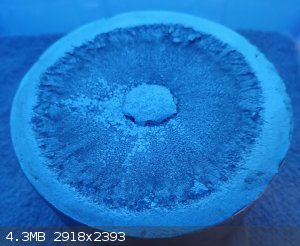
The lead has now cooled, this is how it came out of the pot
top
bottom
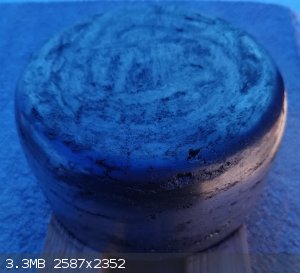
I think that it is now clean enough to cast.
CAUTION : Hobby Chemist, not Professional or even Amateur
|
|
|
Fulmen
International Hazard
Posts: 1794
Registered: 24-9-2005
Member Is Offline
Mood: Bored
|
|
Yes, this is common in my experience. I always ignited the fumes anyway to keep the smell down, and to prevent a huge fireball when the smoke
inevitably ignites.
@teodor: Lead needs fluxing if you want pure metal. The oxidation rate of molten metal in air is actually fairly slow, so a lid is usually enough to
prevent any significant loss. But without fluxing you often get a oatmeal-like mix of metal and oxides that won't cast well. Some claim that the oxide
is reduced by the flux, I sincerely doubt it. The boiling point of wax is simply too low for this. I believe it simply breaks the adhesion between
metal and oxides.
We're not banging rocks together here. We know how to put a man back together.
|
|
|
Sulaiman
International Hazard
Posts: 3938
Registered: 8-2-2015
Member Is Offline
|
|
I am inclined to believe that
something has reduced most of the oxide that I added back to the pot.
I had lots of dross, but after this run I had quite a lot of charcoal and a surprisingly small amount of dross.
(considering that more than half of the lead was from old diving weights, and quite a lot from corroded battery plates)
I used a dry wood stick because the charring of it releases, amongst other stuff, carbon monoxide - capable of reducing lead oxide.
That is something like what I read anyway.
I guess that the hot vapourised wax, or its combustion products, may also reduce lead oxide.
I am a complete beginner at this, so I accept all advice.
CAUTION : Hobby Chemist, not Professional or even Amateur
|
|
|


![[*]](images/xpblue/default_icon.gif)


