Disruptive
Harmless

Posts: 14
Registered: 12-12-2025
Member Is Offline
Mood: Curious
|
|
Carboxy Esters and Biochemistry - Let Us Dig into the Nitrogen Cycle Reactions First
It is hereby taken as given that fundamental biological reactions in the nitrogen cycle are enabled by carboxy ester chemistry. The reactions are
outlined in
"EVIDENCE OF CARBOXY ESTER MECHANISMS IN NITRIFICATION FROM THE DYNAMIC REACTION KINETICS AT NATURAL CONCENTRATIONS. Part II and III- zenodo.8239416
" (preprint with 500 downloads - free).
Taking biochemistry reactions as a subset of general chemistry, and not a kind of biological redox magic, let us examine the oxidation of ammonia in
nitrification. With the carboxy ester route, it is carbamate that is being oxidised by a peroxide making enzyme to form iron stabilized hydroxamic
acid. The question then is, what molecules and haems are involved in making the carbamate and transporting the hydroxamic acid? Where are they to be
found? With the addition of hydroxylamine (hydrazine?), ester molecules can be hijacked. The use of isotopes is thus an option. Can the iron molecule
be converted to a magnetite form to allow isolation via magnetism? ATP and phosphate ions are probably involved, which provides another way to find
the molecules involved. Any suggestions and help from the amateur chemistry world would be greatly appreciated. If the professionals (Profs) have left
the science lab since 2023, then the "amateurs", also those with a PhD, need to step in. We are in a climate crisis.
For those who disagree with the carboxy ester mechanisms, please repeat the reaction kinetic experiments outlined in the preprints and report the
statistical results. For participants of the latest conference on nitrification, who do not need to respond to disruptive science (chemical
engineering fundamentals) theories, please open a post disproving the ferric hydroxylamine test for esters.
I should not need to say it, but please review the evidence before posting a reply. If you intend to follow up on these reactions yourself, I would
ask you to send a note to that effect.
Many thanks in advance
Merry Newtonmas
Attachment: Part3Short.pdf (154kB)
This file has been downloaded 26 times
Attachment: chemguide.PDF (632kB)
This file has been downloaded 26 times
Attachment: EsterTest1934.PDF (139kB)
This file has been downloaded 32 times
|
|
|
Texium
Administrator
Posts: 4731
Registered: 11-1-2014
Location: Salt Lake City
Member Is Offline
Mood: Seeking gainful employment
|
|
What sort of feedback are you looking for? It’s not clear at all given your post or the three seemingly random documents that you attached.
|
|
|
Texium
|
Thread Moved
18-12-2025 at 12:47 |
Disruptive
Harmless
Posts: 14
Registered: 12-12-2025
Member Is Offline
Mood: Curious
|
|
Thanks for the feedback. I am looking for help in finding and identifying other key molecules in the nitrification reactions.
The first document is a short summary of the part 3 preprint and the issues at hand. In 1952 a famous chemist hypothesised an organic carbon path for
the oxidation of ammonia, but an experiment adding hydroxylamine, and reported in Nature, led some researches to believe that hydroxylamine itself was
an intermediate. As a chemist you probably know the ferric hydroxylamine test for esters. There is thus no direct evidence for hydroxylamine itself
and the preprints yield evidence for carboxy ester mechanisms. That is the carboxy ester reactions are in line with the famous chemists organic
moleculr hypothesis. The problem is that hydroxylamine is quoted to date by nitrification biologists as the intermediate and all the other reactions
are seen as some magic redox enzyme chemistry. I don't want to be over dramatic, but knowledge of the reaction rates and mechanisms in the nitrogen
cycle are very important given the climate crisis. The nitrification biologists sem not to want to admit that they most likely took a wrong path in
1952 and they are not communicating as scientists would be expected to do.
The chemguide document is taken from the website with the same name. It is for 17 year old chemistry school students and the reaction rate equation
example is as in the preprint.
The estertest1934 is an early reference to the standard ferric hydroxylamine test for esters.
|
|
|
bnull
National Hazard
Posts: 933
Registered: 15-1-2024
Location: East Woods
Member Is Offline
Mood: Happy New Year!
|
|
I don’t know. It looks like an extraordinary claim. I’d feel more comfortable if there was an independent study confirming, or at least
suggesting, the same mechanism, either as the sole pathway or as one of several operating in nature. Nature often performs the same function in more
than one way (carbon fixation via Calvin cycle and Wood-Ljungdahl, for example).
|
|
|
chempyre235
Hazard to Others
Posts: 200
Registered: 21-10-2024
Location: Between Nb and Tc
Member Is Offline
Mood: Buried in chemistry
|
|
| Quote: | | Nature often performs the same function in more than one way |
I agree. If heme is involved with nitrogen fixation (though I admittedly haven't read much about this particular phenomenon in biochemistry), I'd say
that there is a redox reaction likely involved. Hemoglobin promotes a redox reaction with diatomic oxygen, reversibly reducing it to a superoxide
(O2-), which bonds to the iron center in the heme, which oxidizes from Fe2+ to Fe3+ in the process.
Superoxide dismutase causes disproportionation (dismutation) of superoxide radicals to peroxide and diatomic oxygen. I don't know for sure, but I
would guess that ammonia oxidation applies similar principles.
Maybe try some reading on hydroxylamine oxidoreductase, which is the heme-based compound responsible for the oxidation of ammonia in some bacteria.
Additionally, nitrogenases, which are where hydrazine may be involved, are responsible for the evolution of nitrogen gas from amines and ammonia by
some anaerobic bacteria.
| Quote: | | The nitrification biologists sem not to want to admit that they most likely took a wrong path in 1952 and they are not communicating as scientists
would be expected to do. |
| Quote: | | If the professionals (Profs) have left the science lab since 2023, then the "amateurs", also those with a PhD, need to step in. We are in a climate
crisis. |
@Disruptive, could you elaborate a little, please? These are very exasperated claims, but with no explanation or evidence presented.
"However beautiful the strategy, you should occasionally look at the results." -Winston Churchill
"I weep at the sight of flaming acetic anhydride." -@Madscientist
"...the elements shall melt with fervent heat..." -2 Peter 3:10
|
|
|
Disruptive
Harmless
Posts: 14
Registered: 12-12-2025
Member Is Offline
Mood: Curious
|
|
Thanks for the interest. What you mean is extraordinary claims need extraordinary proof. YES my point. Please repeat the experiments people. All you
need is an old aquarium. After 2 years the nitrification biologists have refused to answer e-mails never mind do repeat experiments (the technology
has improved).
The first issue is that hydroxylamine itself has never been proven as adding hydroxylamine is the test for esters. Indeed it has never been found in
the normal oxidation of ammonia. I go into this in detail in the preprints. What I have shown in my kinetic data, and that of others, is that
hydroxylamine itself is not compatible with the kinetics. The kinetics demands additional molecules to ammonia.
You are absolutely correct, biochemistry often uses the same mechanisms elsewhere. In fact this is how I zoomed in on carboxy esters. You will find
carboxy phosphate ester on the urea cycle.
My approach was based upon looking at nitrification as a chemical process, I am a chemical engineer by training. My design project was an ammonia
plant. I wanted to know how biochemistry did such reactions at much milder conditions.
Given the climate crisis, what odds do you accept to not follow up on the work? Yes a lot of nitrification biologists have to ask themselves what have
they been doing, but the worst course of action surely is to ignore.
"It is the responsibility of scientists never to suppress knowledge, no matter how awkward that knowledge is, no matter how it may bother those in
power; we are not smart enough to decide which pieces of knowledge are permissible, and which are not. …"
Carl Sagan
You probably have not got into the subject much at this point, but the preprint series tries to cover the A to Z of the subject.
|
|
|
Disruptive
Harmless
Posts: 14
Registered: 12-12-2025
Member Is Offline
Mood: Curious
|
|
Yes. The theorised mechanisms involve oxidation changes of state regarding iron. The question is, what is reacting with the peroxide (super oxide)? A
carboxy ester or ammonia? The kinetics say there are more than one molecules involved. Carbon dioxide is hiding in plain sight. I am open to a
hypothesis using other molecules and mechanisms that fit the data.
The evidence is in 5 preprints and literature data. I asked people to review the evidence, so that the details could be discussed.
|
|
|
Disruptive
Harmless
Posts: 14
Registered: 12-12-2025
Member Is Offline
Mood: Curious
|
|
I had this in the general chemistry thread as the evidence is from reaction kinetic experiments. The experiments rule out a one molecule (ammonia
only) reaction. There are 5 preprints full of evidence and discussion in which the results are examined in detail and with an overview. The post is
not klick bait, but I probably only have one chance to get peoples attention. I know it is almost as crazy as to suggest that the protons from the
reaction are pumped across a membrane to make ATP.
There are two enzymes involved in oxidising the ammonia to nitrite. The second one is a hydrolysis enzyme and it is separated from the peroxide one,
why is explained in the preprints. The hydrolysis enzyme does not like oxygen. The iron stabilised hydroxamic acid is then transported to the
hydrolysis enzyme. The enzyme should thus be named hydroxamic acid oxidoreductase. The enzyme also most likely does the nitrous oxide reaction too at
high toxic concentrations. Having read the literature on the oxidoreductase enzyme one would have a lot of questions.
I was hoping a mad scientist would confirm the results and help find the missing pieces in the puzzle.
|
|
|
chempyre235
Hazard to Others
Posts: 200
Registered: 21-10-2024
Location: Between Nb and Tc
Member Is Offline
Mood: Buried in chemistry
|
|
A quote from a U2U from @Disruptive:
| Quote: |
Thanks for posting your comments.
You are totally correct, I am exasperated. I was hoping that someone like yourself would examine the detailed experiments and discussion in the 5
preprints and respond with some chemistry.
The suppression of science is exactly why I am exasperated. These people are a hazard to other scientists.
Please look at the results. I would much appreciate a considered response. It looks like disruptive science is dead otherwise.
|
I'm not sure why this message needed to be a secret, to I'm reposting to the thread. In response, science has often been suppressed throughout
history. This isn't a new story.
"However beautiful the strategy, you should occasionally look at the results." -Winston Churchill
"I weep at the sight of flaming acetic anhydride." -@Madscientist
"...the elements shall melt with fervent heat..." -2 Peter 3:10
|
|
|
Texium
Administrator
Posts: 4731
Registered: 11-1-2014
Location: Salt Lake City
Member Is Offline
Mood: Seeking gainful employment
|
|
I’m a bit confused. You keep referring to some preprints, but where are they? You didn’t provide a link or attach them, so how do you expect us to
review them? Please post direct links to all the preprints you are referring to. I’d be happy to review them.
Also, expecting that someone will immediately jump in and run experiments to help you based on evidence that you are not directly sharing with us is
quite unrealistic. Being asked simple questions and receiving gentle pushback and skepticism is par for the course when trying to publish ANY science,
even when it’s not trying to upend 70 years of generally accepted theory.
[Edited on 12-24-2025 by Texium]
|
|
|
bnull
National Hazard
Posts: 933
Registered: 15-1-2024
Location: East Woods
Member Is Offline
Mood: Happy New Year!
|
|
Some comments.
Before anything else, I'm not a chemist. I'm supposed to be a physicist but couldn't get past Thermogodamics and still hate it. Even so, I'm more at
home with chemistry and glad to help with it.
The matter of "disruptive science" being dead or in decline is not a simple one. Science advances by accident, not by design--I mean the real
advances, not the incremental tidying-up that gets published every day. No one knows when the next major discovery will come. Fortunately, this thread
is not about these issues.
The preprints are available from Zenodo (click on the author's name). They make a series of 5 parts and, as far as I can guess, this thread was supposed to help produce the sixth
part.
"At the heart of science is an essential balance between two seemingly contradictory attitudes--an openness to new ideas, no matter how bizarre or
counterintuitive they may be, and the most ruthless skeptical scrutiny of all ideas, old and new." Same guy, The Demon-Haunted World. Sagan
describes a "baloney identification kit" somewhere in the same book.
The preprints comprise roughly 100 pages of typed material. Add to that the references at the end of each paper and you’re looking at a substantial
body of literature. I don’t know about others, but if I were to examine the whole question of carboxy esters and nitrification, it wouldn’t take a
week or two. It would take months, even if I were working on it full-time--which I would not be.
The more unconventional an idea is, the more carefully and closely it must be examined. Simply repeating the experiments would mean very little. If
@Disruptive missed something or made an unwarranted assumption, a simple "read the preprints and repeat the experiments" would not suffice. The work
would need thorough scrutiny.
| Quote: | | The nitrification biologists sem not to want to admit that they most likely took a wrong path in 1952 and they are not communicating as scientists
would be expected to do. |
Have you found a peer-reviewed article that states this explicitly? What happened in 1952? Who was the famous chemist you mentioned a few posts above?
| Quote: | | For participants of the latest conference on nitrification, who do not need to respond to disruptive science (chemical engineering fundamentals)
theories, please open a post disproving the ferric hydroxylamine test for esters. |
Do you know how such a test could give false positives? Every test I know of gives false positives under certain conditions.
| Quote: | | There are two enzymes involved in oxidising the ammonia to nitrite. |
Have these enzymes ever been detected in vivo or in vitro? Saying that there is a horse under my bed is not the same as pointing to
its legs sticking out--or galloping it out of my bedroom. Saying isn't showing.
| Quote: | | You are absolutely correct, biochemistry often uses the same mechanisms elsewhere. |
What I said was that Nature uses different mechanisms to do the same thing. Take wings, for example: they're flight appendages that birds and insects
have in common; not exactly the same but perform the same function.
The scientist’s role is to discover and promote knowledge, and to ensure that it is true. If a theory does not fit the facts, it doesn’t matter
how appealing it is or how long one has worked on it--if it is wrong, it must be discarded.
Merry Christmas.
[Edited on 25-12-2025 by bnull]
|
|
|
Disruptive
Harmless
Posts: 14
Registered: 12-12-2025
Member Is Offline
Mood: Curious
|
|
Established theory has the ferric hydroxamate as a standard test for ester groups and this since at least 1934 (see pdf). The theory that ammonia
oxidation in nitrification proceeds via hydroxylamine itself was thus not established in 1952. The reaction kinetics disprove a single molecule
reaction that is NH3 -> H2NOH and by default the evidence is for another route such as the carboxy ester one, which is also to be found on the urea
cycle. Unfortunately, rather than getting scientific push back, the work is being ignored for the last 2 years (a bit like the emperor's new clothes).
I have posted with respect of the amateur chemistry community, otherwise I would have done a YouTube video and asked AI websites for advice.
Being a chemical engineer there are probably people with better laboratory skills and possibilities than me to follow up. Anyway, the information to
date is out there (links were in the Part3Short.pdf), with 500 + downloads for part 3 alone. All the experimental work is in the preprints and anyone
is invited to confirm the results and work on the questions I have raised. They are also free to share their work as they wish. I would just like to
know if any progress is being made.
Many thanks to bnull for the summary and for confirming the scientific nature of the post.
Contrary to bnull's statements, I think the basic chemistry principles can be understood quite quickly (read Part3Short.pdf). The preprints do have
long discussions, as there are many questions to be answered and topics to be discussed if one is attempting to cover much of the nitrogen cycle
reactions.
As a chemical engineer you don't get to avoid thermodynamics either, but I wonder about the biologists. When a reaction is at equilibrium, the Gibbs
free energy yields an equilibrium constant. Nevertheless, chemistry and the reaction pathways dictate final outcomes, and not the thermodynamics. The
idea that all the possible reactions in the nitrogen cycle are due to magical enzyme redox reactions, where the corresponding enzyme is out there
waiting to be discovered (with more funding), is not founded in chemistry. This is the unconventional idea that needs very close examination, not
carboxy ester chemistry. A chemical reaction takes the fastest route, where one exists, regardless of any thermodynamic optimum. However, the
reaction kinetics does yield information regarding reaction mechanisms.
The famous chemist/mathematician was referenced in Part3Short. He was Prof. W. O. Kermack.
https://en.wikipedia.org/wiki/William_Ogilvy_Kermack
https://mathshistory.st-andrews.ac.uk/Biographies/Kermack/
https://www.npg.org.uk/collections/search/person/mp142940/wi...
That his organic molecule theory was not widely cited can only be seen to be suppression, in favour of "progress" regarding the illusive intermediates
through the addition of hydroxylamine experiments.
The claim that hydroxylamine itself is an intermediate, based upon the addition of trace amount of hydroxylamine was published here:
https://www.nature.com/articles/169156a0
The very short article makes no mention that the addition of hydroxylamine is also the test for an ester. The discussion of what reactions could
possibly be taking place has been avoided and Kermack is not a co-author. A carboxy ester reacting with trace amounts of hydroxylamine then yields
(iron stabilized) hydroxamic acid, the true intermediate. The reaction kinetics has been used to
distinguish between the two scenarios. To my knowledge, there are no interferences with the ferric hydroxylamate test at these trace concentrations.
|
|
|
bnull
National Hazard
Posts: 933
Registered: 15-1-2024
Location: East Woods
Member Is Offline
Mood: Happy New Year!
|
|
| Quote: | | He was Prof. W. O. Kermack. |
This, I believe: W. O. Kermack, H. Lees, The Chemosynthetic Micro-organisms (https://www.jstor.org/stable/43414371).
Edit: We agree to disagree.
Your publications deserve to be examined for a longer time because of what they propose to do, which is to show that the biochemical research on the
process of nitrification of the last 70 years or so is wrong. I'm going to tell something to illustrate what I mean.
A few years ago, I had the misfortune of being offered a paper for review. The author was kindly and somewhat humble and asked for my opinion. Being
obnoxiously curious, I began to read the paper carefully. I have a knack of dealing with mathematical stuff and can, within certain limits, feel when
there is a mistake even if I don't spot it at first. Call it intuition or subconscious at work or, as Damon Knight would put it, Fred trying to
communicate.
Anyway. The paper was 4 pages long and intended to prove that the Riemann hypothesis (the name still riles me) was false. If you know what the Riemann
hypothesis is, you might think that 4 pages is not enough to prove it true or false. Page 1 was all right, nothing apparently wrong in page 2 and so
on. I checked up the sources and the uneasiness I felt wouldn't go. So I read the paper again and verified the sources whenever they appeared in the
text. You know what? One formula, upon which the whole argument relied, was not applicable to the interval the author was interested in. His arguments
dealt with the open interval between 0 and 1 and the formula was defined only for complex numbers with real part larger than or equal to 1.
I pointed this fact to the author and suggested he revise the paper before trying to send it to a journal. I rarely use expletives here, but the guy
went fucking apeshit. He called me names, said I knew nothing and so on and so on. When I made public my review, he made public the same insults. They
didn't change the paper from being wrong to being right. The paper then was in version 4; the last time I checked it was in version 45 or so,
resorting to arguments that didn't involve that formula which I had called into question.
The conclusion is, extraordinary claims need extraordinary, out-of-ordinary, non-perfunctory examination and comprovation, no mistakes are permitted.
Your series of articles intend to show that the biological community took the wrong turn long ago and that carboxy esters play a fundamental role in
nitrification. This is a serious affirmation and needs a through examination, from doing a rabbinic splitting of hairs of all the arguments you used,
and the agreement between them and the sources you cited, to repeating the experiments and looking for other possible causes of the phenomena
involved. Hence months, neither days nor weeks followed by a simple "read and repeat".
[Edited on 27-12-2025 by bnull]
|
|
|
Disruptive
Harmless
Posts: 14
Registered: 12-12-2025
Member Is Offline
Mood: Curious
|
|
What has perhaps got lost in the posts is that the work examines the reaction kinetics of nitrification and, in particular, at natural concentrations
(correct interval as the Riemann hypothesis case required). It aids the prediction of nitrification in oceans, rivers and importantly the equations
are based upon reaction mechanisms. Without even going into the biochemistry it yields equations to help improve climate models for example.
bnull, we may have something in common; seeing where something does not add up. In my case, I would suggest also in seeing patterns (e.g. carboxy
esters behind more than just ammonia oxidation). I do not understand what the subject is that we don't agree on. I imagine the nbull increasingly
sceptical order is, theories (those with experimental evidence and statistics), hypothesis (arguments only) and hypothesis where experiments are not
possible. Of course, the confirmation of experiments leads to the establishment of a theory. Chapeaux for reminding everyone to follow all scientific
leads, including disruptive science ones, to their conclusion.
Your cautionary tale is the opposite of what I have presented. The derivation of the rate equations is 17 year old chemistry student exam material
(see Chemguide.pdf) and the maths is a similar level (Riemann hypothesis maths is outside the subject of chemical engineering and way beyond me!). So
we have a child asking, "why has the emperor got no clothes on"? The response of a scientist bubble cannot be to say "shut up kid, the new
(hydroxylamine intermediate/Gibbs Energy) clothes are fantastic and look at the workmanship". Indeed, suppressing the work over years, indirectly
implies that the carboxy ester mechanisms are correct (not disproved thus valid). The Kermack reference you gave is correct and is given in the
reference section of part 3. As noted by others, my work covers many pages and goes into much detail, unlike the Riemann hypothesis cautionary tale.
The very first suggestion that hydroxylamine was an intermediate was based upon a hydrogen transfer "theory" (there was no experimental evidence for
it) and was wrong (electrons are transferred). Kermack's working hypothesis was an organic carbon mechanism (carboxylic acid). Independently and
decades later, through reaction kinetic experiments and existing biochemistry reactions, I came to the carboxy ester mechanisms theory, and more
recently I determined the kinetics to follow the matching half-order kinetics. The carboxy ester mechanisms are close to those of the famous chemist.
As the theory is experimental evidence based, there seems to be some overly cautionary scepticism on your behalf, with your concluding remarks being
valid for all hypothesis and theories. Up until the early 2000s many authors indicated that an organic route could not be ruled out (see
Part3short.pdf). In contrast, recent hypothesised (magical) enzyme redox reactions, which allow any nitrogen cycle reaction to be conducted based on
its Gibbs free energy, have not been tested by the various authors. They break with typical biological pathway chart chemistry.
Sorry science paywall: https://www.nature.com/articles/nrmicro.2018.9
There is no reaction kinetic work, never mind at natural concentrations. The hypothesis breaks with chemistry/thermodynamic theory that the faster
route, where there is one, is taken independently of the Gibbs free energy. Tellingly, no effort has been made to conduct confirmatory reaction
kinetic experiments, disproving the carboxy ester mechanisms.
|
|
|
bnull
National Hazard
Posts: 933
Registered: 15-1-2024
Location: East Woods
Member Is Offline
Mood: Happy New Year!
|
|
| Quote: | | Your cautionary tale is the opposite of what I have presented. |
In essence, no. It is about extraordinary claims and the need to submit them to rigorous tests; about what one says and what one can prove. If your
hypothesis contains a mistake somewhere in the argument chain, one would have first to find where it is--which may not be easy--then see if it
invalidates the hypothesis. How can we do that? The simplest order is: (1) read the papers; (2) read them and the references side-by-side to find
"mistranslations"; (3) examine your experiments to find potential sources of error; (4) devise some other experiments and run them side-by-side with
yours to see if the effects you observed are independent of your setup; (5) find alternative hypotheses to what had been observed and the likelihood
of them compared with yours.
The fellow's paper failed step (2). I'd bet that, without reading your papers, if there are any errors, they will be found in step (3) or (4). By (5)
it will have crossed to the realm of possibilities, which does not necessarily mean that it will be the correct one, only that it is possible in
Nature.
The main issue I see right now is the ferric hydroxylamine test for esters. Where does it fail? It fails somewhere, like all the other tests. Is there
another test you can use?
Edit: One more thing. It may take months until someone gets to the point of testing your hypothesis. You may not have seen it yet but progress here
comes from both curiosity and some sort of scientific selfishness, all constrained by time and money. Experiments are conducted primarily to satisfy
one's own curiosity in one's free time. Sometimes it ends here, sometimes it does not.
If someone shared a paper that claimed that there is a salt in which copper is bonded to both chromate and permanganate (say,
Cu2CrO4(MnO4)2), I'd try it because my field of inquiry (for lack of a better expression) is inorganic
copper chemistry and that'd be a very unusual substance. If it were titanium in place of copper, I'd just take a look at the paper, as I have no
interest in inorganic titanium chemistry at the moment.
[Edited on 31-12-2025 by bnull]
|
|
|
Disruptive
Harmless
Posts: 14
Registered: 12-12-2025
Member Is Offline
Mood: Curious
|
|
You don't seems to have understood the chemistry. I felt somewhat aggrieved because the carboxy ester mechanisms are based upon reaction kinetic
experiments, in contrast to the redox reaction ones that are really only hypotheses. So we have 2 scenarios (to date):
1 NH3 + Peroxide Enzyme -> Hydoxylamine -> ? -> NO2-
2 NH3 + Carboxy Ester + Peroxide Enzyme -> Hydroxamic acid -> See preprints -> NO2-
I have done reaction kinetic tests (mainly in part 2 and 3, but also in 1) that reject Michaelis-Menten kinetics as in scenario 1.
Half-order kinetics is accepted and can only be observed if there are more molecules than NH3 involved. The kinetics are thus compatible with scenario
2, and there are other secondary arguments too.
The experiment with adding hydroxylamine as in 1952, which was converted to NO2-, does not imply hydroxylamine itself is an intermediate. As in the
ferric hydroxamate test hydroxylamine will react with a carboxy ester to yield hydroxyamic acid and be processed as in scenario 2.
Carboxy Ester + Hydroxylamine -> Hydroxamic acid
Indeed, as hydroxylamine is so toxic the carboxy ester also has a moping up hydroxylamine function (through any breakdown of hydroxamic acid). If the
amount of hydroxylamine is too large the biochemistry stops.
The carboxy ester theory is not dependent upon the hydroxylamine test for esters, rather the reaction kinetics where the analytical methods and
accuracies are known. For those that want to maintain scenario 1, they have to counter the reaction kinetic evidence and in addition show that there
is no ester involved. Thus they need to find a test for a carboxy ester, other than the hydroxylamine one, that then fails.
I also have an interest in finding the carboxy ester and the transporting molecules involved. This is where detailed knowledge in chemistry helps.
Thanks for the info regarding how things work on the website. So I need to find people interested in ester chemistry (i.e. general chemistry not only
biochemistry?).
|
|
|
chempyre235
Hazard to Others
Posts: 200
Registered: 21-10-2024
Location: Between Nb and Tc
Member Is Offline
Mood: Buried in chemistry
|
|
Agreed. Among these claims are that scientists, in solidarity, are dismissing the idea of a carboxyester mechanism simply because their forbears would
be wrong if they denied the hydroxylamine hypothesis, and that they are actively conspiring to suppress alternate theories. Do I have this right?
| Quote: |
The nitrification biologists sem not to want to admit that they most likely took a wrong path in 1952 and they are not communicating as scientists
would be expected to do.
|
| Quote: |
The suppression of science is exactly why I am exasperated. These people are a hazard to other scientists.
|
Additionally, you've also posited overtly, that we should experiment to prove your hypothesis immediately because... climate change?
| Quote: |
We are in a climate crisis.
|
| Quote: |
I don't want to be over dramatic, but knowledge of the reaction rates and mechanisms in the nitrogen cycle are very important given the climate
crisis.
|
The idea of an impending climate-caused global demise has been around since at least the 1970s. In the '70s, it was global cooling that was supposed
to trigger another ice age (I still have some science textbooks that say this), the '90s had the global warming panic (the coastal cities were
predicted to be underwater by now), and the 2010s began the current "climate change/climate crisis," which seems to be ill-defined, let alone proven.
Yes, the climate does change. The fossil record bears out that climate change is a normal process, and has been going on a long time. As for the
"impending doom," I believe the appearance of an upcoming immediate threat is artificially generated, primarily for monetary and/or political, rather
than scientific reasons. Al Gore and Greta Thuneberg are a couple of names that come to mind.
It's a neat idea to elucidate the exact pathway for biosynthetic methods of nitrification (there seems to be more than one), but to attempt to compel
users with cries of doom and essentially accusing the scientific community of conspiracy to hide information is indeed melodramatic and a bridge too
far, in my opinion. Let's just stick to the science and leave the rest somewhere else. Just my two cents.
[Edited on 12/31/2025 by chempyre235]
"However beautiful the strategy, you should occasionally look at the results." -Winston Churchill
"I weep at the sight of flaming acetic anhydride." -@Madscientist
"...the elements shall melt with fervent heat..." -2 Peter 3:10
|
|
|
bnull
National Hazard
Posts: 933
Registered: 15-1-2024
Location: East Woods
Member Is Offline
Mood: Happy New Year!
|
|
And you don't seem to have understood what treatment every new scientific hypothesis deserves: "the most ruthless skeptical scrutiny of all ideas, old
and new," which is what I have proposed.
My position, as far as new theories and hypotheses and experimental evidence go, is that if what you suppose or measure or whatever is still breathing
after a heavy scientific beating--in other words, if it resisted the most ruthless examination--then it stands a good chance of being true. A good
chance, not absolute certainty.
I give up.
|
|
|
Texium
Administrator
Posts: 4731
Registered: 11-1-2014
Location: Salt Lake City
Member Is Offline
Mood: Seeking gainful employment
|
|
Quote: Originally posted by chempyre235  |
The idea of an impending climate-caused global demise has been around since at least the 1970s. In the '70s, it was global cooling that was supposed
to trigger another ice age (I still have some science textbooks that say this), the '90s had the global warming panic (the coastal cities were
predicted to be underwater by now), and the 2010s began the current "climate change/climate crisis," which seems to be ill-defined, let alone proven.
Yes, the climate does change. The fossil record bears out that climate change is a normal process, and has been going on a long time. As for the
"impending doom," I believe the appearance of an upcoming immediate threat is artificially generated, primarily for monetary and/or political, rather
than scientific reasons. Al Gore and Greta Thuneberg are a couple of names that come to mind. |
This risks
veering the thread way off course, but I suppose it’s fair game since the OP brought it up. Climate change is real and it’s definitely exacerbated
by human activities. There are mountains of evidence for that now, and it is in fact the denial of it that is politically/economically motivated. Just
because predictive models from the 90s weren’t perfectly accurate doesn’t mean it isn’t happening. Hell, the main reason coastal cities aren’t
underwater yet is because of how much clean energy development there’s been in the last 30 years, which has pushed back the previously predicted
timeline. We may not have reached a tipping point of catastrophic proportions yet, but it’s only a matter of time if severe measures aren’t taken
quickly. Last year was the hottest year on record. This year was the second hottest. Global temperatures haven’t been below the 20th century average
since early 1985, and the average continues to veer away month after month. This isn’t a fluke or a blip, and the more time that passes, the more
undeniable that becomes. So with all due respect, your current take is highly unscientific and need to get your facts straight on this issue.
https://www.pbs.org/newshour/science/2025-was-one-of-three-h...
https://www.scientificamerican.com/article/global-warming-ha...
That being said, I have no idea why the OP brought up climate change in this thread.
@Disruptive: I plan to at least skim the preprints once I have the time to and produce a more informed opinion about the hypothesis. If it’s
professionally written and sounds plausible, maybe I’ll take a deeper look. And this thread stays in biochemistry, because regardless of
the mechanism being proposed, you’re still talking about chemical reactions occurring within biological systems. Filing a thread into a different
subforum hardly affects the readership of it, it’s just a means of organization. I am not a biochemist. My expertise is in organic synthesis, so
based on what you said, I should be just the sort of person you’d want to review it.
|
|
|
chempyre235
Hazard to Others
Posts: 200
Registered: 21-10-2024
Location: Between Nb and Tc
Member Is Offline
Mood: Buried in chemistry
|
|
At the risk of being disliked by the mods, and of further removing this thread from its original intent, I respectfully disagree with your analysis of
my position.
First, I did not disagree that climate change was factual, only that the predictive models, as you said, are highly inaccurate.
Second, and I quote:
| Quote: |
the main reason coastal cities aren’t underwater yet is because of how much clean energy development there’s been in the last 30 years, which has
pushed back the previously predicted timeline.
|
This is a demonstrably false statement for a number of reasons. For one, global carbon fuel usage is actually substantially higher than in the past,
with a drop in 2020 because of the Covid pandemic. See the numbers from the International Energy Agency's site:
+24% Crude oil production (2000-2023)
+18% Oil in emissions (2000-2023)
+66% LPG production (2000-2023)
+65% LPG in emissions (2000-2023)
+82% Coal production (2000-2023)
+74% Coal in emissions (2000-2023)
For another, clean energy development has primarily been taking place only in Western nations. Countries Such as Russia, China, India, Saudi Arabia,
Iran, and Venezuela have increased their fossil fuel reliance over the last 20 years, and do not typically follow the same clean energy standards that
are common in the US and EU.
Third, the only actual measurements of temperature are from the last 150 or so years (a very short time scale geologically speaking). This is unlikely
to be sufficient information to draw catastrophic conclusions. Additionally, we've seen multiple conclusions in the last 50 years, and these have
predicted both a global melt and a global freeze. So, I hope you'll forgive me if I draw criticism to the "crisis" claims.
Fourth, you've greatly oversimplified the climate puzzle to be mainly an issue of energy production methods. Geological evidence demonstrates that the
earth was warmer and had more carbon in the atmosphere and biosphere. I do agree that humans are likely to have some influence in weather phenomena,
but I'm also of the persuasion that there are (to a greater degree) also natural causes at play.
To sum it up, I believe that:
Climate change is real, and has taken place even before human intervention;
The current temperature data is insufficient to conclusively and accurately produce a prediction regarding natural catastrophe;
Clean energy production and carbon emissions have been largely overstated regarding its efficacy toward environmental change.
[Edited on 12/31/2025 by chempyre235]
"However beautiful the strategy, you should occasionally look at the results." -Winston Churchill
"I weep at the sight of flaming acetic anhydride." -@Madscientist
"...the elements shall melt with fervent heat..." -2 Peter 3:10
|
|
|
Disruptive
Harmless
Posts: 14
Registered: 12-12-2025
Member Is Offline
Mood: Curious
|
|
@Texium. Many thanks for the good offer. The modelling of the nitrogen cycle is important in climate models for many reasons. Nitrogen remains the key
limiting element for algae and plant growth. There are many ways in which this effects climate change, both through feedback and feedforward loops. In
addition, nitrous oxide is a very potent green house gas. How this arises is covered in part 3 and part 4. With the Haber-Bosch process vasts amount
of ammonia are being made using natural gas (methane), but the efficiency of getting the fixed nitrogen into your food is extremely bad. This has much
to do with the high concentrations and/or a lack of oxygen (denitrification). To remove excess fixed nitrogen (nitrates from water) creates even more
CO2.
Exactly, biochemistry conforms to chemistry in general as it does to thermodynamics.
|
|
|
Texium
Administrator
Posts: 4731
Registered: 11-1-2014
Location: Salt Lake City
Member Is Offline
Mood: Seeking gainful employment
|
|
| Quote: Originally posted by chempyre235 |
| Quote: |
the main reason coastal cities aren’t underwater yet is because of how much clean energy development there’s been in the last 30 years, which has
pushed back the previously predicted timeline.
|
This is a demonstrably false statement for a number of reasons. For one, global carbon fuel usage is actually substantially higher than in the past,
with a drop in 2020 because of the Covid pandemic. See the numbers from the International Energy Agency's site:
+24% Crude oil production (2000-2023)
+18% Oil in emissions (2000-2023)
+66% LPG production (2000-2023)
+65% LPG in emissions (2000-2023)
+82% Coal production (2000-2023)
+74% Coal in emissions (2000-2023)
|
I will admit, I got a little ahead of myself there, in making a claim based on something I remember reading, but without direct proof. Regardless, I
never disputed that carbon emissions were rising, but supposed that models predicting catastrophic outcomes by now could have been accounting for more
pessimistic future emissions levels than what actually occurred.
It seems that I was making the wrong argument entirely though, as when I went to dig deeper into models making bad predictions, I was unable to find
any evidence of that, and actually came across a more recent paper showing that most of the climate models going all the way back to the 1970s have
been fairly accurate at predicting atmospheric CO2 levels and corresponding temperature change: https://science.nasa.gov/earth/climate-change/study-confirms...
Primary journal source: Attachment: Geophysical Research Letters - 2019 - Hausfather - Evaluating the Performance of Past Climate Model Projections.pdf (3.8MB)
This file has been downloaded 14 times
| Quote: Originally posted by chempyre235 | | For another, clean energy development has primarily been taking place only in Western nations. Countries Such as Russia, China, India, Saudi Arabia,
Iran, and Venezuela have increased their fossil fuel reliance over the last 20 years, and do not typically follow the same clean energy standards that
are common in the US and EU. |
Talk about demonstrably false! China is by far the largest producer of
renewable energy in the world. Brazil and India are also in the top 5 countries. China produces more than double the amount of wind and solar as the
US. And yes, I know China and India have much larger populations and a much greater energy demand, so fossil fuels still make up a larger proportion
of their energy consumption, but China's new production of renewable energy has been growing much faster than its fossil fuel consumption. https://en.wikipedia.org/wiki/List_of_countries_by_renewable...
| Quote: Originally posted by chempyre235 |
Third, the only actual measurements of temperature are from the last 150 or so years (a very short time scale geologically speaking). This is unlikely
to be sufficient information to draw catastrophic conclusions. Additionally, we've seen multiple conclusions in the last 50 years, and these have
predicted both a global melt and a global freeze. So, I hope you'll forgive me if I draw criticism to the "crisis" claims. |
The short timeline is actually the main point of why this is so concerning. While we lack global observational temperature data from
before the late 19th century, we can estimate atmospheric CO2 levels and temperature from tree rings and polar ice cores, and what that has
shown is very grim indeed. See the chart of CO2 levels estimated from ice cores here: https://science.nasa.gov/climate-change/evidence/ We can estimate the rate of warming between ice ages quite accurately, and the recent rate of
warming is 10 times faster than what the natural rate should be.
Furthermore, the "global cooling" hypothesis of the 70s that you allude to was NOT the scientific consensus at the time. There was some scientific
literature at the time discussing a short-term cooling trend of the mid 20th century. The media latched onto that and sensationalized it, but a longer
term global cooling trend was never supported by more than a small minority of scientists: https://nora.nerc.ac.uk/id/eprint/11584/1/2008bams2370%252E1...
PDF upload: Attachment: 2008bams2370_2E1.pdf (4.1MB)
This file has been downloaded 9 times
Beneath that "global cooling" hype, the more immediate concern of scientists was warming, which the media didn't begin picking up on until the 80s-90s
as the short-term cooling blip reversed, leading to the false assumption of scientific hypocrisy, and the perpetuation of the myth that climate
science reversed its consensus.
| Quote: Originally posted by chempyre235 |
Fourth, you've greatly oversimplified the climate puzzle to be mainly an issue of energy production methods. Geological evidence demonstrates that the
earth was warmer and had more carbon in the atmosphere and biosphere. I do agree that humans are likely to have some influence in weather phenomena,
but I'm also of the persuasion that there are (to a greater degree) also natural causes at play.
|
As I stated above, with evidence, the current rate of warming is much faster than what has occurred in
natural cycles over the last 800,000 years. It is that accelerated rate that is the problem. It is breaking the trend of the natural cycles, which
means that unprecedented changes could happen on a much shorter timescale than ice cores and fossil records indicate past changes occurred. Given that
atmospheric greenhouse gases are at the highest concentration ever in that time period, thanks entirely to human-caused emissions, how can you deny
the link? The last time the Earth had this much carbon in the atmosphere was millions of years ago, long before modern humans were around: https://www.climate.gov/news-features/understanding-climate/...
To write off human impact on the climate is to ignore the most significant variable of the last million years. It hasn't been long enough for changes
in solar intensity or Earth's orbit to explain the rapid rate of warming we're experiencing. I'm also not even getting into the impacts of increased
CO2 beyond the greenhouse effect. Ocean acidification is likely even more concerning, and impossible to ignore.
I leave you with the following chart, which makes clear the magnitude of the human impact on global temperature change relative to the natural
variation that you believe is more significant (open the file to see the charts properly, it has a transparent background that's rendered black in the
preview):
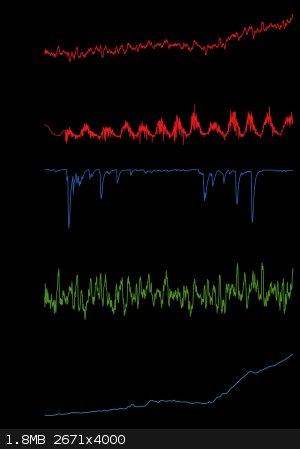
Source: https://web.archive.org/web/20190923190450/https://science20...
|
|
|
Disruptive
Harmless
Posts: 14
Registered: 12-12-2025
Member Is Offline
Mood: Curious
|
|
100 years of hydroxylamine as a hypothesised intermediate?e
The post was to examine the nitrogen cycle including the reaction kinetics, before looking at the carbon cycle for example. The nitrogen cycle
influences climate change as indicated in the last reply. The goal was to determine the ester molecules and the locations.
In case there is any confusion, a theory has some experimental evidence behind it whereas a hydpothesis does not. An oxidation step alone is not very
convincing. Sometimes people claim something is a theory although there is no experimental evidence for it.
As an example, 100 years ago hydroxylamine was first hypothesised as an intermediate (see attached pdf. It is in German. Deepl.com?). This was
presented in a bigger context of a hydrogen transfer theory, where the nitrification reactions involved the transfer of hydrogen (and not electrons).
Needless to say there was no evidence for the "theory" and it has not lasted the test of time.
The problem with hydroxylamine as a hypothesised intermediate is that it is rejected by the reaction kinetics which are half-order and hydroxylamine
reacts with esters. A carboxy ester mechansims can be claimed to be a theory as it has these two pieces of experimental evidence supporting it.
Before the use of amines, acid gases such as H2S and CO2 were removed with ammonia (pdf attached with the data as given in Perry's Chemical Engineers
Handbook 4th edition). Note that CO2 and NH3 yield carbamate under the right conditions. The same reaction is on the urea cycle of course.
Attachment: KluyverDonker1926.PDF (382kB)
This file has been downloaded 7 times
Attachment: Perry4th_AcidGas.PDF (776kB)
This file has been downloaded 6 times
|
|
|
Alkoholvergiftung
Hazard to Others
Posts: 235
Registered: 12-7-2018
Member Is Offline
|
|
Never heard about the hydrogen transfer. Bacterias mostly break things down end get so there electrons.
|
|
|
|



![[*]](images/xpblue/default_icon.gif)


