Altreon
Harmless

Posts: 20
Registered: 11-12-2025
Member Is Offline
Mood: oxidizing
|
|
Mechanism of cathode corrosion in H3PO4/H2SO4?
I have been recently been attempting to synthesize H3PO4•n(HPO3) and H2SO4•nSO3
by electrolysis of the corresponding concentrated acids (85% and 93-98%) using a Pt anode which appears resistant to corrosion . For the cathodes in
sulfuric acid, I've tried, in order of increasing stability, Ag, Ti, Ni, Cu, Mo, W, (Pt) and for phosphoric acid I've tried Ti, W
In conc. sulfuric acid, Ag/Ti dissolve rapidly into a white/purple soln., Ni/Cu form flocculent precipitates that look like metal sulfides and smell
like H2S/SO2, Mo slowly and invisibly corrodes into Mo(blue) above the meniscus, which oxidizes and turns transparent on contact
with the bulk liquid (molybdyl, in analogy to chromyl?) and W very slowly corrodes into a milky solution over a course of days (tungstic acid?)
In conc. phosphoric acid, the Ti surface turns a soft black color, although I couldn't observe any other corrosion due to the soln. turning black from
the C anode, and W works for 12h in 85% 40mL acid, until it gets pulverized into a black powder that oxidizes in air to W(blue), turning the soln.
grey.
I believe the cathode reactions should simply be
2 H3SO4+ --(+2e-)--> 2 H2SO4 + H2 ↑
because of the anomalously high autoionization rate of sulfuric acid, and
2 H4PO4+ --(+2e-)--> 2 H3PO4 + H2 ↑
after all the water is gone, assuming that phosphoric acid autoionizes to the same extent and in the same way as sulfuric acid.
With these reactions, I still have no plausible explanation for the rapid corrosion of these metals. It's strange to me that the cathodic protection
is not enough to reduce the metal salts at the cathodes, especially a metal like Ag (surprising how fast that dissolves compared to Cu), and while
oleum (which should be produced at the anode) is a powerful oxidizer, the corrosion is often a black metal sulfide instead of a sulfate. Phosphoric
acid is even stranger, as it, along with polyphosphoric acid, are non-oxidizing, and the cathode residue from phosphoric acid is a reducing agent/may
be the metal itself. Why does the cathode get destroyed?
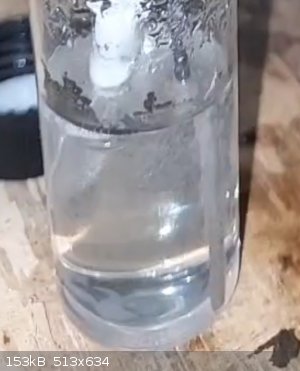
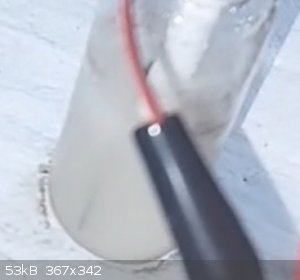
Attached images are of a W rod used as a cathode with the Pt electrode in phosphoric acid and sulfuric acid.
[Edited on 6-1-2026 by Altreon]
|
|
|
Altreon
Harmless
Posts: 20
Registered: 11-12-2025
Member Is Offline
Mood: oxidizing
|
|
After further testing, Ti, Ag, and C are not suitable cathodes for H3PO4. Ti slowly dissolves into a vaguely purplish grey
"solution" with some black dust, which may be a suspension of metallic titanium (on a side note, the peroxotitanyl complex is not nearly as intensely
colored in the electrolyzed H3PO4 as it is in water). Ag very slowly gets coated in a black conductive layer (which may be
Ag3P, as I assume Ag2O reacts with H3PO4) that flakes off to a very small extent, and it turns yellowish
on the areas not covered by H3PO4 (it's quite unusual for silver to react with a non-oxidizing acid at mild temperatures). C (in
the form of smoothened graphite welding electrodes) degrades over a few hours, turning the (reused Ag/H3PO4) solution a clear
but dark grey without any obvious extra precipitate.
So far, Ag is the only cathode that doesn't discolor the solution, and the "Ag3P" chunks are small and very easily separable, making Ag the
toughest electrode so far. I assume that the best cathodes for phosphoric acid follow the standard electrochemical series, as phosphoric acid is
neither a good oxidizer nor a good complexing agent, meaning all metals nobler than Ag would probably work well.
As for H2SO4, graphite seems to be a very stable cathode material. The solution goes through a variety of changes (it has become
cloudy twice and its getting cloudier again) and the C has been coated in a white layer and is currently poorly coated in a yellow layer. I will check
tomorrow if any significant corrosion has occured, as only a few, easily separable but visible chunks of graphite are at the bottom of the vial.
|
|
|
|



![[*]](images/xpblue/default_icon.gif)


