| Pages:
1
2 |
xwinorb
Hazard to Others

Posts: 100
Registered: 9-8-2005
Member Is Offline
Mood: No Mood
|
|
To Isomeric_Fred :
I never got less than 55 % with the modified Leminger method. I never tried exactly the procedure as in the Rhodium page ( Leminger paper ). Can tell
you it works very well for the 2,5-DMBA, my latest was 75 %. If interested see my previous posts.
It DOES NOT works so well for 3,4,5-TMBA though, yields much lower. I would suggest acidic Al-Hg for this one.
I usually use batch sizes 20 g or so of the 2,5-DMBA, in a 2 l BF.
xw.
|
|
|
stoichiometric_steve
National Hazard
Posts: 827
Registered: 14-12-2005
Member Is Offline
Mood: satyric
|
|
Something else that seems to be critical for a nice yield: keep the reaction hot and don't add the HCl too slowly, otherwise the Nitroso intermediate
will tautomerize to the Oxime and hydrolyze to the parent Carbonyl compound.
|
|
|
stoichiometric_steve
National Hazard
Posts: 827
Registered: 14-12-2005
Member Is Offline
Mood: satyric
|
|
Quote: Originally posted by Barium  | | I know of several members of the Hive who have successfully used my methods. Both well trained chemists and simple cooks. |
If you ever come back to read this:
Fuck you, Thomas Lillius
|
|
|
njl
National Hazard
Posts: 609
Registered: 26-11-2019
Location: under the sycamore tree
Member Is Offline
Mood: ambivalent
|
|
Yet another rollercoaster of a thread. Steve, what prep are you referring to in that 11/1/08 reply? I've been try a few variations on the SM thread
linked in the rhodium archive where HCl is added to the substrate in methanol, with zinc being added afterwards and the reaction being cooled.
|
|
|
stoichiometric_steve
National Hazard
Posts: 827
Registered: 14-12-2005
Member Is Offline
Mood: satyric
|
|
Referring to the reduction of secondary nitro compounds with Zn/HCl.
You meant the Leminger variant, which is preferable for primary nitrostyrenes.
|
|
|
njl
National Hazard
Posts: 609
Registered: 26-11-2019
Location: under the sycamore tree
Member Is Offline
Mood: ambivalent
|
|
Right. Honestly the procedure calling for zinc held in suspension with the substrate and addition of the acid over time was much more convenient when
I tried it on nitrostyrenes and I did end up getting reasonable yields despite screwing up isolation. What about the kinetics makes the order of
addition more favorable for different substrates?
|
|
|
OrganicGuy
Harmless
Posts: 29
Registered: 23-2-2020
Member Is Offline
|
|
| Quote: Originally posted by stoichiometric_steve | Yeah, i was wrong about the figures. Whatever those indians claimed, i don't believe them.
The Fe/HCl reduction (yielding ketones) works best at 100°C and 7:2:1 Fe:HCl:Nitroalkene, solvent water, vigorous stirring, and a dash of FeCl3.
| Quote: | Originally posted by Barium
What do you mean? Am I omitting details or what? |
I'm not sure what's wrong with some of your procedures, it could just as well be my fault. But as for your "really wet redfuctive amination", i know
of several people (who have the right kind of experience) having been unable to reproduce your claimed yields. The best i got myself was 10%.
| Quote: | Originally posted by Barium
Seeing you talking about dimeric products and silica gel makes me believe you are talking about the borohydride/EtOH/Dioxane reduction system
|
Nope, i do know my shit. The dimerization is also a problem here - Especially when making indoles the way these fellas did: Beer et al.,
J. Chem. Soc.; 1948, 1605-1609
BTW Barium, you probably never noticed how useful your water/toluene/PTC system is for reduction of secondary nitroalkenes. Your writeups and posts
left me with the impression that all you wanted is to avoid PTCs, despite the fact that there is no double bond reduction as simple as this. I applied
it to large scale batches and it is the best method - easy workup, reaction runs on its own, great yields, easily recycled solvent.
|
Bets results I had was with 5:2:1 if carbonyl iron powder, but with regular cheap 99% iron powder then I had best results with 12:2:1 eq of
Iron/Hcl/p2np.
But best of all works 5:2:1 with zinc/acetic acid 98%/p2np. Reaction time only 30-40 min
|
|
|
Corrosive Joeseph
National Hazard
Posts: 915
Registered: 17-5-2015
Location: The Other Place
Member Is Offline
Mood: Cyclic
|
|
Hey OG, you got any actual yields for that.....?
/CJ
Being well adjusted to a sick society is no measure of one's mental health
|
|
|
RustyShackleford
Hazard to Others
Posts: 202
Registered: 10-12-2020
Location: Northern Europe
Member Is Offline
|
|
Zn/HCl aint so bad to extract if you just add a large excess of hydroxide to re-dissolve the zinc.
|
|
|
stoichiometric_steve
National Hazard
Posts: 827
Registered: 14-12-2005
Member Is Offline
Mood: satyric
|
|
I'd like to know the exact conditions for this procedure, would you be so kind to share them?
|
|
|
OrganicGuy
Harmless
Posts: 29
Registered: 23-2-2020
Member Is Offline
|
|
yes I can do it in a week when I'm home at my computer, but check this doc. I've seen you had a lot of good posts here & there, so you'll figure
it out yourself by then 
Attachment: AUS amphetamine.pdf (1.9MB)
This file has been downloaded 3805 times
|
|
|
stoichiometric_steve
National Hazard
Posts: 827
Registered: 14-12-2005
Member Is Offline
Mood: satyric
|
|
You probably misread that document. There is no mention whatsoever of any yield that high.
|
|
|
OrganicGuy
Harmless
Posts: 29
Registered: 23-2-2020
Member Is Offline
|
|
What yield?, I didn't mentioned how much yield I had, I only stated "the best yield I had was with..." and not how much
The percentage 98 and 99 is purity of iron and concentration of the acetic acid and has nothng to to with yields.
|
|
|
OrganicGuy
Harmless
Posts: 29
Registered: 23-2-2020
Member Is Offline
|
|
During the yrs I have also understood that because a certain document says so and so, doesn't mean you will have the same yield. I have seen many fake
indian documents claiming excellent yields, but when running it exactly the same conditions I got half. And I have seen documents where I had better
yield than they got after some experimentation. A document or journal is not static information, experimentation is always recommended
|
|
|
stoichiometric_steve
National Hazard
Posts: 827
Registered: 14-12-2005
Member Is Offline
Mood: satyric
|
|
I stand corrected, i misread. I thought the 98% stood for yield. But the actual yield of the procedure is absolute shit.
|
|
|
clearly_not_atara
International Hazard
Posts: 2913
Registered: 3-11-2013
Member Is Offline
Mood: Big
|
|
Interesting that a key here seems to be a fast addition and high temp. It seems more often "difficult" reactions call for exactly the opposite. Maybe
the reason this rxn is so famously unreliable is that people optimize for the wrong thing.
|
|
|
ChemichaelRXN
Hazard to Others
Posts: 103
Registered: 7-10-2010
Member Is Offline
Mood: Universal Eye
|
|
If the reaction works ok, you can extract it with chloroform 1.49g/ml instead of toluene 0.865g/ml, which may form emulsion easier than chloroform
would.
You are the same perception looking out, from the same elements around the universe.
You are everything to be anything to begin with.
Https://you-are.space
Https://syntharise.com
|
|
|
OrganicGuy
Harmless
Posts: 29
Registered: 23-2-2020
Member Is Offline
|
|
If using the iron method, then the carbonyl and reduced/electrolytic iron powder gave yields better than regulare cheap iron powder (80-85%). For the
zinc/GAA method, with electrolytic zinc powder I had 75-80% and with cheap zinc below 70%, however the short reaction time is preferable to me since I
value family time. It also depends of course of the nitroalkene purity, AFAIK that's of highest concern when talking yields in these methods. Crap in
crap out...
The most recent doc I had is this attached. It's indian though, but seems worth checking out. Good luck to you with the yield
Attachment: Fe_HCl_MeOH.pdf (435kB)
This file has been downloaded 1001 times
|
|
|
stoichiometric_steve
National Hazard
Posts: 827
Registered: 14-12-2005
Member Is Offline
Mood: satyric
|
|
No worries my little dude, i had awesome yields with electrolytic iron powder.
750ml H2O
200g Fe
1 mol Nitroalkene
2.5g FeCl3
650ml HCl conc.
|
|
|
Organikum
resurrected
Posts: 2344
Registered: 12-10-2002
Location: Europe
Member Is Offline
Mood: frustrated
|
|
Good on you! It shows that the olde Bechamp reaction may win the grand prize for operator tolerance
No offence just banter.
I had awesome yields with sandblasting iron. Seriously. And with other iron as for magnetic experiments from 0,03 mm to 0,4 mm size, usually some
smaller and coarser stuff mixed.
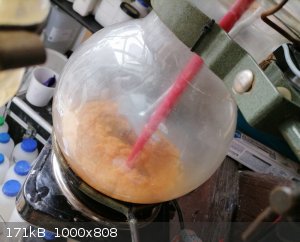
1 mol P2NP was prepared from 1 mol Benzaldehyde and 1,1 mol Nitroethane in situ with cyclohexanolamine acetate or diethylamine acetate as catalyst.
Some IPA and a dash of GAA. Just mix well, heat to 70 °C max and let cool down. Add more catalyst and repeat 3 times. Next day you have a mostly
brownish crystal mush, this is perfectly fine, even if it is still more a liquid it is fine.
This avoids to have to confront the evil P2NP in any way, I cannot stand it. It also gives the best yields ever.
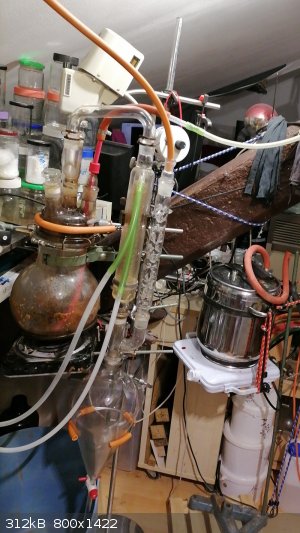
1 mol P2NP, 250 g iron filings or powder, sandblasting iron is actually the next best to the ground up cast iron scrap which was used in the original
Bechamp. 650 ml of 20% HCl and 600 ml of hot water, like 80 °C. A dash of FeCl3 is optional the reaction starts wiuthoput if the water is hot enough.
Strong overhead stirring.
Insertion tube from glas or PTFE near to the bottom of the vessel.
(Steam)-Distillation setup with an intensiv condenser.
Steamgenerator (pressure cooker).
Add hot water and FeCl3 to the P2NP which is already in the vessel. Start stirrer at high. Add all iron. Run HCl 20% to the bottom by the tube as fast
as possible without overpowering the condenser. Take the first 100 ml of condensate off and return to the reaction later. Add Toluene to the
collection vessel. When all the HCl is added turn on heating and connect the pre-warmed steam-generator and start steam.
P2P will come over from almost the first moment, no need to reflux.
Most important: Make sure there is always enough water in the reaction, this is very hard to judge for the mess the iron makes but it is the only way
to fuck this up, let it run too dry.
Overall yields on Benzaldehyde can be easily in the 90ies. For vacuum distilled P2P, not for the raw extract.
A very satisfying thing, lots of action, great yields, hard to botch.
Cudos to Rosco Bodine who lend me a helping hand on this one. Thank you old man!
regards
/ORG
|
|
|
| Pages:
1
2 |



![[*]](images/xpblue/default_icon.gif)


