| Pages:
1
2 |
MineMan
International Hazard

Posts: 1049
Registered: 29-3-2015
Member Is Online
Mood: No Mood
|
|
HMTD… Come on dude. Be safer please. For all of us.
|
|
|
DennyDevHE77
Hazard to Others
Posts: 168
Registered: 15-9-2014
Member Is Offline
Mood: No Mood
|
|
But after all, the HMTD is the best representative of primary explosives in price / initiating ability / ease of manufacture. Is not it?
|
|
|
Etanol
Hazard to Others
Posts: 248
Registered: 27-2-2012
Member Is Offline
Mood: No Mood
|
|
HMTD is an unstable but very effective primary. 100mg would be enough for pure unphlegmatized PETN or RDX.
|
|
|
Microtek
National Hazard
Posts: 994
Registered: 23-9-2002
Member Is Offline
Mood: No Mood
|
|
If you are at all serious about energetics research, you should move away from all organic peroxides as soon as possible. There are many alternatives
that are much better (both in terms of effectiveness, shelf life and safety). Take a look around the forum for ideas.
|
|
|
DennyDevHE77
Hazard to Others
Posts: 168
Registered: 15-9-2014
Member Is Offline
Mood: No Mood
|
|
Quote: Originally posted by Etanol  |
HMTD is an unstable but very effective primary. 100mg would be enough for pure unphlegmatized PETN or RDX. |
In theory, it is. But in fact, for an explosion of 0.1 g, a strong metal case with a cup preventing the outflow of gases is needed.
I often burned out 200-300 mg in an insulin syringe. Moreover, it was a high-quality HMTD from chemically pure reagents. And acetone peroxide burned
out even in an amount of 0.5 g. For the transition from combustion to detonation in these substances is not small (not like lead azide)
Therefore, for reinsurance, I use 0.5-0.8 g. It's still not much. Not 10g. Also, I use silver acetylenide nitrate or lead azide or DDNP when
available.
[Edited on 11-8-2023 by DennyDevHE77]
|
|
|
DennyDevHE77
Hazard to Others
Posts: 168
Registered: 15-9-2014
Member Is Offline
Mood: No Mood
|
|
| Quote: Originally posted by Microtek | | If you are at all serious about energetics research, you should move away from all organic peroxides as soon as possible. There are many alternatives
that are much better (both in terms of effectiveness, shelf life and safety). Take a look around the forum for ideas. |
I also use other, safer primary explosives.
It's just that I make detonator caps in such a way that all this safety is not very significant. At a minimum, I never touch them with my hands, I
carry them by the fire tubes or long wooden sticks tied to them (for tying flowers). I also press without touching them. And I carry them wrapped in a
thick cloth to the place of the explosion.
In general, in the event of an explosion, I risk a small stun.
HMTD has a problem with static and low shelf life. But I don't remember storing ready-made detonator caps for more than a week, and static is solved
by spraying with antistatic.
I have had several times when I needed long-lived capsules. I made them on PETN and white mercury fulminate. It may be a relatively weak initiating
explosive, but time-tested and well mastered.
[Edited on 11-8-2023 by DennyDevHE77]
|
|
|
Etanol
Hazard to Others
Posts: 248
Registered: 27-2-2012
Member Is Offline
Mood: No Mood
|
|
| Quote: Originally posted by DennyDevHE77 |
In theory, it is. But in fact, for an explosion of 0.1 g, a strong metal case with a cup preventing the outflow of gases is needed.
|
This is not a theory. This is practice. Personally, I initiated pressed RDX and PETN with 50 mg HMTD in a plastic reinforcing cup.
|
|
|
DennyDevHE77
Hazard to Others
Posts: 168
Registered: 15-9-2014
Member Is Offline
Mood: No Mood
|
|
| Quote: Originally posted by Etanol | | Quote: Originally posted by DennyDevHE77 |
In theory, it is. But in fact, for an explosion of 0.1 g, a strong metal case with a cup preventing the outflow of gases is needed.
|
This is not a theory. This is practice. Personally, I initiated pressed RDX and PETN with 50 mg HMTD in a plastic reinforcing cup.
|
I should have been more specific in my answer, sorry.
I did not say that this is not possible, I said that even more of it just burned out for me. Not always, sometimes 100 mg was successfully detonated
in the cap of the syringe. Or in the syringe itself. And sometimes not. I need reliability, with a minimum of work. And it just so happens that it’s
much easier for me to press in a larger sample than I do with capping 100 mg. For example, some of my friends drive the rubber piston seal from the
syringe on top of the HMTD, with a hole for the igniter tube, and then fill it with epoxy. And it turns out a reliable detonator.
But it's more work and more interaction with the initiating expl, which I try to minimize.
And even just imagine, will there be a difference if 1g PETN + 0.1 g HMTD, or 1g PETN + 1g HMTD explodes 70 cm away from me?
[Edited on 11-8-2023 by DennyDevHE77]
|
|
|
Etanol
Hazard to Others
Posts: 248
Registered: 27-2-2012
Member Is Offline
Mood: No Mood
|
|
This is a feature of peroxides. It is necessary to manage the deflagration to detonation transition, and not just to press into the pipe. Then the
detonation occurs starting from 20-25 mg HMTD in 100% of cases.
Silver Azid is more easy to use. It does not require special conditions.
| Quote: Originally posted by DennyDevHE77 |
And even just imagine, will there be a difference if 1g PETN + 0.1 g HMTD, or 1g PETN + 1g HMTD explodes 70 cm away from me?
|
1g PETN + 1g HMTD is 1,6 time more dangerous than 1g PETN + 0.1 g HMTD.
But the cup with 0,1g HMTD is inserted already assembled. The explosion risk of 1g PETN + 0.1 g HMTD is lower.
|
|
|
DennyDevHE77
Hazard to Others
Posts: 168
Registered: 15-9-2014
Member Is Offline
Mood: No Mood
|
|
| Quote: Originally posted by Etanol | This is a feature of peroxides. It is necessary to manage the deflagration to detonation transition, and not just to press into the pipe. Then the
detonation occurs starting from 20-25 mg HMTD in 100% of cases.
Silver Azid is more easy to use. It does not require special conditions.
| Quote: Originally posted by DennyDevHE77 |
And even just imagine, will there be a difference if 1g PETN + 0.1 g HMTD, or 1g PETN + 1g HMTD explodes 70 cm away from me?
|
1g PETN + 1g HMTD is 1,6 time more dangerous than 1g PETN + 0.1 g HMTD.
But the cup with 0,1g HMTD is inserted already assembled. The explosion risk of 1g PETN + 0.1 g HMTD is lower. |
Namely, this is what I wanted to say that for organic peroxides, additional manipulations with the detonator are required, for minimal quantities.
Much easier to increase the hitch. This will not be dangerous if you do not touch the syringes with your hands, but it is much faster, more convenient
and less manipulation.
Even if 1g PETN and 1g HMTD are 1.6 times more dangerous, this still does not mean anything, because such an explosion can only harm in the immediate
vicinity of the charge, and not 70 cm.
Another thing is when people use 20 ml syringes filled with organic peroxides to initiate all sorts of ammonals, this is already dangerous. But an
explosion of 1 or 2 g will have almost no consequences if it occurs at a distance of more than 20-30 cm.
|
|
|
Axt
National Hazard
Posts: 981
Registered: 28-1-2003
Member Is Offline
Mood: No Mood
|
|
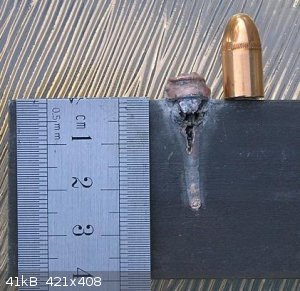
I've some experience with PETN/NG (penthrinite) and can confirm that contrary to the original literature it is susceptible to low velocity detonation
at least when mixed with NC as a gelatiniser.
I can't give ratios for these tests as the NG was just added until the correct consistancy was obtained, although seperately I know 50:48:2
(PETN:NG:SBSP) does produce a nice soft plastic consistency, this ratio is claimed by the original author (Stettbacher) to fire at 8400m/s @
1.68g/cm3.
I first used it 20yrs ago in the tiny shaped charges where 1.3g of penthrinite would penetrate 1" of steel. This was just PETN with NG added until it
had a paste like consistency for loading. These fired without trouble to a #8 commercial det.
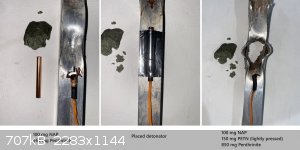
More recently I attempted it as a detonator loading, 50 mg NAP failed to initiate it. Using 100 mg NAP produced a very weak LVD. Using an intermediate
charge of lightly pressed PETN produced a very powerful detonator with greater effect than a #8, but the loading was higher. All these were only
lightly pressed with a teflon rod, penthrinite does go to a high density very easily, fitting a 1g base charge in that tube is typically hard and
definitely cannot be done by hand but was easy with penthrinite.
I'll guess the composition used here as 60% PETN, 35% NG, 5% DBSP (why its grey) But the measurements were lost along the way, I like to use
commercial smokeless powders as the NC source to donate their stabilisers although lower nitrated forms are called for in the lit for penthrinite and
related blasting gelatines (~12% N). it was slightly crumbly but would still hold its form.
|
|
|
| Pages:
1
2 |



![[*]](images/xpblue/default_icon.gif)


