bariumbromate
Hazard to Others

Posts: 105
Registered: 4-2-2025
Location: australia
Member Is Offline
Mood: nitrating
|
|
new red compound discovered?
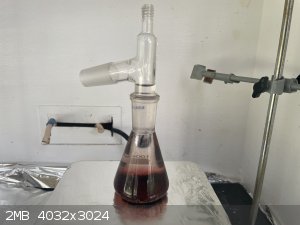
hi guys yesterday i made some methyl salicylate wintergreen from methanol and salicylic acid, so anyway it was getting dark and i had just finished
the distillation of the wintergreen so i left the glassware until the morning,
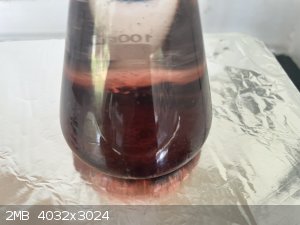
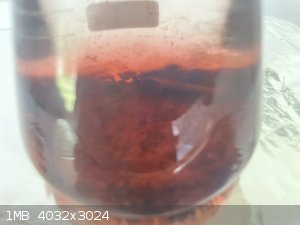
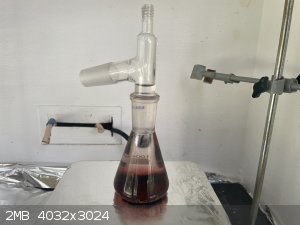
when i got up the the joint between the condenser and the flask were stuck together and there was a black tar in the bottom so i added boiling water
to get it out and suddenly the tar turned red!
is this a new compound or is it something else?
BTW i think i used double the 4ml sulfuric acid also followed this video: https://www.youtube.com/watch?v=dB1uN1rWAv0
thanks
|
|
|
j_sum1
|
Thread Moved
13-8-2025 at 01:27 |
bnull
National Hazard
Posts: 994
Registered: 15-1-2024
Location: East Woods
Member Is Offline
Mood: Fecking annoyed
|
|
Good old tar, always bringing us surprises...
Take small portions of the tar and save the rest in a vial.
Test the small portions. Is it soluble in ethanol? Does the color change on addition of sodium hydroxide? Does it have a funny smell? Is there any
precipitate when you acidify the alkaline solution? What happens when you add iron salts to the alkaline solution?
[Edited on 13-8-2025 by bnull]
|
|
|
teodor
International Hazard
Posts: 1169
Registered: 28-6-2019
Location: Netherlands
Member Is Offline
|
|
I am not an expert in a tar analysis being more succesful in it production, but if I would put a question in my head I will start with some simplest
paper chromatography to check wether the color is from a single compound or it is just a result of a combination.
As for possible side reactions during salicylate esters synthesis there were some interesting discussion with Fery about that in my thread about amyl
salicylate. Actually it is hard to prevent salicylic acid self condensation which can give several different by-products during esterification with
sulfuric acid actualy and for perfumery they patented the usage of oxalyl chloride for synthesis of salicylates with alcohols with 5 and more carbon
atoms (those are the best smelling salicylates).
For methyl and ethyl there is no study about byproducts because those esters were never used in perfumery production, but I believe you can expect
similar side-reactions and complexities of getting the pure compound.
The first historical production of salicylates as a raw matherial for perfumery also avoided fisher esterification method.
But for me the most interesting question is the difference in the smell, not in the tar.
|
|
|
Deathunter88
National Hazard
Posts: 573
Registered: 20-2-2015
Location: Beijing, China
Member Is Offline
Mood: No Mood
|
|
I will refer you to this thread: Werid Color in Esterification Reaction
|
|
|
woelen
Super Administrator
Posts: 8150
Registered: 20-8-2005
Location: Netherlands
Member Is Offline
Mood: interested
|
|
Red colors are quite common with this kind of tars. Charred organics tend to have yellow colors at high dilution, which shifts to red more and more
when getting more concentrated, finally going to black.
I myself had a similar experience when I mixed acetone with sulfuric acid and left this standing. Initially, the liquid was colorless, but after a few
days, it was red, and also somewhat viscous. A similar thing happened to me with a mix of sulfurc acid and denatured alcohol. The mix became a
beautiful brick red, at a later point, it become very dark and the red shifted towards brown. Probably some denaturing agent, which slowly charred in
the acid.
I think that this is what happened in your mix as well.
|
|
|



![[*]](images/xpblue/default_icon.gif)


