SnailsAttack
Hazard to Others

Posts: 179
Registered: 7-2-2022
Location: The bottom of Lake Ontario
Member Is Offline
|
|
Spontaneous (non-shock) cracking of a borosilicate beaker
I was writing at my desk when I heard the loud snap of a glass cracking (every chemist's dread..), followed shortly by maybe 1 or 2 more cracks
(presumably from propagation of the original crack) as I tried to figure out what the hell was breaking.
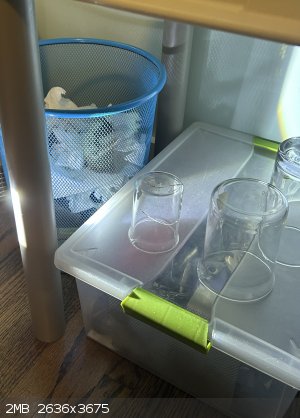
The culprit was the small beaker in the attached photos. The first image shows the cracked beaker exactly as I found it, and the second one shows it
from another angle. It's physically intact, but is obviously now useless.
The beaker is made of borosilicate and is a little over 2 years old. The most strenuous thing I've used it for was to pyrolyze some dry powders by
heating to ~450°C over an open flame (months ago).
Spontaneous breakage (unassociated with thermal shock or external physical stress) is a known phenomenon with tempered glasses (particularly soda-lime
glass), but I haven't been able to find any reports of this occurring with borosilicate glassware.
The beaker's most recent use was to boil some water over an open flame, but that was over a week ago and I haven't touched it since.
Anyways, it was the first piece of glassware that I didn't destroy by thermal shock, dropping it or accidentally kicking it across the room because I
set it down in the middle of the floor and then forgot. Ultimately, I'm guessing the reason it broke was from internal stress acting on microscopic
fractures... very, very slowly.
I'm interested to hear if spontaneous cracking like this has happened to anyone else's glassware.
|
|
|
jackchem2001
Hazard to Others
Posts: 110
Registered: 2-6-2024
Member Is Offline
|
|
Reminds me of this: https://www.youtube.com/watch?v=tGqVMbAQhBs
|
|
|
Sulaiman
International Hazard
Posts: 3942
Registered: 8-2-2015
Member Is Offline
|
|
I have seen little radial cracks where the bottom of the beaker becomes the wall,
just like in your second photo,
in my beakers that have been strongly heated on hotplate,
they may or may not crack on cooling, or next use,
but I've not had one crack after a long cool-down.
Interesting and lucky (vs cracking in use)
PS my theory:
the hot hotplate surface contacts the beaker only around the periphery,
even that contact is uneven,
exactly where the cracks form.
the bottom of that ring of glass will be near hotlpate temperature,
all other closely surrounding glass will be at a MUCH lower temperature,
https://en.m.wikipedia.org/wiki/Thermal_shock
CAUTION : Hobby Chemist, not Professional or even Amateur
|
|
|
Texium
Administrator
Posts: 4742
Registered: 11-1-2014
Location: Salt Lake City
Member Is Offline
Mood: Seeking gainful employment
|
|
I haven’t experienced that issue before, but I also never heat my glassware with an open flame. I would suspect that your heating it with an open
flame introduced a significant amount of invisible stress but it was metastable for a while, until it wasn’t.
Really, you shouldn’t heat any glassware with an open flame- it’s the 21st century and we have so many better, safer methods. If you absolutely
have to though, you should only do it with round-bottom flasks since they are designed to tolerate the stress of uneven heating better than
flat-bottomed vessels. Heating a flat-bottomed vessel with an open flame is just asking for trouble.
And for pyrolysis at 450°, you shouldn’t even be using glass. That’s where a cheap steel vessel like a paint can is better suited to the task.
|
|
|
Texium
|
Thread Moved
17-8-2025 at 06:02 |
bariumbromate
Hazard to Others
Posts: 104
Registered: 4-2-2025
Location: australia
Member Is Offline
Mood: nitrating
|
|
i once re distilled some nitric acid on my hot plate when the bottom fell out of my flask
i had it fully contained so nothing got destroyed 
|
|
|
Fulmen
International Hazard
Posts: 1794
Registered: 24-9-2005
Member Is Offline
Mood: Bored
|
|
High temperatures are hard on borosilicate. At one lab I worked we burned all glassware meant for a certain analysis at 400C after washing, and more
times than not there was some breakage. This was a large oven that was slow to both heat and cool down, so not much thermal shock.
We're not banging rocks together here. We know how to put a man back together.
|
|
|
Sulaiman
International Hazard
Posts: 3942
Registered: 8-2-2015
Member Is Offline
|
|
mainly due to using gas heating I have lately been using a shallow sand bath to heat beakers,
It seems gentler on the glass.
CAUTION : Hobby Chemist, not Professional or even Amateur
|
|
|
Keras
International Hazard
Posts: 1143
Registered: 20-8-2018
Location: (48, 2)
Member Is Offline
|
|
Having good quality beakers helps. For w/e raison I remember having recently put something in a standard 100 mL beaker ('vanilla', prolly Chinese,
boro 3.3 glass) to boil at reduced fire on a gas burner and it cracked. Mind you, there was no big spill, but likewise the glass split. I had time to
save the solution by pouring it into another nearby beaker.
Then I redid the same experiment with a Pyrex™ beaker, and it all went fine. IMHO, the thickness of the glass is important, too.
|
|
|
teodor
International Hazard
Posts: 1169
Registered: 28-6-2019
Location: Netherlands
Member Is Offline
|
|
Last month I do lot of experiments with molten salts using heatgun, molten tin bath and direct flame. I bought a lot of second hand 100 ml duran RBF
for this purpose and I am prepared that 50% of them don't survive cooling when direct flame is used. It never happens either with heatgun or with the
molten metal bath. I found that when I need to use an open flame to get particularly high temperature fast I still can protect the flask with cooling
it with hot air first from a heatgun at a moderate temperature (300C) and only after that allow it cool to the room temperature. If I have patience I
lower the temperature of the air step by step. It allows me to preserve a flask in most cases. But generally, try to avoid flame without wire gauge or
air bath between it and the flask if you are not prepared to replace the flask after every experiment.
|
|
|
Deathunter88
National Hazard
Posts: 572
Registered: 20-2-2015
Location: Beijing, China
Member Is Offline
Mood: No Mood
|
|
This is very well known by anyone who does any kind lampworking / glassblowing. Whenever you make something, doesn't matter if it's borosilicate or
soda lime, you need to anneal it in a kiln at 565C for a few hours and let it cool slowly.
A kiln costs ~$1000 dollars and so most beginners will opt to not have one to begin with while they are just starting out and practicing their
technique. This is fine, and while some pieces will crack when air cooled, most pieces especially of borosilicate will survive. However, any new
lampworker is warned they should never sell anything that is not annealed, for the exact reason you observed - they can crack at any point from
internal stress! Could be hours, days, weeks, or even years down the line.
Borosilicate should not be heated above 250C, if you do you are severely compromising the glass and you should separate it from your good beakers. It
might not break this time, but you don't want to find out the hard way when there is something dangerous inside.
|
|
|


![[*]](images/xpblue/default_icon.gif)


