DennyDevHE77
Hazard to Others

Posts: 168
Registered: 15-9-2014
Member Is Offline
Mood: No Mood
|
|
Powerful ozonizer, is it possible at home?
Recently I've been thinking about ways to produce large quantities of 100% nitric acid, or better yet, with the addition of nitrogen pentaoxide. One
option is to saturate nitric acid (65%) with nitrogen dioxide, and pass a rich air-ozone mixture through the solution. Or mixing ozone and NO2 in the
gas phase, but this is less convenient.
Theoretically, this method will yield many liters of 100% nitric acid. But practically, I have not even seen ozonators, neither household, nor
industrial, nor homemade, capable of producing more than a few tens of grams of ozone per hour. Is it possible to create an installation, say, with an
ozone output of 500-600 grams of O3 per hour at all? And what type of discharge is the most suitable for high output? Let me say at once that
electricity is almost free for me. I am just guided by the principle that if something is possible, someone must have already done it, and here it
turns out that no one has done normal ozonators.
So, if such an ozonator is possible at all, please share your thoughts, how would you make it? Or you may know those who have already done such a
thing, or even detailed manuals? And also, I will be very grateful if someone has a book about ozone production, usually narrow-profile books very
well describe the technological process and all the theoretical background.
|
|
|
EF2000
Hazard to Others
Posts: 155
Registered: 10-5-2023
Location: The Steppes
Member Is Offline
Mood: Taste testing the Tonka fuel
|
|
Wikipedia says that dielectric barrier discharge (DBD) ozone generators can produce up to 24% ozone concentration in oxygen. Simple calculation shows
that to produce 600 grams of ozone, 280 litres, you need to pump something like 1200 litres of dry pure oxygen through your apparatus. Does it sound
as feasible to you?
Wroom wroom
"The practice of pouring yourself alcohol from a rocket fuel tank is to be strongly condemned encouraged"
-R-1 User's Guide
|
|
|
DennyDevHE77
Hazard to Others
Posts: 168
Registered: 15-9-2014
Member Is Offline
Mood: No Mood
|
|
I saw this article too, but I'm surprised that no one has put it into practice, apparently it's not that simple. Or I wasn't looking hard enough. And
so pumping a few m3 of oxygen or air is not difficult. Oxygen is at least as easy to make by electrolysis.
In the same Wikipedia I have seen references to electrolytic methods with high ozone yield. But I found only a few ways to electrolyze either
perchloric acid on platinum electrodes or electrolysis of ammonium fluoride solution, both more expensive than getting it from air.
|
|
|
Texium
|
Thread Moved
25-3-2024 at 05:50 |
dicyanin
Hazard to Self
Posts: 64
Registered: 29-3-2020
Location: Europe
Member Is Offline
Mood: inquisitive
|
|
Attached are two papers which may be of interest. They were referenced on passing in a work on electrochemistry available in the Sciencemadness
library. One paper discusses the use of a specially designed platinum wire electrode, partially molten in a glass U-tube with its surface partially
exposed, the making of which requires some glassblowing skills. They reported ozone concentrations of 0-15% by electrolysis of aqueous sulfuric acid
under varying conditions.
The second paper uses pretty much the same setup, but studied the effect of AC superimposed on DC in this system. Varying conditions usually gave an
ozone output in the same range but some outliers were reported with concentrations in the 20s and even 30s%.
Both papers are in German and from the early 20th century.
Attachment: electrolytic production of ozone _Zeit. Anorg. Chim 1907_c.pdf (1.5MB)
This file has been downloaded 341 times
Attachment: electrolytic ozone production AC superimposed on DC.pdf (5.7MB)
This file has been downloaded 334 times
sic transit gloria mundi
|
|
|
Rainwater
National Hazard
Posts: 993
Registered: 22-12-2021
Member Is Offline
Mood: Break'n glass & kick'n a's
|
|
Quick google found this, assuming the output rate is correct. You would need a source of pure O2 at 15psi to produce 200g / hour
O3, with a milti stage particulate filter.
The easiest way to scale up to 600g / hour would be to place 3 of these in parallel.
I work with large ozone generators, they are very reliable but extremely difficult to fix/maintain. Cleanliness is 99.999% of the maintenance and
dirt/oil is 100% of the downtime cause.
https://www.a2zozone.com/products/s-200-g
Ya. They cost that much
If you injected a mixture of N2 and O2, you can produce NOx directly
[Edited on 4-4-2024 by Rainwater]
| Quote: | | I will be very grateful if someone has a book about ozone production, |
Ozone chemistry and technology; this book presents sixty papers constituting the proceedings of the International Ozone Conference held in Chicago,
November 1956; a group of international authors presents many facets of the science, technology, and application of this versatile form of oxygen
[Edited on 4-4-2024 by Rainwater]
"You can't do that" - challenge accepted
|
|
|
DennyDevHE77
Hazard to Others
Posts: 168
Registered: 15-9-2014
Member Is Offline
Mood: No Mood
|
|
Thank you so much for your help. If I make something worthwhile, I think I'll post it here.
|
|
|
Mateo_swe
National Hazard
Posts: 581
Registered: 24-8-2019
Location: Within EU
Member Is Offline
|
|
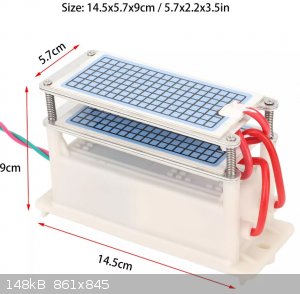
There are these ozone generators found on ebay and similar sites.
This one is advertised as 28g/h and is about 17 Euros.
I have one like this and its producing quite a bit of ozone but i have not tried to measure it or done anything with it yet.
Bevare of peroxides if you plan on using it in experiments.
|
|
|
Tdep
National Hazard
Posts: 521
Registered: 31-1-2013
Location: Laser broken since Feb 2020 lol
Member Is Offline
Mood: PhD is done! It isn't good but it's over lol
|
|
Would be great if you could run a titration to get some sort of estimate on the actual ozone output! It is very easy for the ebay sellers to claim any
sort of grams/hour amount of production. A lot of them are not even designed to run for an hour, so if I was being generous- it is likely that these
numbers come from running it for a minute and then extrapolating the number out to a gram/hour amount, despite the efficiency dropping off as the
thing gets way too hot.
And if I was feeling un-generous, the number could just be a straight up lie. There's zero consequences for lying, and all the reward of increasing
sales if your number is higher than others. I seem to recall it was ~10g/hour a few years ago, so I assume they're in a constant bidding war with the
output number, rather than improving the tech
|
|
|
Twospoons
International Hazard
Posts: 1379
Registered: 26-7-2004
Location: Middle Earth
Member Is Offline
Mood: A trace of hope...
|
|
Like the LiIon batteries claiming 10000mAH in an 18650 cell. Complete BS.
They rely on people being unable to test these things properly.
Helicopter: "helico" -> spiral, "pter" -> with wings
|
|
|
Tdep
National Hazard
Posts: 521
Registered: 31-1-2013
Location: Laser broken since Feb 2020 lol
Member Is Offline
Mood: PhD is done! It isn't good but it's over lol
|
|
Quote: Originally posted by Twospoons  | Like the LiIon batteries claiming 10000mAH in an 18650 cell. Complete BS.
They rely on people being unable to test these things properly. |
Yes agreed- and there a lot more people in the world who can + have the equipment to test for battery capacity than can titrate an ozone generator!
|
|
|
Sir_Gawain
National Hazard
Posts: 525
Registered: 12-10-2022
Location: southeast
Member Is Offline
|
|
Tdep, you titrated yours; what was the actual output?
Edit: I found the video; with a ozone generator that claimed 3g/hr, you got about 250mg/hr with air and about 750mg/hr with pure oxygen. There's no
way any of these generators are getting even close to 28g/hr.
[Edited on 4-11-2024 by Sir_Gawain]
|
|
|
Mateo_swe
National Hazard
Posts: 581
Registered: 24-8-2019
Location: Within EU
Member Is Offline
|
|
Well, the sellers of these things do often claim better numbers than can be had.
And they always assume the best factors as pure oxygen supply, running 24/7 (that these devices and their power supplies cant do).
But the device is relatively cheap and do produce ozone.
Allthough i havent measured it i tried a different variant with 2 SS tubes and HV and the "ceramic plate" one above seems to produce more ozone by
judging the smell.
Certainly not a reliable test at all, but it does produce some ozone and given its quite cheap it might be worth trying out.
One certainly can buy a better, bigger ozone device with accurate specs, but it will be VERY expensive.
|
|
|
Chemister
Harmless
Posts: 9
Registered: 8-3-2014
Member Is Offline
Mood: No Mood
|
|
Would it be possible to recycle the unreacted oxygen back into the ozonator after bubbling it through solution? If so that would significantly reduce
the amount of oxygen you need. Also you can buy oxygen concentrators for like $300 - $400 on amazon. The only put out like 60L/h if you have the
oxygen concentration cranked all the way up, but that's still equivalent to an electrolysis cell running at like 1000 amps if i'm not totally screwing
up my math.
Edit:
Oops just checked the date on this thread. Sorry for the necro
[Edited on 23-8-2025 by Chemister]
|
|
|
MrDoctor
Hazard to Others
Posts: 236
Registered: 5-7-2022
Member Is Offline
|
|
| Quote: Originally posted by Chemister | Would it be possible to recycle the unreacted oxygen back into the ozonator after bubbling it through solution?
[Edited on 23-8-2025 by Chemister] |
Sort of. but you will likely want to address NOX that forms if its not totally pure oxygen, like from a concentrator, as well as the moisture, any air
that has seen reasonable water contact will be way up close to 100%RH, and i cant imagine thats super healthy for the generator. at very least youd
want something that mitigates the risk of condensation forming, a container of sodium chloride might work as a 70%RH buffer, ive heard salt be used to
calibrate a particular RH for hygrometers.
If you throw an inert gas into the mix, electrolysis indeed becomes more feasible, since very little oxygen ever gets converted, and if you can
recirculate it, and all ozone absorbs into your solvent, then the system can remain completely sealed as you just feed in oxygen and the gas
circulates about. i dont think a rubber balloon works like is done with hydrogen or argon, but if you make a bladder from an ozone compatible plastic,
stick tubing in using a polypropylene or brass bulkhead and submerge that under water or just lay something on it, depending on the volume it needs,
that works as a positive pressure bladder like a balloon would give. Im currently doing that to maintain an ever so slight positive pressure on a
pyrolysis reactor where the gas gets recirculated and oxygen needs to be kept out, but, so the output flow is kept to a minimum, and a balloon would
quickly degrade, let oxygen in, and cause an explosion.
Alternatively since electrolysis feeds in so slowly, you could perhaps just make a sealed system with a water lock, and add a kill switch to the
electrolysis using two probes in the water lock. any U-shaped piece of tubing will suffice for this, at about 10 pascals per millimeter ability to
displace the water. the exact formulas can be found by googling fluid manometer, i think U-shaped test tubes with gas inlets are used specifically for
this purpose sometimes.
[Edited on 23-8-2025 by MrDoctor]
|
|
|
teodor
International Hazard
Posts: 1142
Registered: 28-6-2019
Location: Netherlands
Member Is Offline
|
|
| Quote: Originally posted by DennyDevHE77 | | Is it possible to create an installation, say, with an ozone output of 500-600 grams of O3 per hour at all? And what type of discharge is the most
suitable for high output? |
I believe there is a limit around 10% of concentration O3 in O2 at room temperature due to the equilibrium
2 O3 <-> 3 O2
I saw some data of dependency O3 concentration on ozonizer parameters (voltage etc), probably you also can find it, if not I can share. But in any
case, I think you can consider 10% as a practical limit for your work.
|
|
|
Mister Double U
Hazard to Self
Posts: 60
Registered: 21-2-2025
Member Is Offline
|
|
Hello DennyDevHE77,
Many years ago, I built an Ozone generator.
It used a neon sign transformer which delivered 7500V @ 60Hz.
For the reaction tube I used one of the high temperature glass tubes which you can find in some cheap countertop pizza ovens/toasters. Usually the
heating coil of device is in this glass tube. I remember that I put a stainless-steel rod in there for the inner electrode. The diameter of the rod
was just a little smaller than the inner diameter of the tube to have a narrow gap. The rod was connected with a small wire coming out of one end of
the tube. Then aquarium pump hoses were inserted in both sides of the tube and the gaps sealed with hot glue. Finally, the outer electrode was made by
wrapping aluminum foil around the tube and connected to the other pole of the transformer. Air was blown through the system with a 300l/hr aquarium
pump. The whole setup was sitting on a stone table with all wiring exposed - no need to say this was very dangerous! On the other
hand, if you can intergrate all the parts into a proper grounded housing things would be much safer.
The device produced strong ozone smell and could rid my room from any undesirable smells in ~2hrs - need to say I was smoking in my room during my
student days and even that was gone. A while later I also connected a ZVS driven high voltage transformer to the device (15000V @ ~10-30kHz @ 100W).
The high frequency helps to generate more Ozone. The smell coming out of the device was so strong that it actually smelled like Chlorine rather than
Ozone. The tube needed cooling in this setup (big fan) as it got very hot without it.
Unfortunately, I never conducted quantitative testing on the Ozone content.
Here a picture of a similar ZVS device on Ebay (Search: ZVS + High Voltage):
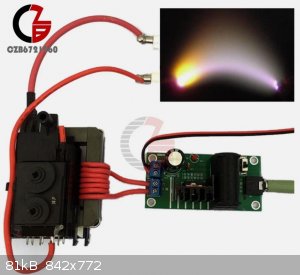
Please note that the picture show a transformer which outputs direct current, but you would need one which outputs alternating current. Unfortunately,
I did not find a better picture.
Hope that helps & friendly greetings!
[Edited on 6-9-2025 by Mister Double U]
|
|
|
Metallophile
Hazard to Self
Posts: 93
Registered: 23-3-2018
Member Is Offline
Mood: No Mood
|
|
I once built something similar also using a neon sign transformer, and 4" x 6" glass plates with metal window screens hot glued to each side. The
screens were 2" smaller in both dimensions than the glass, to give a large enough insulating distance around the outer edges and prevent arcing. This
worked pretty well, until my cable got disconnected due to all the interference I was causing!
|
|
|
chempyre235
Hazard to Others
Posts: 195
Registered: 21-10-2024
Location: Between Nb and Tc
Member Is Offline
Mood: Buried in chemistry
|
|
Ozone generator - UV method
I wasn't quite sure where to put this (and I felt like it didn't warrant a new thread), so I'm putting it here. A while back, some of us SM users
discussed the possibility of generating ozone with UV. I recently discovered a paper that shows peak formation at ~160nm. Paper is attached. I've also
linked the original SM thread.
https://www.sciencemadness.org/whisper/viewthread.php?tid=16...
Attachment: Photochem Photobiology - 2021 - Claus - Ozone Generation by Ultraviolet Lamps.pdf (411kB)
This file has been downloaded 45 times
"However beautiful the strategy, you should occasionally look at the results." -Winston Churchill
"I weep at the sight of flaming acetic anhydride." -@Madscientist
"...the elements shall melt with fervent heat..." -2 Peter 3:10
|
|
|
MrDoctor
Hazard to Others
Posts: 236
Registered: 5-7-2022
Member Is Offline
|
|
A good UV capable lamp that doesnt have a decent chance of burning out the second it his 1000H of runtime (50 days of use, or 100 nights after hours
glowing the room up), will cost as much as if it were made by god, it still probs wont generate a lot of ozone without a fancy aparatus to go with the
lamp. to maximize exposure, because i think that formed ozone acts as an inhibitor to the further formation of ozone, since its not nearly as UV
permissive.
Given that ozone is highly soluble, supposedly, in sulfuric acid, there is a technique i have observed in chemistry for wriggling around certain
material barriers when physics or matter itself dont agree with what you are trying to do.
In castner kellner cells, a pool of mercury is used to transfer sodium into the cathode chamber in such a way that there is no pathway through which,
usually chlorinated brine full of oxygen bubbles, or molten sodium chloride, can ever come into contact with the catholyte. sodium plates onto mercury
that soaks it up, and then releases it again in a molten hydroxide bath, or propylene carbonate if metallic sodium is desired instead of chloride
derived hydroxide.
Something similar can be done to recover pure SO2 from a sulfur candle by bubbling the dilute SO2 into water, and pumping and precipitating the SO2 in
another vessel under heat/sonication/vacuum, etc to pretty much solvent extract it away from atmospheric air, which youd want if you wanted to attempt
a small scale contact process using a sulfur candle.
If you had a very tall 12-20cm wide column full of glass beads, welded it shut like a giant test tube, and bubbled ozone through that via a thin glass
tube through the top, how much would dissolve into the acid as it rises up through that glass while under the pressure of a counter-flowing sulfuric
acid column (95% acid generates about 2-3psi/M not including any intentional extra pressure you might choose to apply? and then, under what
circumstances could it be liberated? heat? decompression? sonication? high surface area material exposure? or maybe even just syphoning the acid out
of the bottom of your column, because if you introduced a frit restrictor down there as well, the acid would naturally be decompressed substantially
lifting it back up again, plus the pressure differential goes to -2psi at the very top of your syphon tube from pump suction, more with a restrictor
adding resistance, and as soon as it decompresses, some pure ozone bubbles out and from there, get creative.
If you are familiar though with how an air conditioner works, subjecting the liquid coolant to a vacuum to rapidly boil it in a high resistance
region, given that peristaltic pumps dont get backflow even under vacuum, you can use one to pump fluid into a flask or backwards gas wash bottle
(drawing from the bottom) and subjecting to as much vacuum as you can before the tubing puling fluid out collapses, most of the ozone should be driven
out. strong vacuum might not even be neccesary, it depends on how concentrated the acid returning to the column is and wether your column can leech
ozone from oxygen/air an an acceptable efficiency. It would be convenient if the vacuum from gravity and/or a restrictor was enough to absorb most of
the ozone, then you could just run air through the thing.
But in short tldr is, sulfuric acid to some degree solvent extracts ozone, allowing for total isolation making purified oxygen viable.
Also it means you can do an ozonolysis like how some hydrogenations are sometimes done just holding the gas in with a balloon and using strong
stirring to in place of bubbling, so gas just goes in, nothing comes out assuming no gaseous byproducts.
|
|
|
chempyre235
Hazard to Others
Posts: 195
Registered: 21-10-2024
Location: Between Nb and Tc
Member Is Offline
Mood: Buried in chemistry
|
|
I think that this setup would be good for attempting to purify ozone (which I do not want to try), or possibly in the OP's case (to synthesize
N2O5. However, I'm planning to try a modified contact process with only ozone at room temp, with elemental sulfur in water
instead of the dioxide, so I don't think that ozone purification will be necessary.
Basically, I'm going to use an oxygen concentrator as both the purifier and as the gas pump, and any unreacted oxygen gas would simply pass through
the apparatus. The concentrated oxygen would pass through a quartz tube which would permit the passage of UV, and by it, production of ozone. All
ozone would be used immediately, and any excess would pass through a scrubber (probably some metal oxide; I haven't decided yet for sure).
"However beautiful the strategy, you should occasionally look at the results." -Winston Churchill
"I weep at the sight of flaming acetic anhydride." -@Madscientist
"...the elements shall melt with fervent heat..." -2 Peter 3:10
|
|
|



![[*]](images/xpblue/default_icon.gif)


