wvcruffler
Harmless

Posts: 16
Registered: 11-9-2025
Member Is Offline
|
|
Ethyl nitrite synthesis
Howdy all!
Briefly - realized I had no sulfuric acid today but did have HCl.
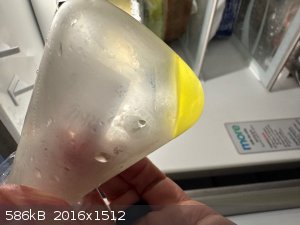
So cooled off and then mixed 1/2 mol each ethanol and HCl.
Dripped this into a 1/2 mol of sodium nitrite in water in an ice bath.
I do believe what I got in the end was a small amount of ethyl nitrite (which I'm using to make "Sweet Spirit of Nitre" which is 4% ethyl nitrate in
high proof ethanol. It was used in a few metal bluing recipes in the late 1800's - early 1900's. I don't actually think it serves much purpose but I
plan to make a few solutions with and without it and see if there is any discernable difference. Anyway, yield sucked. I'll try again after I find
some sulfuric acid.
DrPhil
[Edited on 2-10-2025 by wvcruffler]
Hey what’s that hissing sound?
|
|
|
jackchem2001
Hazard to Others
Posts: 109
Registered: 2-6-2024
Member Is Online
|
|
I think HCl is okay these nitrite esterifications anyway. How good was your cooling? pure EtONO boils at 17 degC
|
|
|
wvcruffler
Harmless
Posts: 16
Registered: 11-9-2025
Member Is Offline
|
|
Fair. Probably lost some because I mixed the alcohol and acid then dripped that into the nitrate solution right after mixing them.
Next time I plan to mix H2SO4 and ethanol ahead of time then cool then add to the sodium nitrite solution in the ice bath.
Hey what’s that hissing sound?
|
|
|
woelen
Super Administrator
Posts: 8150
Registered: 20-8-2005
Location: Netherlands
Member Is Offline
Mood: interested
|
|
Keep in mind that quite some ethyl nitrite dissolves in the aqueous layer. This may lead to considerable losses.
Another option may be to use a warm solution of ethanol in 15% HCl and add warm drops of concentrated solution of NaNO2 to this and lead the gas
through ethanol. This gives you ethanol with the nitrite ester dissolved in it, but some water vapor also makes it into the ethanol. If this is an
issue then you may need to lead the gas through a tube, filled with dry and somewhat warm CaCl2.
|
|
|
wvcruffler
Harmless
Posts: 16
Registered: 11-9-2025
Member Is Offline
|
|
Quote: Originally posted by woelen  | Keep in mind that quite some ethyl nitrite dissolves in the aqueous layer. This may lead to considerable losses.
Another option may be to use a warm solution of ethanol in 15% HCl and add warm drops of concentrated solution of NaNO2 to this and lead the gas
through ethanol. This gives you ethanol with the nitrite ester dissolved in it, but some water vapor also makes it into the ethanol. If this is an
issue then you may need to lead the gas through a tube, filled with dry and somewhat warm CaCl2. |
I don't have the glassware for that setup yet but gives me some goals to scrounge over winter. And when you say concentrated nitric acid is 69% enough
or would I need to distill over some fuming?
Hey what’s that hissing sound?
|
|
|
woelen
Super Administrator
Posts: 8150
Registered: 20-8-2005
Location: Netherlands
Member Is Offline
Mood: interested
|
|
What are you talking about? We are mixing up things about nitrate esters and nitrite esters.
Ethyl nitrate is CH3CH2-O-NO2. Ethyl nitrite is CH3-CH2-O-NO.
Making the first one is hard and quite dangerous. It requires a strong mix of nitric acid and sulfuric acid and the reaction always is at the edge of
runaway, with possibly disastrous effects like fire or even explosion. Ethyl nitrate also is something which I would not like to have around. It is
unstable and easily explodes.
Ethyl nitrite on the other hand, is fairly easily made. Just add NaNO2 to a warm dilute solution of any strong acid and ethanol (dilute HCl, dilute
H2SO4, and dilute HNO3 all work fine, it also works with somewhat stronger solution of sodium bisulfate). A gas escapes, which is mainly CH3CH2-O-NO,
with a little NO and/or NO2 in the mix, which reacts with further (excess) ethanol. If the liquid is very cold, then the nitrite ester also is formed,
but then it does not escape as gas. Its boiling point is 17 C, at lower temperatures some of it may separate as liquid, but there also will be quite
some ester, dissolving in the aqueous layer.
Even better results are obtained with methanol instead of ethanol. You can use colder solutions, leading to less decomposition and a purer product.
Nearly all methyl nitrite escapes as gas and can be dissolved in methanol.
|
|
|
wvcruffler
Harmless
Posts: 16
Registered: 11-9-2025
Member Is Offline
|
|
| Quote: Originally posted by woelen | What are you talking about? We are mixing up things about nitrate esters and nitrite esters.
Ethyl Text - I couldnt sort out how to edit the post. You mention warm - most references i have seen they are chilling it! In my case
I added the HCL/Ethanol mix to my sodium nitrite solution dropwise via an additon funnel. Haven't tried to add it to a warmed solution but I had it
bubble up at one point with a chilled sodium nitrite and chilled HCL/ETOH. I was not monitoring temp but it didn't feel particularly warm.
In any case I got all I needed to make the Spirit of Nitre but I'll run it again sometime just to do it. |
Hey what’s that hissing sound?
|
|
|
woelen
Super Administrator
Posts: 8150
Registered: 20-8-2005
Location: Netherlands
Member Is Offline
Mood: interested
|
|
I told to use warm solutions (not boilingly hot), in order to drive off the ethyl nitrite as a gas. Luke warm is OK.
If you use a ice cold solution, then you indeed have less decomposition, but then also a lot of the ethyl nitrite remains in solution and cannot be
easily isolated. The fact that it can escape as gas makes isolation very easy. Just lead the gas through ethanol and you get your desired solution.
For this reasdon, working with methyl nitrite is easier. then you can use a chilled solution, to keep decomposition rates lower, while still getting
most of it as a gas. The boiling point of methyl nitrite is lower and this escapes as gas anyway.
With higher nitrites, you want strong cooling. These do not escape as gas, but due to their longer carbon-chains, they also are less soluble in
aqueous solutions and they easily separate from the aqueous layer as a yellow liquid, which can be easily separated.
|
|
|
jackchem2001
Hazard to Others
Posts: 109
Registered: 2-6-2024
Member Is Online
|
|
Isopropyl nitrite has a lovely smell of lemonade if I remember right. Though, you should immediately move away if you smell it because it can cause a
headache
|
|
|



![[*]](images/xpblue/default_icon.gif)


