| Pages:
1
..
31
32
33 |
Microtek
National Hazard

Posts: 992
Registered: 23-9-2002
Member Is Offline
Mood: No Mood
|
|
I tested the initiating ability of both the bromate and nitrate with respect to RDX. Both substances adequately initiated 200 mg RDX at the 30 mg
level in 7.5 mm ID brass tubes. The RDX was pressed as hard as I am able by hand (about 50 bar) while the primary was only pressed firmly. At the 10
mg level, the nitrate complex failed, while the bromate achieved a very marginal detonation which dented the witness plate much less than at the 30 mg
level (though still considerable more than the control experiment where a base "charge" of 200 mg CaCO3 was used). Bearing in mind that these were
single tests, I don't think there is too much difference between the two substances. Perhaps the bromate is slightly more effective. In any case, the
AZTR-based complexes are much more powerful, but of course they involve more work.
I didn't heat any of the tested complexes, and it is possible that things may change if any bound water is driven off. Next up is to test the
sensitivity of the two complexes.
|
|
|
Axt
National Hazard
Posts: 977
Registered: 28-1-2003
Member Is Offline
Mood: No Mood
|
|
Unfortunately, I cannot reproduce that.
Cu(NO3)2·3H₂O, 2.42 g, 10.01 mmol
C₂H₄N₄, 2.52 g, 29.96 mmol
3 eq 4-ATZ in 50 mL water mixed with 1 eq copper nitrate in 50 mL water, immediately turns dark blue. Within 5 min a precipitate had formed, left it
an hour it's formed a viscous soup. Filtered and dried. Took the form of very small sky blue needles, too small to see with naked eye. Fluffy,
lint-like to the feel.
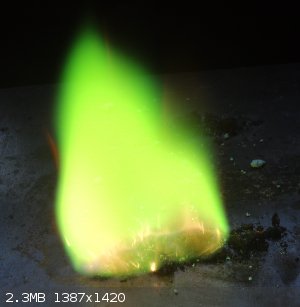
Deflagrated mildly on ignition, luminous green flame. Fairly easy to elicit a snap under the blow of a ball peen hammer. It doesn't show any of the
DDT characteristics as described.
So there's another puzzle to solve. My copper nitrate is the remnants of dissolving copper plumbing pipe in HNO3 and the 4-ATZ is purchased from china
(I haven't made it since the perchlorate experiments).
|
|
|
Microtek
National Hazard
Posts: 992
Registered: 23-9-2002
Member Is Offline
Mood: No Mood
|
|
Hmm. I will double check that I haven't confused the bromate with the nitrate by doing another preparation (I prepared all the complex salts in
parallel, so that is not impossible). I made my Cu(NO3)2 by dissolving the calculated amount of basic copper carbonate in dilute nitric acid then
evaporating to dryness (in air stream at ca. 90 C), diluting with distilled water and evaporatng again.
My product does match the physical appearance you describe.
Edit:
Well, I have to agree with your findings. I can't reproduce it either, and I think the most probable scenario is that I had actually prepared the
bromate, just from the nitrate instead of from the sulfate.
Apart from the importance of keeping proper lab notes, I guess that the takeaway here is that the bromate seems to be less soluble than the other
complexes.
[Edited on 28-9-2025 by Microtek]
|
|
|
Axt
National Hazard
Posts: 977
Registered: 28-1-2003
Member Is Offline
Mood: No Mood
|
|
Heh, well problem solved. It is the best green flame I've seen though.
I dropped a periodate salt out from the acetate, its mildly interesting but not in any practical sense. It's an immediate precipitation, one of those
fine mud-like pasty forms, pale green in colour, seemed to gas off a bit in suspension. It puffs or pops on ignition depending on if it's a fine
powder or caked lump.
Seeing if a chlorate will drop from KClO3 would be the next logical step.
|
|
|
Microtek
National Hazard
Posts: 992
Registered: 23-9-2002
Member Is Offline
Mood: No Mood
|
|
I tried the chlorate. I prepared it from copper acetate without any issues. It is fairly soluble in hot water (I warmed the solution for about 1 hour
while stirring to ensure equilibrium conditions had been reached), but reprecipitates on cooling. It is the same light blue colour as the bromate but
not nearly as vehemic. It pops on ignition in the open and cracks in foil, but does not shred the foil as the bromate.
|
|
|
Axt
National Hazard
Posts: 977
Registered: 28-1-2003
Member Is Offline
Mood: No Mood
|
|
Out of curiosity I precipitated the persulphate from the acetate Cu(C2H4N4)3S2O8? it's an instant pale blue precipitate too, flares off faster than
the nitrate, a bit slower than the perchlorate. Only the small amount struck with a hammer will initiate, feebly spreading the rest. A bulky molecule
with a single peroxidic bond, it's obviously low energy but has a rapid deflagration.
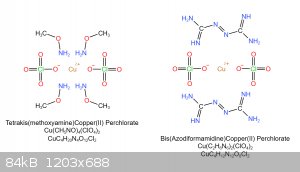
I've identified a couple more ligands that haven't been explored, I can't find any reference to methoxyamine (CH3ONH2) nor azodiformamidine
(NH2-C(=NH)-N=N-C(=NH)-NH2) complexes. Methoxyamine prep aint for the faint of heart but it is commercially available and I have confirmed it will
complex with copper nitrate. Azodiformamidine is a simple permanganate oxidation of aminoguanidine nitrate where it is basic enough and insoluble
enough to precipitate as a dinitrate but in low yield, I got 5.4 g from 32 g aminoguanidine bicarbonate. I'm not sure why this high nitrogen CO
balanced molecule has no reported energetic properties. I haven't attempted a complex, and I'm not sure if the free base is stable.
[Edited on 11-10-2025 by Axt]
|
|
|
Axt
National Hazard
Posts: 977
Registered: 28-1-2003
Member Is Offline
Mood: No Mood
|
|
I was able to distil some methoxyamine, from its hydrochloride using concentrated hydroxide in water, it boils off at about 50C.
The copper perchlorate complex presumed to be as shown above - Cu(CH3ONH2)4(ClO4)2 - precipitates from cooling an ethanol solution (basic copper
carbonate + 70% HClO4 + slight excess CH3ONH2 in EtOH) as purple shards.
It's not a particularly vehemic substance in the open, it'll flash off in an instant but with a bit of a courser crackling sound than that of a thump.
When 40 mg was confined in a single layer of Al foil and heated it will detonate shredding the foil. It also detonates strongly under hammer impact,
its fairly sensitive but that's yet to be quantified.
It would be most interesting to compare to a methylamine complex, to see how the energetic oxygen of methoxyamine influences it. The closest I can
find is Woelen's description of the ethylenediamine complex here: https://woelen.homescience.net/science/chem/exps/Ni_en_compl... although there is no video. I've never made this myself.
[Edited on 12-10-2025 by Axt]
|
|
|
Axt
National Hazard
Posts: 977
Registered: 28-1-2003
Member Is Offline
Mood: No Mood
|
|
More testing and comparisons for copper methoxyamine perchlorate (CMOAP). I made copper ethylenediamine perchlorate (CEDP) to compare alkyamines to
alkyloxyamines.
The oxyamine is significantly more soluble in ethanol. CMOAP will precipitate when cooled to -10 and left a couple hours, CEDP precipitates
immediately. This gives CMOAP a larger crystal size in approx. 58% yield compared to 89% yield for CEDP, it may be worth trying isopropanol instead of
ethanol for CMOAP.
The oxyamine is vastly more heat sensitive than the amine, CMOAP ignites at 134C whereas CEDP ignites at 298C. CMOAP flashes on being touched by a
glowing splint, whereas CEDP only splutters without propagation.
The oxyamine DDT's far easier than the amine. CMOAP detonates strongly the instant it's touched by a butane flame in single foil containment, CEDP
just sputters out the side after some heating.
The oxyamine is far more impact sensitive than the amine. The distance for no fire in 10 for a 1025 g weight at 8mm increments is 24 mm for CMOAP and
104 mm for CEDP. For comparison mercury fulminate is 48 mm. Both CMOAP and CEDP explode easily and powerfully when struck with a hammer on anvil, it's
very difficult to differentiate impact sensitivities using a hammer.
In conclusion, copper methoxyamine perchlorate is very sensitive to both heat and percussion even by primary explosive standards. Its ability to DDT
unconfined is low, but very high given only slight containment. It is probably too sensitive to attempt initiating efficiency, I expect it would
perform well though. It's shown no deterioration over the 4 days it's been sitting in the open.
[Edited on 13-10-2025 by Axt]
Attachment: copper methoxyamine perchlorate 40mg foil com.mp4 (5.4MB)
This file has been downloaded 99 times
|
|
|
underground
National Hazard
Posts: 719
Registered: 10-10-2013
Location: Europe
Member Is Offline
|
|
Did you tried to add abit of dextrin to CMOAP ? just like NHN. Most likely nitrate/persulphate would be less sensitive. A double salt of CMOAP could
be usefull since it is storage stable. Maybe a mixture of various copper salts like nitrates/perchlorates/persulphates then add the MOA.
|
|
|
Axt
National Hazard
Posts: 977
Registered: 28-1-2003
Member Is Offline
Mood: No Mood
|
|
Practical and persulphate don't belong in the same sentence, just a novel curiosity. I've only seen two, the ammonia and the 4-aminotriazole. The
tetraamine is the most sensitive to friction complex I know of, and both decompose after a few days.
Coprecipitate may or may not work, generally this relies on similar solubilities. I had attempted the nitrate first by freebasing into ethanol but
it's too contaminated by chloride to characterise (its burning mildly, bright blue). Also tried extraction of the free base with ethylacetate (kinda
worked) but distillation is definitely the way to go, although I'm unsure about the safety of this.
The logical path forward would be to try different metal ions, zinc for example which generally has a dampening effect or precipitating the iron(III)
from acetone. One could also try hard complexing ions such as gallium or even calcium, these may be unlikely to bond to the oxygen but could be tried.
|
|
|
Axt
National Hazard
Posts: 977
Registered: 28-1-2003
Member Is Offline
Mood: No Mood
|
|
So, I tried zinc methoxyamine perchlorate. It precipitates from ZnO + HClO4 + MOA in isopropanol when cooled in the freezer, but it cannot be dried
without liquifying. I haven't established a reason for this, maybe it's just both hygroscopic and highly soluble in water to the point it will
dissolve into that fraction of water. Less likely but a possibility is it being an ionic liquid, the example one could draw on is ZnCl2 + urea which
forms a liquid at room temperature. It will still explode when soaked up into paper and struck with a hammer.
|
|
|
Axt
National Hazard
Posts: 977
Registered: 28-1-2003
Member Is Offline
Mood: No Mood
|
|
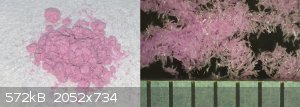
I did try nickel methoxyamine perchlorate, it turns from green->blue->purple->mauve of addition of methoxyamine and precipitated from cold
ethanol but I couldn't seem to get it dry and was forming purple patches. It seemed to be losing methoxyamine and taking in water. I didn't try to
desiccate it, although it's pretty, it's not that interesting to me. It wouldn't be expected to be as potent as the copper based on oxygen balance.
The copper salt has been stable and hasn't changed sitting unconfined for over a week.
|
|
|
Axt
National Hazard
Posts: 977
Registered: 28-1-2003
Member Is Offline
Mood: No Mood
|
|
Just an update on copper methoxyamine perchlorate, it does seem to be hygroscopic albeit not to the extent of the zinc and nickel salts. A pile placed
on absorbent paper is leeching its colour into the paper, suggesting a cycle of drawing in moisture through the night, dissolving in it and re-drying
through the day. The crystals have become clumpy. The complex itself still seems stable, the clumped crystals in about half the size of a pea now
detonate unconfined from the minimal self-containment the clumping has created.
I attempted to form iron(III) methoxyamine perchlorate by dripping methoxyamine into Fe(ClO4)3 in acetone. It explodes on contact. In water it stays
in solution. It seems it is too unstable to exist as a solid.
[Edited on 14-11-2025 by Axt]
|
|
|
Axt
National Hazard
Posts: 977
Registered: 28-1-2003
Member Is Offline
Mood: No Mood
|
|
Quote: Originally posted by Axt  | I attempted to form iron(III) methoxyamine perchlorate by dripping methoxyamine into Fe(ClO4)3 in acetone. It explodes on contact. In water it stays
in solution. It seems it is too unstable to exist as a solid.
|
This is incorrect, as I tried with indium nitrate and it did the same thing. It's most likely that the complexation is so exothermic that its spot
boiling the acetone. This could be tested/averted by just diluting the methoxyamine in acetone before the addition. Regardless these complexes do not
precipitate from acetone and would need to be evaporated and desiccated.
|
|
|
Axt
National Hazard
Posts: 977
Registered: 28-1-2003
Member Is Offline
Mood: No Mood
|
|
Here is two translated quotes from Chinese Journal of Universities, (2001), vol. 22, pg. 895. regarding Manganese Carbohydrazide Perchlorate.
"Impact Sensitivity According to standard WJ 1870-89, the results show that with a drop hammer mass of 800g, the 50% ignition height is 28.1cm, and
the standard deviation is 1.43cm. Compared with conventional detonating explosives such as lead azide and tetrazide under the same test conditions, it
exhibits very low sensitivity to impact."
"Under optimal conditions. the ultimate initiation charge of the title compound is 80 mg, while under normal assembly conditions for ordinary
detonators, the ultimate initiation charge is around 120 mg. A normal production charge of 160-200 mg can ensure the reliability of the detonators
function."
I tried it, here is the results.
Its preparation is exactly as you'd expect, neutralise manganese carbonate with HClO4 and pour into solution of carbohydrazide at 70C. It precipitates
after about 10 seconds as nice free flowing clear crystals.
It will not propagate deflagration when ignited in the open, just sputters.
Its impact sensitivity was very high, firing at 32 mm with 1025 g weight this is comparable to DPPE-1 and MTX-1 and much higher than lead azide.
It wouldn't initiate when rubbed under the weight of a 32oz hammer on steel but would when pushed down upon and rubbed.
Loading 120 mg under just enough pressure to seat it above 650 mg of PETN resulted in full detonation.
So in conclusion, its prep is easy, crystal form is very nice and it does initiate PETN but its sensitivity was far higher than advertised.
[Edited on 13-1-2026 by Axt]
|
|
|
| Pages:
1
..
31
32
33 |



![[*]](images/xpblue/default_icon.gif)


