Sulaiman
International Hazard

Posts: 3942
Registered: 8-2-2015
Member Is Offline
|
|
how effective is a Vigreaux column ?
I've not done a lot of different types of fractional distillations,
mostly ethanol during the early months of the covid outbreak.
I used a 600mm packed insulated column with reflux condenser,
I get about an additional ten theoretical plates from this column.
During this time I made a few negative comments about Vigreaux condensers
even though I never used one,
so I bought one and tried it.
My 300mm Vigreaux gave an additional 1.5 theoretical plates.
(when packed with 3mm glass spheres about four plates)
A question for members that use a Vigreaux column :
How many equivalent theoretical plates do you get with what height of Vigreaux column ?
CAUTION : Hobby Chemist, not Professional or even Amateur
|
|
|
Fulmen
International Hazard
Posts: 1794
Registered: 24-9-2005
Member Is Offline
Mood: Bored
|
|
Never measured it, but your experience seems reasonable. Simple armchair physics is enough to see that it can't have much separation power, on the
other hand it comes with very few down sides. It's simple to set up, has little holdup and won't flood easily.
We're not banging rocks together here. We know how to put a man back together.
|
|
|
Sir_Gawain
National Hazard
Posts: 527
Registered: 12-10-2022
Location: southeast
Member Is Offline
|
|
How do you calculate “theoretical plates” and what exactly does it represent? I’ve never gotten a satisfactory answer on that.
|
|
|
Sulaiman
International Hazard
Posts: 3942
Registered: 8-2-2015
Member Is Offline
|
|
if a liquid is evaporated/boiled and the vapours are condensed and collected
it is called a simple distillation.
This is equivalent to one theoretical plate.
For columns like Snyder or bubble cap trays each stage condenses vapour to liquid
then re-boils the most volatile components of the mixture/liquid.
Each stage acts like a simple distillation (almost, nothing is perfect)
So for example, a boiling pot with three trays in the column would effectively behave as if (slightly less than) four simple distillations were
performed,
each distilling the products of the previous distillation.
This would be nearly four theoretical plates.
In a packed column the vapour condenses on the packing and is re-evaporated,
rather than this occuring at a particular physical level,
the process is a gradual incremental effect,
needing a certain height of packing to achieve one theoretical plate,
commonly known as height equivalent to a theoretical plate (HETP)
eg my 25mm id column packed with 3mm diameter glass balls has a HETP of about 60 mm, so my 600mm tall column achieves about 10 theoretical plates
(plus one for the boiling pot = 11 plates total.)
If I used a better packing material (eg Raschig rings) the HETP would be lower.
How do you calculate HETP or overall number of plates ?
1) knowing the total surface area (packing plus walls) and thermodynamic data for the components to be separated,
using the 'laws' of Dalton, Henry and Raoult you could calculate HETP etc.
Good luck with that.
2) perform a distillation for which you have a boiling point diagram
and graphically determine the number of plates,
knowing the initial and final concentrations.
https://en.wikipedia.org/wiki/McCabe%E2%80%93Thiele_method
If you change the components to be distilled you will have different thermodynamic constants
so the HETP will be different for different components.
So I should specify HETP = 60mm for an ethanol:water mixture.
CAUTION : Hobby Chemist, not Professional or even Amateur
|
|
|
Fulmen
International Hazard
Posts: 1794
Registered: 24-9-2005
Member Is Offline
Mood: Bored
|
|
A "theoretical plate" is basically an idealized single stage (non-fractional) distillation setup. A liquid is boiled, and the vapor is condensed.
I've never done the math, you will have to look up the [url= https://en.wikipedia.org/wiki/Fenske_equation]Fenske equation[/url] for that. There are
also graphical methods.
We're not banging rocks together here. We know how to put a man back together.
|
|
|
markx
National Hazard
Posts: 657
Registered: 7-8-2003
Location: Northern kingdom
Member Is Offline
Mood: Very Jolly
|
|
A "theoretical plate height" is exactly that....a theoretical length of a particular column that is responsible for one simple distillation step under
reflux conditions. Well for plate columns one can assume within reason that one plate (if well designed and properly refluxed) is about the HETP and
they be roughly equal in height and quantized simply by the structure and design of the column internals. For packed columns the reality tends to be
more complicated as the "plates" shall form in an emergent nature and not be equal in height. Much depends on the structure, density and nature of the
packing (also the nature of the surface properties of the packing), reflux ratio, vapor speed and so on and so forth. The real equilibrium system
inside a packed column is much more vague, dynamic and intertwined. One still can reduce it down to HETP and the number thereof, just by measuring the
achieved separation and comparing the result to how much simple distillation steps would it take for such an outcome, but it is a rather simplistic
model in my opinion.
Exact science is a figment of imagination.......
|
|
|
kmno4
International Hazard
Posts: 1523
Registered: 1-6-2005
Location: Silly, stupid country
Member Is Offline
Mood: No Mood
|
|
Found somewhere :
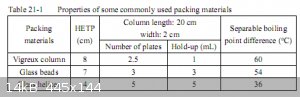
I use 40 cm VC. It is sensitive to air movements but a loose sheet of aluminium foil, around whole column, fixes it.
As written elsewhere, it is possible to perform nice experiment of azeotropic dehydration of acetic acid-water solution using this column, so
performane is not so bad.
Curiosities:
1)Ethanol separated from denatured one, is always stinky, no matter how many distillations were performed.
2) Some time ago I bought few liters of benzene, marked as "pure" (original bottles), freshly produced. This benzene has odour similar, but not quite
as benzene from other (old) bottle.
I decided to check purity by distillation using my VC and it was good movement. The liquid boils in several degrees range at the top of the column and
it was impossible to obtain pure sample of benzene 
Possibly it contains some cyclohexane or something similar....
This "pure" benzene is not even technical grade, I made a complaint ("we apologise...") and got another bottle of "pure" benzene. But its purity was
the same as earlier : an inseparable mixture of benzene with something... f*ck.
Слава Україні !
Героям слава !
|
|
|
jackchem2001
Hazard to Others
Posts: 110
Registered: 2-6-2024
Member Is Offline
|
|
You might be able to improve component separation by operating at vacuum pressure. The ultimate vacuum is limited by what your condenser can get down
to.
Also, what is the reasoning for insulating the column as I see in some replies? My instinct is actually to do the opposite - to blow some air over the
outside of the column, if it is not possible to deliver a controlled amount of reflux
|
|
|
Sulaiman
International Hazard
Posts: 3942
Registered: 8-2-2015
Member Is Offline
|
|
@kmno4 : that is an interesting table.
for 3mm glass beads I get 60mm with a 25 mm id column
and the table shows 70mm for a 20 mm id column ...quite similar 
the Vigreaux data is surprising,
almost as good as a packed column with reflux condenser.
I bought the cheapest NS24 Vigreaux column on eBay at that time,
(it has a side-arm take-off)
not as many fingers as the more expensive variants,
so maybe I am still over-critical of Vigreaux columns .... ?
or maybe I ran the distillation too fast ?
or maybe the authors used a reflux condenser ?
observations:
before using glass spheres of uniform size,
I tried cheaper glass beads intended for some kind of cosmetic fingernail procedure,
they looked like slightly flattened spheres of various but similar sizes,
the column flooded easily.
Next I tried glass beads for jewelry, each with a central hole.
The column did not flood so easily but the holdup was excessive (guesstimated).
With uniform 7mm diameter spherical beads all was ok but the HETP was higher than I wanted,
so now I use 3mm diameter spheres,
which is probably about the smallest diameter that does not instantly flood the column.
The best separations were achieved when I kept the column just on the edge of flooding.
Good separation was achieved (lower HETP)
BUT continuous monitoring, with adjusting of heating rate were required,
not recommended.
Maybe one day I'll invest in some Raschig rings or similar.
@jackchem2001:
I agree that insulating a Vigreaux (without a reflux condenser) seems 'wrong'.
If WITH a reflux condenser then insulation is good.
CAUTION : Hobby Chemist, not Professional or even Amateur
|
|
|



![[*]](images/xpblue/default_icon.gif)


