Varungh
Hazard to Self

Posts: 70
Registered: 23-6-2025
Location: India
Member Is Offline
Mood: Bad mood
|
|
Making chromates
Aim-to make chromate salts
Materials required- alkali sulfate salt, filtration apparatus, single cell electrolyzer, NaCl, graphite electrode, chrome steal bolt
Theory-single cell electrolysis of alkali sulfates corrodes the annode
If Chrome SS bolt is used instead of a inert annode, it is oxidised to Fe(OH)3 and if nickel and Chromium present, to their hydroxides
Chromium hydroxide can be oxidised by sodium bleach to sodium chromate and the bleach itself is reduced to NaCl
Procedure-a SS bolt is taken and thoroughly rusted in a sodium sulfate using electrolysis.
The annode dust is collected by filteration.
A solution of NaCl is electrolyzed by carbon annodes. This makes dilute bleach. Overstep here and you make chlorate. Chlorate should be avoided
The annode dust is treated with bleach. Sodium chromate is obtained
Precautions - sodium chromate is slightly carcinogenic.
Note-pictures to be added later
|
|
|
j_sum1
Administrator
Posts: 6473
Registered: 4-10-2014
Location: Limbo
Member Is Offline
Mood: Just got through yet another "take this job and shove it" moment.
|
|
Most routes I have seen begin by dissolving stainless steel in hydrochloroc acid then purifying by selective precipitation. Finally oxidising (usually
with hypochlorite), concentrating, and precipitating a product. Potassium dichromate is the easiest target. Soduim is darned near impossible due to
its extreme solubility.
|
|
|
Varungh
Hazard to Self
Posts: 70
Registered: 23-6-2025
Location: India
Member Is Offline
Mood: Bad mood
|
|
Instead of making sodium bleach(NaClO) potassium bleach(KClO) can be used instead. KClO decomposes fast so make and use instantly.
Edit-the cation of the chromate depends on the bleach you use. NaClO makes the sodium chromate, and KClO makes the portasium chromate.
Pottasium chromate can be acidified to potassium Dichromate.
[Edited on 19-12-2025 by Varungh]
|
|
|
Radiums Lab
Hazard to Others
Posts: 299
Registered: 18-3-2025
Location: India
Member Is Offline
Mood: Experiencing the elegance of science.
|
|
You can get chromates and dichromates from amazon in India.
Water is dangerous if you don't know how to handle it, elemental fluorine (F₂) on the other hand is pretty tame if you know what you are doing.
|
|
|
Varungh
Hazard to Self
Posts: 70
Registered: 23-6-2025
Location: India
Member Is Offline
Mood: Bad mood
|
|
I suppose yes, you can get everything with money but this Takes away the main point of amatuer Chemestry . We assemble here to make this by our own,
and not buy it.
|
|
|
Hexabromobenzene
Hazard to Others
Posts: 263
Registered: 27-4-2021
Member Is Offline
|
|
Use chlorides for metal electrolysis. It disintegrate less readily in sulfates.
For chromates, you need an alkaline environment. You can then add alkali to the chloride.
The equilibrium concentration of hypochlorite is low. I recommend dissolving the hydroxide precipitate in the same pot as the carbon anode.
Chromate aerosols are carcinogenic.
|
|
|
bnull
National Hazard
Posts: 994
Registered: 15-1-2024
Location: East Woods
Member Is Offline
Mood: Fecking annoyed
|
|
Keep the wet hydroxides in the filter and wash them with the hypochlorite solution. Nickel and iron hydroxide remain in the filter, chromate passes
through to the filtrate.
|
|
|
Varungh
Hazard to Self
Posts: 70
Registered: 23-6-2025
Location: India
Member Is Offline
Mood: Bad mood
|
|
Quote: Originally posted by Hexabromobenzene  | Use chlorides for metal electrolysis. It disintegrate less readily in sulfates.
For chromates, you need an alkaline environment. You can then add alkali to the chloride.
The equilibrium concentration of hypochlorite is low. I recommend dissolving the hydroxide precipitate in the same pot as the carbon anode.
Chromate aerosols are carcinogenic. |
I am not specifically after chromate for one. Besides that homemade bleach is usually alkaline due to excess NaOH made during production
The reason I use sulfate is because sulfate during electrolysis do not oxidise Chromium hydroxide to chromates. This is convenient for me as if I
would have used chloride, the simultaneously running hypochlorite production would make chromate which would be more convenient, yes but I like to
avoid carcinogenic mist for a reason. Sulfate leaves me with hydroxide which does not aresolize and is not carcinogenic.
|
|
|
Varungh
Hazard to Self
Posts: 70
Registered: 23-6-2025
Location: India
Member Is Offline
Mood: Bad mood
|
|
Lead chrome (PbCrO4)
I made some lead chromate. Aq Lead acetate and sodium chromate was mixed which lead to a double displacement. While lead chromate is both neurotoxic
and carcinogenic, it is less so as their parents, which are deadlier.
Ignore my handwriting, it is usually worse. Besides I am ordering new HDPE bottles for storage since as you can see, using a old sanitizer bottle does
not work well.
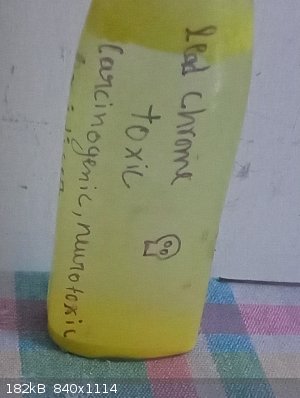
|
|
|
Radiums Lab
Hazard to Others
Posts: 299
Registered: 18-3-2025
Location: India
Member Is Offline
Mood: Experiencing the elegance of science.
|
|
| Quote: Originally posted by Varungh |
I suppose yes, you can get everything with money but this Takes away the main point of amatuer Chemestry . We assemble here to make this by our own,
and not buy it. |
Why make it when you can buy it for cheap, if chromate is going to be used for making something not accesible that is the point, yea sure you can
explore the thing (in small quantities) but if you have a cheaper, purer and readily available source without headache then why not? I odered Lead,
Cadmium di-chromate from amazon.
Water is dangerous if you don't know how to handle it, elemental fluorine (F₂) on the other hand is pretty tame if you know what you are doing.
|
|
|
Hexabromobenzene
Hazard to Others
Posts: 263
Registered: 27-4-2021
Member Is Offline
|
|
| Quote: Originally posted by Varungh | | Quote: Originally posted by Hexabromobenzene | Use chlorides for metal electrolysis. It disintegrate less readily in sulfates.
For chromates, you need an alkaline environment. You can then add alkali to the chloride.
The equilibrium concentration of hypochlorite is low. I recommend dissolving the hydroxide precipitate in the same pot as the carbon anode.
Chromate aerosols are carcinogenic. |
I am not specifically after chromate for one. Besides that homemade bleach is usually alkaline due to excess NaOH made during production
The reason I use sulfate is because sulfate during electrolysis do not oxidise Chromium hydroxide to chromates. This is convenient for me as if I
would have used chloride, the simultaneously running hypochlorite production would make chromate which would be more convenient, yes but I like to
avoid carcinogenic mist for a reason. Sulfate leaves me with hydroxide which does not aresolize and is not carcinogenic.
|
When electrolyzing chlorides with a stainless steel anode, you'll only get hydroxides unless you use extreme current densities.
The reaction with hypochlorite is as follows:
Sodium hydroxide + hypochlorite + chromium hydroxide = sodium chromate + sodium chloride. You'll need additional alkali in any case.
When electrolyzing chloride with an inert anode, you'll get a very dilute hypochlorite solution (no more than 20 grams per liter). It's best to make
with hydroxides reaction in a one pot with stirring.
|
|
|
Varungh
Hazard to Self
Posts: 70
Registered: 23-6-2025
Location: India
Member Is Offline
Mood: Bad mood
|
|
| Quote: Originally posted by Radiums Lab | | Quote: Originally posted by Varungh |
I suppose yes, you can get everything with money but this Takes away the main point of amatuer Chemestry . We assemble here to make this by our own,
and not buy it. |
Why make it when you can buy it for cheap, if chromate is going to be used for making something not accesible that is the point, yea sure you can
explore the thing (in small quantities) but if you have a cheaper, purer and readily available source
without headache then why not? I odered Lead, Cadmium di-chromate from
amazon. |
I am using it to make a historical paint lead chrome. It is rather accessible for one hence I wanted it completely homemade. Besides this method is
accessible to those who do not have commercial access to Cr(VI) salts. I am sorry I did not made myself clear.
|
|
|
chloric1
International Hazard
Posts: 1240
Registered: 8-10-2003
Location: GroupVII of the periodic table
Member Is Offline
Mood: Stoichiometrically Balanced
|
|
There are still pottery sources of potassium dichromate in USA. Also dwindling options in pyrotechnic suppliers. Where sodium dichromate is mother
of all chromium chemistry in industrial settings, potassium dichromate is the home chemist chromium panacea. It is easy to purify by recrystallize
and although less soluble than sodium dichromate it can still be used to make chromium trioxide.
Fellow molecular manipulator
|
|
|
Varungh
Hazard to Self
Posts: 70
Registered: 23-6-2025
Location: India
Member Is Offline
Mood: Bad mood
|
|
Photos
The yellow liquid in the bottle is my chromate. The white bottle is my electrolyzer. The bottle was of my choice because of it's narrow opening,
avoiding the mist.
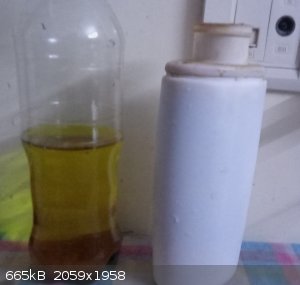
|
|
|
Varungh
Hazard to Self
Posts: 70
Registered: 23-6-2025
Location: India
Member Is Offline
Mood: Bad mood
|
|
You can distinctly see the hydroxide sludge at the bottom. It will be removed. I intend extracting nickel from it.
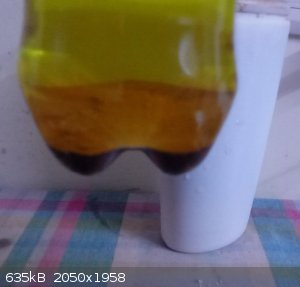
|
|
|
Varungh
Hazard to Self
Posts: 70
Registered: 23-6-2025
Location: India
Member Is Offline
Mood: Bad mood
|
|
The inside of the electrolyzer. It is overed in bown iron hydroxide. The 2 holes at the sides are for fitting the annode and cathode. This is a
electrolysis bottle, clearly superior to others because the electrode placement on the sides prevent mist. The middle bigger hole can be used to
monitor the cell. A cap of a cold drink bottle can be fitted inverted to create a decent sealing.
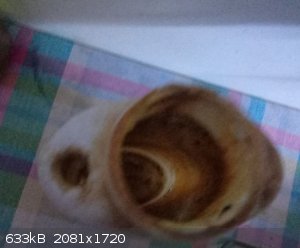
|
|
|
Varungh
Hazard to Self
Posts: 70
Registered: 23-6-2025
Location: India
Member Is Offline
Mood: Bad mood
|
|
| Quote: Originally posted by chloric1 | | There are still pottery sources of potassium dichromate in USA. Also dwindling options in pyrotechnic suppliers. Where sodium dichromate is mother
of all chromium chemistry in industrial settings, potassium dichromate is the home chemist chromium panacea. It is easy to purify by recrystallize
and although less soluble than sodium dichromate it can still be used to make chromium trioxide. |
I intend on making H2CrO4 using my sodium chromate, by brute forcing it. Electrolysis of sodium chromate in a split cell configuration essentially, to
force the cations to leave.
Chromate>dichromate >chromic acid
|
|
|
DraconicAcid
International Hazard
Posts: 4506
Registered: 1-2-2013
Location: The tiniest college campus ever....
Member Is Offline
Mood: Semi-victorious.
|
|
| Quote: Originally posted by Varungh |
I intend on making H2CrO4 using my sodium chromate, by brute forcing it. Electrolysis of sodium chromate in a split cell configuration essentially, to
force the cations to leave. |
How exactly is this going to work?
Please remember: "Filtrate" is not a verb.
Write up your lab reports the way your instructor wants them, not the way your ex-instructor wants them.
|
|
|
Hexabromobenzene
Hazard to Others
Posts: 263
Registered: 27-4-2021
Member Is Offline
|
|
| Quote: Originally posted by Varungh | | You can distinctly see the hydroxide sludge at the bottom. It will be removed. I intend extracting nickel from it. |
Could you describe the experiment in more detail?
You can easily obtain dichromate by electrolysis, but the efficiency will drop significantly in the production of chromic acid. To avoid cathodic
reduction, place the chromate only in the anode compartment. You cannot obtain pure chromic acid by this method.
Alkali will accumulate in the cathode compartment. A polypropylene diaphragm is the best material for this synthesis.
[Edited on 21-12-2025 by Hexabromobenzene]
|
|
|
Varungh
Hazard to Self
Posts: 70
Registered: 23-6-2025
Location: India
Member Is Offline
Mood: Bad mood
|
|
| Quote: Originally posted by Hexabromobenzene | | Quote: Originally posted by Varungh | | You can distinctly see the hydroxide sludge at the bottom. It will be removed. I intend extracting nickel from it. |
Could you describe the experiment in more detail?
You can easily obtain dichromate by electrolysis, but the efficiency will drop significantly in the production of chromic acid. To avoid cathodic
reduction, place the chromate only in the anode compartment. You cannot obtain pure chromic acid by this method.
Alkali will accumulate in the cathode compartment. A polypropylene diaphragm is the best material for this synthesis.
[Edited on 21-12-2025 by Hexabromobenzene] |
The nickel oxides/hydroxide and iron hydroxide mix will be mixed in ammonia. I suppose it is only natural ammonia dissolves nickel compounds.
I am also considering the polypropylene diaphram electrolyser you described. I did try using it for making NaOH and metal chlorides but it seems it it
hopeless-it keeps leaking.
|
|
|
Hexabromobenzene
Hazard to Others
Posts: 263
Registered: 27-4-2021
Member Is Offline
|
|
Are you sure? The method with metal salts works even with poor diaphragms since a layer of hydroxides is formed, which acts as diaphragm. In this way
I have already prepared 3 kg of sodium hydroxide, a kilogram of potassium hydroxide and the same number of moles of salts iron and zinc. The method is
very simple.
You need to remove the diaphragm very quickly after electrolysis due to leakage. If you want to reduce leakage significantly, you can try the method
with a solution of polypropylene in paraffin and then removing the paraffin with a solvent
In the case of preparing metal salts, you can wrap the fabric in several layers to create a sort of polypropylene hydroxide composite diaphragm. With
a large area, resistance does not play such a role
[Edited on 22-12-2025 by Hexabromobenzene]
|
|
|
Varungh
Hazard to Self
Posts: 70
Registered: 23-6-2025
Location: India
Member Is Offline
Mood: Bad mood
|
|
A H type split electrolysis cell will be taken. The catholyte is dilute NaOH Soln. The annolyte is Na2CrO4 solution.
A Cu cathode and a Pb annode will be used.
On application of a electrilc current Na2CrO4 is split on Na+ ions and CrO4 2+ ions
In the annode chamber the CrO4 2+ ions react with excess Na2CrO4,making Na2Cr2O7.
At the catholyte Na+ ions make NaOH.
Sodium ions at the annolyte will run out however
Once that starts to happen CrO4 2+ will react with H+ making H2CrO4.
A dehydrating agent converts it to CrO3.however H2CrO4 itself is useful and can be used as is.
|
|
|
Varungh
Hazard to Self
Posts: 70
Registered: 23-6-2025
Location: India
Member Is Offline
Mood: Bad mood
|
|
| Quote: Originally posted by Hexabromobenzene | Are you sure? The method with metal salts works even with poor diaphragms since a layer of hydroxides is formed, which acts as diaphragm. In this way
I have already prepared 3 kg of sodium hydroxide, a kilogram of potassium hydroxide and the same number of moles of salts iron and zinc. The method is
very simple.
You need to remove the diaphragm very quickly after electrolysis due to leakage. If you want to reduce leakage significantly, you can try the method
with a solution of polypropylene in paraffin and then removing the paraffin with a solvent
In the case of preparing metal salts, you can wrap the fabric in several layers to create a sort of polypropylene hydroxide composite diaphragm. With
a large area, resistance does not play such a role
[Edited on 22-12-2025 by Hexabromobenzene] |
Thank you. I shall consider doing so for my sulfuric acid production. However another problem is that these polypropylene diaphrams are for bulk
synthesis. Like making H2SO4,NaOH or FeCl2(special thanks for the FeCl2 electrolytic prep). These do not scale down well. As it so happens, I am not
sure of taking the risk of working with lots of Cr(VI) (especially as I only have neoprene gloves).
|
|
|
bnull
National Hazard
Posts: 994
Registered: 15-1-2024
Location: East Woods
Member Is Offline
Mood: Fecking annoyed
|
|
The usual way to make sodium dichromate is by acidifying chromate:
$$2 CrO_4^{2-} + 2 H^{+} \leftrightarrow Cr_2O_7^{2-} + H_2O.$$
It can't get much simpler than that. No toxic mist, no "how long is it going to take". You just dissolve sodium chromate in acid, heat it (not to
boiling, mind you), dissolve potassium chloride or sulfate in it and cool it. You can recrystallize the resulting potassium dichromate later if you
will.
You don't need a dehydrating agent to make CrO3. Chromic acid only exists in solution, like sulfurous acid or ammonium hydroxide. Evaporate
the water and the trioxide crystallizes.
What is going to happen during electrolysis is the production of lead chromate at the anode, which may or may not flake off.
| Quote: | | However another problem is that these polypropylene diaphrams are for bulk synthesis. |
You have to adapt the manufacturing technique to scale them down properly. In other words, be more careful when welding, perhaps use a penknife or
scalpel heated by a small flame (alcohol lamp, for example) in place of a soldering iron.
|
|
|
Hexabromobenzene
Hazard to Others
Posts: 263
Registered: 27-4-2021
Member Is Offline
|
|
I don't understand the problem. Electric soldering iron is a universal tool for welding plastics. It can be used to weld thick buckets and even thin
bags. It all depends on the welding technique. The techniques are similar to welding metal but it's much easier because the plastic is viscous.
If you want to weld a very small container, you can use medical syringes. To weld thin fabric to plastic, do not touch the fabric directly with the
soldering iron. Melt the base plastic and allow the melt to fuse with the fabriс
You can even weld bags. To weld bags, you need to separate the edge material and weld it.
|
|
|



![[*]](images/xpblue/default_icon.gif)


