| Pages:
1
2 |
UndermineBriarEverglade
Hazard to Self

Posts: 79
Registered: 13-6-2024
Member Is Offline
|
|
Simple melt-cast carrier 2,4-dinitrophenoxyethyl nitrate (DNPOEN)?
Quote: Originally posted by KFeNAT  |
As an alternative to TNT for amateur casting, 2,4-Dinitrophenoxyethyl nitrate could be tried. It is said to have a melting point of about 64 degrees
Celsius and can be prepared simply by nitrifying Phenoxyethanol with mixed acid at low temperatures. |
I can't find much about this compound. Wiley's Explosives 7E gives it as "dinitrophenoxyethylnitrate":
| Quote: | Dinitrophenoxyethylnitrate
pale yellow crystals
empirical formula: C8H7N3O8
molecular weight: 273.2 g/mol
energy of formation: −236.8 kcal∕kg = −990.6 kJ∕kg
enthalpy of formation: −256.3 kcal∕kg = −1072.2 kJ∕kg
oxygen balance: −67.4%
nitrogen content: 15.38%
density: 1.60 g∕cm3
solidification point: 64 °C = 147 °F
lead block test: 280 cm3 ∕10 g
detonation velocity, confined: 6800 m∕s = 22 300 ft∕s
at ρ = 1.58 g∕cm3
deflagration point: over 300 °C = 570 °F
impact sensitivity: 2 kp m = 20 N m
The compound is insoluble in water, but soluble in acetone and toluene. It is prepared by dissolving phenyl glycol ether in sulfuric acid and pouring
the reaction mixture into mixed acid at 10–20 °C (50–68 °F).
It is a nitrocellulose gelatinizer.
|
It appears to be a good candidate for melt-cast explosives: good power, sensitivity between RDX and TNT. Unfortunately they don't say where the data
is from. Dettx.com lists it under "DNPOEN" but has little information.
US Patent 3037057, 1962, gives a very cold mixed-acid synthesis with 60% yield and says it's soluble in methanol:
| Quote: |
To a solution prepared by admixing 83 grams of concentrated sulfuric acid and 41 grams of 60 percent nitric acid, contained in a reaction flask, there
were slowly added with stirring 20 grams of 2-phenoxy-1-ethanol. During the addition, the temperature of the reaction mixture was not allowed to rise
above -10° C. by means of a Dry Ice and acetone bath surrounding the flask. Upon the complete addition of the alcohol, the nitrated product was
poured onto ice and filtered. The crude 2-(ortho, para-dinitrophenoxy)-1-ethylnitrate thus obtained weighed 24 grams. The nitronitrate ester product
was then purified by recrystallization from methanol and exhibited the following properties: melting point: 68 C. |
Phenoxyethanol is available to consumers as a cosmetics preservative for $30/kg. Has DNPOEN been tried in an amateur setting? Seems too good to be
true.
|
|
|
Microtek
National Hazard
Posts: 992
Registered: 23-9-2002
Member Is Offline
Mood: No Mood
|
|
Any info on the trinitro derivative? It seems an obvious thing to try, so maybe it doesn't have a suitable melting point.
|
|
|
KFeNAT
Harmless
Posts: 23
Registered: 27-5-2025
Member Is Offline
Mood: No Mood
|
|
| Quote: Originally posted by Microtek | | Any info on the trinitro derivative? It seems an obvious thing to try, so maybe it doesn't have a suitable melting point. |
Yes, it is recorded on page 364 of the same book mentioned above (Wiley's Explosives 7th). Its melting point is 104.5°C, its detonation velocity is
7600 m/s at a density of 1.65 g/cm³, its expansion value of lead casting is 350 cm³ (10 g), and it is slightly less sensitive to impact than RDX
(7.9 N•m). The method described in the book is that it can be obtained simply by re-nitrifying the dinitro compound.
However, I think it might be possible to use a combination of high-concentration nitric acid and sulfuric acid, or sulfuric acid and KNO3, to directly
digest phenoxyethanol into trinitrophenoxyethanol nitrate. The electron-donating effect of the ether group is stronger than that of methyl and
hydroxyl groups, making the benzene ring easier to nitrate. Therefore, compared to TNT and TNP, its trinitroation should have a lower requirement for
reaction temperature. It is possible to obtain the trinitro product within the temperature range where the nitrate ester is not oxidized and
destroyed.
Attachment: Explosives (Rudolf Meyer, J_ (Z-Library).pdf (4.2MB)
This file has been downloaded 82 times
|
|
|
Axt
National Hazard
Posts: 977
Registered: 28-1-2003
Member Is Offline
Mood: No Mood
|
|
US1560426A is the patented trinitro analogue https://patents.google.com/patent/US1560426A/en?oq=us1560426
It seems the nitration conditions are pretty mild, for the lower analogues low temperatures are used to prevent over nitration. Interesting find, I
never knew it was so available. I checked the price it was the equivalent of $20 US a litre here.
vol. 8 P236 PATR2700 is its entry. There is discrepancy for the sensitivity for the dinitro, in there its far less sensitive >120cm vs >40cm for
TNT.
|
|
|
KFeNAT
Harmless
Posts: 23
Registered: 27-5-2025
Member Is Offline
Mood: No Mood
|
|
Phenoxyethanol is available to consumers as a cosmetics preservative for $30/kg. Has DNPOEN been tried in an amateur setting? Seems too good to be
true.[/rquote]
I haven't actually tried synthesizing or testing this substance yet. It seems very suitable and easy to synthesize, which is very exciting. However,
I'm also puzzled as to why so few people have used it; at least in the discussions I've participated in so far, no one has actually tested it. It's
worth mentioning, though, that in my area, phenoxyethanol is only $6/kg. When I have time, I'll definitely try it myself and see if it really works.
|
|
|
UndermineBriarEverglade
Hazard to Self
Posts: 79
Registered: 13-6-2024
Member Is Offline
|
|
Wiley's Explosives 7th also says the trinitro variant is "very stable", and the patent reports that it's soluble in benzene. It is slightly less
suitable for amateur melt-casting since it can't be done in a hot water bath. Without solubility numbers it will likely take some experimentation to
separate them, but a mix might be fine for practical purposes. If I attempt a synthesis, I will probably start with KNO3 + sulfuric acid and measure
the melting point of the result.
The precursor has been commercially available since the 30s, so I don't see any good reason why these haven't been explored. Maybe "phenyl cellosolve"
used to be much more expensive. My worry is that DNPOEN/TNPOEN have some hidden downside: dangerously high sensitivity while liquid, chemical
incompatibility with common explosives, a tendency to weep nitric acid or form dangerous salts, toxicity, etc. I wish there was literature on their
practical use.
|
|
|
Microtek
National Hazard
Posts: 992
Registered: 23-9-2002
Member Is Offline
Mood: No Mood
|
|
If you really want to use a water bath for the melting, you could just add salt or ethylene glycol to the water to raise the boiling point. Or you
could mix in a little of the dinitro derivative to lower the melting point.
I would imagine that the abundant availability of toluene from the petrochemical sector is the reason why TNT won out. At any rate, I suppose it falls
to the members of this forum to do the exploratory work.
|
|
|
UndermineBriarEverglade
Hazard to Self
Posts: 79
Registered: 13-6-2024
Member Is Offline
|
|
Synthesis
Performed my first small-scale synthesis of DNPOEN & TNPOEN with potassium nitrate. I intended to prepare primarily TNPOEN and then tweak the
parameters to produce DNPOEN, but obtained a significant fraction of the dinitro and a very low overall yield of <25%. I will vary the temperature
and acid quantities, and maybe distill some nitric acid.
Both compounds are highly soluble in acetone. Only the minimum quantity must be used, or it'll take a lot of water to precipitate them again. They are
like ETN in this respect. DNPOEN's solubility in acetone is on the order of 27g/100mL.
I have also learned that separation is easy. In hot ethanol, DNPOEN will melt while TNPOEN remains in solution.
----
Target: 4.995 grams TNPOEN (0.0157 mol, "1 part")
Inputs:
1 part phenoxyethanol (0.0157 mol)
5 parts nitric acid in situ:
2.5 parts sulfuric acid
5 parts potassium nitrate
5 parts sulfuric acid (to protonate the nitric acid)
2.5 parts sulfuric acid (for dehydrating effect)
10 parts sulfuric acid, unplanned. Mixture became too thick for a stir bar and I hadn't set up my overhead stirrer.
Yield:
0.42g DNPOEN (0.10 parts)
0.82g TNPOEN (0.16 parts)
Procedure:
A chilled beaker of H2SO4 was placed in a water-ice bath with magnetic stirring. KNO3 was added in
scoops, with temperature kept to 15-20°C.
Then phenoxyethanol was added dropwise. Some white gas, presumably nitric oxide, was released along with an objectionable sweet/antiseptic smell
(phenoxyethanol does not smell good by itself). Upon addition to the mix, the clear phenoxyethanol turned to a very dark beet red. The reaction
mixture looked like raspberry syrup: almost black in the center, and red visible in thin sections. During and after phenoxyethanol addition, the
mixture thickened enough to stop the stir bar, requiring repeated additions of sulfuric acid.
After 30 minutes, addition was complete. After some time, the mixture was removed from the cooling bath and allowed to rise to ambient
temperature (17°C). There was no further evolution of heat. It did, however, continue to thicken, requiring the addition of 9mL of sulfuric acid
(16.52g 93.2%) in total.
After a total of 85 minutes, the reaction mixture was drowned in 900mL of cold tap water to yield a cloudy orange solution.
This solution was filtered to yield an orange scum, some dark red/brown crystals, and a vibrant orange filtrate. The filtrate was deeply colored
but unclouded, and despite chilling and dilution nothing more could be extracted from it.
Solids were dissolved in 20mL of acetone and crashed into ~2-400 mL of water, but precipitation was not complete. More water was required, which
yielded small orange crystals in a milky yellow solution resembling limoncello. These were filtered and the filtrate discarded.
The solids were dissolved in 20mL of denatured alcohol warmed in a hot water bath. Most of the solids dissolved, but a dark red part melted and
remained at the bottom of the beaker. Then, the mixture was cooled to obtain 3 substances:
Solidified dark red puddle of DNPOEN
This was removed with tweezers and rinsed in water to remove the orange crystals stuck to it. Then, it was dissolved dropwise in the minimum necessary
acetone (1.46g) and dumped into ~250mL of water. This precipitated round solids that dropped to the bottom and stuck together, created an oily sheen
across the top that quickly solidified, and left clear water in between. 0.42g of solid DNPOEN was obtained by vacuum filtration.
Reddish liquid, unrecoverable D/TNPOEN in alcohols
The liquid component was poured off into water to yield a milky white solution. Filtration yielded almost nothing, just a few straggler orange
crystals.
Orange crystals of TNPOEN
Finally, the orange crystals were dumped into water. They remained undissolved and the water remained clear. 0.82g of TNPOEN[?] was obtained by
vacuum filtration. The crystals are short spikes with a crunchy texture, denser than nitroguanidine's fluffy hairs.
I used a Thiele tube to measure the melting point of the DNPOEN and found a range of 63-66°C in accordance with the literature. I compared against
two digital thermometers and found that, at least around 65°C, my glass thermometer reads 5° low, so the earlier reaction temperatures may not be
correct.
I haven't yet tested the melting point of the presumed TNPOEN, or any explosive properties of either substance.
|
|
|
UndermineBriarEverglade
Hazard to Self
Posts: 79
Registered: 13-6-2024
Member Is Offline
|
|
Synthesis 2
Ran the experiment again with an overhead stirrer. I think the bright colors of the initial run were just char from poor stirring. Chilling the
phenoxyethanol helped as well. Crystal shape is the same, but one product is cream instead of red and the other is white instead of orange. Yield is
still low, and the ratio of products is still the same. I will change 1 variable at a time until I see improvements.
----
Target: 4.995 grams TNPOEN (0.0157 mol, "1 part")
1 part phenoxyethanol (0.0157 mol)
5 parts nitric acid in situ:
2.5 parts sulfuric acid
5 parts potassium nitrate
5 parts sulfuric acid (to protonate the nitric acid)
2.5 parts sulfuric acid (for dehydrating effect)
9 parts sulfuric acid, as needed to thin mixture
Yield:
0.45g DNPOEN (0.10 parts)
1.06g TNPOEN (0.21 parts)
Procedure:
A chilled beaker of H2SO4 was placed in a water-ice bath with overhead stirring. KNO3 was added in
scoops, with temperature kept to 15-20°C.
Then chilled phenoxyethanol was slowly added. When multiple drops were added at once, or when they landed near the edges and were not adequately
stirred, streaks of dark purple showed. When added slowly there was no change in color. Overall, the reaction mixture was a bubble gum pink. During
and after phenoxyethanol addition, the mixture thickened enough to prevent even stirring, requiring repeated additions of sulfuric acid.
After 34 minutes, addition was complete. There was no further evolution of heat. The mixture thickened somewhat, requiring the addition of 8mL
of sulfuric acid (14.68g 93.2%) in total.
After a total of 85 minutes, the reaction mixture was drowned in 900mL of cold tap water to yield a pale, cloudy solution.
This solution was filtered to yield a pink cake and a translucent yellow filtrate. The filtrate was discarded.
Solids were dissolved in 40mL of hot denatured alcohol, revealing some insoluble specks. The hot solution was crashed into 900 mL of water to
yield a cloudy white solution, which was vacuum filtered.
The resulting solids were dissolved in 5mL of acetone, which was gravity filtered into a small beaker to remove contaminants. Then it was poured
into 900mL of water and vacuum filtered.
With the contaminants removed, the solids were once again fully dissolved in a slight excess of denatured alcohol at room temperature (about
30mL). The solution was heated until a puddle formed at the bottom, then cooled until the puddle had fully solidified.
The remaining solution was poured off into water and vacuum filtered to obtain 1.06g of white crystals (TNPOEN?).
The solidified material was air dried to obtain 0.45g of cream-colored DNPOEN.
|
|
|
KFeNAT
Harmless
Posts: 23
Registered: 27-5-2025
Member Is Offline
Mood: No Mood
|
|
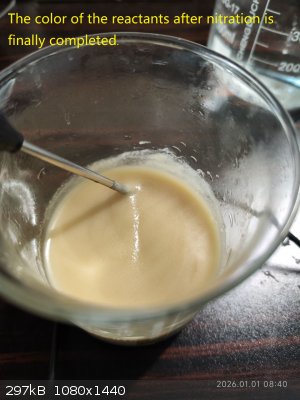
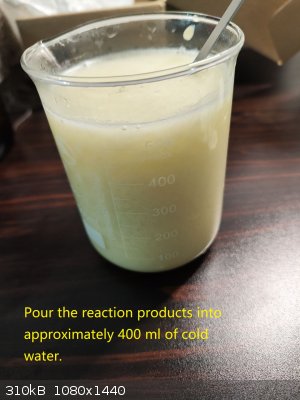
I have currently tried two different nitration methods.
1; First, phenoxyethanol is mixed with sulfuric acid to undergo sulfonation and esterification. Then, the mixed solution is added dropwise to a mixed
acid (POE: 96% H₂SO₄ = 1:2, 60% HNO₃: 96% H₂SO₄ = 1:1.7).
POE + 96% H₂SO₄ = 20g + 40g
60% HNO₃ + 96% H₂SO₄ = 50g + 85g
This method does not oxidize the reactants, thus avoiding the formation of a purple substance.
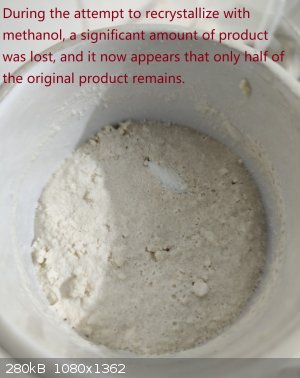
Initially, I tried using inexpensive methanol to dissolve the wet product; however, methanol proved to be an unsuitable solvent.
Firstly, D/TNPOEN's solubility in methanol is insufficient, and secondly, when the product contains water, heating and dissolving it produces a
layered solution.
The low-melting-point D/TNPOEN-methanol complex is in the lower layer, and the yellow D/TNPOEN-H₂O-methanol solution is in the upper layer.
Furthermore, when these were poured directly into water, severe emulsification occurred; almost only the lower layer of the D/TNPOEN-methanol complex
gradually turned into a yellow solid due to methanol removal and cooling.
The substances contained in the upper solution were difficult to recover due to emulsification.
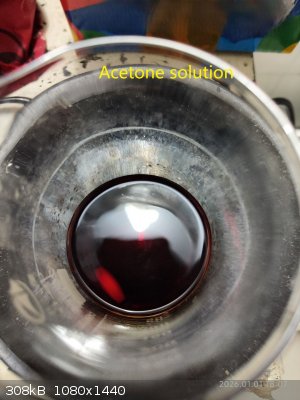
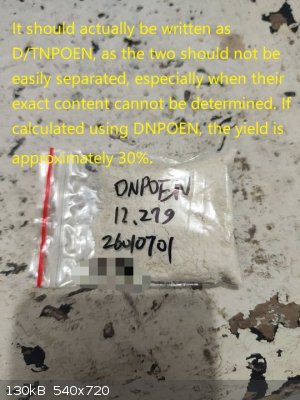
Therefore, I dissolved and stabilized the remaining lumpy product again using acetone, ultimately obtaining only about a 30% yield.
If I had used highly efficient acetone from the beginning, the yield should have been at least between 50% and 60%.
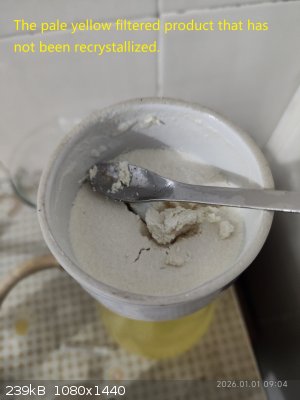
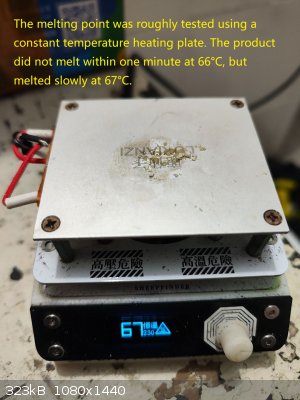
Finally, the pale yellow product obtained by recrystallization from acetone was tested using a hot plate with a slow heating method, and its melting
point was approximately 67°C.
|
|
|
KFeNAT
Harmless
Posts: 23
Registered: 27-5-2025
Member Is Offline
Mood: No Mood
|
|
For some reason, it seems like the images aren't being uploaded. Clicking send when there's an image attached to the post doesn't actually do
anything.
|
|
|
Axt
National Hazard
Posts: 977
Registered: 28-1-2003
Member Is Offline
Mood: No Mood
|
|
| Quote: Originally posted by KFeNAT | | For some reason, it seems like the images aren't being uploaded. Clicking send when there's an image attached to the post doesn't actually do
anything. |
It's likely they are oversized either in dimensions or file size, generally you have to resize photographs. I just use ms paint.
That is a good idea, sulphonation before nitration. I did "stress test" this nitration and it is very prone to oxidation. Adding phenoxyethanol to 68%
NA 98% SA mixed acids at anything over 25C results in puffs of smoke, why they were running it with dry ice in the lit.
|
|
|
UndermineBriarEverglade
Hazard to Self
Posts: 79
Registered: 13-6-2024
Member Is Offline
|
|
Synthesis 3
Tried sulfonation first. Faster addition time, but a different set of dark colors during reaction and no increase in yield. US1560426A went from di to
trinitro at 30-35C in mixed acid. Perhaps this reaction requires a low initial temperature so as not to oxidize the POE, and then gentle heating for
full nitration? I haven't actually tested the melting point of the "TNPOEN" yet, so it's possible that I'm just separating out an H2O mix
like KFeNAT thinks and the product is mostly DNPOEN. But regardless of composition, the bulk yield is still very bad. Perhaps interference by the
salt.
----
Target: 1 part = 0.0157 mol TNPOEN = 4.995 grams
Inputs:
1 part phenoxyethanol (0.0157 mol)
5 parts potassium nitrate
10 parts sulfuric acid
5.6 parts sulfuric acid added to keep it stirrable
Yield:
0.18g DNPOEN (0.10 parts)
0.84g TNPOEN (0.16 parts)
Procedure:
Chilled all ingredients. Acid and POE were combined in a water-ice bath with overhead stirring. KNO3 was slowly added.
This was quite exothermic, resulting in a temp rise to 40°C when I added too large of a portion. Otherwise, temperature was kept at 15-20°C. During
and after KNO3 addition, the mixture turned yellow, green, and then brown. 3mL acid was added to thin the mixture. In total, this took 22 minutes.
The reaction was allowed to continue for 60 minutes at 0-5°C with no particular evolution of heat. Another 2mL acid was added to thin the
mixture. During the reaction, the brown mixture lightened in color.
The mixture was poured into 900mL of water and filtered to yield a crude white filter cake and a clear pale yellow filtrate, which was
discarded.
The filter cake was dissolved in 10ml of acetone to yield an orange liquid with brown stringy impurities, which was strained and poured into
900mL water.
The resulting solids were filtered, then dissolved in ~20mL of denatured alcohol in a small beaker. The solution was placed in a hot water bath
until a puddle formed on the bottom. Then, the beaker was moved to a water-ice bath and a seed crystal was added to the liquid. The puddle solidified
and TNPOEN[?] crystals began to form in the liquid.
0.18g of cream-colored solid [DNPOEN?] was removed from the bottom of the solution and rinsed with water.
The solution was poured into 900mL of water and filtered to obtain 0.84g of white crystals [TNPOEN?].
[Edited on 2026-1-11 by UndermineBriarEverglade]
|
|
|
UndermineBriarEverglade
Hazard to Self
Posts: 79
Registered: 13-6-2024
Member Is Offline
|
|
Synthesis 4
A higher temperature is not the way to go. Patent literature strikes again!
---
Target: 1 part = 0.0157 mol TNPOEN = 4.995 grams
Inputs:
1 part phenoxyethanol (0.0157 mol)
5 parts potassium nitrate
10 parts sulfuric acid
3.3 parts sulfuric acid added to keep it stirrable
Yield: 11-13%
Procedure:
Chilled all ingredients in freezer. With overhead stirring, in a salt-ice bath, combined acid and POE. Then slowly added
KNO3, keeping temperature under 15C. This took 24 minutes. Solution turned light green, then light brown. 2mL of sulphuric acid was added.
Reacted 1h under continuous stirring. After 5 minutes, temperature had reached 5C. The salt-ice bath was siphoned out and cautiously replaced
with warm water until, after 40 minutes of reaction, the temperature had hit 40C. No heat was evolved from the mixture and the high temperature kept
it thin and workable. Mixture remained light brown, with slight POE smell and purple oxidation only on the sides of the beaker.
The mixture was poured into 900mL water and filtered to obtain a white filter cake and a clear filtrate (discarded).
The filter cake was dissolved in 6mL of acetone, strained into 900mL water, and filtered.
0.54g of white solid was recovered. No attempt at characterization was made.
[Edited on 2026-1-11 by UndermineBriarEverglade]
|
|
|
KFeNAT
Harmless
Posts: 23
Registered: 27-5-2025
Member Is Offline
Mood: No Mood
|
|
I adjusted the image size and text description, and now it should be able to be sent successfully.
| Quote: Originally posted by KFeNAT | I have currently tried two different nitration methods.
1; First, phenoxyethanol is mixed with sulfuric acid to undergo sulfonation and esterification. Then, the mixed solution is added dropwise to a mixed
acid (POE: 96% H₂SO₄ = 1:2, 60% HNO₃: 96% H₂SO₄ = 1:1.7).
POE + 96% H₂SO₄ = 20g + 40g
60% HNO₃ + 96% H₂SO₄ = 50g + 85g
This method does not oxidize the reactants, thus avoiding the formation of a purple substance.
Initially, I tried using inexpensive methanol to dissolve the wet product; however, methanol proved to be an unsuitable solvent.
Firstly, D/TNPOEN's solubility in methanol is insufficient, and secondly, when the product contains water, heating and dissolving it produces a
layered solution.
The low-melting-point D/TNPOEN-methanol complex is in the lower layer, and the yellow D/TNPOEN-H₂O-methanol solution is in the upper layer.
Furthermore, when these were poured directly into water, severe emulsification occurred; almost only the lower layer of the D/TNPOEN-methanol complex
gradually turned into a yellow solid due to methanol removal and cooling.
The substances contained in the upper solution were difficult to recover due to emulsification.
Therefore, I dissolved and stabilized the remaining lumpy product again using acetone, ultimately obtaining only about a 30% yield.
If I had used highly efficient acetone from the beginning, the yield should have been at least between 50% and 60%.
Finally, the pale yellow product obtained by recrystallization from acetone was tested using a hot plate with a slow heating method, and its melting
point was approximately 67°C. |
|
|
|
UndermineBriarEverglade
Hazard to Self
Posts: 79
Registered: 13-6-2024
Member Is Offline
|
|
Nice pics. Your sulfonated POE is a much darker color than mine, but that might be due to the larger amount of material. How long did you run the
reaction and at what temperature?
I tested the melting point of my "TNPOEN" from runs 2 and 4 and it is 65°C, so the methanol "separation" is a failure and must just be water like you
said. With such a low melting point I doubt there is much trinitro in there. For practical purposes it shouldn't matter, but it is unsatisfying not to
have a way to separate them.
|
|
|
KFeNAT
Harmless
Posts: 23
Registered: 27-5-2025
Member Is Offline
Mood: No Mood
|
|
| Quote: Originally posted by UndermineBriarEverglade | Nice pics. Your sulfonated POE is a much darker color than mine, but that might be due to the larger amount of material. How long did you run the
reaction and at what temperature?
I tested the melting point of my "TNPOEN" from runs 2 and 4 and it is 65°C, so the methanol "separation" is a failure and must just be water like you
said. With such a low melting point I doubt there is much trinitro in there. For practical purposes it shouldn't matter, but it is unsatisfying not to
have a way to separate them. |
When adding POE to sulfuric acid, the temperature should be controlled below 20°C. After all the POE has been added, the temperature should be raised
to 30°C and held for about 20-30 minutes. Although theoretically POE can withstand higher temperatures in sulfuric acid without structural
decomposition, if the temperature is too high, it is generally believed that when it exceeds 50°C, it may cause -CH2OH to dehydrate and condense into
-CH2OCH2-, thereby reducing product performance, especially during the process of adding alcohols to sulfuric acid.
|
|
|
KFeNAT
Harmless
Posts: 23
Registered: 27-5-2025
Member Is Offline
Mood: No Mood
|
|
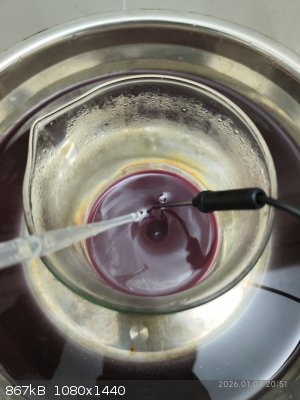
Another method is direct nitration.
POE was slowly added dropwise directly to the mixed acid while cooled (12-17°C). After the final addition was complete, the reactant temperature was
raised to 25°C and maintained for 10 minutes.
POE: 35g
60% HNO3: 90g
96% H2SO4: 230g
When using this method, the addition of POE must be slow. Under strong stirring, the previous drop of POE must be completely mixed in the solution
before adding the next drop. Adding too quickly will cause the POE to not disperse in time, leading to a sharp increase in local temperature,
oxidation of the reactants, and the production of nitrogen oxides and white fumes. Simultaneously, the color of the entire reaction system was the
same as in the original poster's case, resembling purple jam. I believe this color indicates that POE has been oxidized, producing phenolic and
quinone impurities.
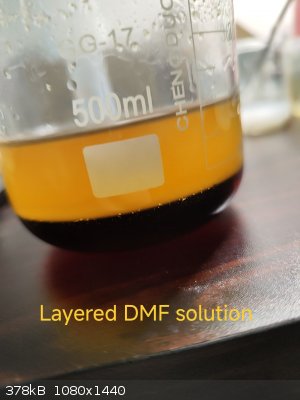
I tried using DMF as the recrystallization solvent this time.
However, for the crude product containing water, a bilayer solution still occurred.
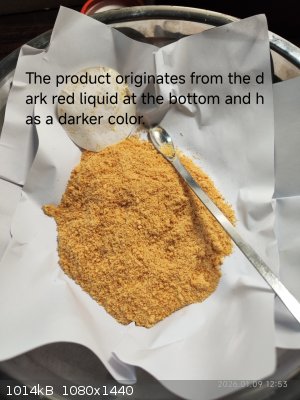
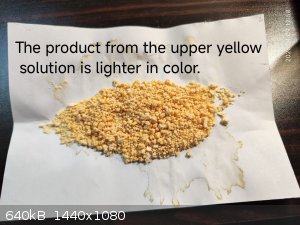
This time, 120 ml of DMF was used, and the solution formed liquid layers at approximately 50 degrees Celsius. This means that the dark red liquid at
the bottom is likely still a low-melting-point complex of D/TNPOEN and DMF, while the upper yellow solution is likely a mixture of D/TNPOEN-H₂O-DMF.
Heating to 70 degrees Celsius did not eliminate the layering or dissolve most of the dark red complex in the lower layer.
Therefore, I separated the two solutions while they were still hot, treating the yellow upper layer and the dark red lower layer separately.
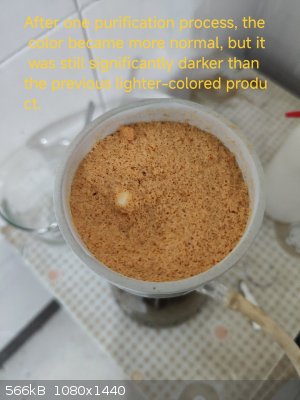
For the separated dark red bottom layer: I added 50 ml of acetone to keep the substances dissolved. After it cooled completely, I added 300 ml of 1%
NaHCO₃ aqueous solution to redefine the product and remove residual acid.
For the separated yellow upper layer: After cooling, I added water to redefine the product. After filtering the precipitate, I dissolved it again in
acetone, then added an appropriate amount of 1% NaHCO₃ solution for stabilization and precipitation.
In the end, I got two products, one darker and one lighter.
|
|
|
KFeNAT
Harmless
Posts: 23
Registered: 27-5-2025
Member Is Offline
Mood: No Mood
|
|
The total weight of the dark and light-colored products was 49.71 + 11.25 = 60.96g. Based on DNPOEN, the yield is approximately 87%.
Using the heating plate again, a rough test of the melting points of both products showed very similar results: both exhibited slow melting at 66°C
and rapid melting at 68°C.
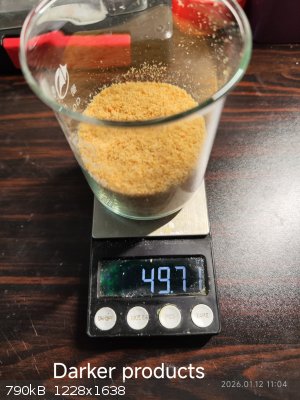 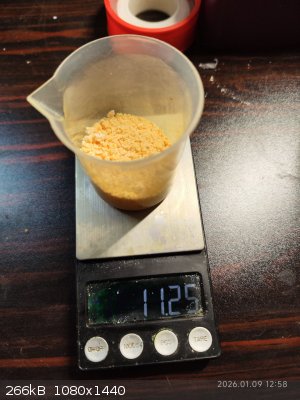 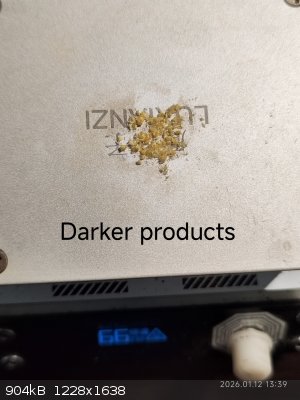  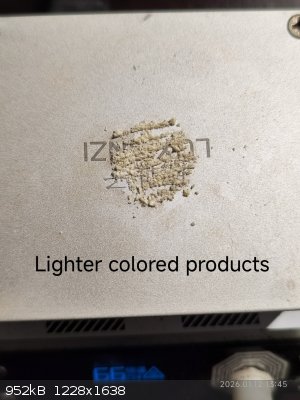 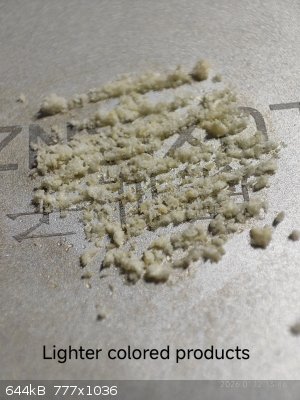 
|
|
|
UndermineBriarEverglade
Hazard to Self
Posts: 79
Registered: 13-6-2024
Member Is Offline
|
|
Synthesis 5 & 6
Still working on this. I tried nitrate salt synthesis with NaNO3 instead of KNO3 twice, first following the parameters of my
third synthesis and then using cautious KFeNAT timing (20m at 25C). Sodium nitrate makes for a much thinner reaction mixture. However, in both cases I
noticed significant oxidation during the reaction with no precipitate once poured into water. I think my NaNO3 is not completely dissolving
in the cold acid, so before I give up on it I will try preparing the mixed acid with some heat before cooling and adding POE.
|
|
|
UndermineBriarEverglade
Hazard to Self
Posts: 79
Registered: 13-6-2024
Member Is Offline
|
|
Synthesis Attempt 7
I am giving up on sodium nitrate. After run #5 I tested my NaNO3. When added to sulfuric acid and heated with copper, it produces red
NO2 gas and blue-green copper nitrate just like my KNO3. So I don't think there's anything wrong with it. This time around, I
used a pump to continuously circulate water in the bath, so temperature control was pretty much perfect. I think the sodium just interferes somehow,
either promoting oxidation of the POE or forming a water-soluble compound. I will return to KNO3; if I can't get a good yield by varying
process parameters, I'll distill nitric acid and try with mixed acid.
----
Target: 1 part = 0.0157 mol TNPOEN = 4.995 grams
1 part phenoxyethanol
5 parts sodium nitrate
10 parts sulfuric acid
3mL sulfuric acid added to keep it stirrable
Yield: 0
Procedure:
Combined acid and NaNO3 with strong stirring in a warm water bath until some white fumes were evolved. Added 1mL of
H2SO4 since not all the NaNO3 had dissolved. Then, the warm water was replaced with -1°C ice/water/salt to cool the
uniform white solution to 5°C.
Added POE dropwise at 0-5°C. Each drop of POE produced a 1°C rise and brown streaks that were absorbed into the solution, which turned a
glossy beige. Addition took 40 minutes, and 2mL of sulfuric acid was added to thin the mixture. Everything looked good until, after the POE was almost
completely added, the brown streaks started taking longer and longer to disappear into the solution. The temperature continued to drop, and at 0°C a
translucent light brown layer formed at the upper edge of the glossy reaction mix despite very strong stirring. Eventually, the entire solution
suddenly turned to a translucent brown and lost its glossy character. At this point, several drops of the reaction mix were dropped into water with no
visible precipitate.
A 25°C bath was applied to raise the reaction mix to approximately the same temperature for 10 minutes. The mix darkened to black, with deep
green visible at the edges.
When poured into water, no precipitate was obtained.
|
|
|
UndermineBriarEverglade
Hazard to Self
Posts: 79
Registered: 13-6-2024
Member Is Offline
|
|
Synthesis 8
A direct KNO3 nitration with good yield and nice white crystals. Procedure was carried out with the circulating water/ice/salt bath from
last run. I tried to add the POE as fast as possible without overheating. During recrystallization, I found that both acetone and ethanol resulted in
two-phase solutions. For the final recrystallization of fully dry crystals, an anhydrous solvent might be required.
-----
Target: 1 part = 0.0157 mol DNPOEN = 4.289 grams
1 part phenoxyethanol
5 parts potassium nitrate
10 parts sulfuric acid
7.7 parts sulfuric acid added to keep it stirrable
Yield: .84 parts DNPOEN (3.62g)
Procedure:
In a circulating water/ice/salt bath under heavy overhead stirring, KNO3 was added to sulfuric acid. During addition,
temperature was kept below 30°C to avoid NO fumes. Then, the mixture was chilled to 5°C.
POE was added dropwise to the mix over 13 minutes. During addition, the reaction mix was kept below 10°C, and the POE beaker was also cooled in
the ice bath. 5mL sulfuric acid was added to keep the mixture flowing. A few drops of POE were lost due to accidentally dropping an ice cube in the
POE beaker. The mixture turned bubble-gum pink.
The water-ice-salt bath was siphoned out and replaced with 25°C water. Replacement and subsequent temperature rise of the reaction mixture took
5 minutes.
The mixture was held at approximately 25°C for 10 minutes. The warm water bath was topped up with hot water as necessary to maintain it at
25°C. Another 2mL acid was added to thin the reaction mixture.
The mixture was rinsed into about 900mL water (it was too thick to pour) and filtered. The wastewater had only a faint yellow tinge.
The beige filter cake was dissolved in about 10mL of acetone, which formed two layers. The layers were separated with a pipette and graduated
cylinder, and some undissolved matter was removed from the layer boundary.
The top layer was clear and resulted in a small amount of extremely fine crystals when poured into water. These were filtered and
set aside without measuring.
The bottom layer was translucent yellow and oily in appearance. When poured into 200mL of water, it precipitated into globular beige masses.
The precipitate "B" was filtered and then dissolved in about 50mL of hot 95% ethanol. About half remained on the bottom in a molten pool. The
solution was cooled to 0C and diluted with another 200mL of water to make sure all the product fell out of solution. Finally, it was vacuum filtered
to obtain 3.62g of suspected DNPOEN: a mat of fine white needle-like crystals and about 1.5g of solid, cream-colored "puddle" that probably contains
some water.
|
|
|
KFeNAT
Harmless
Posts: 23
Registered: 27-5-2025
Member Is Offline
Mood: No Mood
|
|
I conducted a lead compression test (Hess)
This test used the product obtained by direct nitration (dark product plus a small amount of light product to fill to 50g).
Its relative stamina appears to be slightly weaker than TNP. It also produced very thick black smoke after the explosion.
The steel disc I used in the experiment had a diameter of 50mm, instead of the standard 40mm, thus providing a larger area to receive the explosive
shock energy.
Furthermore, the diameter of the lead cylinder ranged from 39.5-39.6mm, slightly thinner than the standard 40.0mm lead cylinder.
Therefore, for the same experiment, my lead cylinder compression was higher than the standard value in the reference materials.
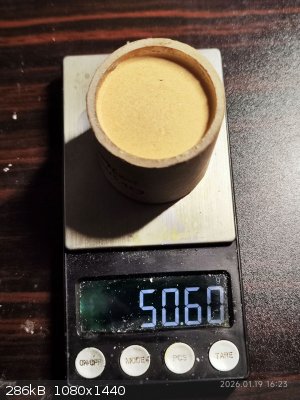 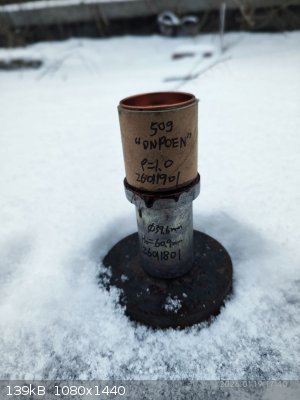  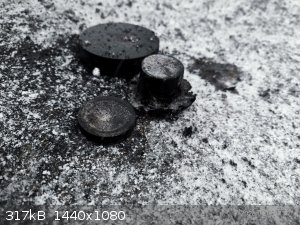 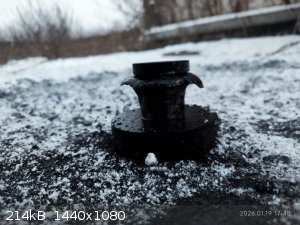 
Attachment: DNPOEN HESS.mp4 (3MB)
This file has been downloaded 30 times
Attachment: DNPOEN HESS 0.125x.mp4 (2.3MB)
This file has been downloaded 27 times
|
|
|
KFeNAT
Harmless
Posts: 23
Registered: 27-5-2025
Member Is Offline
Mood: No Mood
|
|
| Quote: Originally posted by KFeNAT | This test used the product obtained by direct nitration (dark product plus a small amount of light product to fill to 50g).
Its relative stamina appears to be slightly weaker than TNP. It also produced very thick black smoke after the explosion.
The steel disc I used in the experiment had a diameter of 50mm, instead of the standard 40mm, thus providing a larger area to receive the explosive
shock energy.
Furthermore, the diameter of the lead cylinder ranged from 39.5-39.6mm, slightly thinner than the standard 40.0mm lead cylinder.
Therefore, for the same experiment, my lead cylinder compression was higher than the standard value in the reference materials.
|
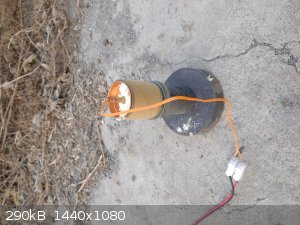
The following are TNP and ANFOAl as references.
[Edited on 20-1-2026 by KFeNAT]
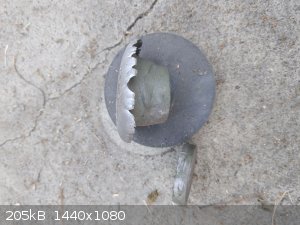    
Attachment: TNP HESS 0.2x.mp4 (2.8MB)
This file has been downloaded 35 times
Attachment: ANFOAl HESS 0.125x.mp4 (1.7MB)
This file has been downloaded 32 times
|
|
|
UndermineBriarEverglade
Hazard to Self
Posts: 79
Registered: 13-6-2024
Member Is Offline
|
|
Nice work! I think it's time for a wiki page. I am curious about the performance of DNPOEN once melt-cast to a higher density, and of oxygen-balanced
mixes. Have you done any sensitivity testing? I will do a few more small syntheses before testing and scaling up.
|
|
|
| Pages:
1
2 |
|


![[*]](images/xpblue/default_icon.gif)


