UndermineBriarEverglade
Hazard to Self

Posts: 79
Registered: 13-6-2024
Member Is Offline
|
|
Sodium nitrate from CAN
I have some calcium nitrate fertilizer and thought to use sodium carbonate to convert it to sodium nitrate:
Ca(NO3)2 + Na2CO3 → 2 NaNO3 + CaCO3
Unfortunately, I learned by the resulting ammonia smell that the "calcium nitrate" actually contains some ammonium nitrate (and an unknown amount of
water). That threw off my stoichiometry. I filtered out the CaCO3 and boiled the solution for an hour until the ammonia was gone:
2 NH4NO3 + Na2CO3 → 2 NaNO3 + 2 NH3 + CO2 + H2O
Now I have a basic solution of sodium nitrate and remaining excess sodium carbonate. How do I get rid of the carbonate?
|
|
|
Nemo_Tenetur
Hazard to Self
Posts: 79
Registered: 13-12-2023
Location: Germany
Member Is Offline
|
|
It´s probably better to seperate the CAN by fractional crystallization in ethanol before you add the sodium carbonate. Calcium nitrate is in
ethanol much more soluble than ammonium nitrate. According to the solubility values given in wikipedia and sciencemadness wikipedia the relation is
about 13,5 : 1, this should make separation by fractional crystallization easy.
|
|
|
fx-991ex
Hazard to Others
Posts: 119
Registered: 20-5-2023
Member Is Offline
|
|
Apparently CAN is a double salt, i dont think it can be separated like this.
Add more CAN to react the excess carbonate.
[Edited on 12-1-2026 by fx-991ex]
|
|
|
Nemo_Tenetur
Hazard to Self
Posts: 79
Registered: 13-12-2023
Location: Germany
Member Is Offline
|
|
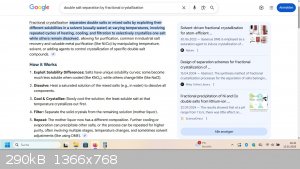
Google AI say it´s possible. I´ve never tried it personally, though. Who knows for sure?
|
|
|
Fulmen
International Hazard
Posts: 1794
Registered: 24-9-2005
Member Is Offline
Mood: Bored
|
|
Most calcium nitrate today is sold as the double salt Ca5NH4(NO3)11·10H2O . If you haven't messed up the amounts too much you should be able to correct the stoichiometry a bit, if not I would try to
titrate it with CAN until no more precipitation occurs.
Further separation is a bit uncertain as I can't find any solubility data for the double salt. However I suspect it will be more soluble than sodium
nitrate, so boiling it down should work.
If that doesn't work you could try adding a very slight excess of sodium carbonate. it is less soluble in cold water than the nitrate, so it should
precipitate out first.
https://en.wikipedia.org/wiki/Solubility_table#S
We're not banging rocks together here. We know how to put a man back together.
|
|
|
clearly_not_atara
International Hazard
Posts: 2923
Registered: 3-11-2013
Member Is Offline
Mood: Big
|
|
Posting AI slop like this should be an instant ban.
Separating salt hydrates using organic solvents is a dubious idea in general. The water of crystallization will throw everything off; it dissolves in
hence contaminates the solvent. Unless you have a published procedure you probably want to find another way.
I would stick with the original plan; you can separate sodium nitrate from the carbonate essentially by concentrating the solution and cooling.
Gassing CO2 helps. NaNO3 is much more soluble than sodium carbonate. The sesquicarbonate and bicarbonate are even less soluble.
|
|
|
Texium
Administrator
Posts: 4742
Registered: 11-1-2014
Location: Salt Lake City
Member Is Offline
Mood: Seeking gainful employment
|
|
“Who knows for sure?”
Ffs. I know for sure that the AI response is full of shit from the briefest of readings, because it doesn’t even talk about double salts,
and just gives the most basic overview of recrystallization imaginable, using sodium chloride and potassium nitrate as the example (two salts that do
not form a double salt and are trivially easy to separate).
And yeah, I’m absolutely going to propose another amendment to the forum guidelines cracking down on the use of AI as a “source” and
uncritically posting screenshots or verbatim statements of AI generated drivel. It’s nothing but a waste of time and energy.
|
|
|
UndermineBriarEverglade
Hazard to Self
Posts: 79
Registered: 13-6-2024
Member Is Offline
|
|
Perhaps I could just bake off the water immediately before dissolving the CAN into ethanol. Based on the package fine print (15.5% nitrate nitrogen,
1% ammonical nitrogen, 19% calcium) I think it is 7(Ca(NO3)2)+1(NH4NO3)+13(H2O), but I'm not
confident. That would be the easiest way to save my CaCO3-NaNO3 solution, since I could add the pure calcium nitrate until the
pH returned to neutral.
I think it would be tough to titrate with CAN until CaCO3 precipitated since the calcium carbonate is so fine. I wish I could simply add
CAN until the pH returned to neutral, but I think the generated ammonia would interfere. And removing it by carrying out the addition under heat would
be slow and unpleasant.
When drying or cooling a solution of multiple salts, does the least-soluble one fully precipitate before the next one starts, or is it like
distillation where close-boiling compounds both have appreciable vapor pressure and need multiple plates for good separation? E.g., if I took a fully
saturated solution of 180g sodium nitrate and 45.5g sodium carbonate at 100C and then lowered the temperature to 0C, would both salts precipitate
until a fully saturated solution of 7g sodium carbonate and 73g sodium nitrate remained? If I dried that solution and then added 15.38mL of boiling
water, would that fully dissolve the carbonate (15.38mL * 45.5g/(100mL) = 7g), partially dissolve the nitrate (15.38mL * 180g/100mL = 27g), and leave
some pure nitrate to be collected?
|
|
|
bnull
National Hazard
Posts: 994
Registered: 15-1-2024
Location: East Woods
Member Is Offline
Mood: Fecking annoyed
|
|
You need to consider the common ion (in this case, sodium) in such calculations.
|
|
|
fx-991ex
Hazard to Others
Posts: 119
Registered: 20-5-2023
Member Is Offline
|
|
its probably
5Ca(NO₃)₂·NH₄NO₃·10H₂O
Do your CAN dissolve completely/or almost completely vs leaving residue? its possible theres some non water soluble component throwing off the %
ratio.
[Edited on 12-1-2026 by fx-991ex]
|
|
|
macckone
Dispenser of practical lab wisdom
Posts: 2211
Registered: 1-3-2013
Location: Over a mile high
Member Is Offline
Mood: Electrical
|
|
Calcium ammonium nitrate can be converted to calcium nitrate by adding calcium hydroxide and driving off excess ammonia and water.
|
|
|
Radiums Lab
Hazard to Others
Posts: 299
Registered: 18-3-2025
Location: India
Member Is Offline
Mood: Experiencing the elegance of science.
|
|
You better dissolve CAN in water and add NaOH, the NH3 can be collected. Chill the sol. Filter it.
Water is dangerous if you don't know how to handle it, elemental fluorine (F₂) on the other hand is pretty tame if you know what you are doing.
|
|
|
Radiums Lab
Hazard to Others
Posts: 299
Registered: 18-3-2025
Location: India
Member Is Offline
Mood: Experiencing the elegance of science.
|
|
Do this outside. Cold water trap can be used for NH3. Your title confused me for the cerium version.
Water is dangerous if you don't know how to handle it, elemental fluorine (F₂) on the other hand is pretty tame if you know what you are doing.
|
|
|
yobbo II
National Hazard
Posts: 820
Registered: 28-3-2016
Member Is Offline
Mood: No Mood
|
|
Where is the world is 'most' CAN sold as the double salt and not simply AN mixed with chalk (or something like chalk).
Yob
|
|
|
UndermineBriarEverglade
Hazard to Self
Posts: 79
Registered: 13-6-2024
Member Is Offline
|
|
I gave up. With heavy stirring and a large excess of water to keep the CaCO3 from getting in the way, I combined all the CAN, the first solution, and
what I estimated to be a slight molar deficit of sodium carbonate. I added additional sodium carbonate until the pH read slightly basic, then poured
off and filtered the solution. I might wash and save the sediment if I can think of anything useful to do with it. I boiled down the solution through
a Graham condenser with no gaseous ammonia escaping and such a low concentration in the distillate that it didn't smell. Eventually, the distillate
went from basic to neutral, and the saturated salt solution also read neutral. I boiled the nitrate dry to obtain a 60% yield (ouch). Some probably
remains in the CaCO3 cake. Any remaining calcium nitrate shouldn't make much difference for my purposes.
(edit: and it did seem to be the double salt. The CAN was in the form of uniform prills, not a mix.)
[Edited on 2026-1-15 by UndermineBriarEverglade]
[Edited on 2026-1-16 by UndermineBriarEverglade]
|
|
|
bnull
National Hazard
Posts: 994
Registered: 15-1-2024
Location: East Woods
Member Is Offline
Mood: Fecking annoyed
|
|
I hate it when the ideas come too late to be useful. If ammonium nitrate is acceptable as a substitute for the sodium salt, use ammonium carbonate
instead of sodium carbonate. Excess ammonium carbonate can be removed by heat--it decomposes at 60 °C.
|
|
|
RU_KLO
Hazard to Others
Posts: 319
Registered: 12-10-2022
Location: Argentina
Member Is Offline
|
|
What about a phosphate route?
Try in a test tube.
1) dissolve X grs. of CAN in H2O.
2) filter to remove non dissolved + any junk the CAN has.
3) add dropwise phosphoric acid till no more precipitate forms.
(Check pH before adding, after some drops and when there in no more precipitation , you want neutral to mildly basic - use drops of diluted NaOH (to
not overshoot - too basic) -
IMPORTANT: watch out for ammonium hydroxide production (do it outside)
"Most calcium orthophosphates are sparingly soluble in water, but all dissolve in acids"
"Calcium Orthophosphates: Crystallization and Dissolution"
Lijun Wang 1, George H Nancollas 1,*
Published in final edited form as: Chem Rev. 2008 Sep 25;108(11):4628–4669. doi: 10.1021/cr0782574
https://pmc.ncbi.nlm.nih.gov/articles/PMC2743557/#:~:text=2H...).-,1,(OCP)%20are%20often%20encountered.
Then you need to separate the sodium nitrate, this is done by solubility.
from this ideas:
"The presence of nitrate in the solution resulted in a decrease in the solubility of either sodium fluoride or trisodium phosphate. The presence of
hydroxide in the solution also resulted in decreased solubility for each component."
"Solubility in the Na + F + NO3 and Na + PO4 + NO3 Systems in Water and in Sodium Hydroxide Solutions"
Dinesh Selvaraj,† Rebecca K. Toghiani,*,†,‡ and Jeffrey S. Lindner†
Institute for Clean Energy Technology (ICET), and Dave C. Swalm School of Chemical Engineering, Mississippi State
University, Mississippi State, Mississippi 39762
maybe using some alcohol to precipitate the phosfate and not the nitrate....
("The order of decreasing solubility of sodium nitrate and water is of
methanol<ethanol<isopropanol (only for low or high mass fractions). In other words, the solubility of sodium nitrate and water decreases with
increasing molecular weight of the alcohol"
problems:
1) adding a new "problematic" ion (phosphate)
2) solubility of trisodium phosfate is high
3) solution pH "control" is very important in phosphates
4) a lot of reading should be done regarding solubilities of phosfates/nitrates and they interaction.
So what you think? Its a solution or a problem?
Go SAFE, because stupidity and bad Luck exist.
|
|
|
pesco
Hazard to Self
Posts: 95
Registered: 19-11-2015
Member Is Offline
Mood: No Mood
|
|
How about adding excess of sodium carbonate to get rid of all ammonia and use this batch with sodium bisulfate to distill off nitric ?
I know, nitric have been done with ammonium nitrate, but I am just not very keen on it. Probably overly cautious, but ...
Then on next batch do correct stechiometry to separate salts.
|
|
|



![[*]](images/xpblue/default_icon.gif)


