dicyanin
Hazard to Self

Posts: 69
Registered: 29-3-2020
Location: Europe
Member Is Offline
Mood: inquisitive
|
|
preparation of succinic anhydride from succinic acid (using a Dean-Stark trap)
PREPARATION OF SUCCINIC ANHYDRIDE FROM SUCCINIC ACID USING A DEAN-STARK TRAP
The idea was based on a comment by AvBaeyer in Magpie's preparation of succinic anhydride thread back in 2019:
http://www.sciencemadness.org/talk/viewthread.php?tid=154133...
Quote: Originally posted by AvBaeyer  |
As an aside, some time back I made succinic anhydride by refluxing the acid in toluene with a catalytic amount of p-toluenesulfonic acid in
conjunction with a Dean-Stark trap. It worked well also. At the time I did not have enough acetic anhydride to use the Fieser procedure.
|
I was not able to find examples of this procedure in the literature, although there are a few papers that use a similar principle using a mineral acid
and a dehydration agent.
Here are the results of three experiments:
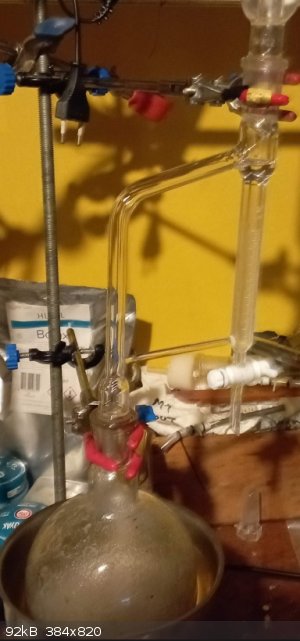
Experiment I
In a 1 liter roundbottom flask were added a stir bar, 40 g (0.34 mol) succinic acid, 200 ml freshly distilled toluene and 4 g p-toluenesulfonic acid
monohydrate. A Dean-Stark trap and reflux condensor were attached, and the mixture was refluxed with good stirring for 26 hours. The mixture was
filtrated hot, and the filtrate was allowed to cool, and put in the freezer overnight. The succinic anhydride precipitate was filtered off, air dried
and recrystallised from fresh toluene.
About 2 ml water was collected in the Dean-Stark trap.
Yield: 8 g succinic anhydride (24%)
mp was 115°C, a bit depressed but still pure enough for most purposes
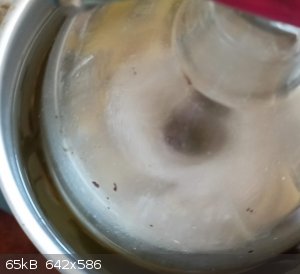
good stirring is essential
It works well but seems more suitable for smaller amounts, although the filtercake, judging from the mixed crystal structures there probably was some
more anhydride in there. It is easy to see the difference between the two, succinic anhydride also has a characteristic smell, a bit naphtalene like
when warm, to my nose. It sublimates near its melting point. According to the Merck index, very pure succinic anhydride can be obtained through
sublimation under vacuum.
After some reading up, it was found that the dehydration reaction is accelerated around 140°C, so another experiment was prepared using xylene
instead of toluene
Experiment II
In a 1 liter roundbottom flask were added a stir bar, the dried and ground filter cake from experiment I, 120 ml xylene (technical grade, dried over
CaCl2) and 1.7 g p-toluenesulfonic acid monohydrate. A Dean-Stark trap and reflux condensor were attached, and the mixture was refluxed
with good stirring for 15 hours, after which all succinic acid had reacted and a dark solution was left, from which after chilling in the freezer
overnight succinic anhydride precipitated.
About 3 ml was collected in the Dean-Stark trap.
The Merck index suggests absolute ethanol as recrystallisation solvent for succinic anhydride. Not having that on hand I tried using isopropanol, but
screwed it up accidentally using aqueous IPA, it was decided to set that batch (mixed anhydride and acid) aside to be used in a succimide synthesis.
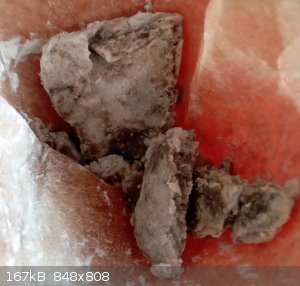
crude succinic anhydride
Experiment III
In a 1 liter roundbottom flask were added a stir bar, 30 g (0.25 mol) succinic acid, 3 g (0.03 mol) succinic anhydride, 120 ml xylene and 1.5 g
p-toluenesulfonic acid monohydrate. A Dean-Stark trap and reflux condensor were attached, and the mixture was refluxed with good stirring for 13
hours.
+1 h : 1 ml collected in Dean-Stark trap
+3 h : 2 ml
+7 h : 3 ml
+13 h: 4 ml ; all solids had dissolved in the flask ; small amount of sublimated succinic anhydride in the D-S trap :
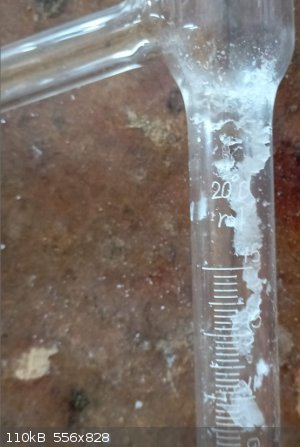
The cooled filtrate was again chilled in the freezer overnight, filtered and air-dried. The crude succinic anhydride was recrystallised from 75 ml
toluene, the grey solid was dried in a dessicator over CaCl2.
Yield: 24 g (84% based on succinic acid consumed)
The idea behind adding a small amount of previously prepared succinic anhydride was to see if it helped speed up the reaction time.
BTW when doing prolonged heating at these temperatures using an oil bath (I used fresh peanut oil) it helps alot to add a dash of butylated
hydroxytoluene (BHT) to the oil, a strong anti-oxidant (prevents free radical-mediated oxidation) that helps to keep the odor bearable. Half a
teaspoon in 0.5 liter of oil corresponds to about 5000 ppm.
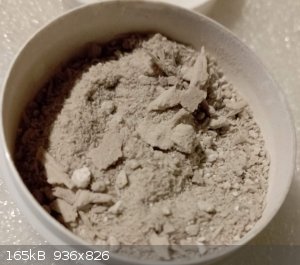
after recrystallisation from toluene
sic transit gloria mundi
|
|
|
oberkarteufel
Hazard to Self
Posts: 55
Registered: 11-12-2018
Member Is Offline
Mood: Mayonesium sulfate
|
|
Nice work!
Apparently, succinic anhydride can also be made by thermal dehydration of neat succinic acid, and purified by recrystallization from 100% acetic acid.
https://youtu.be/5AprbOVQkCs?si=0p1Vj-vNTgInpNLo
Regarding the dehydration via the azeotropic distillation, maybe using higher boiling hydrocarbons, like turpentine (~155°C) or limonene (~175°C)
would speed up the reaction even further?
|
|
|
|



![[*]](images/xpblue/default_icon.gif)
