| Pages:
1
2 |
Invictus395
Harmless

Posts: 10
Registered: 25-11-2025
Member Is Offline
Mood: No Mood
|
|
I'm in a bit of a pickle. I could use some advise please
Hey folks,
Long time browser but first time poster. I could use some advise on a rather urgent issue. I'm not sure where to post this so my apologies if I posted
it in the wrong place.
Long story short I need to dislodge a lead ball (with wad and powder charge) from a Hawken black powder rifle. I didn't clean it as well as I should
have and got it jammed in there good. I tried everything to dislodge it and failed. I brought it to a gunsmith who also tried everything to dislodge
it, and gave up (how over is it?). Unfortunately I had a listing online to sell this rifle and someone bought it. I figured I'd work it out before it
got sold and left the listing up, now here we are.
So I'm moving to Plan C, chemistry. How can I best dissolve the lead ball, quickly, without damaging the steel or causing a dangerous reaction with
the black powder behind it? My first thought is dilute nitric acid. The nitric will dissolve the lead -> lead nitrate, and diluting it at an
approximately 1:4 ratio should prevent saturation and move the reaction to completion. It also should passivate the steel barrel, preventing any
structural damage. Afterwards I can remove the passivation with a long brass brush. I am not certain how the dilute HNO3 would react with black powder
so I'll likely test this prior just to be safe.
I've read that ammonia + H2O2 might also work for dissolving the lead, though I'm not familiar with this route or how it'll react with the other
components so I'm not as confident with it.
My questions are, if you were in my situation, what would you use to quickly dissolve the lead while not damaging the barrel or causing any dangerous
reactions with the powder? Do you see any potential issues arising from using dilute nitric acid that I'm not aware of? All other
tips/advise/criticism is welcome! Hit me with it. Thank you!
[Edited on 26-1-2026 by Invictus395]
|
|
|
bnull
National Hazard
Posts: 994
Registered: 15-1-2024
Location: East Woods
Member Is Offline
Mood: Fecking annoyed
|
|
Flint or cap?
|
|
|
Invictus395
Harmless
Posts: 10
Registered: 25-11-2025
Member Is Offline
Mood: No Mood
|
|
It uses caps
|
|
|
bnull
National Hazard
Posts: 994
Registered: 15-1-2024
Location: East Woods
Member Is Offline
Mood: Fecking annoyed
|
|
Did you try an air compressor and some grease?
Edit: Black powder is simply going to get wet if you use dilute nitric acid.
[Edited on 26-1-2026 by bnull]
|
|
|
MrDoctor
Hazard to Others
Posts: 249
Registered: 5-7-2022
Member Is Offline
|
|
lead nitrate will displace the iron and plate the entire interior in lead. and if the conditions permit the lead to dissolve so with that displaced
layer, meaning passivation will probably be inhibited and its just going to favor eating the iron instead.
lead is soft. it might take some time but you can just couple a drill-bit to a rod or tube of appropriate size, slide it down in there and mill it
away by hand. adding water beforehand eliminates the friction heat risk.
if the charge in there is chlorate based, armstrong mixture, it might be problematic adding nitric acid to that, the risk of nitric acid making its
way through that is.
youll need to look into this, because i dont know what hazards it can create and what it takes to decontaminate afterwards, but mercury might soften
the lead up. gallium will too though youd need indium and tin as well to make the alloy that is liquid at room temp, and i dont know how well it forms
a soft amalgam with lead at nice safe room temp to warm temperatures. tin and indium are cheap but gallium is expensive.
Peroxide+base might work though, but it will be incredibly slow
|
|
|
DraconicAcid
International Hazard
Posts: 4504
Registered: 1-2-2013
Location: The tiniest college campus ever....
Member Is Offline
Mood: Semi-victorious.
|
|
You'd be better off trying to melt the lead than to dissolve it with acid.
Please remember: "Filtrate" is not a verb.
Write up your lab reports the way your instructor wants them, not the way your ex-instructor wants them.
|
|
|
bnull
National Hazard
Posts: 994
Registered: 15-1-2024
Location: East Woods
Member Is Offline
Mood: Fecking annoyed
|
|
Melt it inside a gun?
Chemical means that do not damage the rifle will be very slow, except for mercury, which will soften the ball but doesn't seem healthy.
Mechanical means, considering that lead is soft, will remove the ball. I don't know what methods you and the gunsmith have tried, so I'm probably
listing most of them. You need to remove the nipple, though.
Add more powder, put the nipple back in and fire it again. I'm quite sure you did that before but, well, you're not going to spend
a pound of powder to dislodge the ball. If two or three more firings can't remove the ball, then the situation is much more serious than I suspected.
A real pickle indeed.
Connect an air compressor to the nipple hole. Don't forget to wet the powder first so it doesn't fire. How many psi is a good question.
Do the same as above with a grease gun instead of a compressor. Put some oil in the barrel so as to wet the ball and lub the exit path.
A last question: is it a .54?
[Edited on 28-1-2026 by bnull]
|
|
|
DraconicAcid
International Hazard
Posts: 4504
Registered: 1-2-2013
Location: The tiniest college campus ever....
Member Is Offline
Mood: Semi-victorious.
|
|
The steel barrel will have a much higher mp than the lead. I have no experience with gunsmithing, but no matter how bad the idea is, it's better than
trying to dissolve the lead in acid.
Please remember: "Filtrate" is not a verb.
Write up your lab reports the way your instructor wants them, not the way your ex-instructor wants them.
|
|
|
Twospoons
International Hazard
Posts: 1392
Registered: 26-7-2004
Location: Middle Earth
Member Is Offline
Mood: A trace of hope...
|
|
Pour in molten tin ( MP ~230C). It will alloy with the lead leaving you with lead solder (MP ~ 200C). Pour out the the molten solder. Temps easily
reachable with a small gas torch, hot air gun, or domestic oven.
A small bar of Sn97Cu lead free solder should be easy to obtain (97%tin, balance copper)
[Edited on 28-1-2026 by Twospoons]
Helicopter: "helico" -> spiral, "pter" -> with wings
|
|
|
Sulaiman
International Hazard
Posts: 3942
Registered: 8-2-2015
Member Is Offline
|
|
first job is to make the black powder safe
eg flush (via a syringe needle or very small bore tube) with water to dissolve away the oxidiser.
Any heat will melt the sulphur, I don't know if that is a big problem,
if it is then before heating,
flushing with carbon disulphide would dissolve sulphur
it is VERY flammable, carcinogenic, and it ruins surface finishes.
worst of all it is hard to obtain and not cheap.
DO NOT FLUSH WITH SOLVENTS UNTIL AFTER ANY OXIDISER HAS BEEN REMOVED OR NEUTRALISED.
lots of warm Dichloromethane may work, also not a friendly chemical.
others may have better ideas 
how about a red hot poker ?
steel rod, red hot at one end shoved UP the barrel. (wear ppe)
[Edited on 28-1-2026 by Sulaiman]
CAUTION : Hobby Chemist, not Professional or even Amateur
|
|
|
Radiums Lab
Hazard to Others
Posts: 299
Registered: 18-3-2025
Location: India
Member Is Offline
Mood: Experiencing the elegance of science.
|
|
Heating to melt lead might not be an option because the gun can go off.
Water is dangerous if you don't know how to handle it, elemental fluorine (F₂) on the other hand is pretty tame if you know what you are doing.
|
|
|
MrDoctor
Hazard to Others
Posts: 249
Registered: 5-7-2022
Member Is Offline
|
|
tight as it might be i cant imagine that its perfectly vacuum tight. also is there not some sort of ingress point on the other side for the striking
hammer? try pulling a vacuum on it, if nothing else it should let you draw water or some other liquid in there for a while until the carbon clogs up
around the bullet, fortunately the oxidizers here are super water soluble.
Im asssuming that the cap probably blocks off direct access to the section where the powder is loaded, otherwise you could just flush it out with a
syringe or something, but its not going to be perfectly vacuum tight without something acting as a soft/flexible sealant. A brake tester or whatever
they use those vacuum hand pump tools for in automotive work, those go down past -700mmHg, try that, if it bleeds air through, introduce some solvent
of choice through whatever seam its leaking through, if you get lucky maybe the up to 14PSI vacuum force will also dislodge the bullet.
If it were me, first thing id try to do is force a bit of a thick lubricant through there like your gun oil, then slide something in there with a flat
ending that would go between the barrel and bullet, now excessively lubricated all throughout, and twisting it, hopefully that deformation is enough
that it unsticks it, oil gets in there preventing re-binding against the wall, and the end result is the bullet moves. from there, a vacuum pulled on
it along with some tapping would dislodge it. if not though id still be able to wet it enough to drill a hole through manually by hand, and i can just
hook the hole and pull it out with some wire or something.
|
|
|
DraconicAcid
International Hazard
Posts: 4504
Registered: 1-2-2013
Location: The tiniest college campus ever....
Member Is Offline
Mood: Semi-victorious.
|
|
Yeah, I missed that it still had powder in it. So it's only a slightly better idea than using acid.
At least nobody suggested using ethyl bromide to convert it to volatile tetraethyllead. It might work on paper, but worst plan ever.
Please remember: "Filtrate" is not a verb.
Write up your lab reports the way your instructor wants them, not the way your ex-instructor wants them.
|
|
|
Twospoons
International Hazard
Posts: 1392
Registered: 26-7-2004
Location: Middle Earth
Member Is Offline
Mood: A trace of hope...
|
|
Heating is still an option - you just have to allow for the possibility of powder ignition. Which means securing the barrel to something solid and
pointing it into a sandbag or similar. Heating can be rigged so you can observe from a safe distance.
I doubt there's any chemical method that will remove the lead without also destroying the barrel.
Helicopter: "helico" -> spiral, "pter" -> with wings
|
|
|
Invictus395
Harmless
Posts: 10
Registered: 25-11-2025
Member Is Offline
Mood: No Mood
|
|
Quote: Originally posted by MrDoctor  | "lead nitrate will displace the iron and plate the entire interior in lead. and if the conditions permit the lead to dissolve so with that displaced
layer, meaning passivation will probably be inhibited and its just going to favor eating the iron instead.
lead is soft. it might take some time but you can just couple a drill-bit to a rod or tube of appropriate size, slide it down in there and mill it
away by hand. adding water beforehand eliminates the friction heat risk."
I figured I was missing something. Really glad I asked. Ill try that
"if the charge in there is chlorate based, armstrong mixture, it might be problematic adding nitric acid to that, the risk of nitric acid making its
way through that is."
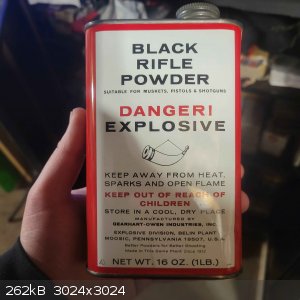
This is the black powder I used. Likely just a granulated mix of the standard 75/15/10 KNO3/Charcoal/Sulfur but it is pretty old and doesn't list the
exact composition on the container
"youll need to look into this, because i dont know what hazards it can create and what it takes to decontaminate afterwards, but mercury might soften
the lead up. gallium will too though youd need indium and tin as well to make the alloy that is liquid at room temp, and i dont know how well it forms
a soft amalgam with lead at nice safe room temp to warm temperatures. tin and indium are cheap but gallium is expensive."
I'd like to avoid this ideally  I have zero experience with decontamination and
it needs to ship ASAP, could create a nasty liability issue I have zero experience with decontamination and
it needs to ship ASAP, could create a nasty liability issue
Peroxide+base might work though, but it will be incredibly slow |
Another time I'll test this out when I'm not in a rush
|
|
|
Invictus395
Harmless
Posts: 10
Registered: 25-11-2025
Member Is Offline
Mood: No Mood
|
|
| Quote: Originally posted by bnull | Did you try an air compressor and some grease?
Edit: Black powder is simply going to get wet if you use dilute nitric acid.
[Edited on 26-1-2026 by bnull] |
I did try lubricant oil and elbow grease, but not a compressor. I'll try that too, good idea. One thing I forgot to mention is the ramrod is stuck in
the barrel too... Would have to force air through the cap hole (for lack of better words). Not sure how I'll create a good enough seal to force air
through
|
|
|
Invictus395
Harmless
Posts: 10
Registered: 25-11-2025
Member Is Offline
Mood: No Mood
|
|
The question is how do I melt the lead without igniting the black powder charge?
I did a quick search and it looks like the auto-ignition temp for black powder is somewhere between 572F and 867F. The melting point for lead is
621.5F. Perhaps if I had a high end kiln I could slowly increase the temperature until reaching the melting point. But its risky and it would likely
compromise the temper for the steel barrel. One source is saying between 300F-500F is enough to lose the temper depending on steel composition
|
|
|
Invictus395
Harmless
Posts: 10
Registered: 25-11-2025
Member Is Offline
Mood: No Mood
|
|
| Quote: Originally posted by bnull |
Melt it inside a gun?
Chemical means that do not damage the rifle will be very slow, except for mercury, which will soften the ball but doesn't seem healthy.
Mechanical means, considering that lead is soft, will remove the ball. I don't know what methods you and the gunsmith have tried, so I'm probably
listing most of them. You need to remove the nipple, though.
Add more powder, put the nipple back in and fire it again. I'm quite sure you did that before but, well, you're not going to spend
a pound of powder to dislodge the ball. If two or three more firings can't remove the ball, then the situation is much more serious than I suspected.
A real pickle indeed.
Connect an air compressor to the nipple hole. Don't forget to wet the powder first so it doesn't fire. How many psi is a good question.
Do the same as above with a grease gun instead of a compressor. Put some oil in the barrel so as to wet the ball and lub the exit path.
A last question: is it a .54?
[Edited on 28-1-2026 by bnull] |
I havent tried firing the rifle to be honest. I was concerned about it blowing up if it didn't dislodge it. Also the existing powder charge could be
wet with barrel lubricant that I poured down the barrel during my initial attempts to dislodge it. I can try the air compressor through the nipple
route, though how would you recommend I get a good seal? I have some basic compressor heads that I can post pics of if needed. My compressor maxes out
at 200 PSI. Its a .45 cal
|
|
|
chempyre235
Hazard to Others
Posts: 207
Registered: 21-10-2024
Location: Between Nb and Tc
Member Is Offline
Mood: Quite distracted
|
|
Maybe a can of spray air will to the trick. These usually come with a straw, and by flipping the can upside-down, the liquid that sprays out can reach
-50°C, which might be enough shrink the ball loose. Also, I'd think that the lead should cool faster than the steel because it has a smaller total
mass than the barrel. Additionally, lead has greater than double the coefficient of thermal expansion of steel, and so the ball should contract at a
much more rapid rate than the barrel. In the steel industry, a shrink fit is similarly achieved using liquid nitrogen.
[Edited on 1/29/2026 by chempyre235]
"However beautiful the strategy, you should occasionally look at the results." -Winston Churchill
"I weep at the sight of flaming acetic anhydride." -@Madscientist
"...the elements shall melt with fervent heat..." -2 Peter 3:10
|
|
|
Invictus395
Harmless
Posts: 10
Registered: 25-11-2025
Member Is Offline
Mood: No Mood
|
|
| Quote: Originally posted by Sulaiman | first job is to make the black powder safe
eg flush (via a syringe needle or very small bore tube) with water to dissolve away the oxidiser.
Any heat will melt the sulphur, I don't know if that is a big problem,
if it is then before heating,
flushing with carbon disulphide would dissolve sulphur
it is VERY flammable, carcinogenic, and it ruins surface finishes.
worst of all it is hard to obtain and not cheap.
DO NOT FLUSH WITH SOLVENTS UNTIL AFTER ANY OXIDISER HAS BEEN REMOVED OR NEUTRALISED.
lots of warm Dichloromethane may work, also not a friendly chemical.
others may have better ideas
how about a red hot poker ?
steel rod, red hot at one end shoved UP the barrel. (wear ppe)
[Edited on 28-1-2026 by Sulaiman] |
Not bad ideas, but each leaves me with more questions/concerns than the last  If I
put water through the nipple itll rust so fast in there if I dont resolve it quickly. I don't think KNO3 is very soluble in ethanol, but maybe
glycerol would be an effective solvent that wouldnt oxidize the steel? If I
put water through the nipple itll rust so fast in there if I dont resolve it quickly. I don't think KNO3 is very soluble in ethanol, but maybe
glycerol would be an effective solvent that wouldnt oxidize the steel?
Melted sulfur is a nightmare unfortunately. I once filtered some melted sulfur through a mesh sieve and it completely ruined it. Filled all the holes
and hardened, and can't be dissolved with any chemicals I have on hand (no carbon disulphide unfortunately). Though I do have dichloromethane, albeit
only a small amount. I'd be terrified poking a red hot poker down the barrel of a loaded black powder rifle It could work, but that margin for error worries me immensely
|
|
|
Invictus395
Harmless
Posts: 10
Registered: 25-11-2025
Member Is Offline
Mood: No Mood
|
|
| Quote: Originally posted by Twospoons | Pour in molten tin ( MP ~230C). It will alloy with the lead leaving you with lead solder (MP ~ 200C). Pour out the the molten solder. Temps easily
reachable with a small gas torch, hot air gun, or domestic oven.
A small bar of Sn97Cu lead free solder should be easy to obtain (97%tin, balance copper)
[Edited on 28-1-2026 by Twospoons] |
Not a bad idea, but the molten solder might ignite the black powder charge right?
|
|
|
Invictus395
Harmless
Posts: 10
Registered: 25-11-2025
Member Is Offline
Mood: No Mood
|
|
| Quote: Originally posted by MrDoctor | tight as it might be i cant imagine that its perfectly vacuum tight. also is there not some sort of ingress point on the other side for the striking
hammer? try pulling a vacuum on it, if nothing else it should let you draw water or some other liquid in there for a while until the carbon clogs up
around the bullet, fortunately the oxidizers here are super water soluble.
Im asssuming that the cap probably blocks off direct access to the section where the powder is loaded, otherwise you could just flush it out with a
syringe or something, but its not going to be perfectly vacuum tight without something acting as a soft/flexible sealant. A brake tester or whatever
they use those vacuum hand pump tools for in automotive work, those go down past -700mmHg, try that, if it bleeds air through, introduce some solvent
of choice through whatever seam its leaking through, if you get lucky maybe the up to 14PSI vacuum force will also dislodge the bullet.
If it were me, first thing id try to do is force a bit of a thick lubricant through there like your gun oil, then slide something in there with a flat
ending that would go between the barrel and bullet, now excessively lubricated all throughout, and twisting it, hopefully that deformation is enough
that it unsticks it, oil gets in there preventing re-binding against the wall, and the end result is the bullet moves. from there, a vacuum pulled on
it along with some tapping would dislodge it. if not though id still be able to wet it enough to drill a hole through manually by hand, and i can just
hook the hole and pull it out with some wire or something. |
That's actually the last thing I tried. I poured gun lubricant down the barrel and attempted to use the ramrod to dislodge it and force the lubricant
around the bullet. Unfortunately the ramrod is now stuck in there too. I even attached a hook to the end of the ramrod for better grip and even with
the combined strength of two grown men (my brother and I) it wouldn't budge an inch. That was BEFORE I brought it to the gunsmith
I'll try feeding a wire down there and scraping the lead out next I think. maybe a wide steel screw at the end of a dowel or something, so I can dig
into it and pull
|
|
|
Invictus395
Harmless
Posts: 10
Registered: 25-11-2025
Member Is Offline
Mood: No Mood
|
|
| Quote: Originally posted by chempyre235 | Maybe a can of spray air will to the trick. These usually come with a straw, and by flipping the can upside-down, the liquid that sprays out can reach
-50°C, which might be enough shrink the ball loose. Also, I'd think that the lead should cool faster than the steel because it has a smaller total
mass than the barrel. Additionally, lead has greater than double the coefficient of thermal expansion of steel, and so the ball should contract at a
much more rapid rate than the barrel. In the steel industry, a shrink fit is similarly achieved using liquid nitrogen.
[Edited on 1/29/2026 by chempyre235] |
That's very clever, I like that idea. I'll try this as well. I'll pick up some computer duster and give it a shot
|
|
|
bnull
National Hazard
Posts: 994
Registered: 15-1-2024
Location: East Woods
Member Is Offline
Mood: Fecking annoyed
|
|
| Quote: Originally posted by Invictus395 | | I havent tried firing the rifle to be honest. I was concerned about it blowing up if it didn't dislodge it. Also the existing powder charge could be
wet with barrel lubricant that I poured down the barrel during my initial attempts to dislodge it. I can try the air compressor through the nipple
route, though how would you recommend I get a good seal? I have some basic compressor heads that I can post pics of if needed. My compressor maxes out
at 200 PSI. Its a .45 cal |
You need an adapter that fits the nipple hole thread. Remove the nipple and take it to the hardware store to find one that fits, if the heads you have
do not fit the hole. Flush the chamber with WD-40 or soapy water (be quick and beware of rust!), plug the compressor and try 20 to 30 psi. Increase
the pressure by 5 to 10 psi each time and do it with the barrel pointing somewhere safe; you don't want to spear someone or something with your
ramrod.
You can post pics of the heads and the nipple (the rifle's), that could help.
|
|
|
pesco
Hazard to Self
Posts: 95
Registered: 19-11-2015
Member Is Offline
Mood: No Mood
|
|
Lead has significantly higher thermal expansion coefficient compared to steel.
That means, that it also contracts more.
Try freezing the gun. the lower temp the better and then try to dislodge the round.
If doesn't work, then once charge is made safe you can try to heat-freeze cycle couple times.
Reason is when you heat it, the round will want to expand more than a barrel, but having nowhere to go it will "elongate" instead. Once cooled it
should have slightly smaller diameter. Freezing should make dislodging easier.
If you have access to welder, weld some drill bit to the end of a steel threaded rod. Using such looooong drill bit you should be able to access the
round, gently drill in and pull out. Lead is soft, so shouldn't make much difference.
If the charge is still present do not, at any moment, put hand or tool on top the rod. Rather grab a side of it with pliers and "drill in". That is
precaution in case the charge goes off. Very small chance, but not 0%.
Trying to use acid will most likely permanently ruin the barrel.
Trying to melt the lead or sulphur might trigger the charge, besides such immense heat is probably not the best for antique firearm.
|
|
|
| Pages:
1
2 |



![[*]](images/xpblue/default_icon.gif)


