| Pages:
1
2 |
clearly_not_atara
International Hazard

Posts: 2923
Registered: 3-11-2013
Member Is Offline
Mood: Big
|
|
Quote: Originally posted by Sulaiman  | first job is to make the black powder safe
eg flush (via a syringe needle or very small bore tube) with water to dissolve away the oxidiser. |
I think Sulaiman is on the right track here. Rinse out the oxidizer (usually soluble) from the powder, then you don't have to worry about blowing
yourself up.
But we also need to consider what is actually going on inside the barrel. An explosive charge should be able to displace a bullet from a rifle. No
amount of friction should prevent this. Therefore, we should consider the pessimistic scenario: the bullet is already welded to the barrel.
Consequently, your best bet is probably to remove the lead by abrasive means. Clean the powder out, get a long drill, and drill a hole through the
bullet. Then use a long metal rod (e.g. rebar) as a chisel to break off as many chunks as you can, then carefully file out the barrel (lead is much
softer than steel and won't be hard to erode). Wear appropriate PPE and work somewhere that you can clean.
|
|
|
pesco
Hazard to Self
Posts: 95
Registered: 19-11-2015
Member Is Offline
Mood: No Mood
|
|
If using the "looooong drill bit method" make sure you make some spacer around the drill bit to prevent it sliding and scratching the inside of the
barrel. It meant to be a guide.
If you cut a circle out of thick plastic to fit into the barrel then it should work fine. The plastic should be thick, or several thinner glued
together, even if with double sided tape.
If its thin it might bend or fold and the drill bit would scratch the barrel, and you want to avoid that.
|
|
|
Twospoons
International Hazard
Posts: 1392
Registered: 26-7-2004
Location: Middle Earth
Member Is Offline
Mood: A trace of hope...
|
|
OP says he's got the ramrod stuck in there too  , so its going to be tricky
getting a drill bit in until he figure than issue out. , so its going to be tricky
getting a drill bit in until he figure than issue out.
How on earth did you get the ramrod stuck?
Drilling lead wont be easy (I've tried it for fishing sinkers) - being soft and sticky it tends to gum up the drill bit flutes rather than making
nice chips. Use a lot of cutting oil.
Helicopter: "helico" -> spiral, "pter" -> with wings
|
|
|
bnull
National Hazard
Posts: 994
Registered: 15-1-2024
Location: East Woods
Member Is Offline
Mood: Fecking annoyed
|
|
Another thing I forgot to ask: is it a smooth bore or a rifled barrel?
Freezing the barrel may mess up the temper of the steel. I don't know how cold it would have to be, though, and I suppose the OP don't want to find it
out experimentally. Gun barrels are projected to withstand heat.
The ball is not welded to the barrel. Why? See the picture below:
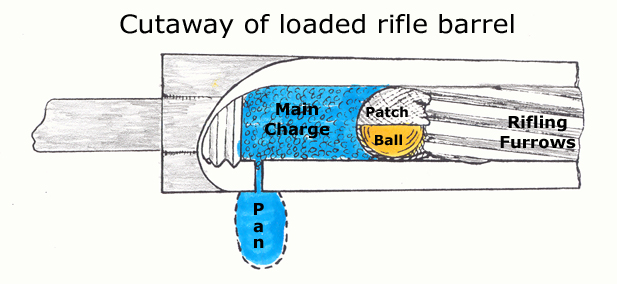
The lead ball is sort of wrapped in a patch, which is usually a piece of cotton fabric because cotton is flammable but doesn't melt and can make a
pretty good seal between ball and barrel. When the rifle is fired, the main charge sets off and the resulting gases push ball and patch out of the
tube. What happened here is that ball and patch are still in the same place. I don't know what happened, maybe the OP used too little
powder and the barrel is a rifled barrel. It would go a long way to explain why the ball is still there.
The drill bit would work if it wasn't for the ramrod. It wouldn't scratch a smooth bore barrel enough to be a problem because a smooth bore has always
a lot of scratches; forensics use the scratches as a sort of fingerprint. A rifled barrel is a different kettle of fish. A flat wood drill bit smaller
than .45 with a soft sleeve would be perfect, or else an even smaller HSS bit so the OP could make a hole deep enough to introduce a drywall screw and
use it to pull the ball out. Being a rifled barrel would make it harder.
The only ways, unless @Invictus395 removes the ramrod, involve (1) blowing the ball out from the chamber side with air or grease or (2) removing the
breech plug or the barrel, which is more work than really needed. Firing with the ramrod still there is out of the question.
|
|
|
clearly_not_atara
International Hazard
Posts: 2923
Registered: 3-11-2013
Member Is Offline
Mood: Big
|
|
Yeah, no idea about the ramrod. Maybe there's tar involved? You could try heating the whole thing up and then yanking on it.
|
|
|
pesco
Hazard to Self
Posts: 95
Registered: 19-11-2015
Member Is Offline
Mood: No Mood
|
|
Freezing won't affect temper. It will affect steel properties while it's at low temperature, but this changes are not permanent, and it's all reversed
when the steel comes back to room temperature.
Heating it to 200-300 °C will on the other hand affectt temper permanently. For older alloys it is safer to assume the lower end temperature is
detrimental.
Didn't see the stuck ramrod mentioned before. Nevertheless, dislodging the ramrod shouldn't be a problem. Vice + prying with twisting should do the
job.
|
|
|
MrDoctor
Hazard to Others
Posts: 249
Registered: 5-7-2022
Member Is Offline
|
|
doesnt this mean the thing causing everything to be stuck, compressed into the gaps, is cotton then? cant something be done about that?
from experience i can tell you, strong hydrogen peroxide over 30% makes paper crumble like its ash, im sure there would be a peroxide conc safe to
potentially expose BP to
|
|
|
DraconicAcid
International Hazard
Posts: 4504
Registered: 1-2-2013
Location: The tiniest college campus ever....
Member Is Online
Mood: Semi-victorious.
|
|
| Quote: Originally posted by MrDoctor | doesnt this mean the thing causing everything to be stuck, compressed into the gaps, is cotton then? cant something be done about that?
from experience i can tell you, strong hydrogen peroxide over 30% makes paper crumble like its ash, im sure there would be a peroxide conc safe to
potentially expose BP to |
That's also going to rust the barrel.
Please remember: "Filtrate" is not a verb.
Write up your lab reports the way your instructor wants them, not the way your ex-instructor wants them.
|
|
|
pesco
Hazard to Self
Posts: 95
Registered: 19-11-2015
Member Is Offline
Mood: No Mood
|
|
I don't believe this can be successfully resolved with chemical means. At least not without proper lab and "exotic" solvents.
It is mechanical problem and more fit for some mechanical/gunsmith/metalworking/machining forum.
Even so, its good that it was asked over here - we have here many people with brains 
|
|
|
MrDoctor
Hazard to Others
Posts: 249
Registered: 5-7-2022
Member Is Offline
|
|
im surprised the gun smith wasnt able to get the ram rod out either though, thats very strange. unless i missed something, id have to draw the
conclusion that the ram rod was too short and is fully inside the barrel.
I posted a reply earlier, i dont think peroxide will do much to this steel, especially if its oiled and, idk what youd call it but, well weathered i
guess? like, its exposed to sulfur and nitrate, the interior should be coated in some sort of stable passivation layer, also unless guns are as prone
to rusting as mild steel, at least in my experience, 15-20m of exposure that would properly compromise cellulose wouldnt do anything much to any sort
of air-stable steel.
But theres also cellulose dissolving enzymes out there, iirc nilered or some other chemtuber used some to make toiletpaper wine. i dont know how
effective they are but, they break cellulose down into sugar, i can see them being available at places that service septic systems, and possibly at
the more sciency brew shops, but the enzyme(s) do exist. The only one i know of is cellulase.
|
|
|
bnull
National Hazard
Posts: 994
Registered: 15-1-2024
Location: East Woods
Member Is Offline
Mood: Fecking annoyed
|
|
| Quote: Originally posted by Invictus395 | Long story short I need to dislodge a lead ball (with wad and powder charge) from a Hawken black powder rifle. (1) I didn't clean it as well
as I should have and got it jammed in there good.
(2) How can I best dissolve the lead ball, quickly, without damaging the steel or causing a dangerous reaction with the black powder
behind it?[Edited on 1-2-2026 by bnull] |
(1) The barrel is dirty. Black powder always leaves residues, mostly potassium salts (potassium carbonate, sulfides, a little sulfate, maybe some
nitrite and nitrate) and some carbon and sulfur. The steel is coated with them, that's why the ball doesn't budge. (2) The barrel must not be damaged
beyond usual (those tiny scratches I mentioned before) because the rifle has already been sold and is someone else's gun now.
A peroxide solution has a few problems. It will react with the sulfur-potassium derivatives in the barrel, it is mostly water, it will be decomposed
by the dirt, and the reaction products may be able to attack the steel in the barrel before getting to the cotton patch itself. To make things more
pear-shaped, potassium carbonate and sulfides (and some nitrite perhaps) in the residues would make the solution alkaline and more prone to
decomposition. Chemical means are out. Mechanical means can remove ball and ramrod.
The environment in there is not proper for enzymes and they would be too slow anyway. Remember, the cotton is compressed into a thin layer between
ball and barrel and it is this part that is the problem.
[Edited on 1-2-2026 by bnull]
|
|
|
Fulmen
International Hazard
Posts: 1794
Registered: 24-9-2005
Member Is Offline
Mood: Bored
|
|
The proper way to do this is to remove the cap nipple and attach either an air line or a grease gun. Some shooters recommend vinegar/peroxide for
removing lead fouling from the barrel, but as far as I can tell it will attack the barrel to some degree, at least if left for an extended period. I
would not recommend it for this job. The only aqueous solution I can think of that will dissolve lead without attacking steel is hot concentrated
caustics.
We're not banging rocks together here. We know how to put a man back together.
|
|
|
RedDwarf
Hazard to Others
Posts: 173
Registered: 16-2-2019
Location: UK (North West)
Member Is Offline
Mood: Variable
|
|
If it was my problem I'd probably be turning to drilling the ball out as others have suggested, but I wondered if Bnull is correct that the ball is
jammed because of the cotton, whether it would be possible to dissolve the cotton using Sweitzer's reagent (Copper Hydroxide in aqueous ammonia).
There are practical problems even if this would work theoretically:
1) I've no idea whether the reagent would react with the barrel and/or black powder components
2) The process could be very slow with the jammed material having very little surface area available for reaction, and you'd probably need to
recirculate the solution pumping it down a tube to jet into the reaction area to promote turbulent mixing
3) Having already used oil to try to free the ball you'd probably need to clean the cotton (to make it available to dissolve) by flushing the barrel
with solvent or detergent solution.
So, probably all in all not a solution, but in the spirit of brainstorming might trigger other ideas!
|
|
|
pesco
Hazard to Self
Posts: 95
Registered: 19-11-2015
Member Is Offline
Mood: No Mood
|
|
Sweitzer's reagent will copper plate inside of a barrel and lead ball and by the time it gets to cotton it won't be Sweitzer's reagent anymore.
Not ideal.
Drill the ball out. Once hollow it will be, relatively easy to remove as it will fold. Lead is soft.
|
|
|
bnull
National Hazard
Posts: 994
Registered: 15-1-2024
Location: East Woods
Member Is Offline
Mood: Fecking annoyed
|
|
(1) Schweizer's reagent will react with the ball, the barrel and the lead residues in it, not to mention the various salts in the gunk. (2) The
ball-patch combination looks like a badminton birdie, so the reagent will react with the excess cotton opposite to the chamber. It would take a large
quantity of reagent to dissolve it before attacking the pressed cotton around the ball.
Perhaps using a hammer would loosen the ball enough to be pulled out. A ramrod can be wood or metal. If it is wood, using a vise to remove it and
using a hammer are possibly bad ideas. Assuming it is metal and the powder has been flushed out of the chamber, the ramrod could be tapped with a
hammer--I mean soft taps, not a rehearsal for Mahler's Sixth. If it works and the ball is removed, good; if it doesn't, the barrel won't be damaged
beyond normal.
|
|
|
| Pages:
1
2 |



![[*]](images/xpblue/default_icon.gif)


