Hexabromobenzene
Hazard to Others

Posts: 263
Registered: 27-4-2021
Member Is Offline
|
|
Direct electrosynthesis of sulfuric acid from gypsum (detailed study)
A year ago I tried to make sulfuric acid from gypsum, but my attempts failed. Also, attempts at synthesis from sodium sulfate gave an unacceptably
small yield. Finally, a method for producing sulfuric acid by electrolysis was developed, but the results were not impressive.
The main problem is the mobility of hydroxide and hydrogen ions. Because of this, they absorb a large amount of electric current. By using salts of
slightly soluble bases, this problem can be partially solved, but hydrogen ions will remain. To synthesize sulfuric acid with good yield, an anion
exchange membrane is needed
And so: this article was discovered:
https://www.researchgate.net/publication/250398058_Factors_a...
| Quote: |
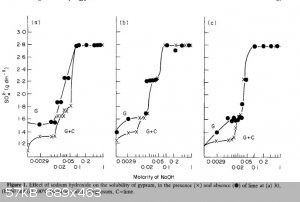
1. The solubility of gypsum increases in very dilute sodium hydroxide solutions. 2. Lime lowers the solubility curve of gypsum in sodium hydroxide
solutions of concentrations less than 0 . 0 8 ~at 30°C. At higher temperatures its effect is limited to 0.02~NaOH. 3. Gypsum dissolves in 2 0 . 0 8
~NaOH. Under these conditions lime is completely insoluble and temperature has no further effect The precipitation of lime is accelerated by a rise
of temperature. This is shown by the X-ray diffraction patterns of the gypsum stirred in 0 . 0 5 ~NaOH solution at different temperatures (Figure 3).
At 30°C the lines of Ca(OH)2 are not present but are found increasingly at 60 and 100°C respectively |
As we see, the conclusions are as follows: The concentration of sulfate ions does not increase after adding more than 0.08 mol per liter of alkali to
the gypsum suspension. This is important. If you add more alkali, the current efficiency of the sulfuric acid will begin to drop. The study also shows
that the reaction of gypsum and alkali requires heating to at least 50 degrees.
The following installation has been assembled for electrosynthesis: A bucket with a suspension of gypsum in 0.08 N sodium hydroxide, a cathode from a
stainless steel shower hose and a polypropylene diaphragm. Options with and without a catinonite layer were tested. With a cation exchanger layer, the
current efficiency seems to be slightly higher. Anon lead plate. At the beginning of electrolysis, corrosion is noticeable due to impurities in the
gypsum. After some time, the anode potential increases, ozone begins to be released and the corrosion rate drops very significantly. At the very
beginning of electrolysis, the current is only 0.1A at a voltage of 12 volts but then increases to 3A due to acid accumulation and heat. High voltage
is important. It provides the heat necessary for the reaction and overcomes the high resistance cathode solution. I don't think the voltage can be
reduced significantly below 10V. At 5 volts the current is very small, less than an ampere and does not produce enough heat. Also, during
electrolysis, the anode chamber is hotter than the cathode chamber (60 versus 50 degrees). This is also important: water evaporates faster from the
anode compartment and this creates a counterflow of liquid. The area of the anode is many times smaller than the cathode and the voltage drops
more at the anode, which leads to heating.
In the first experiment with simple polypropylene, after passing about 100 ampere hours, approximately 300 grams of 250 ml of sulfuric acid were
obtained. In the second experiment with a diaphragm with a layer of catinite and 150 ampere hours, 2 times more acid was obtained but with a slightly
lower concentration
The yield of sulfuric acid is 0.5-1 grams per ampere hour. Not very impressive. But the installation is simple and the initial components are very
accessible and cheap
To increase electrical conductivity using potassium hydroxide instead sodium hydroxide in the cathode space. An anion exchange membrane, in theory,
can increase yield to 2 grams of sulfuric acid from ampere hour. You can also try to increase counterflow by increasing the voltage and evaporation
from the anode chamber with a small anode area
[Edited on 19-1-2026 by Hexabromobenzene]
|
|
|
Varungh
Hazard to Self
Posts: 70
Registered: 23-6-2025
Location: India
Member Is Offline
Mood: Bad mood
|
|
What annodes were used? Pb/PbO2?
MMO performs poorly and will corrode
Only Pb/PbO2 are decent here(apart from graphite)
Pb annodes form PbO2 when used as annode in sulfate electrolyte. This layer is self healing in sulfates
|
|
|
Mister Double U
Hazard to Self
Posts: 66
Registered: 21-2-2025
Member Is Offline
|
|
Hello Hexabromobenzene,
You mentioned that the "yield of sulfuric acid is 0.5-1 grams per ampere hour". I do think that is pretty good actually. If I did the math correctly
that equals a current efficiency of 27 to 54%.
I really like the idea of being able to obtain H2SO4 from Gypsum - the most easily obtainable sulfate.
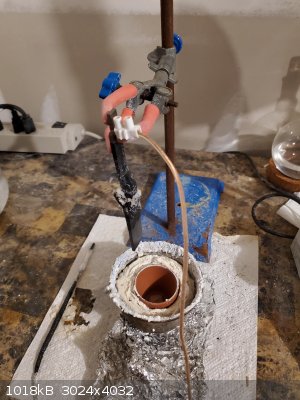
I did a quick test run with a flowerpot and a suspension of Gypsum in Sodium Carbonate solution. My thoughts were that this will form Sodium Sulfate
and Calcium Carbonate and the conductivity would be better than just straight Gypsum. Indeed, I was able to read ~2A @ 6V. Unfortunately, current
efficiency was very low ~5%. So, I can confirm your observations you made in the beginning of your post.
Here a pic of the setup after I stopped the experiment:
|
|
|
Hexabromobenzene
Hazard to Others
Posts: 263
Registered: 27-4-2021
Member Is Offline
|
|
The results have been revised.
After evaporation of the sulfuric acid solution from 2 experiments, 200 grams of acid with a density of 1.35 (50%) were obtained. In total, about 100
grams of acid. 250 ampere-hours were consumed in the two experiments. The yield is about 0.4 grams per ampere-hour, which is close to the theoretical
value if considering the mobility of sulfate and hydrogen ions. It's low, but acceptable, since gypsum is very cheap and readily available.
However, if it is possible to make an anion-exchange diaphragm, the results will be much better.
The anode is a cast lead ingot.
|
|
|
Hexabromobenzene
Hazard to Others
Posts: 263
Registered: 27-4-2021
Member Is Offline
|
|
Quote: Originally posted by Mister Double U  | Hello Hexabromobenzene,
You mentioned that the "yield of sulfuric acid is 0.5-1 grams per ampere hour". I do think that is pretty good actually. If I did the math correctly
that equals a current efficiency of 27 to 54%.
I really like the idea of being able to obtain H2SO4 from Gypsum - the most easily obtainable sulfate.
I did a quick test run with a flowerpot and a suspension of Gypsum in Sodium Carbonate solution. My thoughts were that this will form Sodium Sulfate
and Calcium Carbonate and the conductivity would be better than just straight Gypsum. Indeed, I was able to read ~2A @ 6V. Unfortunately, current
efficiency was very low ~5%. So, I can confirm your observations you made in the beginning of your post.
Here a pic of the setup after I stopped the experiment:
|
The equivalent concentration of carbonate should not be much greater than 0.08 N. Otherwise, your current yield will drop significantly. Use potassium
salts for better conductivity
[Edited on 4-2-2026 by Hexabromobenzene]
|
|
|
Hexabromobenzene
Hazard to Others
Posts: 263
Registered: 27-4-2021
Member Is Offline
|
|
You can try the following: Increase the voltage so that the anode solution heats up as much as possible due to the small anode surface area compared
to the cathode. This will cause it to evaporate rapidly and create a countercurrent, which is so important.
|
|
|



![[*]](images/xpblue/default_icon.gif)


