Ormarion
Hazard to Self

Posts: 69
Registered: 19-12-2017
Location: France
Member Is Offline
Mood: Alkylating her DNA
|
|
6- Benzyl Azulene synthesis
Hello everyone, today a little (or rather big) post on one of the synthesis i believe to be the proudest of in a long time : 6-Benzyl Azulene
This procedure was reproduced following the protocole written by a friend, you can find it linked down bellow:
https://starklab.de/index.php/2025/01/02/6-benzylazulene/
First of all, the synthesis of the pyridinium salt :
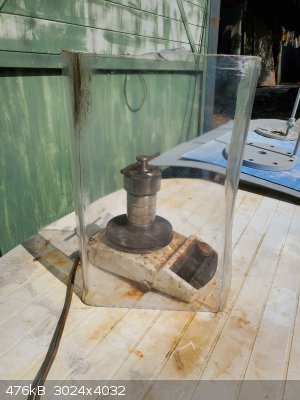
For this part i used one of those chinese pressure reactor with a PTFE container inside to run the alkylation as the reagent arent super volatile or
unstable
-In the 100ml PTFE container was added 4ml of 4-benzyl pyridine, and 4ml of 1-butyl chloride, the reactor was then tightly closed, and was simply put
directly on top of my hotplate after moving it outside and installing a safety sheild (just in case of)
-Heating was started until a temperature of approximately 130°C was reached. In my case i let the whole reaction run for around 8h before stopping it
and letting it cool down, obtaining a brown like product
-The reaction mix was then crushed up, and washed with 2x20ml of heptane. It was then added into 30ml of acetone and heated for a bit, dissolving away
all of the dirty coloration. Once filtered under vacuum with 10ml of acetone, the reaction afforded a clean white hygroscopic powder
-m : 4 Benzyl N butyl pyridinium chloride : 4,55g (69% nice)
Y litterature : 65%
Note: It took me a while to perform the next part, around 6 month, even if the pyridinium was storred correctly i believe it absorbed a bit of
moisture wich impacted the final part. I recommend to dry it in the oven before use
Second part: Dicyclopentadiene cracking :
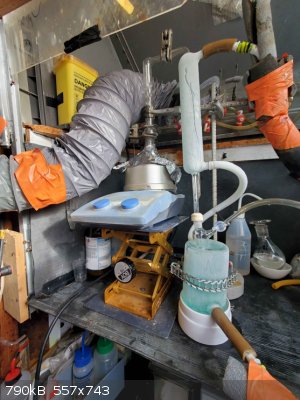
For this part, i used a setup i set aside just to distill Cp2 as it tend to stink a lot and i did not feel like washing it each time i need to make
more of it
-In a 250ml RBF was added a few grams of iron powder, a magnetic stir bar and 50ml of dicyclopentadiene
-The setup was fully assembled and the condenser/ recieving flask coolant temp was lowered to -20°C, the setup was also quickly inerted under argon
-Heating was gently started and increased up to 185°c on the plate, and around 165°c in the flask. At this point cyclopentadiene should start to
recondense in the vigreux column and distill over slowly
-The few ml of product obtained were stored in the freezer at -20°C to be used in the following hours
Third part : Sodium cyclopentadienide synthesis
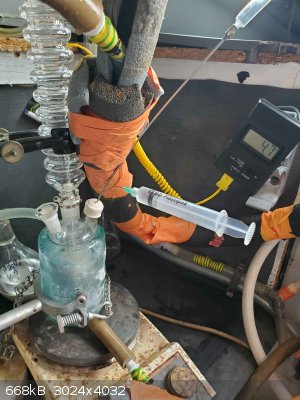
-A 3 neck small reactor and its glassware was dried in the oven for a hour beforehand, before moving it into my jacketed glycol beaker for efficient
cooling.
-After inerting the setup properly, 12ml of dry DMF was injected trough a septum, followed by 300mg of NaH (1eq) 60% in paraffin. Stirring and cooling
was started until 0°C was reached, and trough the septum was then slowly added 2.5ml of cyclopentadiene (4 eq). Powerful exotherm occured spiking the
temp to 8°C for a bit before cooling down, so be sure to really add it dropwise and wait for the H2 evolution to stop
Last part : benzyl azulene synthesis
-After flushing out the generated H2 with more argon, on the side 3.26g (1eq) of the pyridinium salt was weighted, and quickly added in the reactor
mix in one go. The solution became rapidly brown red, and it was left to stir at room temp for a hour while keeping it inerted.
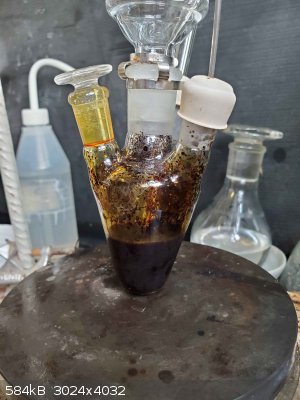
-After a hour heating was started until reflux at 160°c was obtained. It was kept like this for the next 6 hours and slowly took a very slight yellow
greenish tint
Notes : Never heat up DMF and NaH together, this can easily lead to a explosion, here cyclopentadiene is used in excess, so none of it should be left,
but in those situations, its best to use a shield for safety
-After the 6h reflux, heating was stopped and the mix was left to cool down.
It is at this point that i "kinda" messed up but managed to fix it later, while adding 25ml of water to the mix, a lot of sticky tar precipitated and
would stick to the reactor walls, trapping most of the product inside of it without me realising.
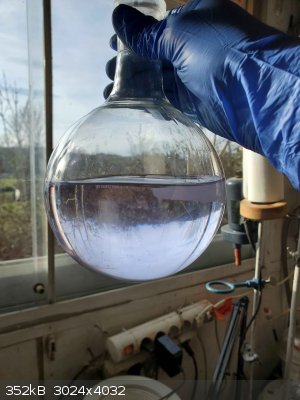
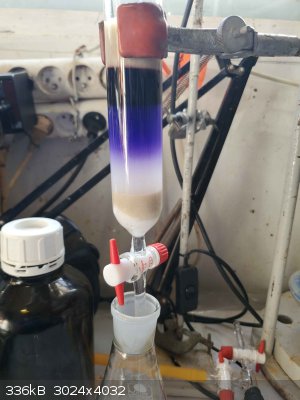
-I performed 3x30ml room temp hexane washes and obtained a yellow solution that was then dried over anhydrous MgSO4, TLC in pure heptane showed the
presence of a apolar blue spot, wiich leaded me to evaporate the solution over silica to prepare a solid deposite, and added into a chromatography
column to be purified with pure hexane
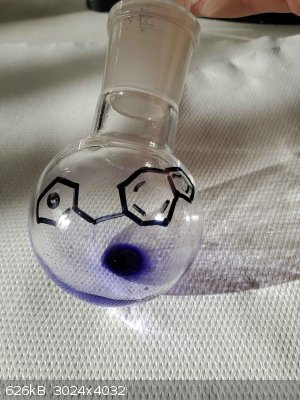
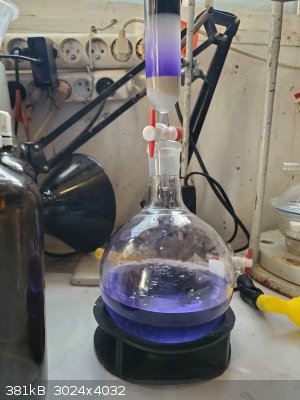
The blue phase is the first to come and easy to see, allowing me to separate it and removing the solvent to obtain....90mg of a deep blue oil,
representing 2,7% yeild
-I then decided to investigate where the rest could have gone as my friend obtained a result closer to 20%, i tried to boil the remaining tar stuck to
the glassware in hexane and obtained a way darker brown oil that i dried, evaporated on silica, and purified trough column chromatography a second
time. At this point it was clear the fraction was way way more concentrated. In total i used approximately 1,5L of hexane for each column that was
recycled with my rotavap.
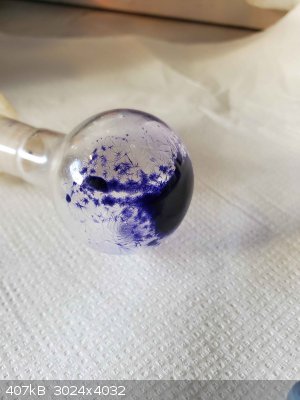
-The main blue fraction was then evaporated under vacuum and afforded a deep blue oil that rapidly crystallized upon cooling, forming beautiful
needles
-It was transfered in a smaller container, weighted, and a mass of 230mg was measured, representing 7% more yeild. I believe there is still quite some
left in the tar, so in the next weeks i might retry a last and final extraction using heptane this time
In the future i might try to redo this reaction using 4 tbutyl pyridine, or maybe regular one, and scale it up to attempt some chemistry with it. I
will see if i manage to get some analysis done for purity even if with this color it cant be anything else than a azulene
Thanks for reading me ! :3


|
|
|
Fery
International Hazard
Posts: 1122
Registered: 27-8-2019
Location: Czechoslovakia
Member Is Offline
|
|
Wow well done! Thanks for sharing. High practical skills. Your product has beautiful color.
|
|
|
palico
Hazard to Self
Posts: 70
Registered: 1-10-2013
Member Is Offline
Mood: No Mood
|
|
Dear Ormarion,
well done, nice job ! I confess, your lab quite scare me...
Anyway, your azulene color is simply wonderful ! But the best is in photoluminescence emission. Azulene, is the first reported compound to show an
anti-Kasha emission, it means fluorescence comes from upper singlet state as S2, S3 and so on, and not from S1 as usually is from common organic
fluorophores.
Have you any possibility to study absorption and emission of that ?
|
|
|
oberkarteufel
Hazard to Self
Posts: 55
Registered: 11-12-2018
Member Is Offline
Mood: Mayonesium sulfate
|
|
Does this procedure also work with other pyridines? The regular one, the ones with alkyl, nitro, amide, amino etc. groups?
|
|
|
Ormarion
Hazard to Self
Posts: 69
Registered: 19-12-2017
Location: France
Member Is Offline
Mood: Alkylating her DNA
|
|
Hey Palico, yea i get it its unfortunately not as clean and professional looking as i would like it to be ^^' (im working on it however but money you
know)
Concerning you question im not very knowledgeable in the subject, if for absorption you are refering to a UV absorption spectrum measured in a
spectrophotometer, yes i could ask one of my old teacher to run one. Otherwise im not really sure how i could.
And to answer oberkarteufel, i believe most other alkyl/aryl pyridine works probably fine, thats why i wanna try it using 4 tert butyl pyridine, but
considering the harsh conditions i fear that other functions wouldnt resist it, maybe regular pyridine would works, however its also more volatile
when you run the first step.
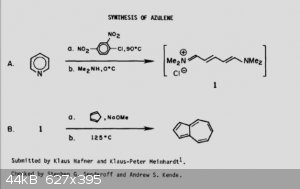
The ""classic"" methode its derived from use dinitrichloro benzene for it normally, so it could be worth a try
Edit*
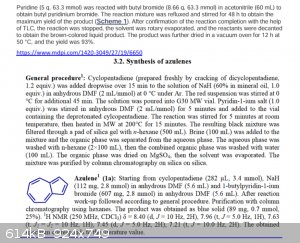
After going trough my archive i even found you a procedure so it definitely work with regular pyridine
[Edited on 17-1-2026 by Ormarion]
|
|
|
Ormarion
Hazard to Self
Posts: 69
Registered: 19-12-2017
Location: France
Member Is Offline
Mood: Alkylating her DNA
|
|
Little update on the project
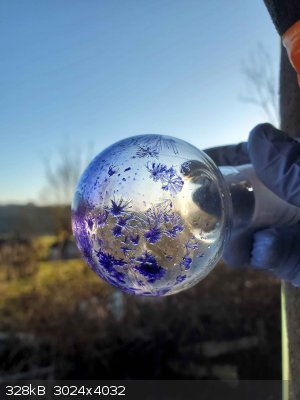
After some time i managed to perfom a third extraction of the tar to a better extend using boiling heptane as the washing solvent until most of it
seemed to have been extracted, and performed again a third column using hexane. I got 50 more mg out of it bringing the total yeild of benzyl azulene
closer to 15% Still not great but definitely sufficient for this time
At least the tar is very soluble in acetone so its not too annoying to clean.
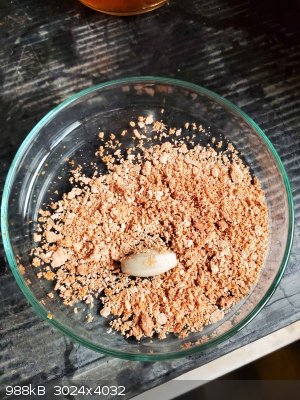
On the side, i started the 4 Methyl version using 4 picoline with n butyl chloride in the same conditions as the one described above (6h at 130°c in
a pressure reactor with 1,5eq of butyl chloride)
However the obtained yeild was way lower (1.6g/ 20%) compared to the 69% obtained before. I recommend to probably use a better alkylating agent such
as butyl bromide if you try to reproduce it
I will give feedback once i try to make the 4 methyl azulene
|
|
|
|



![[*]](images/xpblue/default_icon.gif)

