Asus3
Harmless

Posts: 10
Registered: 25-11-2025
Member Is Offline
Mood: No Mood
|
|
Update-Micro Short Path Fractional Distillation with Cow Apparatus
Hi all. Its been a while since my last post.
So far I've gone through about 8 trials with a certain essential oil.
I went from using different heating baths, to different configurations. I think I cooked my essential oil I had in the process.
Some background information, Hotplate stirrer sh-2 180watt, I've used about 250mL (iirc) oil in a 500mL beaker, so far, if I remember correctly, I've
had best luck lowering my apparatus into this. However, the SH-2 hotplate stirrer is not always enough, I also have a 500watt moka pot.
With this, I configuration I need stirring to break up the nucleation sites and prevent superheating, I want a nice even boil. So I've incoroporated
an air bleed into a claisen adapter pot on my micro short path appparatus, and got rid of the 100, or 200, (i've forgotten) mm - vigreux column, for
now.
I'm hoping my air bleed tube suffices, apparatus placed into hot peanut oil. tried a heat gun, I gues 350 watts or wahtever it wasn't nearly enough
--- for the likely encounterance of a setup here'.
I've got glass borosilicate wool, which I heard can BREAK-UP-BUMPING and make a nice steady even boil, no superheated jumping,bumping,kicking or
splashing...
Has anyone heard about this?
I tried a couple of times, and so far I've found that a broken up shards from a tobasco bottle seems to work better, for a while (until the pockets of
air in the glass get swollen iirc)
You can see my videos on my facebook, I'm appreciative of comments.
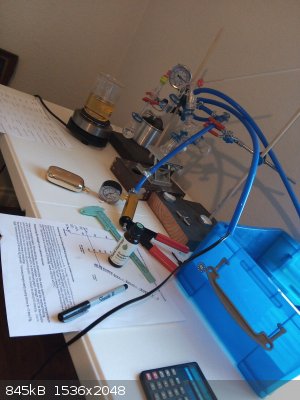
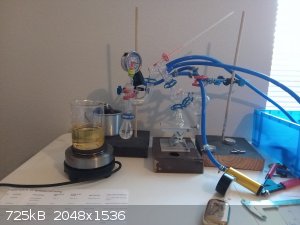
Below I show my setup, the micro short path apparatus, atop a claisen adapter (unpacked : l )
I will be attempting to distil 1,8 cineole and a-pinene from the 13mLish of Eucalyptus Globulus essential oil I added into the 25mL distillation
flask.
whole setup is 19/22, using a hand vacuum pump, so far. Curious about inert gas bleeds, anyone want to give any pointers? Also would the solder pot be
a better heat source? I suspect the amount of oil I used evens out a lot of temperature fluctuations from the cycling of the device (i'm guessing
thats the terminology/meaning)---
Anyways.
Hows it all look?
[Edited on 7-2-2026 by Asus3]
[Edited on 7-2-2026 by Asus3]
[Edited on 7-2-2026 by Asus3]
[Edited on 7-2-2026 by Asus3]
[Edited on 7-2-2026 by Asus3]
|
|
|
Asus3
Harmless
Posts: 10
Registered: 25-11-2025
Member Is Offline
Mood: No Mood
|
|
I just distilled a pinene- and 1,8 cineole from 12mL essential oil of Eucalyptus Globulus.
It went kinda fast, I'm worried my rate of vaporization got a little high, I await it to cool down / come to pressure before opening each flask and
sniffing to see if one smells more like citrus vs eucalyptus. along with other potential identification techniques--
chatgppt exemplifies:
""4. Gauge Response
The temperature gauge responds dynamically to each stroke of the pump because:
Each stroke reduces system pressure, lowering the boiling point.
The thermometer senses the liquid/vapor interface, which rapidly equilibrates to the new boiling point.
So you see the red line jump down a little after each pump stroke, then rise slightly as the hotplate adds energy again.
Think of it like a “tug-of-war” between heat input and pressure drop:
Pump down → boiling point drops → temp reading dips.
Hotplate → adds heat → temp reading rises toward new boiling point.
Repeat — the gauge oscillates or creeps up/down as you work the pump."
. Why It’s Visible
Micro short path setups have small volumes:
Less thermal mass → temperature responds quickly.
Small vapor paths → pressure changes propagate quickly.
Hand vacuum pump strokes are significant relative to system volume, so each stroke produces a measurable effect."
Pump → ↓ pressure → ↓ boiling point → temp gauge drops.
Heat → ↑ temperature → liquid approaches new boiling point → vapor formation → temp gauge rises.
Repeating this shows the gauge “jump” with each hand pump stroke."
1. Why some pump strokes don’t move the gauge
Even if you stroke the hand pump, sometimes the temperature gauge barely changes. This happens because:
Phase diagram considerations
The liquid-vapor system has a phase boundary: for a given pressure, the liquid only boils at a specific temperature.
If your system is already at or near the new equilibrium boiling point, removing a tiny bit of vapor (one pump stroke) doesn’t appreciably change
pressure or temperature.
Limited vapor volume
Micro short path setups are very small. If the vapor space is mostly saturated, pumping a little air doesn’t immediately reduce the partial pressure
of your distillate vapor enough to lower the boiling point.
Non-ideal mixtures
Most distillations involve multiple components.
On a binary (or more) phase diagram, some fractions don’t start boiling until a certain composition is reached.
Early on, or between fractions, pressure changes don’t shift the boiling point significantly, so the gauge doesn’t respond.
2. Visualizing it on the phase diagram
Think of a T–x or P–T diagram:
Horizontal axis = composition (x)
Vertical axis = temperature (T)
Curves = boiling points of mixture vs. pure components
When you pump:
If you’re between the curves, removing pressure won’t immediately trigger more boiling — gauge stays almost still.
Once the liquid hits the next fraction’s boiling point, a stroke produces visible vapor, gauge jumps.
This explains the “some strokes move it, some don’t” behavior.
3. Other factors
Thermal lag: small liquid volumes heat/cool quickly, but sometimes the thermometer is in the vapor, not perfectly equilibrated.
Pump stroke size vs. system volume: in tiny micro setups, one stroke may not change total moles of gas enough to shift pressure noticeably."
-Chatgpt"
Going to use my labjack to cradle my hotplate, somehow, and make adustments, once I get the heating out of control.
[Edited on 7-2-2026 by Asus3]
[Edited on 7-2-2026 by Asus3]
|
|
|
Mateo_swe
National Hazard
Posts: 590
Registered: 24-8-2019
Location: Within EU
Member Is Offline
|
|
If you are trying to vacuum distill an aromatic oil you must get a good vacuum pump, a hand pump will not do well or at all.
You need a vacuum pump that can supply a higher vacuum so get a high vacuum pump type.
The ones used by HVAC guys do make a high vacuum and is not very expensive but they use oil that need to be changed often and use a cold trap also.
Also be aware that working with high vacuum has it risks and read up on the procedures, and use a face shield and good protective clothing just in
case it implodes.
|
|
|
bnull
National Hazard
Posts: 997
Registered: 15-1-2024
Location: East Woods
Member Is Offline
Mood: Fecking annoyed
|
|
| Quote: | | (...) chatgppt exemplifies (...) |
Be very careful when using AI to obtain information. It knows nothing about what it seems to be explaining.
|
|
|
Asus3
Harmless
Posts: 10
Registered: 25-11-2025
Member Is Offline
Mood: No Mood
|
|
Quote: Originally posted by bnull  | | Quote: | | (...) chatgppt exemplifies (...) |
Be very careful when using AI to obtain information. It knows nothing about what it seems to be explaining. |
Well, all it really is is the clasius clapeyron equation + a couple of boiling points.
|
|
|
|



![[*]](images/xpblue/default_icon.gif)


