| Pages:
1
2
3
4
5 |
bnull
National Hazard

Posts: 991
Registered: 15-1-2024
Location: East Woods
Member Is Offline
Mood: Taking a few days off. Damned AI leeches.
|
|
| Quote: | | I could re-run the experiment with no amyl-alcohol and just methanol next week, and then see if it smells like cookies. Is there a particular reason
I should expect that smell? |
About 15 years ago, when electrolysing an alkaline complex of Cu2+ in aqueous glycerol I noticed an odd smell, like cookies, coming out of
the solution. I don't know what it was, apart from being an oxidation product of glycerol. Acrolein?
|
|
|
semiconductive
Hazard to Others
Posts: 433
Registered: 12-2-2017
Location: Scappoose Oregon, USA.
Member Is Offline
Mood: Explorative
|
|
My sister smelled the test tube and concluded it smelled more like wine than cookies. So, I'll just go with that. Her nose is better than mine.
Did your glycerine turn yellowish (not that you could see it with Cu, I suppose) ?
I ask, because:
I have bought Schwan™ Glycerol USP, from the local shopping centers in the past. It came in a tiny/neat 40 [cc] or so sized brown bottle. It's
meant to use as an emollient, or as a sweetner in confections (like cookies).
When I looked the data up online, I was informed that USP (grade?) could legally have up to 20% water in it, though the remainder had to be pure
glycerol ... yada yada. The pages I read at the time suggested that it was very difficult to remove the water without damaging the Glycerol.
Several times I tried to raise the temperature of Glycerol to above the boiling point of water to 'dry' it. I didn't have precision temperature
measurement at the time, so I can't tell you exactly how hot the bottom of the flask was; and I didn't know that kerosene or USP mineral oil were
better floaters than limonene.
In air, glycerol would yellow extremely easily when any bubbles showed up. There would then be a strange odor that I would describe as almost burnt
carmel candy.
A very similar smell would happen under limonene, at which point I just assumed that air wasn't needed to cause the yellowing and smell. I assumed
that (maybe) just water is enough to decompose Glycerol -- or just heat.
Being disabled means I forget to press the enter key to start temperature regulation ... sometimes ... as in this morning with my sister talking to
me...
And then an hour later realize that I forgot to plug the electrode back in after cleaning the desk up.
See where the Plot thickens:
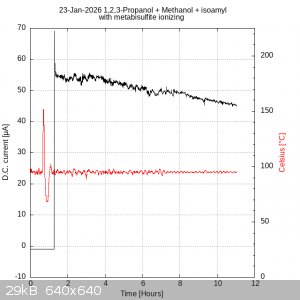
I'll smell it again in the morning.
|
|
|
bnull
National Hazard
Posts: 991
Registered: 15-1-2024
Location: East Woods
Member Is Offline
Mood: Taking a few days off. Damned AI leeches.
|
|
I couldn't see it. The solution became a suspension of yellow to orange particles. The particles could be cuprous oxide or lead oxide, maybe even
both, as I was using lead and graphite electrodes at the time. To make things more confusing, the lead electrode was an alloy of lead with a bit of
tin that didn't darken or flake off excessively during electrolysis.
Edit: my glycerine doesn't discolor but fumes like mad and stinks of acrolein if I boil it.
[Edited on 23-1-2026 by bnull]
|
|
|
semiconductive
Hazard to Others
Posts: 433
Registered: 12-2-2017
Location: Scappoose Oregon, USA.
Member Is Offline
Mood: Explorative
|
|
Some memories of cleaning up messes are probably best left in the past... 
My 5 minute and 150 [°C] excursion, yesterday, did not noticeably change the odor of my test tube.
There's no yellow coloring either.
I'm mildly curious.
The temperature definitely went above the boiling point of water.
The temperature was not above the boiling point of glycerine ~290 [°C]
(I hope that data was discovered with a vacuum running!)
Acrolein:
If acrolein is created by hydrolysis, then less than 2% water (Duda™ Energy) might be too small to make acrolein; but (Schwan™) U.S.P. and
<20% water might be enough water ?
On the other hand, if acrolein is primarily catalyzed by impurities; then I question whether Duda PPol vs. Schwan PPol has less of -- animal fatty
acid, water, plant terpenols, ...
Then again, I used sodium metabisulfite, which is a mild reducing agent. eg: Sulfite might want to become sulfate before 1,2,3-PPol wants to become
acrolein ?
To solve the puzzle:
I'll test straight Duda™ energy glycerol by cooking it in a test tube under kerosene. Let's see if it makes an odor by itself. I'll have to see if
I can get Schwan™ at the store.
If I had a refractometer, I could estimate how much water that each PPol sample has. But, I just have a spectrometer; ( unfortunately numerical
integrals done by Wolfram™ and other's, still dis-agree as of Jan-2026: https://physicsdiscussionforum.org/integration-of-planck-s-b... )
So, Let's see what I can do with density. I have bought a NEST lab pipette that transfers by using suction into a plastic tube. This isn't a highly
accurate (or expensive) device, but I'm hoping it will last more than five uses which is all the disposable ones seem to handle before the plastic
cracks.
I have a 1.000 to 5.000 [cm³] NEST device, and I bought two of them. If I can accurately measure 1 [cm³] of glycerol, then I might be able to
figure out how much water there is from the mass.
Let's test with water first, which is more troublesome (vapor pressure is higher).
I'll set the NEST device to 1.000 [cm³]. Put 100 [mL] of reverse osmosis water in an Erlenmeyer in the microwave, and bring it to boiling.
Now I'll transfer water five times, into a weighed and tared test-tube.
!That didn't go well!
The erlenmeyer cooled down to 40 [°C] before the pipette was ready and assembled to use. I got between four and 5 samples before the water changed
by two degrees [°C].
I had to learn not to push the button all the way down, but only to the point where it meets spring resistance. Otherwise it jams.
Note: The temperature recorded is the start temperature of the sampling:
| Code: |
T= 40.1 [°C] x̅=  1.186 σ=  0.044 [g]  μ₀=  1.190 σ₀=  0.045 [g] 3.741%
T= 34.9 [°C] x̅=  1.183 σ=  0.016 [g]  μ₀=  1.185 σ₀=  0.016 [g] 1.346%
T= 30.1 [°C] x̅=  1.176 σ=  0.012 [g]  μ₀=  1.178 σ₀=  0.012 [g] 1.032%
T= 25.1 [°C] x̅=  1.162 σ=  0.015 [g]  μ₀=  1.164 σ₀=  0.015 [g] 1.326%
|
I got too much water each time and lots of variance. I'm not very consistent/steady at pipetting.
Let's try again!
I'll turn the dial down to 0.800 [cm³].
This time I'm aiming for 10 samples at each temperature.
I'll take the tip off, shake it out, and let fresh air in between every temperature run in order to make sure no water gets up into the suction
chamber itself.
| Code: |
T= 70.0 [°C] x̅=  0.972 σ=  0.094 [g]  μ₀=  0.988 σ₀=  0.096 [g] 9.703%
T= 60.0 [°C] x̅=  0.985 σ=  0.030 [g]  μ₀=  0.988 σ₀=  0.030 [g] 3.005%
T= 50.0 [°C] x̅=  0.974 σ=  0.018 [g]  μ₀=  0.976 σ₀=  0.018 [g] 1.893%
T= 40.0 [°C] x̅=  0.963 σ=  0.019 [g]  μ₀=  0.966 σ₀=  0.019 [g] 1.945%
T= 40.0 [°C] x̅=  0.970 σ=  0.008 [g]  μ₀=  0.971 σ₀=  0.008 [g] 0.781%
T= 37.0 [°C] x̅=  0.961 σ=  0.013 [g]  μ₀=  0.962 σ₀=  0.013 [g] 1.330%
T= 35.0 [°C] x̅=  0.960 σ=  0.004 [g]  μ₀=  0.960 σ₀=  0.004 [g] 0.368%
T= 30.0 [°C] x̅=  0.965 σ=  0.006 [g]  μ₀=  0.966 σ₀=  0.006 [g] 0.576%
T= 25.0 [°C] x̅=  0.964 σ=  0.014 [g]  μ₀=  0.964 σ₀=  0.014 [g] 1.492%
|
i took >90 samples, and the pipette is still working. Good enough.
I've computed the experimental statistics twice, first with standard math AKA: a Root of mean-squares algorithm; and second with math designed to
estimate the mean of a population from a "Gaussian" sample, better. I take the square of a rooted mean.
I see I'm getting some decent repeatability ( sigma is small ) .... I just need more practice.
Uh... Wait... Water density goes down (less mass/volume) with higher temperature, doesn't it ?
I think this is what I'm supposed to be getting:
https://www.novabiomedical.com/education-training/knowledge-...
?! I get the opposite result !?
[Edited on 24-1-2026 by semiconductive]
|
|
|
semiconductive
Hazard to Others
Posts: 433
Registered: 12-2-2017
Location: Scappoose Oregon, USA.
Member Is Offline
Mood: Explorative
|
|
If my Reverse osmosis water filter is expired, then I get some calcium through it in addition to CO₂ gas forming carbonic acid. But I expect
briefly boiling would precipitate any calcium out -- so I think the water's volume vs. NIST specifications ought to be correct because I brought the
water to a boil before hand.
If this pipette really is backward, then I suppose I could put pieces of nylon inside the pipette tip until I reduce the volume just enough that air
expansion and temperature cancel out.
I can also put nylon washers under the depressor to stop it in the spring area at a repeatable spot. The only annoying weakness of this device is
that the volume is set by spinning the depressor. It's not stiff enough to prevent me from accidentally changing it's volume setting when trying to
rapidly use it.
Am I overlooking something?
Thoughts?
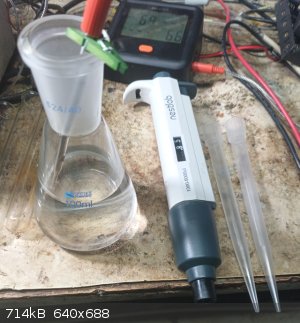
|
|
|
bnull
National Hazard
Posts: 991
Registered: 15-1-2024
Location: East Woods
Member Is Offline
Mood: Taking a few days off. Damned AI leeches.
|
|
I guess I used a not so clean test tube. Today I heated some glycerine and, alas, it discolored to golden honey with smell of cookies. Ten years old
double-distilled, pharmaceutical glycerine, 99.5% at least.
|
|
|
semiconductive
Hazard to Others
Posts: 433
Registered: 12-2-2017
Location: Scappoose Oregon, USA.
Member Is Offline
Mood: Explorative
|
|
Fascinating. But, sometimes acrolein is clear...
I will probably get to cooking some 1,2,3-propanol in the next post.
I ran a whole bunch of calibration tests on my mass scale, today. Over 10 years, it's average drift is 6 [mg] out of 300 [g]. But, it annoyingly can
thermally drift or get hysterisis by up to ±10 [mg] over an hour. ( It rarely does so, and only certain final masses, such as 'none' are followed by
more than 100 [g] prior -- eg: that seems to be particular susceptible to it. )
Measuring my 50 gram standard is reasonably precise.
50.034, 50.034, 50.032, 50.030, 50.032, 50.033, 50.032, 50.031, 50.031, 50.029, 50.023 → μ=50.031 σ = 0.003 [g].
But, when I do it with 30 [g] + 20 [g] masses, I get: 49.996 σ=0.003 [g]
The same with smaller masses added together.
So, I think I probably need to steam the 50 [g] mass ... and/or (probably) replace it.
That's not a today job. But, it puts my pipette idea in perspective.
I'm confident that the scale is accurate to the same random bias error over it's whole range.
But: Still, the 1% variation that I get most of the time is pretty much within the scale's drift limit. It might not only be my pipette technique
which is causing the deviations.
If I had my 3D printer running, I could print myself a liquid self-leveling mass scale that's accurate to 0.0001 [g]. But: Chicken egg problems ...
I need to electroplate a steel rock tumbler drum to be 3D print accurately. eg: because I need iron free glass dust without moisture. And when I buy
fumed silica from online, it's already been exposed to moisture and causes the resin to set even before I print it.
Unfortunately: Plating shops in portland, OR, refuse to do any work for the public since the government got into heavily inspecting them.
Not that tin is toxic, but what can you do...
I wonder if I can buy electroless nickel to make a protective coating over iron and if I need to sand blast the steel drum first...
[Edited on 29-1-2026 by semiconductive]
|
|
|
semiconductive
Hazard to Others
Posts: 433
Registered: 12-2-2017
Location: Scappoose Oregon, USA.
Member Is Offline
Mood: Explorative
|
|
Cooked 1,2,3-Propanol. No color change up to 180 [°C] at the bottom of the test tube with 1.5 [cc] PP-ol under 5 [cc] kerosene (deodorized,
super-pure). The thermometer at the top of PP-ol only registered 90 [°C] even after 20 hours.
Removing some kerosene, I got temperature up to 200 [°C] at the bottom of test tube and 101 [°C] at the kerosene-alcohol interface. However, 1 [cc]
kerosene is not as good an oxygen barrier.
I decided to check what impurities, added, will do:
In order to get the PP-ol to discolor at all, I had to add some calcium chloride (anhydrous). That made the PP-ol turbid and a very slightly yellow.
Then I added sodium-metabisulfite, and it floated on the surface (see picture) and caused gas bubbling. But it also made the slight yellow color
begin to fade.
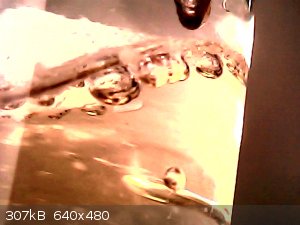
I'm waiting to see if the bisulfite ever dissolves or not.
But, there's was never any odor.
Very curious.
Edit: The bisulfate began to dissolve, slowly, but as it did the 1,2,3-PPol turned black rapidly (less than 2 hours to totally opaque) and began to
have strong odors. Duda™ energy, 1,2,3-PPol is advertised as 99.7+ pure. Mine has been opened for over a year, so I estimate it's still 98%+ still
pure.
Calcium sulfite normally absorbs 4 water molecules to crystallize.
In order to test 1,2,3-PPol with a better oxygen barrier at higher temperatures, I'll need to use smaller samples of 1,2,3-PPol. Because it's a
better thermal insulator than Kerosene is.
Redoing the experiment, 600 [mg] PP-ol, 2 [g] kerosene, unfortunately a couple of air bubbles got lodged in the PP-ol. I'll let it run anyway, and
see at what temperature the bubbles dislodge.
The air bubbles never dislodged. They absorbed when the bottom of the test tube was at around 175 [°C]. This caused the PP-ol to golden-yellow
slightly. I'm watching it to see if it will darken.
This photo is slightly misleading, because the camera is aimed along the refraction line. There isn't actually a dark band of material between the
kerosene and the PP-ol. The color, to the eye, is golden yellow but not quite as dark as it shows in the photo.
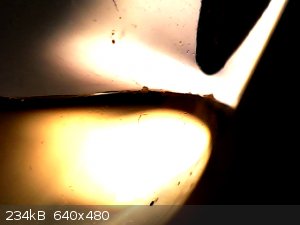
Note: The bottom of the test tube is holding steady at 195 [°C], while the kerosene just above the 1,2,3-PP-ol, is at about 125 [°C].
On this temperature graph, the air bubbles shrank between hours 3 and 5. This is where the yellowing occurred and the index of refraction of the
1,2,3-PPol changed remarkably. The white you see in the picture is a piece of teflon plastic behind the test tube so I could see the color changes
of the liquid.
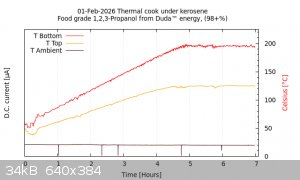
My 30 watt soldering iron can't get any hotter, so this is pretty much the best I can do for a test tube experiment. I'm not sure if I can get a tiny
heating mantle that would fit a test tube bottom.
There are temperature spikes in the graph, which is a bug in the INKBIRD bluetooth thermometer system. I'm working on that in another thread.
But, with a little bit more work I ought to be able to do time-lapse films of test tube reaction with text labeling on the video itself. 
[Edited on 1-2-2026 by semiconductive]
|
|
|
semiconductive
Hazard to Others
Posts: 433
Registered: 12-2-2017
Location: Scappoose Oregon, USA.
Member Is Offline
Mood: Explorative
|
|
Another thought occurs to me about obtaining sulfite ions.
How dangerous would it be.....
The solubility of SO₂ gas in water goes up as temperature goes down, and the gas doesn't all leave water when sulphite salts are acidified; on the
other hand, there are other organics which actually complex SO₂.
According to Mellor in the volume on sulfur chemistry (see scimadness libeary), pp.~209,
Acetone complexes double it's own mass of SO₂ at 0 [°C].
If that's true, then I might be able to put sodium bisulfite or metabisulfite into the bottom of a test tube, cover it with 1[cc] of acetone mixed
with ethyl citrate to reduce it's solubility in kerosene, and then cap the mix with kerosene. This would keep air out and (hopefully) prevent slow
oxidation of sulfides into sulfates.
Then I can just allow dry HCl gas to bubble into the chilled solution at 0[°C].
The result should be table salt remains in the bottom of the test tube and acetone dissolves either H₂SO₃ or SO₂ under kerosene.
I should then be able to pipette the solution into a well stoppered Erlenmeyer, and put it in the freezer for short periods of time.
Also, Mellor pointed out something else that I find very interesting:
Mellor also notes, p.101, that K2CO₃ + S₈ can be dissolved in ethanol although neither is soluble in ethanol by itself. This suggests that
potassium sulfite, or potassium polysulfides, may be formed by the reaction.
Since I suspect polysulfides might be the key to electroplating iron pyrite, so that's also worth a try!
|
|
|
semiconductive
Hazard to Others
Posts: 433
Registered: 12-2-2017
Location: Scappoose Oregon, USA.
Member Is Offline
Mood: Explorative
|
|
Refraction data for water over temperature, how I am proceeding -- what I am learning:
I contacted someone in Turkey about an article on water refraction. In my last correspondence, they mentioned that they thought I was something like
a 'data' assassin and recommended that I do a high precision refraction measurement myself and 'publish it somewhere' -- rather than try to figure
stuff out from other people's data. ( So I won't mention her name here. )
I am attempting to follow her advice.
Building a refractometer:
I have capillary glass tubes, and am able to construct a refractometer based on the original Lorenz design:
https://riviste.fupress.net/index.php/subs/article/download/...
Jamin mirrors for optical surveying are common, and I have some.
I also have found that I can stretch glass fiber by melting it and pulling it, which thins the fiber and jacket. The shape becomes somewhat like a
catenary/hyperbolic bend. This leaks more light depending on the refractive index of the fluid that surrounds it. So, I might be able to use a
partially melted fiber as a second way to check the Lorenz measurements.
I don't have temperature control totally automated yet with calibrated glass thermocouple probes. ( I really need my 3D printer to work already!!! )
Tentatively,however, my first attempts match with the Turkish fiber optic experiment's plotted data. (which I can only get by picking it off a graph,
as she doesn't publish the numbers!).
Which is to say, that my earlier comment to her on the her equation's dis-agreement with NIST has nothing to do with her actual data.
Her raw data isn't bad. BUT -- her published curve fit equation, and her data, do not describe the same curve.
I find the situation fascinating. She thought my pointing out the discrepancy was like an attack / discrediting smear campaign. Rather than as an
opportunity to rise above her peers.
Things I have learned:
NIST's and IAPWS "data" isn't raw data.
Their data is actually a curve fit to the Lorenz-Lorentz equation.
The first article that I linked, ( Bashktov and Genina) from Russia, isn't actually using their own data (either) but is in fact curve fitting NIST's
curve fit data. ( A curve fit of a curve fit !!! )
https://www.researchgate.net/publication/366494863_A_Simple_...
In all cases of disagreement that I've found, it is actually a curve fit equation that that is in disagreement with another curve fit equation.
It's not the 'raw' data itself. For all raw data I am finding is reasonably consistent (with random errors).
Therefore, I'm of the opinion that If the Turkish fiber optic experiment's raw data is correct, then the Lorenz Lorentz curve-fit equation makes
slightly wrong predictions above 60 [°C]. I expect to get better data once I have 3D printing capabilities and a good calibrated thermometer.
But:
The 'upward' curve of the Lorenz-Lorentz equation in my earlier plots is actually evidence that a cube root of water volume will more accurately fit
the data than multiplying by a raw volume.
Looking at Lorenz paper, it's fairly obvious that his derivation tries to match the leading terms of the Cauchy semi-empirical dispersion equation.
The same Cauchy semi-empirical equation is being used by both the various articles I linked as the 'simple' equation for their curve fits as well. I
suspect something about the Cauchy semi-empirical equation is not quite correct.
[Edited on 13-2-2026 by semiconductive]
|
|
|
teodor
International Hazard
Posts: 1167
Registered: 28-6-2019
Location: Netherlands
Member Is Offline
|
|
About your initial question of getting "free" (SO3)2- ion.
If we would skip a gass phase reactions that is possible only on condition of solution, that means the ion has mobility and can be separated from
cation. There are 2 types of solutions: solid and liquid ones.
For liquid ones there are several methods. Some very sensitive acids could be produced by ion-exchange resins (e.g. you exchange Na+ with H+ or
whatever). If you mean some space configuration, zeolites could be used to lock anions in specific cavities. But for electorchemistry I believe a
common solution should be enough.
There are different solvents for SO2. All of them will give some type of mobile anion. Check SO2 solubility in different solvents.
As for water 1 kg at 0C it dissolves 3.55 mol of SO2 (Brasted, comprehensive inorganic chemistry, vol. 8). It is not bad. AcOH is far better solvent
for SO2 by the way (also AcOH has well studied electochemistry).
If you plan to do some experiments you need not only know the method of getting free ions but some proof also that you have got it (because the
experimental conditions always vary). For this purpose you have to start with pure SO2 and replace it with salts only when you get some qualitative
results as the next step. The first step in chemistry is an experiments with pure substances and then you can replace it with more cheap ones or make
the laboratory efforts cheaper but you need to get the reference data first. Without reference experimental data the cost of experiments is always
high because of the initial step error impact. For this reason the zero step is literature search especially for experimental details - x g SO2, t=y
C, got z % ions - repeat and check the experiment from literature, than start to vary conditions to make it closer to your schema. This is how you can
proceed.
SO2 is not deadly toxic. It can be generated with Kipp's apparatus or just flask/dropping funnel (not so convenient as Kipp's because Kipp's produce
only the amount required to saturate the solvent). Don't neglect a practical chemistry. You can easily store excess of SO2 in a freezer in a form of
SO2*7H2O, those are nice harmless crystalls below 0C. Just add some water to get H2SO3 solution. As for more concentrated ionic solution SO3 or
possible oleum would be an excelent solvent but it is much harder to work with.
In any case, I would just start with the solubility table of SO2.
P.S. As a practical obstacles for your final goals I would look into polymerization tendency of sulfur-oxygen acids, e.g. forming dithio acids which
is how SO2 can behave in complex conditions.
P.P.S. You can't build anything by analysis. You can build something only by a synthesis. So, you use what you already have, know and tried to get
more, know more and try more. There is no way to start with a mental construction and than implement it without having 99% parts of this schema aleady
as a product of previous synthetic efforts. By this reason a practice of operating Kipp's apparatus is much more important to get some results with
(SO3)2- ions.
As I noticed the chance to get a constructive response here is in reverse ratio to the length of the text in the message. Few people read something
which is longer 2 or 3 paragrpahs at all. So, I intentionally try to respond to only one aspect of your question, getting free (SO3)2-, otherwise the
discussion would be not maintainable. But I think I am over 2-3 paragraphs limit now ...
(Another aspect of starting a good discussion is to providing references to a literature. Your experimental details are for internal usage, and for
discussion every result should be related to already known and published experiment. What was done before, what you did and what you observe as a
difference. This way we can gain in a knowledge of a science. And this is not criticism, just my explanation of poor contribution from my side to
potentially quite interesting thread).
[Edited on 13-2-2026 by teodor]
|
|
|
semiconductive
Hazard to Others
Posts: 433
Registered: 12-2-2017
Location: Scappoose Oregon, USA.
Member Is Offline
Mood: Explorative
|
|
| Quote: | There are different solvents for SO2. All of them will give some type of mobile anion. Check SO2 solubility in different solvents.
As for water 1 kg at 0C it dissolves 3.55 mol of SO2 (Brasted, comprehensive inorganic chemistry, vol. 8). It is not bad. AcOH is far better solvent
for SO2 by the way (also AcOH has well studied electochemistry). |
I am trying to.
I have glacial acetic acid (AcOH).
Also: According to Mellor (see two posts back) Acetone is an excellent solvent of SO₂.
My main problem is accurate equipment and methods for making measurements with in order to verify the results of what I've made.
My background is electronics, and if it's electrical I can make it work.
Chemistry -- I only took inorganic 200 level, undergrad.
I've been reading a lot of chemistry and physics publications;
But, I am finding mistakes in articles that are quite annoying and even which undermine the credibility of experiments that I can do.
For example, Lorenz Lorentz theory was derived using a semi-empirical Claussius Messoret formula. Both researchers used the same crude approximation,
which is isn't for molecules but for a homogenous cavity.
To compensate for hetrogenous molecules in a liquid, giving different refraction indicies, requires using a discrete electronic model ( and at least a
reference to the Vanderwall's equation of state for liquids and gasses near boiling! Which I can do. ) But, neither of these was done in the case of
Water even up to the boiling point by NIST. So, NIST's article was actually misleading to me.
I only discovered that the LL equation was approximate after reading and doing some computations based on the suggestions of D.E. Aspres, Bell
Laboratories in American Journal of Physics, Vol 50, No. 8, Aug 1982.
https://www.researchgate.net/publication/235409855_Local_Fie...
| Quote: | | SO2 is not deadly toxic. It can be generated with Kipp's apparatus or just flask/dropping funnel (not so convenient as Kipp's because Kipp's produce
only the amount required to saturate the solvent) |
I have an addition funnel, formic acid 95%, and sodium meta bisulfite. I've been told that will generate SO₂ gas by several chem sites on the
internet. I was thinking of setting up a dripper.
But: I was dubious because formic acid isn't actually a strong acid; even citric acid is stronger than formic. I tried formic acid under kerosene
and added Na-MBS: Not surprisingly, I didn't get any gas bubbles passing through the kerosene.
Given what you say about AC-OH, I think the odds that formic can dissolve SO₂ are probably high. There is only one saturated carbon atom
difference, after all.
There is so much (unqualified) information on the web without conditions recorded, that it's difficult for me to design an experiment that has a
reasonable chance of succeeding.
Note:
The experiments I just did, in the last 10 posts, essentially demonstrates that glycerol under kerosene (anoxic conditions) does not yellow up to 150
[°C]. The yellowing I'm getting, apparently is an aldehyde. For aldehydes form adducts with sodium meta bisulfite, and the yellowing faded when I
added Na-MBS. Alcohols don't form adducts with Na-MBS.
So, I know enough about glycerol (now) that I am reasonably confident that if I added SO₂ gas to it, that I could at least tell if the gas was
dissolving or bubbling out.
Note:
I also have iron pyrite, I can get muriatic acid, and that will produce SO₂ gas in bulk. I'm not sure how to keep HCl gasses and moisture out of
the product -- but I do have CaCl₂ and a drying tube.
I don't have a kipp system yet -- but I also have test tubes with gas outlets near the bottom that can be stoppered. I could connect two of them
together with silicone hose to generate SO₂ in one test tube, and dissolve it in the neighboring test tube in acetic, or 1,2,3-propanol, or
methonol, etc.
|
|
|
bnull
National Hazard
Posts: 991
Registered: 15-1-2024
Location: East Woods
Member Is Offline
Mood: Taking a few days off. Damned AI leeches.
|
|
| Quote: | | I also have iron pyrite, I can get muriatic acid, and that will produce SO₂ gas in bulk. |
It won't work. Iron pyrite is iron sulfide, not sulfite.
|
|
|
semiconductive
Hazard to Others
Posts: 433
Registered: 12-2-2017
Location: Scappoose Oregon, USA.
Member Is Offline
Mood: Explorative
|
|
Quote: Originally posted by bnull  | | Quote: | | I also have iron pyrite, I can get muriatic acid, and that will produce SO₂ gas in bulk. |
It won't work. Iron pyrite is iron sulfide, not sulfite. |
Doh! H₂S. I knew that.
Yes, muriatic acid + na-MBS, then.
|
|
|
teodor
International Hazard
Posts: 1167
Registered: 28-6-2019
Location: Netherlands
Member Is Offline
|
|
I’ve attached a chapter from Seidel / Linke book, it is about SO2 solubility in different substances.
My idea is that because any solubility which is different from what is predicted Raoult’s law means some chemical reaction between solvent and
solute (a solvate formation) and in many solvents that solvate is charged (but not always as SO3- ion, and I assume that is not a strict requirement)
the solvents which dissolve SO2 better are more capable of the solvate formation.
We can also probably predict that solvate is charged in those solved which are self-ionizing. This is not limited to prototropic solvents (water,
ammonia, anhydrous acids). Liquid SO2 itself is oxidotropic solvent and it dissociates to ions:
SO2 <-> SO++ + SO3—
Some salts like KI or KSCN are very soluble in SO2 and can elevate the boiling point, I assume up to a room temperature. This is also could be true
for compounds like toluene, mixture of nitrobenzene and SO2 and others which have high solubility numbers or low vapour pressure of the system.
Also at some point with liquids a solution of SO2 in a solvent can become solution of a solvent in SO2.
Which results you would like to measure and what is the equipment you try to use?
Formic acid is stronger than citric acid. And also stronger than acetic acid. But I assume it is not so convenient to work with.
SO2 doesn’t react with O2, so if you need an oxygen scavenger (you mentioned anoxic conditions) it can not serve the purpose.
Attachment: SO2.A.pdf (1.8MB)
This file has been downloaded 14 times
|
|
|
semiconductive
Hazard to Others
Posts: 433
Registered: 12-2-2017
Location: Scappoose Oregon, USA.
Member Is Offline
Mood: Explorative
|
|
Hmmm...
When I look up pka₁ of citric acid, I get 3.13, pka₂ is 4.76. etc.
? Don't Larger numbers means a more tightly bound H atom and a weaker acid ?
When I look up formic acid, I get pka₁ = 3.87.
3.13 < 3.87, so I am under the impression that for first ionizations (infinite dilution) -- citric is stronger than formic.
I have 95% formic, and 99.9+% glacial acetic. Either is fine to use. Although my formic is old enough that it's slightly discolored due to light
induced chemical reaction or oxidation.
Unfortunately, a mouse broke my glass HCl jar (distilled, 40+% using a vigereaux and gas trap) and it predictably exploded into a cloud of gas -- (
but the mouse survived!!!) . So, I'll need to get muriatic at the hardware store and re-distill it, or use just use sulfuric acid.
Because my vacuum pipettes suck for accuracy ... I also bought glass borosilicate 3.3 TD 1 ml pipettes designed for 20 [°C]. It has 0.01 [cc]
gradulations. I was going to buy some temperature regulators for my milligram scale, and see if I can get the precision of my scale to increase.
These are the only tools beside reagant grade chemicals that I presently have to make measurements with that could possibly make accurate denisty
measurements to figure out anything about dissolved gasses or ions.
I have an optical spectrometer, but I don't have a way to calibrate it yet.
I also have multiple thermometers, but they are only partially functional. ( I'm paying someone to fix it, but they are slow. )
----
Roults law shows that the boiling point (AKA out-gassing point for SO₂?) is affected by the molar fraction of each substance in solution. This is
similar to Henry's law.
These require solubility calculations, etc.
The Russian article I linked to earlier, has a few example solubility calculations that ought to be parallel to the SO₂ gas calculations I'll need
to do.
These calculations should be related to Raoult's law and Henry's law.
So, let me give an example of what I know and where I get stuck:
I was taught in undergrad chemistry that mole fraction calculations are done by writing reactants over products, and dropping any pure water,
electron, or solid terms. The purpose of my chemistry classes was just to teach me how to read literature and have a basic understanding of how the
calculations are done so I can follow other people's instructions.
Here's an explanitory article for just water ionization, and solvation of gasses in water:
https://www.researchgate.net/publication/276498338_Electroch...
Equilibrium equations (2) and (3), talk about diatomic gas molecules dissolved in water.
They aren't clear exactly what state the gas is in, and because there are electron transfers I assume you will treat these equilibriums as a chemical
reaction and not just a dissolution process:
H₃O + 2e⁻ ⇌ H₂ + 2·H₂O #(2)
1/2·O₂ + H₂O + 2e⁻ ⇌ 2·OH⁻ #(3)
If I assume the gas is the reactant, and the ions are the product, then I will get a specific constant that tells how hard it is for a diatomic gas to
turn into ions:
KH₂(aq) = [ H₃⁺ ]² · [2e⁻] / ( [ H₂ ] · [H₂O] )
KH₂(aq) = [ H₃⁺ ]² / ( [ H₂ ] )
Therefore I get:
[H₃O⁺] = √( KH₂ · [H₂] )
Which agrees with the Russian paper's stated equation on p. 244.
However, If I do the same with the diatomic oxygen ...:
1/2·O₂ + H₂O + 2e⁻ ⇌ 2·OH⁻ #(3)
O₂ + 2·H₂O + 4e⁻ ⇌ 4·OH⁻ #(3)
KO₂ = ( [ OH⁻ ]⁴ ) / ( [H₂O]² + [ O₂ ] + [ e⁻ ]² )
KO₂ = [ OH⁻ ]⁴ / [ O₂ ]
I get a fourth root:
[ OH⁻ ] = ∜( KO₂ · [ O₂ ] )
Which is not the same as the Russian article's [ OH⁻ ] = 2·√( KO₂ · [ O₂ ] )
And I don't follow how they got the equation that they got.
Later in the paper, they talk about non-ionized dissolved gas in water.
But, they went the route of a diatomic molecule dis-associating in those calculations, and I've never seen that kind of calculation in U.S.
literature. ( My chem class is worthless in understanding what I'm supposed to do. )
I'll need to do the same for SO₂ in solution, to determine equilibriums, after reading your paper carefully.
But, there's SO₂ gas (which I assume is a gas bubble in solution, and which has a volume of a gas per molecule); then there's SO₂ (aq) which is
hydrated with at least one water molecule and doesn't obey the gas law for volume any more, then there are the ionized states of SO₂.
And, I'm not sure how to treat each one in terms of molar equation writing and constants.
More to come (below) after I think about the paper you gave me....
|
|
|
semiconductive
Hazard to Others
Posts: 433
Registered: 12-2-2017
Location: Scappoose Oregon, USA.
Member Is Offline
Mood: Explorative
|
|
Thank you for the paper, Teodor.
From reading it, I notice that there is a way using an iodine solution to titrate SO₂, in order to figure out quantitatively how much is dissolved.
Do you happen to know what kind of solution is used and how? That seems like something worth ordering and keeping on hand in my lab.
| Quote: | | SO2 doesn’t react with O2, so if you need an oxygen scavenger (you mentioned anoxic conditions) it can not serve the purpose.
|
This brings up one of many issues that are partially confounded and not recorded in the data ( including the book chapters you just gave me to read. )
Water, upon standing, will absorb diatomic oxygen and nitrogen from the air.
Yet, the experimenters do not say what condition the water was prepared from nor how long their experiments took to complete, nor what precautions
were used to exclude atmospheric air from the experiments.
Often, I have found (to my dismay) that lack of recording conditions may mean an experimenter never even thought of the issue and that their data is
contaminated with unknown variables.
From my research, I think it's generally sufficient to bring distilled water to just 99.9 [°C], in order to expel air molecules from it. But,
something has to be done in order to prevent the cooling water from re-absorbing air and CO₂ immediately. Freshly distilled water is naturally
an-oxic, although the Russian paper that I read suggests that it may generate it's own oxygen because of chemical equilibrium issues. I don't know on
what time-scale to expect oxygen to spontaneously appear in water.
For now:
I simply place kerosene (ultra pure) on top of my liquid mixtures. O₂ is more soluble in cooling kerosene than in water, so kerosene acts as a
sponge and slows the penetration of O₂ into a freshly boiled solution of water. It's also possible to get powdered aluminum or tin and place it in
the kerosene when in a glass jar, and then expose it to UV light in order to initiate reactions with oxygen to remove the dissolved moelcules.
I also have CO₂ on hand and can use that to displace air above kerosene. (Although I've been lazy, so far... ) CO₂ is polar, and pretty much
won't dissolve in kerosene.
I'm open to suggestions, if you have any, for other ways to limit the access of oxygen to my experiments. 
But part of the issue, is I don't have a way to measure how much oxygen has penetrated into my solutions until something obvious (like rust) shows up.
|
|
|
semiconductive
Hazard to Others
Posts: 433
Registered: 12-2-2017
Location: Scappoose Oregon, USA.
Member Is Offline
Mood: Explorative
|
|
Note: Sulfite ions,are mentioned in the literature as absorbing and reacting with oxygen (in what form, I don't know) -- and transforming slowly into
sulfuric acid. This is an un-desirable side reaction which I want to avoid.
[Edited on 19-2-2026 by semiconductive]
|
|
|
teodor
International Hazard
Posts: 1167
Registered: 28-6-2019
Location: Netherlands
Member Is Offline
|
|
Hm, I think the solution is some salt of a transitional method with lower valency, like Cu(I), V(II) (extremely powerful scavenger) etc. But e.g. Zn
will not work - it will form dithionite with SO2, which is also very fast O2 scavenger, but it reacts with O2 to form SO4-- ion which possible you try
to avoid.
Oxygen can easily penetrate any liquid which can dissolve it. The lowest solubility is in hexane, paraffine oil and highest alcohol (C10+). Kerosene
is a mixture of hydrocarbons and I think oxygen has good solubility in it. You need only pure saturated hydrocarbons like medical paraffine oil. Or
pure hexane/heptane etc.
And indeed, over time Na2SO3 solution is converting to Na2SO4 even in closed bottles.
It is better operate in a closed system allowing scavenger to destroy all the existing oxygen before start of the operation.
You also mentioned that solubility in SO2 is by forming "molecular cavity" if I understood your previous messages correctly. It is not always so and
highly dependend on the solute.
[Edited on 19-2-2026 by teodor]
|
|
|
semiconductive
Hazard to Others
Posts: 433
Registered: 12-2-2017
Location: Scappoose Oregon, USA.
Member Is Offline
Mood: Explorative
|
|
This post is a derivation of an improved model for refraction index of a substance vs. density.
Relative dielectric constant of a substance is a value equal to the index of refraction (of that same substance) squared. It varies with frequency,
but is constant at any specific frequency.
ε_r = n²
Which means that a Lorenz-Lorentz model OUGHT (but isn't) to be identical to a model where every molecule is an electronic capacitor having a constant
dielectric constant inside and the space between molecules is a capacitor with the dielectric constant of empty space.
Unfortunately Lorenz and Lorentz, both made a simplifying assumption that is not rigorously correct in three dimensional volumes of liquids or gas.
They used a polarization model with a single charge cavity and no corrections for series vs parallel dipole moments.
eg: This neglects the different series and parallel effects of molecules spread out in space. Capacitors do not add in only one way.
For an analytical solution that predicts the quality of the error made by Lorenz and Lorentz, I'm going to make a simple linear assumption. I am
going to assume that molecules can be modeled linearly as a cubic shaped capacitor with two imaginary conducting plates oriented perpendicular to one
arbitrary dimension of the space.
For water, then, the mass and volume of each water molecule 'capacitor' can be found from the maximum water density 3.98 [°C].
Note: At 980 [nm], 3.98 [°C], 1 [ atm ] the refractive index of water is computed as 1.3266 from IAPWS formula. This means the dielectric constant
is ε_r = 1.3266² at 980 [nm].
If the total volume of water material is (1 [cm])³, but the total volume we measure the capacitance of is is (B [cm])³ , then the difference in
volumes is empty space between and around the water molecules.
Note: It does not matter how many smaller molecular cubes the 1 [cm] cube of water is broken up into, because in electronic circuit theory, capacitors
are linear circuit elements. The only things that *really* matter are the relative number of water molecules found longitudinally ( in series ) when
passing through any given cube vs. transversely ( in parallel ). For this determines the number of series to parallel elements in a capacitor
network.
But, this means I can compute the exact same (bulk) capacitance answer by imagining all water swept into a corner of the volume B³ and the rest left
as empty space.
By definition, the density of the entire cube is still 1/B³ even though we've compressed the 1 [cc] of effectively 3.98 [°C] water into a single
corner of the cube.
The capacitance of the entire cube can be computed from a network of cuboid shaped capacitors that contain one and only one kind of 'thing' each.
I break the entire cubic volume (B³) up into one cuboid capacitor formed of maximum density water, and three capacitors of different sizes that
represent the remaining (empty) cuboid spaces around the water.
The nominal capacitance of a cuboid is defined as:
C = dielectric constant · area_of_face / length_between_faces
I can then describe the entire volume as four cuboid capacitors.
C₀ = ( ε₀ · ε_r ) · 1² [cm²] / 1 [cm] # Capacitor made only of water
C₁ = ε₀ · 1² [cm²] / (B-1) [cm] # Empty space in series with water
C₂ = ε₀ · (1·(B-1)) [cm²] / (B-1 [cm]) # Small space in parallel with water
C₂ = ε₀ · (B-1)·(B) [cm²] / (B [cm] ) # Larger space in parallel with water
I'm neglecting electric field fringing effects, and molecule shape effects, because the error is a fixed percentage based on geometry and this error
usually cancels when converting a capacitor value back into a dielectric value. The capacitance values are crude, but the dielectric values ought to
be quite accurate.
The total capacitance of the composite cube is:
C = 1/ ( 1/C₀ + 1/C₁ ) + C₂ + C₃
C = ε₀·( 1/( 1/ε_r + B - 1) + 1-1/B + B-1 )
Therefore, for the whole cube, the average dielectric constant is:
n² = ε_a = 1/( B² - B + B/ε_r) + 1 - 1/B²
eg: This is (theoretically) the "average" or "equivalent" dielectric value that light would encounter at a given density when moving through equally
dispersed water molecules in a volume.
---------------------------------------------------------------------
Here is a graph of IAPWS prediction for 980 [nm] light's index of refraction in freshly distilled water from freezing to boiling at 1 [atm]. I've
also included a plot of what my lumped electronic circuit model predicts for the same color of light.
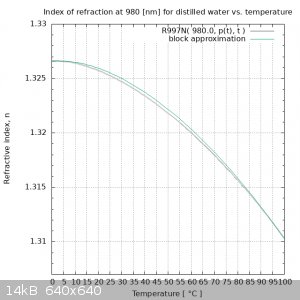
| Code: |
#!/bin/env gnuplot
# Compute an 'average' index of refraction for a 1 [cm³] volume of ε_k media
# distributed in a vaucuum volume of B³, where refractivity is ε₀.
# Written by Andrew Robinson of Scappoose, 2026
# Copyright 2026; Released under the GNU pubic license GPL3.0.
# https://www.gnu.org/licenses/gpl-3.0.html
#

# 980 [nm], IAPWS calibration
n_k = 1.3266
E_k = n_k**2

# Block model of how permittivity changes with molecule spacing
E_B( B ) =  1/( B**2 - B + B/E_k ) + 1 - 1/B**2
n_d( d ) = E_B( (d/1000.)**-0.3333333333 )**0.5

# IAPWS -- characteristic equation
# l is wavelength in nanometers
# p is density in kg/m³
# T is temperature in kelvin

R997(l,p,T)=(_a0+_a1*(p/p0)+_a2*(T/T0)+_a3*(l/l0)**2*(T/T0)+_a4/((l/l0)**2)+_a5/((l/l0)**2-Luv**2)+_a6/((l/l0)**2-Lir**2) + _a7*(p/p0)**2 )*(p/p0)
_R997(x)=sqrt( (1+2*x)/(1-x) )
# Caution, this inputs temperature in Celsius and converts it to Kelvin.
R997N(l,p,t)=_R997( R997(l,p,t+273.15) )
T=293.15; T0=273.15
l0=589.0
Lir=5.432937; Luv=0.229202
p=997.0 ; p0=1000.0
_a0=0.244257733
_a1=0.00974634476
_a2=-.00373234996
_a3=0.000268678472
_a4=0.00158920570
_a5=0.00245934259
_a6=0.900704920
_a7=-.0166626219
# IAPWS -- density equation for water 0-100C   ( <0.02% error )
# https://chem-casts.com/knowledge/density-of-water
p(T) = ( 999.83952 \
		+16.945176*T \
		-7.9870401e-3*T**2 \
		-4.6170461e-5*T**3 \
		-2.805425e-10*T**5 )/(1 + 1.6879851e-2*T)
#
set title "Index of refraction at 980 [nm] for freshly distilled water vs. temperature"
set dummy t
set grid
set xlabel "Temperature [ °C ]"
set xrange [ 0 : 100.0 ]
set xtics 5
set yrange [1.307:1.330]
set ytics auto
set mytics 5
set ylabel "Refractive index, n"
plot R997N( 980.0, p(t), t ) lw 3 lc 'grey',  n_d( p(t) ) ti 'block dielectric'
|
What is important in this graph is not how accurate the IAPWS density vs temperature equation is, but the relative shape difference between the IAPWS
curve and my own prediction of index of refraction based on density.
The IAPWS graph represents assumptions based on a Cauchy curve fit of the index of refraction data. My curve has a very similar shape but is slightly
higher in value in general but crosses over near boiling.
Now:
Find a graph of experimental data for water at 980 [nm] using fiber optics, vs. a Cauchy curve fit in an article referenced in one of my earlier
posts. (Esra K. and and S¸ Yaltkaya are authors, Indian Journal of Physics. ) Esra's actual fiber optic data at 980 [nm] tends to be above her
Cauchy curve fit.... (Equation #5 in the article) and crosses over near boiling.
eg: The actual data compared to a Cauchy curve fit agrees (qualitatively) with the electronic correction model I just computed compared against a
standard IAWPS curve fit.
[Edited on 20-2-2026 by semiconductive]
|
|
|
semiconductive
Hazard to Others
Posts: 433
Registered: 12-2-2017
Location: Scappoose Oregon, USA.
Member Is Offline
Mood: Explorative
|
|
| Quote: | | Oxygen can easily penetrate any liquid which can dissolve it. The lowest solubility is in hexane, paraffine oil and highest alcohol (C10+). Kerosene
is a mixture of hydrocarbons and I think oxygen has good solubility in it. You need only pure saturated hydrocarbons like medical paraffine oil. Or
pure hexane/heptane etc. |
Ultra pure lamplighter's kerosene fuel, on the label, says made from paraffin.
I know how to reduce copper chloride using ascorbic acid, but I don't think it oxidizes easily afterward. I'll have to look into that.
| Quote: | | You also mentioned that solubility in SO2 is by forming "molecular cavity" if I understood your previous messages correctly. It is not always so and
highly dependend on the solute. |
Water is not a very homogenous substance.
Avagadro's number was estimated by Lorenz (a dutch physicist) based on refraction inferences; but his approximation is a homogenous one plane
calculation and has the correct exponent ·10¹⁹ but isn't even one figure accurate in the decimal places.
Yet, his equation is what IAPWS is using for calculating water density and states.
The equation I derived in the immediately preceeding post is a modern correction to the L-L refraction formula. But, the main difference is that it
assumes a hetrogenous matrix of molecules such that light can move alternately through vacuum and through water either in parallel or series.
It is not a 'homogenous' single cavity approximation.
Anyplace around a water molecule that isn't 1 gram/cc of space density, must be modeled as a cavity of vacuum that the molecule is inside of.
In more modern theory, vander-walls computes a 'volume' or radius of distance between molecules that they 'will not approach' each other.
These effective 'volume' ideas are critical to computing chemical reactions in liquids.
But this vanderwall's radius is a statistical average of some sort.
Because, eg: water is not all at exactly the same temperature or pressure (especially when in a container, and gravity pulling on it!)
If the average temperature of water is 99 [°C], then we might estimate that a bell curve describes how much of the water is hotter or cooler. ( or
another curve ).
But the distributed nature of water means there will be a very small number of micro boiled places which are effectively at 101 [°C] in a bath of
water which measures 99 [°C] with a thermometer no matter where you place it.
The 'state' of water is not described, exactly, by a single temperature.
Some water is in liquid form, and some of itcan be in gas form (This may be true even at freezing, although the percentage of water at boiling with
the average water temperature at freezing might be less than 1 part in a trillion...).
The magic of the mass-action law is hidden inside statistical averages.
The beauty of the vanderwalls approach is that gas and liquids are not separate states, but that a single gas law can describe both liquid and
gasseous states.
However, (obviously) the total density of water (or any liquid) will depend on how much of it is in gas form vs. hydrated form, vs. double-hydrated
form, etc.
Is is the hetrogenous nature of water which pH is describing, and that's not the only hetrogenous effect present.
This is what was so disturbing to me when reading the Russian article. I naively thought that either hydrogen gas was a gas in water, or it
chemically combined to make hydronium ions.
But the Russian view doesn't just accept that gas H₂ dissolves in water. He also assumed that there is disassociated and un-ionized hydrogen
dissolved in water. Therefore, we have four distinct species [ H₃O ], [ H₃O⁺ ], [ OH⁻ ], and [OH] in even pure water; and each will have
a different vander-walls radus as a liquid.
And, now, I realize that I probably also have to consider H₂ gas as a distinct thing taking up a different volume from any of the previously
mentioned ions.
So, I'm looking at SO₂ with trepidation, and thinking -- how many ways can this thing become distinct?
The relationships must all be governed by the mass action laws; it's just a matter of accounting for all statistically significant possibilities and
figuring out equilibrium constants.
|
|
|
bnull
National Hazard
Posts: 991
Registered: 15-1-2024
Location: East Woods
Member Is Offline
Mood: Taking a few days off. Damned AI leeches.
|
|
| Quote: | | I know how to reduce copper chloride using ascorbic acid, but I don't think it oxidizes easily afterward. |
Cuprous chloride is easy to oxidize and is photosensitive, especially when wet.
|
|
|
semiconductive
Hazard to Others
Posts: 433
Registered: 12-2-2017
Location: Scappoose Oregon, USA.
Member Is Offline
Mood: Explorative
|
|
I know that cooking glycerol turns it a golden yellow when exposed to oxygen at temperatures above 155 [°C].
I don't have a way to calibrate my spectrometer for photon counts; but I certainly could compare the relative brightness of two color pixels after
adding known volumes of oxygen to 1 gram of 1,2,3,PP-ol and cooking it. This would give me a way to correlate amount of oxygen exposure in the form
of air bubbles absorbed by glycerol to color change.
That, at least, would allow me to objective test how much ultra-pure kerosene leaks oxygen vs. paraffin. (I have solid USP paraffin as well)
eg: I could watch how long it takes for glycerol to yellow underneath paraffin wax vs. lamplighters kerosene.
On rather curious point, ultra pure kerosene can be frustrating in that when the liquid below it has been boiled that it will suddenly begin mixing
with the upper layers. It's as if the polar vs. non-polar idea stops working and the two liquids mix once boiled. Only density makes a difference
as to which liquid floats and which one sinks.
But, I'm reasonably confident that it excludes oxygen better than most other organic liquids that I've tried. Hexane isn't one I've tried because
it's listed as a mild neurotoxin.
|
|
|
semiconductive
Hazard to Others
Posts: 433
Registered: 12-2-2017
Location: Scappoose Oregon, USA.
Member Is Offline
Mood: Explorative
|
|
| Quote: | | Cuprous chloride is easy to oxidize and is photosensitive, especially when wet. |
So, I mix cupric chloride with ascorbic acid, and I will get cuprous chloride . If I'm recalling correctly, the Cu-(I)-Cl will precipitate as a
slightly off white powder.
Question:
I can certainly run the precipitate through a 15ml buchner filter and rinse with distilled water. Would this be enough to get rid of the ascorbic
acid?
|
|
|
teodor
International Hazard
Posts: 1167
Registered: 28-6-2019
Location: Netherlands
Member Is Offline
|
|
| Quote: Originally posted by semiconductive | Hmmm...
When I look up pka₁ of citric acid, I get 3.13, pka₂ is 4.76. etc.
? Don't Larger numbers means a more tightly bound H atom and a weaker acid ?
When I look up formic acid, I get pka₁ = 3.87.
3.13 < 3.87, so I am under the impression that for first ionizations (infinite dilution) -- citric is stronger than formic.
I have 95% formic, and 99.9+% glacial acetic. Either is fine to use. Although my formic is old enough that it's slightly discolored due to light
induced chemical reaction or oxidation.
|
Do you have the conditions of infinite dilution in water in your experiment? pKa is solvent-dependent. When we talk about absolute acids, I don't want
to have any formic acid on my skin.
Formic acid can react with alcohol to form ester, citric acid is not. So, I assume their strength in non-aqueous conditions are reverted.
Of course, absolute acetic acid is a better solvent than formic acid from practical point of view because it is stable in pure state and formic acid
is not.
But I agree, I have no right to talk about acid strength without precisely understanding the conditions. Just from a practical point of view, don't
treat a formic acid as a weak acid.
Also I am still reading your others comments when I have time, so may be I will respond to some other your thoughts. But there is general remark:
there is no one theory of solubility. So, there is no one generic model you can use in all situations. That's why those solubility data get my
measurement is important. There are many ways how water can interract with SO2 and even more ways how SO2 can interract with different substances and
not all those ways are well-studied yet. Some of them are studied. But there is no one general formula or theory which can be used in all those cases.
[Edited on 23-2-2026 by teodor]
|
|
|
| Pages:
1
2
3
4
5 |
|



![[*]](images/xpblue/default_icon.gif)


