Romix
Hazard to Others (Literally)

Posts: 499
Registered: 19-6-2015
Member Is Offline
Mood: No Mood
|
|
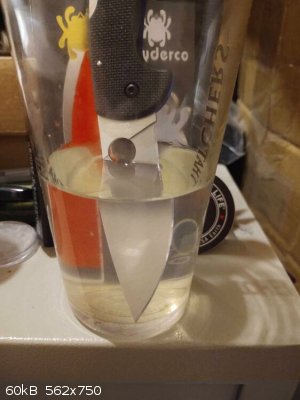
Spyderco's LC200N steel.
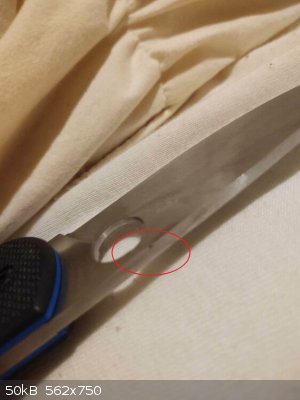
Left blade of Spyderco Siren knife in a cup with concentrated solution of table salt, on 3rd day in it some rust appeared and I noticed a little hole
on the blade eaten by salty solution.
[Edited on 22-2-2026 by Romix]
|
|
|
Romix
Hazard to Others (Literally)
Posts: 499
Registered: 19-6-2015
Member Is Offline
Mood: No Mood
|
|
https://www.youtube.com/shorts/SPftWhLLKPU
|
|
|
Romix
Hazard to Others (Literally)
Posts: 499
Registered: 19-6-2015
Member Is Offline
Mood: No Mood
|
|
Photo in the fist comment is 3rd day in salty water.
|
|
|
Texium
Administrator
Posts: 4748
Registered: 11-1-2014
Location: Salt Lake City
Member Is Online
Mood: Seeking gainful employment
|
|
Why should I not send this to Detritus?
|
|
|
Romix
Hazard to Others (Literally)
Posts: 499
Registered: 19-6-2015
Member Is Offline
Mood: No Mood
|
|
Do it, if you want.
|
|
|
j_sum1
Administrator
Posts: 6475
Registered: 4-10-2014
Location: Limbo
Member Is Offline
Mood: Just got through yet another "take this job and shove it" moment.
|
|
This is called pitting.
Basically, a mini galvanic cell is created which accelerates corrosion in a highly localised area. As the pit develops, the corrosion rate increases.
(Lovely positive feedback loop.)
Aluminium, chromium and stainless steels are the most susceptible, especially in an environment with chloride ions. Best prevention is a surface
treatment such as anodising, or to keep the metal clean, and preferably dry.
It can happen rather quickly. I am curious as to why you left your knife in salt water for so long.
|
|
|
Romix
Hazard to Others (Literally)
Posts: 499
Registered: 19-6-2015
Member Is Offline
Mood: No Mood
|
|
Quote: Originally posted by j_sum1  | This is called pitting.
Basically, a mini galvanic cell is created which accelerates corrosion in a highly localised area. As the pit develops, the corrosion rate increases.
(Lovely positive feedback loop.)
Aluminium, chromium and stainless steels are the most susceptible, especially in an environment with chloride ions. Best prevention is a surface
treatment such as anodising, or to keep the metal clean, and preferably dry.
It can happen rather quickly. I am curious as to why you left your knife in salt water for so long. |
Thank you for your reply, you are not the first person saying that this is pitting type of corrosion. I did it to test the knife, before buying more
of the same supplier, salt series too Magnacut, H2, as the knife is advertised to handle salty water and do not rust in it.
|
|
|



![[*]](images/xpblue/default_icon.gif)


