Altreon
Harmless

Posts: 31
Registered: 11-12-2025
Member Is Offline
Mood: oxidizing
|
|
Separation of VO(2+) and Fe(2+/3+)
I have access to ferrovanadium-85, an alloy of approximately 85% vanadium and 15% iron, and I am trying to separate each element. I have managed to
dissolve 10g of the alloy in a 2.5 times molar excess of sulfuric acid along with some peroxide to redissolve light brown
V2(SO4)3, which has resulted in a nearly black solution that looks light blue when diluted, with seemingly no trace
of the brown of hydrolyzed Fe3+. I then filtered the solution, which left behind a grey gel-like precipitate (insoluble in water, no idea
what it is). My plan was to oxidize the VO2+ to VO2+ using H2O2 and filtering out highly
insoluble V2O5, but even at room temperature, the peroxide very quickly decomposes, first forming a deep red solution. The deep
red complex (peroxovanadyl(V)?) is stable in dilute solution but heating it to decomposition turns the soln. blue instead of yellow.
I'm currently stuck on what to do next. Using (hypo)vanadate for separation is not ideal, because of the amount of base I'd have to add and the
possibility that iron forms a really insoluble vanadate. Google says that peroxide is indeed supposed to oxidize VO2+ to
VO2+, but this doesn't seem to be working. Coupled with the lack of the strongly colored Fe3+, is there a chance that
all the iron is Fe2+, and that it is undergoing the Fenton reaction in a way that catalytically reduces all vanadium(V) to vanadium(IV)?
How would I go about preventing this?
|
|
|
Alchemica
Harmless
Posts: 22
Registered: 31-5-2025
Member Is Offline
Mood: No Mood
|
|
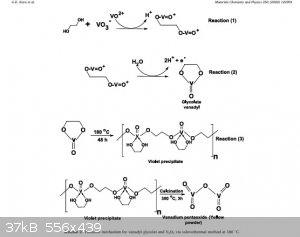
Just something I saw in my readings that I thought could possibly be of use to simply purify your vanadium compounds, via their ethylene glycol
complexes?
https://doi.org/10.1016/j.matchemphys.2020.122991
|
|
|
teodor
International Hazard
Posts: 1169
Registered: 28-6-2019
Location: Netherlands
Member Is Offline
|
|
I think peroxide is not ideal oxidiser here because of presence of transition metals catalizing the decomposition.
You have sulfates mixture. I am wondering, is it possible to make oxidation/metathesis reaction with ammonium persulfate? Ammonium metavanadate is
roughly 80 times less soluble than persulfate.
It could be different results including V2O5 or NH4VO3 precipitation which probably is highly pH dependent.
At high pH (you can try to add KOH + K2S2O8) I would expect potassium metavanadate in solution and Fe(OH)3 precipitation.
So, I propose to use different experiments with potassium and ammonium persulfate, KOH and NH3 solution as well as H2SO4. Mixing in different
proportion observe the results and find when you have difference (pH/anion). Than decide what can work for you.
The key points here: 1) NH3 could be oxidised; 2) high pH activate oxidative properties of persulfate.
|
|
|
bnull
National Hazard
Posts: 993
Registered: 15-1-2024
Location: East Woods
Member Is Offline
Mood: Fecking annoyed
|
|
Is electrolysis an option?
|
|
|
woelen
Super Administrator
Posts: 8150
Registered: 20-8-2005
Location: Netherlands
Member Is Offline
Mood: interested
|
|
Quote: Originally posted by teodor  | I think peroxide is not ideal oxidiser here because of presence of transition metals catalizing the decomposition.
You have sulfates mixture. I am wondering, is it possible to make oxidation/metathesis reaction with ammonium persulfate? Ammonium metavanadate is
roughly 80 times less soluble than persulfate.
It could be different results including V2O5 or NH4VO3 precipitation which probably is highly pH dependent.
At high pH (you can try to add KOH + K2S2O8) I would expect potassium metavanadate in solution and Fe(OH)3 precipitation.
So, I propose to use different experiments with potassium and ammonium persulfate, KOH and NH3 solution as well as H2SO4. Mixing in different
proportion observe the results and find when you have difference (pH/anion). Than decide what can work for you.
The key points here: 1) NH3 could be oxidised; 2) high pH activate oxidative properties of persulfate. |
I would try with Na2S2O8 as oxidizer. At high pH (13 or higher) you don't get metavanadate, but orthovanadate, VO4(3-). At pH around 11 you get
metavanadate, but that ion is not a single entity, it appears to be some polymeric species, which better can be written as [(VO3)n](n-).
At very high pH all iron will precipitate, either as Fe(OH)3, or as FeVO4. In the latter case you lose some vanadium, but most of it will remain in
solution. If you boil down the solution, you destroy all residual peroxide and you are left with a (nearly) colorless solution of Na3VO4 with excess
sodium and sulfate ions in it. If you carefully lower the pH of this solution to around 2, then you get a bright orange flocculent precipitate of
hydrous V2O5. You could try to collect that precipitate and then redissolve this in as little as possible of solution of NaOH. Boiling down that
solution gives you NaVO3, mixed with Na3VO4. Precise stoichiometry will be hard to obtain, but at least you then have something, which only contains
vanadium(V) and sodium as main metallic species.
See also here: https://woelen.homescience.net/science/chem/solutions/v.html
|
|
|
Altreon
Harmless
Posts: 31
Registered: 11-12-2025
Member Is Offline
Mood: oxidizing
|
|
I unfortunately don't have access to persulfates, and my solution contains VO2+ so without an oxidizer I can't use the insolubility of
NH4VO3 to achieve anything. The only other strongly oxidizing reagent I have is KMnO4, but that would introduce a
third metal into the mix.
V2+ is impossible to reduce in aqueous environment. I do not know anything about electrowinning in non-aqueous conditions. Even if I
focused on reduction of iron, electrolysis is just such a costly process for 8.5g of metal. In theory I could also use Zn to reduce Fe but that seems
like a waste of Zn (it would also reduce the V)
That ethylene glycol complex seems to be on the cutting edge of vanadium chemistry, and I could not find any sources detailing its synthesis from a
vanadium(IV) precursor (the reactions proceed using ammonium metavanadate), and I could not find info about the solvent used in its synthesis.
As a side note, I tried adding freezing the soln. and adding H2O2, but upon warming to room temp the red color degrades into
brown, very dark green(???), then dark blue, and I have seen most of these colors before. It seems that H2O2 really can't
oxidize VO2+ in acidic soln.
I've given up and added 8 equivalents of KOH to neutralize all the sulfuric acid and create a solution of vanadates. For some reason the black gel in
soln. did not dissolve despite lots of KOH, but it is much easier to oxidize with peroxide, turning from brown (hypovanadate?) with a black gel to
yellow with a brown gel, probably Fe(OH)3. Despite boiling the black gel for 2 hours, it is very voluminous and pretty much impossible to
filter without access to vacuum, especially considering the strongly alkaline conditions, so I may have to discard and repeat this synthesis. (Is
there a reason why Fe(OH)3 is so hard to filter in excess alkali? It doesn't dissolve in it AFAIK....)
[Edited on 2-3-2026 by Altreon]
|
|
|
|


![[*]](images/xpblue/default_icon.gif)


