Alchemica
Harmless

Posts: 26
Registered: 31-5-2025
Member Is Offline
Mood: No Mood
|
|
Aroma chemistry: Cinnamaldehyde via glycidic acid to phenylacetaldehyde utilising Oxone
Cinnamon (cinnamaldehyde) to phenylacetaldehyde (honey-like, sweet, rose, green, grassy - imparts hyacinth, narcissi, or rose nuances). A project that
hopefully can be followed olfactorily with the nose and via TLC etc
This was a small-scale feasibility experiment to see if such a reaction I conceptualised actually worked.
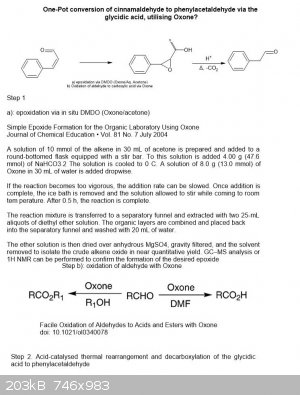
Tried to see if dual epoxidation and oxidation of cinnamaldehyde with Oxone in aqueous acetone afforded the glycidic acid, which could be heated with
aqueous acid to promote rearrangement and decarboxylation to phenylacetaldehyde
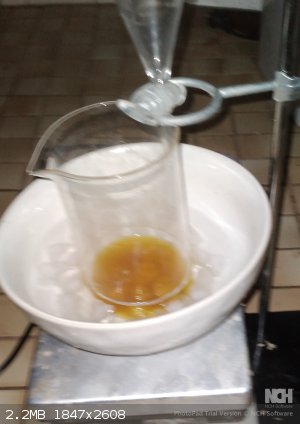
Cinnamaldehyde (13.2g, 100mmol) and sodium bicarbonate (40g) in 200mL acetone was vigorously stirred in an ice bath whilst Oxone (80g x 2, 160g total)
in 600mL water was added dropwise slowly, maintaining a low temperature in the reaction mixture despite the exotherm. After addition of the last Oxone
solution, the reaction mixture was allowed to return to room temperature and stirred overnight. An orange-yellow oil with a distinct sweet aroma was
separated and treated with hydrochloric acid (50mL, 15%) at 80 deg. C for 15min.
The reaction was followed via TLC, using acetone as the mobile phase.
a) cinnamaldehyde
b) reaction mixture after treatment with Oxone in aq. acetone
c) new products formed after short duration of heating in aq. HCl
Attachment: oxiranes oxone.pdf (71kB)
This file has been downloaded 52 times
Attachment: oxone aldehyde oxidation.pdf (66kB)
This file has been downloaded 44 times
[Edited on 22-2-2026 by Alchemica]
|
|
|
Texium
Administrator
Posts: 4748
Registered: 11-1-2014
Location: Salt Lake City
Member Is Offline
Mood: Seeking gainful employment
|
|
Your TLC looks like mostly if not completely starting material, but it’s hard to say for certain because your mobile phase is way too polar. Try
mixing acetone with hexanes or whatever other alkane you can access in varying proportions to find a mixture that will give you cleaner separation of
spots, rather than running everything together at the solvent front.
Also, try spotting a more dilute solution. Your spots appear to be too concentrated, which leads to more streaking.
[Edited on 2-22-2026 by Texium]
|
|
|
Alchemica
Harmless
Posts: 26
Registered: 31-5-2025
Member Is Offline
Mood: No Mood
|
|
Thanks for the input Texium, yes, still early days with this experiment and definitely needs optimisation, including improved TLC solvent system. Just
posting the concept for starters
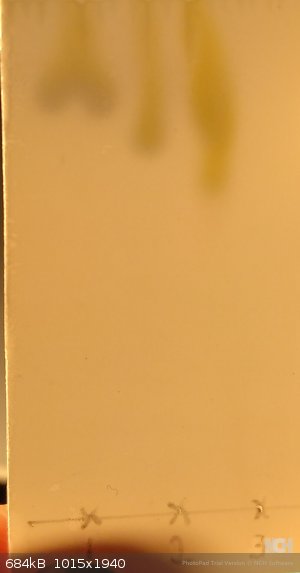
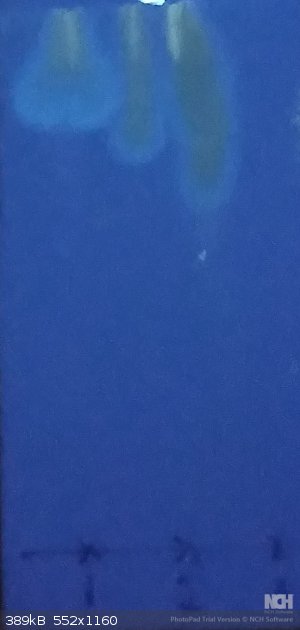
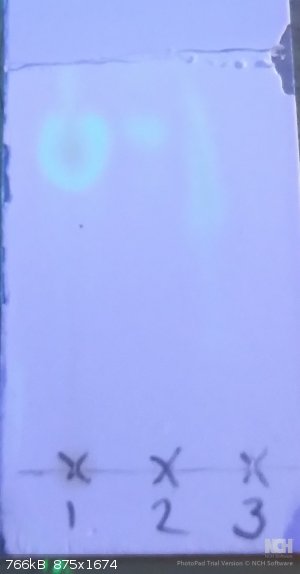
Only had xylenes available for clean non-polars but here's 2:1 xylene:acetone with the samples diluted in MeOH prior to spotting.
1. Cinnamaldehyde
2. Rxn with Oxone product
3. aq. HCl/heat product
[Edited on 22-2-2026 by Alchemica]
|
|
|
zed
International Hazard
Posts: 2320
Registered: 6-9-2008
Location: Great State of Jefferson, City of Portland
Member Is Offline
Mood: Semi-repentant Sith Lord
|
|
Have you actually succeeded with this oxidation?
A similar experiment of oxidizing Cinnamaldehyde with Sodium Perborate in Glacial Acidic Acid, was reported to not work. At least, not as those
chemists attempted to do it.
An intermediate was not very stable and the result was that the substrate was oxidized and decarboxylated all of the way to Benzoic Acid.
Now, if you were to perform this oxidation on an ester of Cinnamic Acid, and then decarboxylate the product, that would probably work.
I'm very interested in evolution of your experiment. Tell me more!
|
|
|
Alchemica
Harmless
Posts: 26
Registered: 31-5-2025
Member Is Offline
Mood: No Mood
|
|
Thanks for the input Zed.
Have to come up with some ways to better characterise the final produc. It smells lovely but is a low melting point 'brown goo' that crystalises to a
semi-solid brown mass when cooled.
Wouldn't be surprised (if the phenylacetaldehyde actually forms from the glycidic ester) that under the acidic conditions, it further undergoes
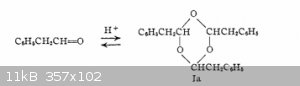
polymerisation, as discussed in The Spontaneous Polymerization of Phenylacetaldehyde (Erikson and Grammer, 1958):
http://www.electronicsandbooks.com/edt/manual/Magazine/J/Journal%20of%20the%20American%20Chemical%20Society%20US/1958%20%20(vol%20080)/20%20%20(5329-5
582)/5466-5469.pdf
The trimer of phenylacetaldehyde seems to have a mp of 114.5-115°C
I'll try and react a bit with FeCl3 and see if it could contain benzoic acid as a dominant constituent
Any other suggestions welcomed for characterising the product better.
"When benzoic acid reacts with ferric chloride (FeCl₃), it forms a yellowish-green color complex known as ferric benzoate. This reaction is a common
test for the presence of benzoic acid and is characterized by the formation of a buff-colored precipitate or a reddish-brown color, depending on the
conditions."
|
|
|



![[*]](images/xpblue/default_icon.gif)


