| Pages:
1
2 |
UndermineBriarEverglade
Hazard to Self

Posts: 79
Registered: 13-6-2024
Member Is Offline
|
|
Synthesis 9
With my improved cooling setup, I also tried KFeNAT's sulfonation method. Rather than adding KNO3 to POE in an excess of sulfuric acid, I
combined POE with sulfuric acid and then dripped that into the nitration mix. The yield was about the same as my last run, with greater acid
consumption, a slower and more complicated procedure, and additional losses from what was left behind in the beaker of POE/acid. I can see how
sulfonation would be better for larger-scale reactions though, since temperature was very easy to manage.
-----
Target: 1 part = 0.0157 mol DNPOEN = 4.289 grams
1 part phenoxyethanol
5 parts potassium nitrate
10 parts sulfuric acid for nitration mix
2.7 parts (2.5mL / 4.5g 93.2%) sulfuric acid for the sulfonation
6.7 parts sulfuric acid added to keep it stirrable
Yield: .81 parts DNPOEN (3.51g)
Procedure:
In ice bath (no salt), KNO3 was added to sulfuric acid, with temp kept below 30°C or so.
In a separate beaker in the ice bath, POE was added dropwise to 4.5g H2SO4 with light stirring. Temperature was kept below
10°C. The mixture developed a very slight pink sheen and thickened.
Under heavy overhead stirring, the POE-acid mix was pipetted into the mixed acids. This was only slightly exothermic, taking 19 minutes with
temperature kept below 10°C. The mixture formed a white cream that was thinned with about 6mL of sulfuric acid.
The water-ice bath was replaced with 30°C water and held for 20 minutes. A speck of mixture stuck to the side of the beaker turned purple. The
main reaction mix went from bright white to off-white.
The mixture was rinsed into ~900mL water and filtered to yield a bright white filter cake and a very slightly yellow filtrate.
The filter cake was dissolved in 12mL of acetone, separating into two layers. As before, the top layer was clear and the bottom was an oily
yellow. The top layer, which smelled of acetone, was pipetted into water to yield a small crop of fine crystals. When additional acetone was added to
the remaining yellow solution, it did not form a separate layer.
The yellow bottom layer was poured into water, filtered, and added to warm ethanol. The partial solution was heated in a beaker until the
undissolved DNPOEN had just barely melted. Acetone and heat were applied until all the DNPOEN had dissolved. Then, the beaker cooled to 10C, a seed
crystal was added, and mild stirring was applied to precipitate a mat of fine white crystals. An excess of cool water was added to complete
precipitation.
3.51 grams of small white needle-like crystals were obtained by vacuum filtration.
|
|
|
KFeNAT
Harmless
Posts: 29
Registered: 27-5-2025
Member Is Offline
Mood: No Mood
|
|
Quote: Originally posted by UndermineBriarEverglade  | | Nice work! I think it's time for a wiki page. I am curious about the performance of DNPOEN once melt-cast to a higher density, and of oxygen-balanced
mixes. Have you done any sensitivity testing? I will do a few more small syntheses before testing and scaling up. |
It is significantly less sensitive than TNP and Tetryl, even in its molten state.
It can explode when struck forcefully on a rail with a hammer, making it more sensitive than nitroguanidine.
It detonates relatively easily at lower pack densities; in my Hess test, I successfully made it work using a detonator packed with 0.8g of ETN.
Since the critical diameter of its cast products is likely similar to that of TNT (>30mm), I currently do not have enough samples to manufacture
pure DNPOEN ingots to verify whether its detonation performance matches the description in the book.
|
|
|
UndermineBriarEverglade
Hazard to Self
Posts: 79
Registered: 13-6-2024
Member Is Offline
|
|
DNPOEN seems insensitive even while melted. I can detonate ETN by dropping a 2lb hammer about 5 inches onto a sample on a 1/4" steel plate. In the
same conditions, I have been unable to detonate nitroguanidine or DNPOEN even with a very hard hammer blow. I heated the plate to melt the DNPOEN and
still could not get it to detonate. I have decided that it is insensitive enough to handle with while molten. Unfortunately, I haven't been able to
get quantitative data. I tried to muffle my drop hammer apparatus, but positive tests are still too loud to attempt more than a handful of runs.
I melted 1g of DNPOEN and added low-density nitroguanidine needles. The NQ did not react or appreciably dissolve. The DNPOEN filled the spaces between
the needles to form a solid mass upon cooling, but I was only able to add about 0.2g of NQ. Good mixes will need high bulk density NQ.
|
|
|
KFeNAT
Harmless
Posts: 29
Registered: 27-5-2025
Member Is Offline
Mood: No Mood
|
|
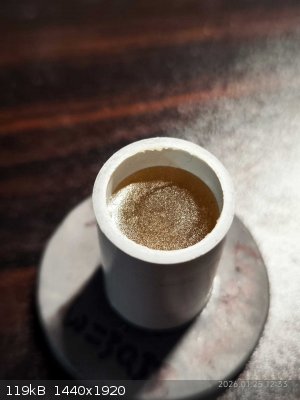
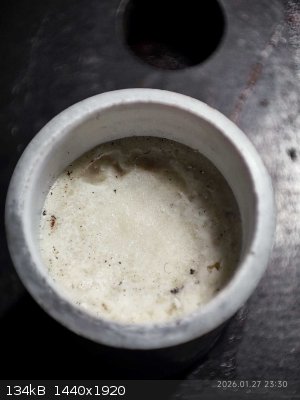
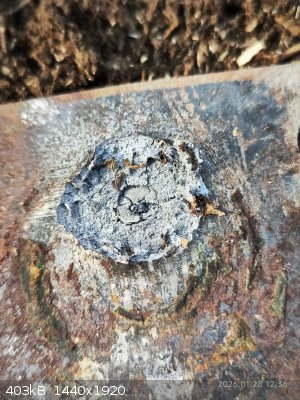
Several casting mixtures containing DNPOEN tested.
First is the DNPOEN/ETN/PETN (3/2/3) mixture.
This mixture completely liquefies upon heating with steam, and the PETN dissolves completely. It has the lowest possible viscosity.
However, it solidifies very slowly, requiring at least two full days to fully solidify, which is perhaps a common problem with low-melting-point
nitrate ester mixtures.
Attachment: VID_20260311_235009.mp4 (1.6MB)
This file has been downloaded 28 times
Attachment: VID_20260128_124025 00_00_00-00_00_04.mp4 (1.4MB)
This file has been downloaded 25 times
|
|
|
KFeNAT
Harmless
Posts: 29
Registered: 27-5-2025
Member Is Offline
Mood: No Mood
|
|
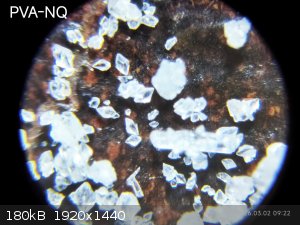
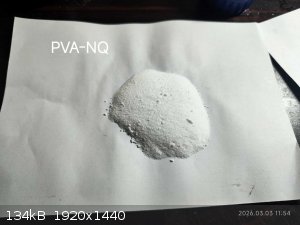
So I thought of adding solid components that cannot be dissolved in it, as these solid powders would help speed up the solidification process.
NQ recrystallized from PVA solution is indeed a good choice, as it possesses a high free packing density. Furthermore, it exhibits good compatibility
with nitrate esters and does not compromise overall stability.
However, both NQ and DNPOEN are relatively insensitive explosives. If only these two components are used, initiation will become difficult, and a
large amount of explosive would be needed to reach the critical diameter for detonation. I believe this is not practical.
Therefore, I believe it is necessary to add some sensitive substances, such as ETN. This would significantly reduce the critical diameter of the fused
mixture, making it applicable in more situations.
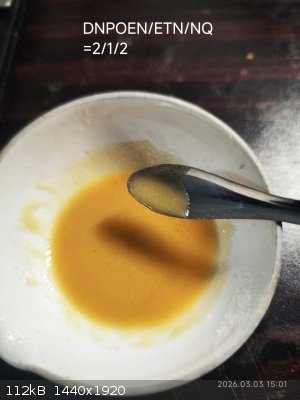
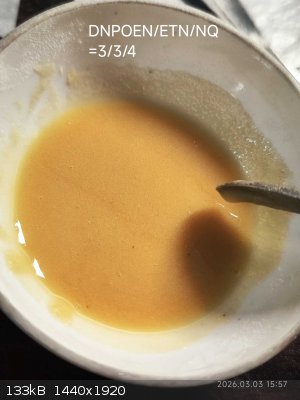
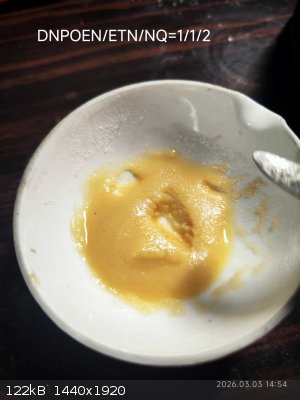
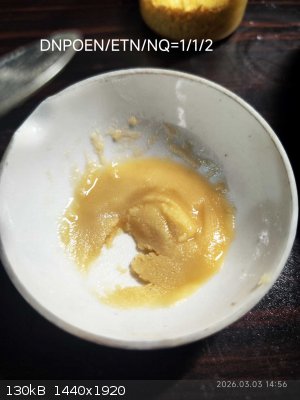
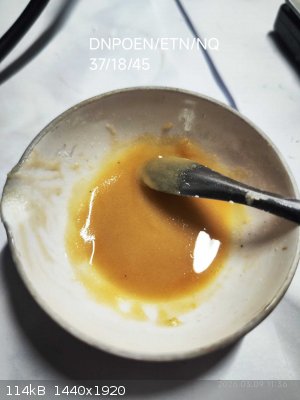
The following are liquidity tests for several different ratios of DNPOEN/ETN/NQ.
Attachment: VID_20260303_160647.mp4 (1.2MB)
This file has been downloaded 34 times
Attachment: VID_20260303_160941.mp4 (2.1MB)
This file has been downloaded 31 times
Attachment: VID_20260309_113910.mp4 (2.8MB)
This file has been downloaded 32 times
|
|
|
KFeNAT
Harmless
Posts: 29
Registered: 27-5-2025
Member Is Offline
Mood: No Mood
|
|
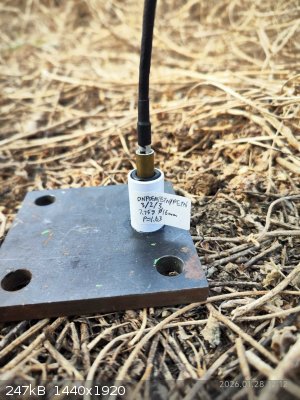
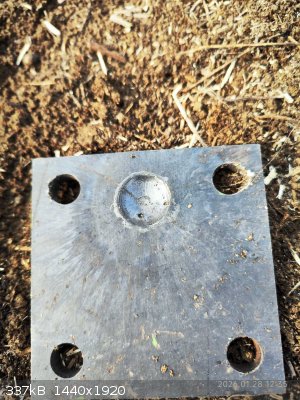
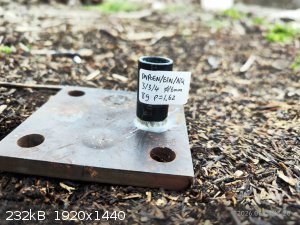
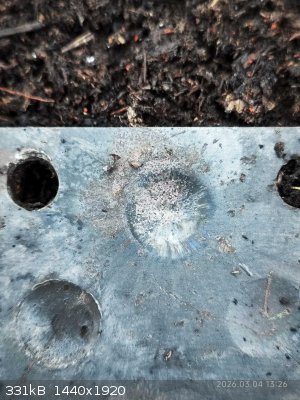
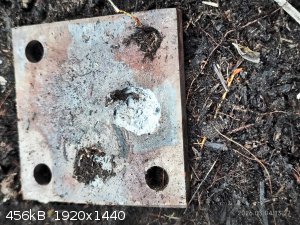
It appears that they can be started and function normally with 0.6g of etn at a density of 1.55.
DNPOEN/ETN/NQ=3/3/4
Attachment: VID_20260304_133242.mp4 (1.1MB)
This file has been downloaded 26 times
|
|
|
KFeNAT
Harmless
Posts: 29
Registered: 27-5-2025
Member Is Offline
Mood: No Mood
|
|
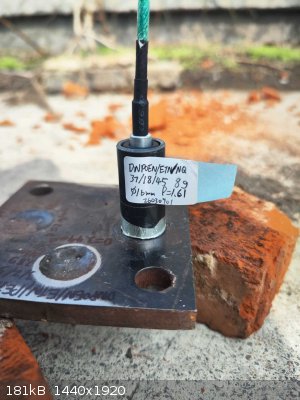
DNPOEN/ETN/NQ=37/18/45
 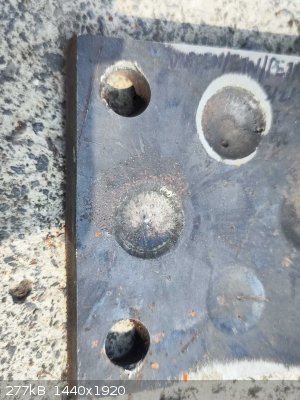 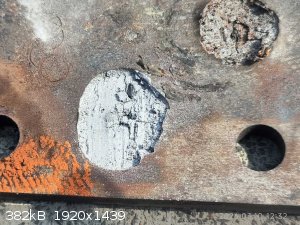
Attachment: VID_20260310_123446.mp4 (1.1MB)
This file has been downloaded 23 times
|
|
|
KFeNAT
Harmless
Posts: 29
Registered: 27-5-2025
Member Is Offline
Mood: No Mood
|
|
Some simple conclusions
1. The maximum NQ content is 45%. When it reaches 50%, the fluidity of the melt mixture becomes very poor, making it difficult to pour from the
container.
2. At the same NQ content of 40%, the DNPOEN/ETN ratio has little effect on the melt fluidity.
3. The ambient temperature is approximately 10°C, and the melt is allowed to cool naturally after casting. With a DNPOEN/ETN/NQ ratio of 3/3/4, the
time required for complete solidification is less than 24 hours.
By reducing the ETN content and increasing the NQ content (37/18/45), the time required for complete solidification is further reduced to less than 4
hours.
4. The steel plate is ordinary low-carbon steel (S235 or A36) with a thickness of 9.7 mm.
5. The 3/3/4 ratio mixture begins to melt at approximately 43°C.
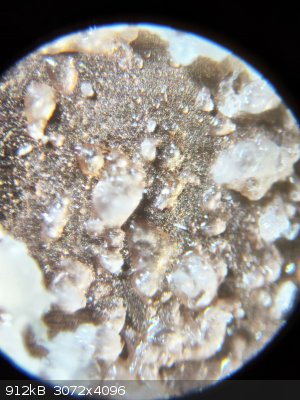 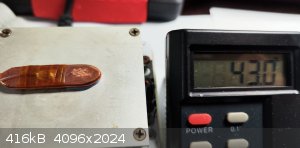
|
|
|
Axt
National Hazard
Posts: 981
Registered: 28-1-2003
Member Is Offline
Mood: No Mood
|
|
That's a neat composition KFeNAT, thankyou for the visuals.
Did your NQ recrystallisation vary much from the Chinese lit method? ie.
1 part NQ
14 part water with 0.01-0.10 % PVA (poly ~1750)
Boil to dissolve
Adjust pH to 8 with ammonia solution
Under stirring cool 0.1-0.5C per minute to 50C
Rapidly cool from 50C to 20C
Filter, rinse and dry at 65C.
Nominal density increased from 0.16 to 0.8-0.9g/cm3.
|
|
|
KFeNAT
Harmless
Posts: 29
Registered: 27-5-2025
Member Is Offline
Mood: No Mood
|
|
| Quote: Originally posted by Axt | That's a neat composition KFeNAT, thankyou for the visuals.
Did your NQ recrystallisation vary much from the Chinese lit method? ie.
1 part NQ
14 part water with 0.01-0.10 % PVA (poly ~1750)
Boil to dissolve
Adjust pH to 8 with ammonia solution
Under stirring cool 0.1-0.5C per minute to 50C
Rapidly cool from 50C to 20C
Filter, rinse and dry at 65C.
Nominal density increased from 0.16 to 0.8-0.9g/cm3.
|
No, there is no significant difference; it is basically the same as this method, with only some differences in details.
1. I used PVA1788, but I don't think it will make a significant difference compared to 1750. In addition, 1750 dissolves in water faster and is easier
to use.
2. I did not strictly control the cooling rate, but simply kept stirring and allowed the solution to cool and crystallize naturally at room
temperature of about 10°C.
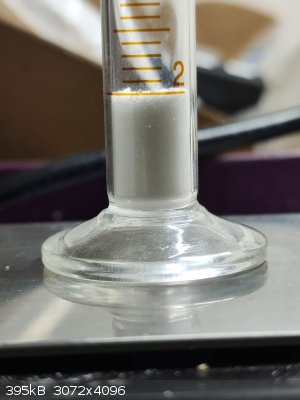
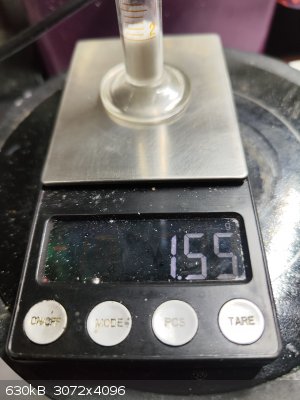
3. Using a small liquid graduated cylinder for rough measurement, the free bulk density of this product is approximately 0.77 g/cm³.
|
|
|
| Pages:
1
2 |



![[*]](images/xpblue/default_icon.gif)


